Refine search
Actions for selected content:
26205 results in Theoretical Physics and Mathematical Physics
The classical equations of motion of an electron
-
- Journal:
- Mathematical Proceedings of the Cambridge Philosophical Society / Volume 42 / Issue 3 / October 1946
- Published online by Cambridge University Press:
- 24 October 2008, pp. 278-286
- Print publication:
- October 1946
-
- Article
- Export citation
The number of configurations of molecules on a lattice
-
- Journal:
- Mathematical Proceedings of the Cambridge Philosophical Society / Volume 42 / Issue 3 / October 1946
- Published online by Cambridge University Press:
- 24 October 2008, pp. 303-310
- Print publication:
- October 1946
-
- Article
- Export citation
PSP volume 42 issue 3 Cover and Back matter
-
- Journal:
- Mathematical Proceedings of the Cambridge Philosophical Society / Volume 42 / Issue 3 / October 1946
- Published online by Cambridge University Press:
- 24 October 2008, pp. b1-b5
- Print publication:
- October 1946
-
- Article
-
- You have access
- Export citation
The resultant of a large number of events of random phase
-
- Journal:
- Mathematical Proceedings of the Cambridge Philosophical Society / Volume 42 / Issue 3 / October 1946
- Published online by Cambridge University Press:
- 24 October 2008, pp. 245-249
- Print publication:
- October 1946
-
- Article
- Export citation
PSP volume 42 issue 3 Cover and Front matter
-
- Journal:
- Mathematical Proceedings of the Cambridge Philosophical Society / Volume 42 / Issue 3 / October 1946
- Published online by Cambridge University Press:
- 24 October 2008, p. f1
- Print publication:
- October 1946
-
- Article
-
- You have access
- Export citation
The elastic stresses produced in a thick plate by the application of pressure to its free surfaces
-
- Journal:
- Mathematical Proceedings of the Cambridge Philosophical Society / Volume 42 / Issue 3 / October 1946
- Published online by Cambridge University Press:
- 24 October 2008, pp. 260-271
- Print publication:
- October 1946
-
- Article
- Export citation
The elastic response of a large plate to a Gaussian distribution of pressure varying with time
-
- Journal:
- Mathematical Proceedings of the Cambridge Philosophical Society / Volume 42 / Issue 3 / October 1946
- Published online by Cambridge University Press:
- 24 October 2008, pp. 338-341
- Print publication:
- October 1946
-
- Article
- Export citation
The complete system of the binary (4, 1) form
-
- Journal:
- Mathematical Proceedings of the Cambridge Philosophical Society / Volume 42 / Issue 3 / October 1946
- Published online by Cambridge University Press:
- 24 October 2008, pp. 206-216
- Print publication:
- October 1946
-
- Article
- Export citation
Proceedings at the meetings held during the session 1945–1946: Annual General Meeting
-
- Journal:
- Mathematical Proceedings of the Cambridge Philosophical Society / Volume 42 / Issue 3 / October 1946
- Published online by Cambridge University Press:
- 24 October 2008, pp. 342-343
- Print publication:
- October 1946
-
- Article
- Export citation
The cambridge philosophical society statement of accounts for the year ended 31 JULY 1945
-
- Journal:
- Mathematical Proceedings of the Cambridge Philosophical Society / Volume 42 / Issue 3 / October 1946
- Published online by Cambridge University Press:
- 24 October 2008, pp. 344-345
- Print publication:
- October 1946
-
- Article
- Export citation
The variation of the dipole moment of adsorbed particles with the fraction of the surface covered*
-
- Journal:
- Mathematical Proceedings of the Cambridge Philosophical Society / Volume 42 / Issue 3 / October 1946
- Published online by Cambridge University Press:
- 24 October 2008, pp. 292-303
- Print publication:
- October 1946
-
- Article
- Export citation
A new type of boundary-value problem in hyperbolic equations
-
- Journal:
- Mathematical Proceedings of the Cambridge Philosophical Society / Volume 42 / Issue 3 / October 1946
- Published online by Cambridge University Press:
- 24 October 2008, pp. 250-260
- Print publication:
- October 1946
-
- Article
- Export citation
-
In developing the theory of radiative transfer in expanding atmospheres (Chandrasekhar, 1945 a, b) the author has recently encountered certain novel types of boundary-value problems in hyperbolic equations which appear to merit consideration for their own sake. As related to the equation

the boundary-value problems which occur are of the following general type

i.e. along AB in Fig. 1. Along AD (x = 0 and 0 ≤ y ≤ l2) and BC (x = l1, 0 ≤ y ≤ l2) we are further given that

and

where φ(y) and ψ(y) are two known functions. The problem is to solve equation (1) in the rectangular strip ABCD satisfying the stated boundary conditions.
Statistical mechanics and the partitions of numbers
-
- Journal:
- Mathematical Proceedings of the Cambridge Philosophical Society / Volume 42 / Issue 3 / October 1946
- Published online by Cambridge University Press:
- 24 October 2008, pp. 272-277
- Print publication:
- October 1946
-
- Article
- Export citation
Two moment problems for bounded functions
-
- Journal:
- Mathematical Proceedings of the Cambridge Philosophical Society / Volume 42 / Issue 3 / October 1946
- Published online by Cambridge University Press:
- 24 October 2008, pp. 189-196
- Print publication:
- October 1946
-
- Article
- Export citation
-
1. Let (a, b) denote an unbounded interval. Given the numbers s0, …, sn−1, consider the problem of finding what conditions they must satisfy in order that there shall be a function f(x), 0 ≤ f ≤ 1, such that

The large-sample theory of sequential tests
-
- Journal:
- Mathematical Proceedings of the Cambridge Philosophical Society / Volume 42 / Issue 3 / October 1946
- Published online by Cambridge University Press:
- 24 October 2008, pp. 239-244
- Print publication:
- October 1946
-
- Article
- Export citation
On the generation of sets of four tetrahedra of which any two are mutually inscribed
-
- Journal:
- Mathematical Proceedings of the Cambridge Philosophical Society / Volume 42 / Issue 3 / October 1946
- Published online by Cambridge University Press:
- 24 October 2008, pp. 217-225
- Print publication:
- October 1946
-
- Article
- Export citation
Note to the preceding paper by C. V. H. Rao
-
- Journal:
- Mathematical Proceedings of the Cambridge Philosophical Society / Volume 42 / Issue 3 / October 1946
- Published online by Cambridge University Press:
- 24 October 2008, pp. 226-229
- Print publication:
- October 1946
-
- Article
- Export citation
-
If (a1, b1, c1), (a2, b2, c2), (a3, b3, c3) be three sets of numbers subject to the six relations such as
 and with a positive determinant, then the four tetrahedra, M, M1, M2, M3, whose angular points have coordinates given by the rows of the four matrices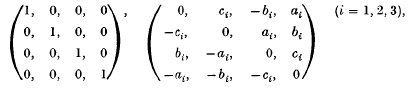
are such that every two are mutually inscribed. The sixteen points so arising are the nodes of a Kummer surface having for one form of its equation

 and with a positive determinant, then the four tetrahedra,
Diamagnetism and superconductivity of a collective electron assembly
-
- Journal:
- Mathematical Proceedings of the Cambridge Philosophical Society / Volume 42 / Issue 3 / October 1946
- Published online by Cambridge University Press:
- 24 October 2008, pp. 311-327
- Print publication:
- October 1946
-
- Article
- Export citation
Point-curve correspondences: II. Induced and extended correspondences
-
- Journal:
- Mathematical Proceedings of the Cambridge Philosophical Society / Volume 42 / Issue 3 / October 1946
- Published online by Cambridge University Press:
- 24 October 2008, pp. 229-239
- Print publication:
- October 1946
-
- Article
- Export citation
The complete system of the binary (3, 1) form
-
- Journal:
- Mathematical Proceedings of the Cambridge Philosophical Society / Volume 42 / Issue 3 / October 1946
- Published online by Cambridge University Press:
- 24 October 2008, pp. 196-205
- Print publication:
- October 1946
-
- Article
- Export citation
