Refine search
Actions for selected content:
26208 results in Theoretical Physics and Mathematical Physics
Combinants of a pencil of quadric surfaces. II
-
- Journal:
- Mathematical Proceedings of the Cambridge Philosophical Society / Volume 43 / Issue 4 / October 1947
- Published online by Cambridge University Press:
- 24 October 2008, pp. 488-490
- Print publication:
- October 1947
-
- Article
- Export citation
Note on the conditions for a p-cycle of an algebraic manifold to be of rank k
-
- Journal:
- Mathematical Proceedings of the Cambridge Philosophical Society / Volume 43 / Issue 4 / October 1947
- Published online by Cambridge University Press:
- 24 October 2008, pp. 577-580
- Print publication:
- October 1947
-
- Article
- Export citation
On the problem of random flights
-
- Journal:
- Mathematical Proceedings of the Cambridge Philosophical Society / Volume 43 / Issue 4 / October 1947
- Published online by Cambridge University Press:
- 24 October 2008, pp. 581-582
- Print publication:
- October 1947
-
- Article
- Export citation
The measurement of double and triple correlation derivatives in isotropic turbulence
-
- Journal:
- Mathematical Proceedings of the Cambridge Philosophical Society / Volume 43 / Issue 4 / October 1947
- Published online by Cambridge University Press:
- 24 October 2008, pp. 560-570
- Print publication:
- October 1947
-
- Article
- Export citation
Combinants of a pencil of quadric surfaces. I
-
- Journal:
- Mathematical Proceedings of the Cambridge Philosophical Society / Volume 43 / Issue 4 / October 1947
- Published online by Cambridge University Press:
- 24 October 2008, pp. 475-487
- Print publication:
- October 1947
-
- Article
- Export citation
Kolmogoroff's theory of locally isotropic turbulence
-
- Journal:
- Mathematical Proceedings of the Cambridge Philosophical Society / Volume 43 / Issue 4 / October 1947
- Published online by Cambridge University Press:
- 24 October 2008, pp. 533-559
- Print publication:
- October 1947
-
- Article
- Export citation
Corrigenda
-
- Journal:
- Mathematical Proceedings of the Cambridge Philosophical Society / Volume 43 / Issue 4 / October 1947
- Published online by Cambridge University Press:
- 24 October 2008, p. 590
- Print publication:
- October 1947
-
- Article
-
- You have access
- Export citation
-
A general form of the covering principle and relative differentiation of additive functions. II*.
By A. S. Besicovitch
P. 5, line 7 from the bottom, after ‘F-singular’ add ‘in the class of B-sets’.
P. 5, the bottom line, after ‘function Θ(X)’ add ‘in the class of B-sets’.
P. 7, line 9 from the bottom, forG⊃Xnread
 .
.P. 8, line 4, for
 .
.P. 8, line 5, for
 .
.* Vol. 42 (1946), pp. 1–10.
 .
. .
. .
.Some remarks on Schottky's theorem
-
- Journal:
- Mathematical Proceedings of the Cambridge Philosophical Society / Volume 43 / Issue 4 / October 1947
- Published online by Cambridge University Press:
- 24 October 2008, pp. 442-454
- Print publication:
- October 1947
-
- Article
- Export citation
-
1. We denote by
 the class of all functions regular in |z| < 1, and never taking the values 0 or 1 in |z| < 1. Then Schottky's(1) theorem states:
Theorem A. Let f(z) = a0 + a1z + … belong to
. Then
and hence

where

and the constantsK(a0), K(a0,ρ) depend only on the quantities indicated.
 the class of all functions regular in |
On the algebra of the meson matrices
-
- Journal:
- Mathematical Proceedings of the Cambridge Philosophical Society / Volume 43 / Issue 3 / July 1947
- Published online by Cambridge University Press:
- 24 October 2008, pp. 414-421
- Print publication:
- July 1947
-
- Article
- Export citation
Random associations on a lattice
-
- Journal:
- Mathematical Proceedings of the Cambridge Philosophical Society / Volume 43 / Issue 3 / July 1947
- Published online by Cambridge University Press:
- 24 October 2008, pp. 321-328
- Print publication:
- July 1947
-
- Article
- Export citation
The problem of random intervals on a line
-
- Journal:
- Mathematical Proceedings of the Cambridge Philosophical Society / Volume 43 / Issue 3 / July 1947
- Published online by Cambridge University Press:
- 24 October 2008, pp. 329-341
- Print publication:
- July 1947
-
- Article
- Export citation
-
Suppose that events occur at random points on a line from t = −∞ to +∞, the probability of an event occurring between t and t + dt being λdt. If we select any interval of the line, say the interval [0, y], there will be a finite probability that it contains 0, 1, 2,…,r,…events; in fact, it is not difficult to show that these probabilities form a Poisson distribution, the probability that the interval contains r events being
 (see e.g. (1)). Consider the case when each event consists of an interval of length α (an event being characterized by its first point). What is the probability that the covered portion of the interval [0, y] lies between x and x + dx?
 (see e.g. (1)). Consider the case when each event consists of an interval of length α (an event being characterized by its first point). What is the probability that the covered portion of the interval [0,
 The effect of a fixed vertical barrier on surface waves in deep water
-
- Journal:
- Mathematical Proceedings of the Cambridge Philosophical Society / Volume 43 / Issue 3 / July 1947
- Published online by Cambridge University Press:
- 24 October 2008, pp. 374-382
- Print publication:
- July 1947
-
- Article
- Export citation
On the integrals of a partial differential equation
-
- Journal:
- Mathematical Proceedings of the Cambridge Philosophical Society / Volume 43 / Issue 3 / July 1947
- Published online by Cambridge University Press:
- 24 October 2008, pp. 348-359
- Print publication:
- July 1947
-
- Article
- Export citation
-
The ordinary one-dimensional wave equation

has special integrals of the form

which satisfy the first-order equations

respectively, and are often called progressive waves, or progressive integrals, of (1·1). The straight lines

in an xt-plane are the characteristics of (1·1). It follows from (1·2) that progressive integrals of (1·1) are constant on some particular characteristic, and are characterized by this property.
Simple progressive solutions of the wave equation
-
- Journal:
- Mathematical Proceedings of the Cambridge Philosophical Society / Volume 43 / Issue 3 / July 1947
- Published online by Cambridge University Press:
- 24 October 2008, pp. 360-373
- Print publication:
- July 1947
-
- Article
- Export citation
-
The object of this paper is to determine all the solutions of the wave equation

which are of the simple form

where F denotes an arbitrary function. It will be shown that, in addition to the obvious cases of plane or spherical progressive waves, such solutions exist only when the wave fronts

are certain algebraic surfaces of the fourth order, the cyclides of Dupin. These include, as degenerate cases, the sphere, the plane, the cylinder, the cone, and the torus.

Rectilinear plastic flow of a Bingham solid: I. Flow between eccentric circular cylinders in relative motion
-
- Journal:
- Mathematical Proceedings of the Cambridge Philosophical Society / Volume 43 / Issue 3 / July 1947
- Published online by Cambridge University Press:
- 24 October 2008, pp. 396-405
- Print publication:
- July 1947
-
- Article
- Export citation
The Parseval formulae for monotonic functions. I
-
- Journal:
- Mathematical Proceedings of the Cambridge Philosophical Society / Volume 43 / Issue 3 / July 1947
- Published online by Cambridge University Press:
- 24 October 2008, pp. 289-306
- Print publication:
- July 1947
-
- Article
- Export citation
-
The Parseval formulae for Fourier cosine and sine transforms,
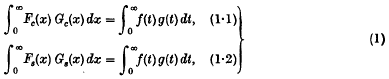
are of course most widely known in connexion with the classical theorems of Plancherel on functions of the class L2 (whose transforms are defined by mean convergence), and with their generalizations. We cannot expect to obtain anything as elegant as the ‘L2’ results when we consider (1) for functions of other kinds. Nevertheless, since the most obvious way of defining Fourier transforms is by means of Lebesgue or Cauchy integrals, we naturally wish to know how far the formulae (1) hold good for transforms obtained in this way. The two most familiar classes of functions having such transforms are:
(i) functions f(t) integrable in the Lebesgue sense in (0, ∞), whose transforms Fe(x) and Fs(x) are defined by the Lebesgue integrals
 respectively; and
(ii) functions f(t) which decrease in (0, ∞), tend to zero as t → ∞, and are integrable over any finite interval (0, T); in this case the transforms are defined by the Cauchy integrals
 .
.
 respectively; and
 .
.Configurations of closed ring molecules
-
- Journal:
- Mathematical Proceedings of the Cambridge Philosophical Society / Volume 43 / Issue 3 / July 1947
- Published online by Cambridge University Press:
- 24 October 2008, pp. 422-428
- Print publication:
- July 1947
-
- Article
- Export citation
The theory of surfaces in a geometry based on the notion of area
-
- Journal:
- Mathematical Proceedings of the Cambridge Philosophical Society / Volume 43 / Issue 3 / July 1947
- Published online by Cambridge University Press:
- 24 October 2008, pp. 307-313
- Print publication:
- July 1947
-
- Article
- Export citation
Two-dimensional plastic flow of a Bingham solid: A plastic boundary-layer theory for slow motion
-
- Journal:
- Mathematical Proceedings of the Cambridge Philosophical Society / Volume 43 / Issue 3 / July 1947
- Published online by Cambridge University Press:
- 24 October 2008, pp. 383-395
- Print publication:
- July 1947
-
- Article
- Export citation
-
The rheological equations of state for an isotropic Bingham solid may be written in tensor form:



where

The notation is explained fully in a previous paper (1). The frame of reference is essentially Eulerian. Primes denote deviatoric components of the stress, strain and rate of strain tensors, pik, εik and eik (for example,
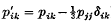 ). The dilatation is denoted by Δ. The rigidity and bulk moduli μ and κ are, if not constants, essentially scalar functions of the stress tensor. The variable viscosity η involves two constants, the yield value ϑ and the reciprocal mobility η1.
 ). The dilatation is denoted by Δ. The rigidity and bulk moduli μ and κ are, if not constants, essentially scalar functions of the stress tensor. The variable viscosity η involves two constants, the yield value ϑ and the reciprocal mobility η
The distribution of projected areas of fragments
-
- Journal:
- Mathematical Proceedings of the Cambridge Philosophical Society / Volume 43 / Issue 3 / July 1947
- Published online by Cambridge University Press:
- 24 October 2008, pp. 342-347
- Print publication:
- July 1947
-
- Article
- Export citation
