Refine search
Actions for selected content:
26205 results in Theoretical Physics and Mathematical Physics
On a class of linear integro-differential equations
-
- Journal:
- Mathematical Proceedings of the Cambridge Philosophical Society / Volume 43 / Issue 2 / April 1947
- Published online by Cambridge University Press:
- 24 October 2008, pp. 153-163
- Print publication:
- April 1947
-
- Article
- Export citation
-
This paper is a sequel to a previous one(1) with the same title which dealt with the general solution of equations of the type

We consider here the more general equation

where g(x) is a given function. We are interested particularly in the existence and uniqueness of solutions of the latter equation and show how these are related to the closure and completeness properties of sets of functions {xneωnx} derived from the kernels kr(y).
A variational method for determining eigenvalues of the wave equation applied to tropospheric refraction*
-
- Journal:
- Mathematical Proceedings of the Cambridge Philosophical Society / Volume 43 / Issue 2 / April 1947
- Published online by Cambridge University Press:
- 24 October 2008, pp. 213-219
- Print publication:
- April 1947
-
- Article
- Export citation
Waves on the surface of a compressible liquid
-
- Journal:
- Mathematical Proceedings of the Cambridge Philosophical Society / Volume 43 / Issue 1 / January 1947
- Published online by Cambridge University Press:
- 24 October 2008, pp. 75-95
- Print publication:
- January 1947
-
- Article
- Export citation
A note on Talbot's bands
-
- Journal:
- Mathematical Proceedings of the Cambridge Philosophical Society / Volume 43 / Issue 1 / January 1947
- Published online by Cambridge University Press:
- 24 October 2008, pp. 130-133
- Print publication:
- January 1947
-
- Article
- Export citation
A note on white light fringes
-
- Journal:
- Mathematical Proceedings of the Cambridge Philosophical Society / Volume 43 / Issue 1 / January 1947
- Published online by Cambridge University Press:
- 24 October 2008, pp. 134-136
- Print publication:
- January 1947
-
- Article
- Export citation
A ring in graph theory
-
- Journal:
- Mathematical Proceedings of the Cambridge Philosophical Society / Volume 43 / Issue 1 / January 1947
- Published online by Cambridge University Press:
- 24 October 2008, pp. 26-40
- Print publication:
- January 1947
-
- Article
- Export citation
A practical method for numerical evaluation of solutions of partial differential equations of the heat-conduction type
-
- Journal:
- Mathematical Proceedings of the Cambridge Philosophical Society / Volume 43 / Issue 1 / January 1947
- Published online by Cambridge University Press:
- 24 October 2008, pp. 50-67
- Print publication:
- January 1947
-
- Article
- Export citation
-
This paper is concerned with methods of evaluating numerical solutions of the non-linear partial differential equation

where

subject to the boundary conditions
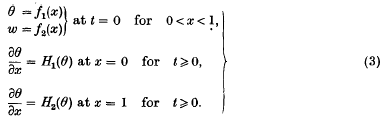
A, k, q are known constants.
Equation (1) is of the type which arises in problems of heat flow when there is an internal generation of heat within the medium; if the heat is due to a chemical reaction proceeding at each point at a rate depending upon the local temperature, the rate of heat generation is often defined by an equation such as (2).
PSP volume 43 issue 1 Cover and Back matter
-
- Journal:
- Mathematical Proceedings of the Cambridge Philosophical Society / Volume 43 / Issue 1 / January 1947
- Published online by Cambridge University Press:
- 24 October 2008, p. b1
- Print publication:
- January 1947
-
- Article
-
- You have access
- Export citation
Integral modular forms and summation formulae
-
- Journal:
- Mathematical Proceedings of the Cambridge Philosophical Society / Volume 43 / Issue 1 / January 1947
- Published online by Cambridge University Press:
- 24 October 2008, pp. 127-129
- Print publication:
- January 1947
-
- Article
- Export citation
A note on the distribution of the different orderings of n objects
-
- Journal:
- Mathematical Proceedings of the Cambridge Philosophical Society / Volume 43 / Issue 1 / January 1947
- Published online by Cambridge University Press:
- 24 October 2008, pp. 1-9
- Print publication:
- January 1947
-
- Article
- Export citation
Time effects in the magnetic cooling method. II
-
- Journal:
- Mathematical Proceedings of the Cambridge Philosophical Society / Volume 43 / Issue 1 / January 1947
- Published online by Cambridge University Press:
- 24 October 2008, pp. 118-122
- Print publication:
- January 1947
-
- Article
- Export citation
Notes on Fourier series (IV): Summability (R2)
-
- Journal:
- Mathematical Proceedings of the Cambridge Philosophical Society / Volume 43 / Issue 1 / January 1947
- Published online by Cambridge University Press:
- 24 October 2008, pp. 10-25
- Print publication:
- January 1947
-
- Article
- Export citation
-
1.1. There are two familiar methods of summation of divergent series usually called the methods (R, 1) and (R, 2). If sn = u0 + u1 + … + un and, as it will be convenient to suppose throughout, u0 = 0, then


when h → + 0§: the convergence of the series for small positive h is presupposed.
The flexure and torsion of aeolotropic beams
-
- Journal:
- Mathematical Proceedings of the Cambridge Philosophical Society / Volume 43 / Issue 1 / January 1947
- Published online by Cambridge University Press:
- 24 October 2008, pp. 68-74
- Print publication:
- January 1947
-
- Article
- Export citation
A rational formulation of the equations of plastic flow for a Bingham solid
-
- Journal:
- Mathematical Proceedings of the Cambridge Philosophical Society / Volume 43 / Issue 1 / January 1947
- Published online by Cambridge University Press:
- 24 October 2008, pp. 100-105
- Print publication:
- January 1947
-
- Article
- Export citation
Note on waves on the surface of running water
-
- Journal:
- Mathematical Proceedings of the Cambridge Philosophical Society / Volume 43 / Issue 1 / January 1947
- Published online by Cambridge University Press:
- 24 October 2008, pp. 96-99
- Print publication:
- January 1947
-
- Article
- Export citation
Excitation of indium 113 by X-rays†
-
- Journal:
- Mathematical Proceedings of the Cambridge Philosophical Society / Volume 43 / Issue 1 / January 1947
- Published online by Cambridge University Press:
- 24 October 2008, pp. 123-126
- Print publication:
- January 1947
-
- Article
- Export citation
On the theory of spinning particles
-
- Journal:
- Mathematical Proceedings of the Cambridge Philosophical Society / Volume 43 / Issue 1 / January 1947
- Published online by Cambridge University Press:
- 24 October 2008, pp. 106-117
- Print publication:
- January 1947
-
- Article
- Export citation
PSP volume 43 issue 1 Cover and Front matter
-
- Journal:
- Mathematical Proceedings of the Cambridge Philosophical Society / Volume 43 / Issue 1 / January 1947
- Published online by Cambridge University Press:
- 24 October 2008, p. f1
- Print publication:
- January 1947
-
- Article
-
- You have access
- Export citation
Functions of a statistical variate with given means, with special reference to Laplacian distributions
-
- Journal:
- Mathematical Proceedings of the Cambridge Philosophical Society / Volume 43 / Issue 1 / January 1947
- Published online by Cambridge University Press:
- 24 October 2008, pp. 41-49
- Print publication:
- January 1947
-
- Article
- Export citation
A theory of the critical temperatures of the normal paraffins
-
- Journal:
- Mathematical Proceedings of the Cambridge Philosophical Society / Volume 42 / Issue 3 / October 1946
- Published online by Cambridge University Press:
- 24 October 2008, pp. 328-337
- Print publication:
- October 1946
-
- Article
- Export citation
