Refine search
Actions for selected content:
26205 results in Theoretical Physics and Mathematical Physics
X-ray excitation of lutecium
-
- Journal:
- Mathematical Proceedings of the Cambridge Philosophical Society / Volume 43 / Issue 3 / July 1947
- Published online by Cambridge University Press:
- 24 October 2008, pp. 429-432
- Print publication:
- July 1947
-
- Article
- Export citation
An equation of quantum mechanics
-
- Journal:
- Mathematical Proceedings of the Cambridge Philosophical Society / Volume 43 / Issue 3 / July 1947
- Published online by Cambridge University Press:
- 24 October 2008, pp. 406-413
- Print publication:
- July 1947
-
- Article
- Export citation
-
The complete set of matrix representations of a set of n quantities β1, β2,…,βn satisfying

is obtained for all values of n. It is found that if n = 2v or n = 2v + 1, there are v + 1 irreducible representations with the respective degrees 1,
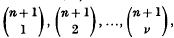 but if n = 2v + 1 there are in addition two conjugate representations of order
  , the symbol
  denoting the binomial coefficient. The explicit representations are given for n = 2, 3, 4, 5.
 but if
  , the symbol
  denoting the binomial coefficient. The explicit representations are given for
 Demagnetizing coefficients and hysteresis losses of rectangular iron-silicon strips
-
- Journal:
- Mathematical Proceedings of the Cambridge Philosophical Society / Volume 43 / Issue 2 / April 1947
- Published online by Cambridge University Press:
- 24 October 2008, pp. 254-261
- Print publication:
- April 1947
-
- Article
- Export citation
A theory of the performance of radar on ship targets
-
- Journal:
- Mathematical Proceedings of the Cambridge Philosophical Society / Volume 43 / Issue 2 / April 1947
- Published online by Cambridge University Press:
- 24 October 2008, pp. 220-231
- Print publication:
- April 1947
-
- Article
- Export citation
The gravitational field of a rotating cohesive system
-
- Journal:
- Mathematical Proceedings of the Cambridge Philosophical Society / Volume 43 / Issue 2 / April 1947
- Published online by Cambridge University Press:
- 24 October 2008, pp. 164-177
- Print publication:
- April 1947
-
- Article
- Export citation
Note on the velocity of propagation of gravitation
-
- Journal:
- Mathematical Proceedings of the Cambridge Philosophical Society / Volume 43 / Issue 2 / April 1947
- Published online by Cambridge University Press:
- 24 October 2008, pp. 178-182
- Print publication:
- April 1947
-
- Article
- Export citation
-
The approximate value of the world invariant
 at a point in a plane containing a rotating cohesive system such as a rod is calculated for a point at great distances from the system. It is found that the invariant has a stationary value when the rod is seen to be pointing towards the point in question. It is concluded that the speed of propagation of gravitation is the same as that of light.
 at a point in a plane containing a rotating cohesive system such as a rod is calculated for a point at great distances from the system. It is found that the invariant has a stationary value when the rod is
 PSP volume 43 issue 2 Cover and Back matter
-
- Journal:
- Mathematical Proceedings of the Cambridge Philosophical Society / Volume 43 / Issue 2 / April 1947
- Published online by Cambridge University Press:
- 24 October 2008, p. b1
- Print publication:
- April 1947
-
- Article
-
- You have access
- Export citation
The heat of adsorption of diatomic molecules
-
- Journal:
- Mathematical Proceedings of the Cambridge Philosophical Society / Volume 43 / Issue 2 / April 1947
- Published online by Cambridge University Press:
- 24 October 2008, pp. 232-239
- Print publication:
- April 1947
-
- Article
- Export citation
A note on relativistic second quantization
-
- Journal:
- Mathematical Proceedings of the Cambridge Philosophical Society / Volume 43 / Issue 2 / April 1947
- Published online by Cambridge University Press:
- 24 October 2008, pp. 183-195
- Print publication:
- April 1947
-
- Article
- Export citation
Optical theory of the echelette grating
-
- Journal:
- Mathematical Proceedings of the Cambridge Philosophical Society / Volume 43 / Issue 2 / April 1947
- Published online by Cambridge University Press:
- 24 October 2008, pp. 240-253
- Print publication:
- April 1947
-
- Article
- Export citation
A note on the theory of dislocation in metals
-
- Journal:
- Mathematical Proceedings of the Cambridge Philosophical Society / Volume 43 / Issue 2 / April 1947
- Published online by Cambridge University Press:
- 24 October 2008, pp. 205-212
- Print publication:
- April 1947
-
- Article
- Export citation
On the initial moments of a bounded function
-
- Journal:
- Mathematical Proceedings of the Cambridge Philosophical Society / Volume 43 / Issue 2 / April 1947
- Published online by Cambridge University Press:
- 24 October 2008, pp. 275-279
- Print publication:
- April 1947
-
- Article
- Export citation
The radiations emitted by
 and its formation in the deuteron bombardment of uranium
-
- Journal:
- Mathematical Proceedings of the Cambridge Philosophical Society / Volume 43 / Issue 2 / April 1947
- Published online by Cambridge University Press:
- 24 October 2008, pp. 267-274
- Print publication:
- April 1947
-
- Article
- Export citation
-
The production of
by deuteron bombardment of uranium has been established and the radiations of this product have been examined by the absorption method. The normal mode of disintegration involves β-particles having an upper energy limit of 1·20 ± 0·02 MeV. and a low-energy γ-ray of 76 ± 3 keV. quantum energy. Evidence has been found for electrons of less energy (about 0·1 per disintegration) and more penetrating γ-rays of relatively low intensity. Quantum radiations corresponding broadly to the L X-radiations, to be expected to follow the internal absorption of the low-energy γ-ray, have also been detected.The excitation function for the process
 has been studied, and the conclusion reached that the Oppenheimer-Phillips mechanism is responsible for the larger part of the yield.
 and its formation in the deuteron bombardment of uranium
 has been studied, and the conclusion reached that the Oppenheimer-Phillips mechanism is responsible for the larger part of the yield.
Stress in an infinite half-plane
-
- Journal:
- Mathematical Proceedings of the Cambridge Philosophical Society / Volume 43 / Issue 2 / April 1947
- Published online by Cambridge University Press:
- 24 October 2008, pp. 287-288
- Print publication:
- April 1947
-
- Article
- Export citation
On the product of three non-homogeneous linear forms
-
- Journal:
- Mathematical Proceedings of the Cambridge Philosophical Society / Volume 43 / Issue 2 / April 1947
- Published online by Cambridge University Press:
- 24 October 2008, pp. 137-152
- Print publication:
- April 1947
-
- Article
- Export citation
-
Let ξ, η, ζ be linear forms in u, v, w with real coefficients and determinant Δ ≠ 0. A conjecture of Minkowski, which was subsequently proved by Remak, tells us that for any real numbers a, b, c there exist integral values of u, v, w for which

and the constant ⅛ on the right is best possible.
Minimum variance and the estimation of several parameters
-
- Journal:
- Mathematical Proceedings of the Cambridge Philosophical Society / Volume 43 / Issue 2 / April 1947
- Published online by Cambridge University Press:
- 24 October 2008, pp. 280-283
- Print publication:
- April 1947
-
- Article
- Export citation
Note on the structure of liquid helium II
-
- Journal:
- Mathematical Proceedings of the Cambridge Philosophical Society / Volume 43 / Issue 2 / April 1947
- Published online by Cambridge University Press:
- 24 October 2008, pp. 262-266
- Print publication:
- April 1947
-
- Article
- Export citation
A note on the Hamiltonian theory of quantization. II
-
- Journal:
- Mathematical Proceedings of the Cambridge Philosophical Society / Volume 43 / Issue 2 / April 1947
- Published online by Cambridge University Press:
- 24 October 2008, pp. 196-204
- Print publication:
- April 1947
-
- Article
- Export citation
Geometrical optics and Maxwell's equations
-
- Journal:
- Mathematical Proceedings of the Cambridge Philosophical Society / Volume 43 / Issue 2 / April 1947
- Published online by Cambridge University Press:
- 24 October 2008, pp. 284-286
- Print publication:
- April 1947
-
- Article
- Export citation
PSP volume 43 issue 2 Cover and Front matter
-
- Journal:
- Mathematical Proceedings of the Cambridge Philosophical Society / Volume 43 / Issue 2 / April 1947
- Published online by Cambridge University Press:
- 24 October 2008, p. f1
- Print publication:
- April 1947
-
- Article
-
- You have access
- Export citation
