Refine search
Actions for selected content:
26208 results in Theoretical Physics and Mathematical Physics
Navigation and the Aircraft Industry
-
- Journal:
- The Journal of Navigation / Volume 4 / Issue 1 / January 1951
- Published online by Cambridge University Press:
- 18 January 2010, pp. 1-11
- Print publication:
- January 1951
-
- Article
- Export citation
Proposals for a New Air Navigation Chart
-
- Journal:
- The Journal of Navigation / Volume 4 / Issue 1 / January 1951
- Published online by Cambridge University Press:
- 18 January 2010, pp. 66-80
- Print publication:
- January 1951
-
- Article
- Export citation
Triple velocity correlations in isotropic turbulence
-
- Journal:
- Mathematical Proceedings of the Cambridge Philosophical Society / Volume 47 / Issue 1 / January 1951
- Published online by Cambridge University Press:
- 24 October 2008, pp. 146-157
- Print publication:
- January 1951
-
- Article
- Export citation
On the reciprocal of a segment of a generalized hilbert matrix
-
- Journal:
- Mathematical Proceedings of the Cambridge Philosophical Society / Volume 47 / Issue 1 / January 1951
- Published online by Cambridge University Press:
- 24 October 2008, pp. 11-17
- Print publication:
- January 1951
-
- Article
- Export citation
-
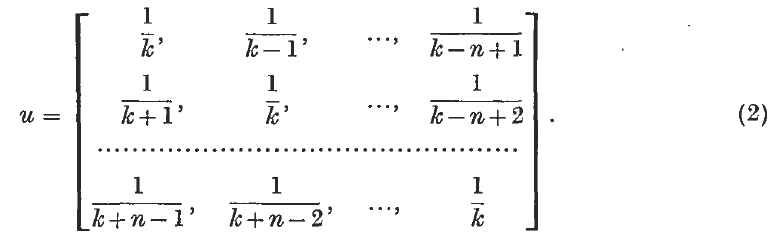
1. Introductory. The present paper is mainly concerned with some forms for the reciprocal of the square matrix u of which the typical element is

and k is not an integer within the range ± (n − 1) inclusive but is otherwise arbitrary; thus
Some metrical theorems in diophantine approximation: v. on a conjecture of mahler
-
- Journal:
- Mathematical Proceedings of the Cambridge Philosophical Society / Volume 47 / Issue 1 / January 1951
- Published online by Cambridge University Press:
- 24 October 2008, pp. 18-21
- Print publication:
- January 1951
-
- Article
- Export citation
-
Introduction. If ξ is a real number we denote by ∥ ξ ∥ the difference between ξ and the nearest integer, i.e.

It is well known (e.g. Koksma (3), I, Satz 4) that if θ1, θ2, …, θn are any real numbers, the inequality

has infinitely many integer solutions q > 0. In particular, if α is any real number, the inequality

has infinitely many solutions.
Slow motion of viscous liquid in a semi-infinite channel
-
- Journal:
- Mathematical Proceedings of the Cambridge Philosophical Society / Volume 47 / Issue 1 / January 1951
- Published online by Cambridge University Press:
- 24 October 2008, pp. 127-141
- Print publication:
- January 1951
-
- Article
- Export citation
The Work of Trinity House
-
- Journal:
- The Journal of Navigation / Volume 4 / Issue 1 / January 1951
- Published online by Cambridge University Press:
- 18 January 2010, pp. 86-92
- Print publication:
- January 1951
-
- Article
- Export citation
A reduction for the matrix equation AB = εBA
-
- Journal:
- Mathematical Proceedings of the Cambridge Philosophical Society / Volume 47 / Issue 1 / January 1951
- Published online by Cambridge University Press:
- 24 October 2008, pp. 7-10
- Print publication:
- January 1951
-
- Article
- Export citation
PSP volume 47 issue 1 Cover and Front matter
-
- Journal:
- Mathematical Proceedings of the Cambridge Philosophical Society / Volume 47 / Issue 1 / January 1951
- Published online by Cambridge University Press:
- 24 October 2008, pp. f1-f2
- Print publication:
- January 1951
-
- Article
-
- You have access
- Export citation
On the line-comitants of a space cubic
-
- Journal:
- Mathematical Proceedings of the Cambridge Philosophical Society / Volume 47 / Issue 1 / January 1951
- Published online by Cambridge University Press:
- 24 October 2008, pp. 46-48
- Print publication:
- January 1951
-
- Article
- Export citation
An extremal property of the hypersphere
-
- Journal:
- Mathematical Proceedings of the Cambridge Philosophical Society / Volume 47 / Issue 1 / January 1951
- Published online by Cambridge University Press:
- 24 October 2008, pp. 245-247
- Print publication:
- January 1951
-
- Article
- Export citation
Markoff chains with an enumerable number of states and a class of cascade processes
-
- Journal:
- Mathematical Proceedings of the Cambridge Philosophical Society / Volume 47 / Issue 1 / January 1951
- Published online by Cambridge University Press:
- 24 October 2008, pp. 77-85
- Print publication:
- January 1951
-
- Article
- Export citation
The Selection of Stars for Astronomical Navigation
-
- Journal:
- The Journal of Navigation / Volume 4 / Issue 1 / January 1951
- Published online by Cambridge University Press:
- 18 January 2010, pp. 31-33
- Print publication:
- January 1951
-
- Article
- Export citation
NAV volume 4 issue 1 Front matter
-
- Journal:
- The Journal of Navigation / Volume 4 / Issue 1 / January 1951
- Published online by Cambridge University Press:
- 18 January 2010, pp. f1-f4
- Print publication:
- January 1951
-
- Article
-
- You have access
- Export citation
The relativistic mass of a rotating cylinder
-
- Journal:
- Mathematical Proceedings of the Cambridge Philosophical Society / Volume 47 / Issue 1 / January 1951
- Published online by Cambridge University Press:
- 24 October 2008, pp. 190-195
- Print publication:
- January 1951
-
- Article
- Export citation
An Almanac for Surveyors - The Star Almanac for Land Surveyors for the year 1951, prepared by H.M. Nautical Almanac Office. H.M. Stationery Office, 1950. 3s.
-
- Journal:
- The Journal of Navigation / Volume 4 / Issue 1 / January 1951
- Published online by Cambridge University Press:
- 18 January 2010, p. 104
- Print publication:
- January 1951
-
- Article
- Export citation
PSP volume 47 issue 1 Cover and Back matter
-
- Journal:
- Mathematical Proceedings of the Cambridge Philosophical Society / Volume 47 / Issue 1 / January 1951
- Published online by Cambridge University Press:
- 24 October 2008, pp. b1-b2
- Print publication:
- January 1951
-
- Article
-
- You have access
- Export citation
The frequency goodness of fit test for probability chains
-
- Journal:
- Mathematical Proceedings of the Cambridge Philosophical Society / Volume 47 / Issue 1 / January 1951
- Published online by Cambridge University Press:
- 24 October 2008, pp. 86-95
- Print publication:
- January 1951
-
- Article
- Export citation
Meteorology and Airfield Design - Meteorology of Airfields. C. S. Durst, B.A. (Meteorological Office publication 507). H.M. Stationery Office, 1949, 87 pp., paper 9·6 × 6 in., 2s.
-
- Journal:
- The Journal of Navigation / Volume 4 / Issue 1 / January 1951
- Published online by Cambridge University Press:
- 18 January 2010, pp. 100-101
- Print publication:
- January 1951
-
- Article
- Export citation
A process for the step-by-step integration of differential equations in an automatic digital computing machine
-
- Journal:
- Mathematical Proceedings of the Cambridge Philosophical Society / Volume 47 / Issue 1 / January 1951
- Published online by Cambridge University Press:
- 24 October 2008, pp. 96-108
- Print publication:
- January 1951
-
- Article
- Export citation
