Refine search
Actions for selected content:
26208 results in Theoretical Physics and Mathematical Physics
The stopping power of liquid water
-
- Journal:
- Mathematical Proceedings of the Cambridge Philosophical Society / Volume 47 / Issue 2 / April 1951
- Published online by Cambridge University Press:
- 24 October 2008, pp. 443-449
- Print publication:
- April 1951
-
- Article
- Export citation
Thomas Gray Memorial Trust
-
- Journal:
- The Journal of Navigation / Volume 4 / Issue 2 / April 1951
- Published online by Cambridge University Press:
- 18 January 2010, p. 208
- Print publication:
- April 1951
-
- Article
- Export citation
On a class of determinantal primals and their multiple loci
-
- Journal:
- Mathematical Proceedings of the Cambridge Philosophical Society / Volume 47 / Issue 2 / April 1951
- Published online by Cambridge University Press:
- 24 October 2008, pp. 286-298
- Print publication:
- April 1951
-
- Article
- Export citation
Statistics of the simple cubic lattice
-
- Journal:
- Mathematical Proceedings of the Cambridge Philosophical Society / Volume 47 / Issue 2 / April 1951
- Published online by Cambridge University Press:
- 24 October 2008, pp. 419-435
- Print publication:
- April 1951
-
- Article
- Export citation
Note on a penny-shaped crack under shear
-
- Journal:
- Mathematical Proceedings of the Cambridge Philosophical Society / Volume 47 / Issue 2 / April 1951
- Published online by Cambridge University Press:
- 24 October 2008, pp. 396-400
- Print publication:
- April 1951
-
- Article
- Export citation
The thermodynamics of magnetization
-
- Journal:
- Mathematical Proceedings of the Cambridge Philosophical Society / Volume 47 / Issue 2 / April 1951
- Published online by Cambridge University Press:
- 24 October 2008, p. 450
- Print publication:
- April 1951
-
- Article
-
- You have access
- Export citation
On the representation of rational sections of the Grassmannian of lines of five dimensions
-
- Journal:
- Mathematical Proceedings of the Cambridge Philosophical Society / Volume 47 / Issue 2 / April 1951
- Published online by Cambridge University Press:
- 24 October 2008, pp. 305-308
- Print publication:
- April 1951
-
- Article
- Export citation
-
The Grassmannian,
 of lines of S5 and also its sections by general spaces of 13, 12, 11 and 10 dimensions were shown to be rational by Severi. The section
  by a general S9 is, by a result of Fano, birationally equivalent to a non-singular cubic primal of S4 and hence is probably not rational.
 of lines of
  by a general
 On the product of three non-homogeneous linear forms
-
- Journal:
- Mathematical Proceedings of the Cambridge Philosophical Society / Volume 47 / Issue 2 / April 1951
- Published online by Cambridge University Press:
- 24 October 2008, pp. 260-265
- Print publication:
- April 1951
-
- Article
- Export citation
-
Let ξ, η, ζ be linear forms in u, v, w with real coefficients and determinant Δ ≠ 0. Then there exists a number ℳ such that, corresponding to any real numbers a, b, c, there exist rational integers u, v, w for which

The function
 and associated polynomials
-
- Journal:
- Mathematical Proceedings of the Cambridge Philosophical Society / Volume 47 / Issue 2 / April 1951
- Published online by Cambridge University Press:
- 24 October 2008, pp. 309-314
- Print publication:
- April 1951
-
- Article
- Export citation
-
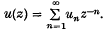
A transform method for the solution of linear difference equations, analogous to the method of the Laplace transform in the field of linear differential equations, has been described by Stone (1). The transform u(z) of a sequence un is defined by the equation
 and associated polynomials
Optimum Flight Paths
-
- Journal:
- The Journal of Navigation / Volume 4 / Issue 2 / April 1951
- Published online by Cambridge University Press:
- 18 January 2010, pp. 178-200
- Print publication:
- April 1951
-
- Article
- Export citation
NAV volume 4 issue 2 Front matter
-
- Journal:
- The Journal of Navigation / Volume 4 / Issue 2 / April 1951
- Published online by Cambridge University Press:
- 18 January 2010, pp. f1-f4
- Print publication:
- April 1951
-
- Article
-
- You have access
- Export citation
The Marine Observer's Handbook, issued by the Meteorological Office (7th edition, June 1950), 122 + iv pp. , cloth 9·6 × 6 in., illustrated. H.M. Stationery Office, 8s. 6d.
-
- Journal:
- The Journal of Navigation / Volume 4 / Issue 2 / April 1951
- Published online by Cambridge University Press:
- 18 January 2010, p. 210
- Print publication:
- April 1951
-
- Article
- Export citation
An application of local uniformization to the theory of divisors
-
- Journal:
- Mathematical Proceedings of the Cambridge Philosophical Society / Volume 47 / Issue 2 / April 1951
- Published online by Cambridge University Press:
- 24 October 2008, pp. 279-285
- Print publication:
- April 1951
-
- Article
- Export citation
On the recurrent solutions of a class of non-linear differential equations
-
- Journal:
- Mathematical Proceedings of the Cambridge Philosophical Society / Volume 47 / Issue 2 / April 1951
- Published online by Cambridge University Press:
- 24 October 2008, pp. 315-330
- Print publication:
- April 1951
-
- Article
- Export citation
-
1. This paper is concerned with certain properties of the solutions of differential equations of the type

where f, g have continuous partial derivatives up to the second order satisfying Lipschitz conditions in some bounded domain
 and are periodic in t with period 2π, ω is a positive constant and k is a small parameter. If f = 0, (1·1) is equivalent to
an equation representing the forced vibrations of a quasi-linear system of one degree of freedom.
 and are periodic in
The structure of the turbulent boundary layer
-
- Journal:
- Mathematical Proceedings of the Cambridge Philosophical Society / Volume 47 / Issue 2 / April 1951
- Published online by Cambridge University Press:
- 24 October 2008, pp. 375-395
- Print publication:
- April 1951
-
- Article
- Export citation
Trapping modes in the theory of surface waves
-
- Journal:
- Mathematical Proceedings of the Cambridge Philosophical Society / Volume 47 / Issue 2 / April 1951
- Published online by Cambridge University Press:
- 24 October 2008, pp. 347-358
- Print publication:
- April 1951
-
- Article
- Export citation
Notes on problems in hexagonal aeolotropic materials
-
- Journal:
- Mathematical Proceedings of the Cambridge Philosophical Society / Volume 47 / Issue 2 / April 1951
- Published online by Cambridge University Press:
- 24 October 2008, pp. 401-409
- Print publication:
- April 1951
-
- Article
- Export citation
Quadrics in finite geometries
-
- Journal:
- Mathematical Proceedings of the Cambridge Philosophical Society / Volume 47 / Issue 2 / April 1951
- Published online by Cambridge University Press:
- 24 October 2008, pp. 299-304
- Print publication:
- April 1951
-
- Article
- Export citation
A regression problem
-
- Journal:
- Mathematical Proceedings of the Cambridge Philosophical Society / Volume 47 / Issue 2 / April 1951
- Published online by Cambridge University Press:
- 24 October 2008, pp. 337-346
- Print publication:
- April 1951
-
- Article
- Export citation
Curvilinear momenta in quantum mechanics
-
- Journal:
- Mathematical Proceedings of the Cambridge Philosophical Society / Volume 47 / Issue 2 / April 1951
- Published online by Cambridge University Press:
- 24 October 2008, pp. 451-453
- Print publication:
- April 1951
-
- Article
- Export citation
