Refine search
Actions for selected content:
26208 results in Theoretical Physics and Mathematical Physics
Publications of the Centre Belge
-
- Journal:
- The Journal of Navigation / Volume 4 / Issue 3 / July 1951
- Published online by Cambridge University Press:
- 18 January 2010, p. 316
- Print publication:
- July 1951
-
- Article
- Export citation
Radar Usage and Speed in Fog
-
- Journal:
- The Journal of Navigation / Volume 4 / Issue 3 / July 1951
- Published online by Cambridge University Press:
- 18 January 2010, pp. 323-325
- Print publication:
- July 1951
-
- Article
-
- You have access
- Export citation
Spectral representation of linear transformations in ω
-
- Journal:
- Mathematical Proceedings of the Cambridge Philosophical Society / Volume 47 / Issue 3 / July 1951
- Published online by Cambridge University Press:
- 24 October 2008, pp. 461-472
- Print publication:
- July 1951
-
- Article
- Export citation
Applications of Oceanographical Research to Navigation
-
- Journal:
- The Journal of Navigation / Volume 4 / Issue 3 / July 1951
- Published online by Cambridge University Press:
- 18 January 2010, pp. 276-287
- Print publication:
- July 1951
-
- Article
- Export citation
Multiplicative norms on Banach algebras
-
- Journal:
- Mathematical Proceedings of the Cambridge Philosophical Society / Volume 47 / Issue 3 / July 1951
- Published online by Cambridge University Press:
- 24 October 2008, pp. 473-474
- Print publication:
- July 1951
-
- Article
- Export citation
-
1. Mazur(1) has shown that any normed algebra A over the real field in which the norm is multiplicative in the sense that

is equivalent (i.e. algebraically isomorphic and isometric under one and the same mapping) to one of the following algebras: (i) the real numbers, (ii) the complex numbers, (iii) the real quaternions, each of these sets being regarded as normed algebras over the real field. Completeness of A is not assumed by Mazur. A relevant discussion is given also in Lorch (2).
Relativistic wave-functions and K-capture for a modified coulomb field
-
- Journal:
- Mathematical Proceedings of the Cambridge Philosophical Society / Volume 47 / Issue 3 / July 1951
- Published online by Cambridge University Press:
- 24 October 2008, pp. 610-616
- Print publication:
- July 1951
-
- Article
- Export citation
Plotting Hyperbolic Coordinates - Notes Techniques du Ministère de l'Air No. 38. ‘Note sur une Représentation Rectiligne des Hyperboles Sphériques’. P. Hugon, vi + 20 pp., paper, 7 × 10·5 in. 200 Fr.
-
- Journal:
- The Journal of Navigation / Volume 4 / Issue 3 / July 1951
- Published online by Cambridge University Press:
- 18 January 2010, p. 321
- Print publication:
- July 1951
-
- Article
- Export citation
Corrigendum
-
- Journal:
- Mathematical Proceedings of the Cambridge Philosophical Society / Volume 47 / Issue 3 / July 1951
- Published online by Cambridge University Press:
- 24 October 2008, p. 626
- Print publication:
- July 1951
-
- Article
- Export citation
Ocean Navigation in Small Craft
-
- Journal:
- The Journal of Navigation / Volume 4 / Issue 3 / July 1951
- Published online by Cambridge University Press:
- 18 January 2010, pp. 301-308
- Print publication:
- July 1951
-
- Article
- Export citation
Auxiliary Star Tables - Tábuas Náuticas e Aeronáuticas: Tábuas Estelares Auxiliares. Radler de Aquino, ii + 18 pages, paper, 6½ × 10 in. Rio de Janeiro, 1950.
-
- Journal:
- The Journal of Navigation / Volume 4 / Issue 3 / July 1951
- Published online by Cambridge University Press:
- 18 January 2010, pp. 321-322
- Print publication:
- July 1951
-
- Article
- Export citation
A Visit to Greenwich
-
- Journal:
- The Journal of Navigation / Volume 4 / Issue 3 / July 1951
- Published online by Cambridge University Press:
- 18 January 2010, p. 315
- Print publication:
- July 1951
-
- Article
- Export citation
A generalization of the Hurwitz composition theorem to irregular power series
-
- Journal:
- Mathematical Proceedings of the Cambridge Philosophical Society / Volume 47 / Issue 3 / July 1951
- Published online by Cambridge University Press:
- 24 October 2008, pp. 477-482
- Print publication:
- July 1951
-
- Article
- Export citation
-
When two functions
 are given, each with a finite radius of convergence, a theorem due independently to Hurwitz and Pincherle (1, 2) provides information about the position of the singularities of the function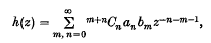
in terms of the positions of the singularities of f(z) and g(z).
 are given, each with a finite radius of convergence, a theorem due independently to Hurwitz and Pincherle (1, 2) provides information about the position of the singularities of the function
Partition theory and thermodynamics of multi-dimensional oscillator assemblies
-
- Journal:
- Mathematical Proceedings of the Cambridge Philosophical Society / Volume 47 / Issue 3 / July 1951
- Published online by Cambridge University Press:
- 24 October 2008, pp. 591-601
- Print publication:
- July 1951
-
- Article
- Export citation
Thomas Gray Memorial Trust
-
- Journal:
- The Journal of Navigation / Volume 4 / Issue 3 / July 1951
- Published online by Cambridge University Press:
- 18 January 2010, p. 308
- Print publication:
- July 1951
-
- Article
- Export citation
Thurlow Award
-
- Journal:
- The Journal of Navigation / Volume 4 / Issue 3 / July 1951
- Published online by Cambridge University Press:
- 18 January 2010, p. 315
- Print publication:
- July 1951
-
- Article
- Export citation
Some Problems of Underwater Navigation
-
- Journal:
- The Journal of Navigation / Volume 4 / Issue 3 / July 1951
- Published online by Cambridge University Press:
- 18 January 2010, pp. 288-300
- Print publication:
- July 1951
-
- Article
- Export citation
On a theorem of Zygmund
-
- Journal:
- Mathematical Proceedings of the Cambridge Philosophical Society / Volume 47 / Issue 3 / July 1951
- Published online by Cambridge University Press:
- 24 October 2008, pp. 475-476
- Print publication:
- July 1951
-
- Article
- Export citation
-
Zygmund (1) proved in 1936 that if f(x) ∈Lp(−∞, ∞) (1 ≤ p ≤ 2), the Fourier transform

exists for almost every λ, in the sense that

exists for almost every λ. The purpose of this note is to provide a short proof of this theorem.

A Dictionary of Navigational Terms
-
- Journal:
- The Journal of Navigation / Volume 4 / Issue 3 / July 1951
- Published online by Cambridge University Press:
- 18 January 2010, p. 317
- Print publication:
- July 1951
-
- Article
- Export citation
PSP volume 47 issue 3 Cover and Front matter
-
- Journal:
- Mathematical Proceedings of the Cambridge Philosophical Society / Volume 47 / Issue 3 / July 1951
- Published online by Cambridge University Press:
- 24 October 2008, pp. f1-f2
- Print publication:
- July 1951
-
- Article
- Export citation
The Principles of Air Navigation - The Principles of Air Navigation. E. W. Anderson (1951), xiv + 262 pp., illustrated, cloth, Demy 8vo, Methuen, 25s.
-
- Journal:
- The Journal of Navigation / Volume 4 / Issue 3 / July 1951
- Published online by Cambridge University Press:
- 18 January 2010, pp. 318-320
- Print publication:
- July 1951
-
- Article
- Export citation
