Refine search
Actions for selected content:
237222 results in Physics and Astronomy

Combustion noise modelling of thermally perfect and multi-species gas flow in nozzles
-
- Journal:
- Journal of Fluid Mechanics / Volume 1014 / 10 July 2025
- Published online by Cambridge University Press:
- 11 July 2025, A39
-
- Article
- Export citation
-
Several hypotheses are employed to describe the fluctuating motions within nozzles and to analytically predict combustion noise generation mechanisms. One of these assumptions is that of a calorifically perfect gas mixture, where $c_p$ is constant. Nonetheless, a realistic flow rather encompasses heat capacities $c_p$ that vary with temperature, i.e. $c_p = c_p(T)$, such that the mixture is called thermally perfect. The influence of the mixture assumptions on noise generation mechanisms is re-examined in this paper. To do so, the quasi one-dimensional Euler equations for multi-species, isentropic and non-reactive flow are considered within the nozzle. Their linearisation yields a new prediction model in addition to showing a new entropy-to-entropy coupling mechanism. Relying on either the assumption of low frequencies or the Magnus’ expansion methodology, two analytical solutions are derived and studied. Validation of these two prediction models is then provided relying on unsteady simulations of axisymmetric nozzles with superimposed incident waves. To generalise previous results, parametric studies are performed considering various nozzle flow geometries. Variations of up to $10\,\,\%$ are exhibited in a choked flow nozzle between the two mixtures, especially for the indirect entropy noise and the entropy-to-entropy transmission moduli.


Turbulence-resolving integral simulations for wall-bounded flows
- Part of
-
- Journal:
- Journal of Fluid Mechanics / Volume 1014 / 10 July 2025
- Published online by Cambridge University Press:
- 11 July 2025, A40
-
- Article
-
- You have access
- Open access
- HTML
- Export citation
-
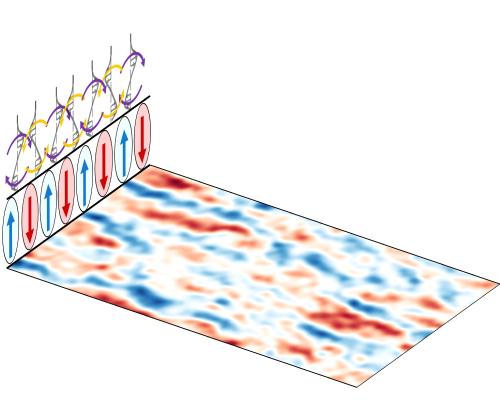
The physical fidelity of turbulence models can benefit from a partial resolution of fluctuations, but doing so often comes with an increase in computational cost. To explore this trade-off in the context of wall-bounded flows, this paper introduces a framework for turbulence-resolving integral simulations (TRIS) with the goal of efficiently resolving the largest motions using a two-dimensional, three-component representation of the flow defined by instantaneous wall-normal integrals of velocity and pressure. Self-sustaining turbulence with qualitatively realistic large-scale structures is demonstrated for TRIS on an open-channel (half-channel) flow configuration using moment-of-momentum integral equations derived from Navier–Stokes with relatively simple closure approximations. Evidence from direct numerical simulations (DNS) suggests that TRIS can theoretically resolve $35\,\%{-}40\,\%$ of the turbulent skin friction enhancement for friction Reynolds numbers between $180$ and $5200$, without a noticeable decrease or increase as a function of Reynolds number. The current implementation of TRIS can match this resolution while simulating one flow through time in ${\sim}1$ minute on a single processor, even for very large Reynolds numbers. The framework facilitates a detailed apples-to-apples comparison of predicted statistics against data from DNS. Comparisons at friction Reynolds numbers of $395$ and $590$ show that TRIS generates a relatively accurate representation of the flow, while highlighting discrepancies that demonstrate a need for improving the closure models. The present results for open-channel flow represent a proof of concept for TRIS as a new approach for wall-bounded turbulence modelling, motivating extension to more general flow configurations such as boundary layers on immersed objects.


Tilting of vortex rings in the oblique collision reduces the longitudinal quadrupole and octupole modes of aerodynamic sound
-
- Journal:
- Journal of Fluid Mechanics / Volume 1015 / 25 July 2025
- Published online by Cambridge University Press:
- 11 July 2025, A1
-
- Article
- Export citation
Elliptic curves and spin
- Part of
-
- Journal:
- Mathematical Proceedings of the Cambridge Philosophical Society / Volume 179 / Issue 3 / November 2025
- Published online by Cambridge University Press:
- 11 July 2025, pp. 519-539
- Print publication:
- November 2025
-
- Article
-
- You have access
- Open access
- HTML
- Export citation
-
In the early 2000s, Ramakrishna asked the question: for the elliptic curve
what is the density of primes p for which the Fourier coefficient \[E\;:\; y^2 = x^3 - x,\] $a_p(E)$ is a cube modulo p? As a generalisation of this question, Weston–Zaurova formulated conjectures concerning the distribution of power residues of degree m of the Fourier coefficients of elliptic curves $E/\mathbb{Q}$ with complex multiplication. In this paper, we prove the conjecture of Weston–Zaurova for cubic residues using the analytic theory of spin. Our proof works for all elliptic curves E with complex multiplication.


A proposed mechanism for the formation of protocell-like structures on Titan
-
- Journal:
- International Journal of Astrobiology / Volume 24 / 2025
- Published online by Cambridge University Press:
- 10 July 2025, e7
-
- Article
-
- You have access
- Open access
- HTML
- Export citation
Iterative approach for time development calculation of tokamak plasma with eddy current effects using a 3D magnetohydrodynamic equilibrium solver
-
- Journal:
- Journal of Plasma Physics / Volume 91 / Issue 3 / June 2025
- Published online by Cambridge University Press:
- 10 July 2025, E91
-
- Article
-
- You have access
- Open access
- HTML
- Export citation
Strong gradient effects on neoclassical electron transport and the bootstrap current in large aspect ratio tokamaks
- Part of
-
- Journal:
- Journal of Plasma Physics / Volume 91 / Issue 4 / August 2025
- Published online by Cambridge University Press:
- 10 July 2025, E97
-
- Article
-
- You have access
- Open access
- HTML
- Export citation
Stress resistance of halophilic Archaea from Lunenburg, Germany: implications for astrobiology
-
- Journal:
- International Journal of Astrobiology / Volume 24 / 2025
- Published online by Cambridge University Press:
- 10 July 2025, e6
-
- Article
-
- You have access
- Open access
- HTML
- Export citation
A measurement of Galactic synchrotron emission using MWA drift scan observations
-
- Journal:
- Publications of the Astronomical Society of Australia / Volume 42 / 2025
- Published online by Cambridge University Press:
- 10 July 2025, e103
-
- Article
-
- You have access
- Open access
- HTML
- Export citation
-
Studying the diffuse Galactic synchrotron emission (hereafter, DGSE) at arc-minute angular scale is important to remove the foregrounds for the cosmological 21-cm observations. Statistical measurements of the large-scale DGSE can also be used to constrain the magnetic field and the cosmic ray electron density of our Galaxy’s interstellar medium. Here, we have used the Murchison Widefield Array drift scan observations at $154.2 \, \textrm{MHz}$ to measure the angular power spectrum $({\mathcal C}_{\ell})$ of the DGSE of a region of the sky from right ascension $349^{\circ}$ to $70.3^{\circ}$ at the fixed declination $-26.7^{\circ}$. In this RA range, we have chosen 24 pointing centers (PCs), for which we have removed all the bright point sources above $\sim430 \, \textrm{mJy}\,(3\sigma)$, and applied the Tapered Gridded Estimator on residual data to estimate the ${\mathcal C}_{\ell}$. We use the angular multipole range $65 \le \ell \le 650$ to fit the data with a model, ${\mathcal C}^M_{\ell}=A\times \left(\frac{1\,000}{\ell}\right)^{\beta}+C$, where we interpret the model as the combination of a power law $(\propto \ell^{-\beta})$ nature of the DGSE and a constant part due to the Poisson fluctuations of the residual point sources. We are able to fit the model ${\mathcal C}^M_{\ell}$ for six PCs centered at $\alpha=352.5^{\circ}, 353^{\circ}, 357^{\circ}, 4.5^{\circ}, 4^{\circ}$, and $1^{\circ}$. We run the Markov Chain Monte Carlo (MCMC) ensemble sampler to get the best-fit values of the parameters $A, \beta$, and C for these PCs. We see that the values of A vary in the range 155–400 mK $^{2}$, whereas the $\beta$ varies in the range $0.9$– $1.7$. We find that the value of $\beta$ is consistent at $2-\sigma$ level with the earlier measurement of the DGSE at similar frequency and angular scales.


The Indian Pulsar Timing Array data release 2: I. Dataset and timing analysis
-
- Journal:
- Publications of the Astronomical Society of Australia / Volume 42 / 2025
- Published online by Cambridge University Press:
- 10 July 2025, e108
-
- Article
-
- You have access
- Open access
- HTML
- Export citation
Spectral signatures of young radio galaxies
-
- Journal:
- Publications of the Astronomical Society of Australia / Volume 42 / 2025
- Published online by Cambridge University Press:
- 10 July 2025, e100
-
- Article
-
- You have access
- Open access
- HTML
- Export citation
-
We investigate the evolution of active galactic nucleus jets on kiloparsec-scales due to their interaction with the clumpy interstellar medium (ISM) of the host galaxy and, subsequently, the surrounding circumgalactic environment. Hydrodynamic simulations of this jet–environment interaction are presented for a range of jet kinetic powers, peak densities of the multiphase ISM, and scale radii of the larger-scale environment – characteristic of either a galaxy cluster or poor group. Synthetic radio images are generated by considering the combination of synchrotron radiation from the jet plasma and free-free absorption from the multiphase ISM. We find that jet propagation is slowed by interactions with a few very dense clouds in the host galaxy ISM, producing asymmetries in lobe length and brightness which persist to scales of tens of kpc for poor group environments. The classification of kiloparsec-scale jets is highly dependent on surface brightness sensitivity and resolution. Our simulations of young active sources can appear as restarted sources, showing double-double lobe morphology, high core prominence (CP $\gt 0.1$), and the expected radio spectra for both the inner- and outer-lobe components. We qualitatively reproduce the observed inverse correlation between peak frequency and source size and find that the peak frequency of the integrated radio spectrum depends on ISM density but not the jet power. Spectral turnover in resolved young radio sources therefore provides a new probe of the ISM.

Evolutionary map of the Universe: Detection and analysis of the shell surrounding the runaway Wolf-Rayet star WR16
-
- Journal:
- Publications of the Astronomical Society of Australia / Volume 42 / 2025
- Published online by Cambridge University Press:
- 10 July 2025, e101
-
- Article
-
- You have access
- Open access
- HTML
- Export citation
-
We present the first radio–continuum detection of the circumstellar shell around the well-known WN8 type Wolf-Rayet star WR16 at 943.5 MHz using the Australian Square Kilometre Array Pathfinder (ASKAP) Evolutionary Map of the Universe (EMU) survey. At this frequency, the shell has a measured flux density of 72.2 $\pm$7.2 mJy. Using previous Australia Telescope Compact Array (ATCA) measurements at 2.4, 4.8, and 8.64 GHz, as well as the Evolutionary Map of the Universe (EMU) observations of the star itself, we determine a spectral index of $\alpha\,=\,+0.74\pm0.02$, indicating thermal emission. We propose that the shell and star both exhibit thermal emission, supported by the its appearance in near-infrared and H $\alpha$ observations. The latest Gaia parallax is used to determine a distance of 2.28 $\pm$0.09 kpc. This star is well known for its surrounding circular nebulosity, and using the distance and an angular diameter of $8.^{\prime}42$, we determine the shell size to be 5.57 $\pm$0.22 pc. We use the Gaia proper motion (PM) of WR16 to determine peculiar velocities of the star as $V_{\alpha}(pec) =$ –45.3 $\pm$5.4 km s $^{-1}$ and $V_{\delta}(pec) =$ 22.8 $\pm$4.7 km s $^{-1}$, which indicates that the star is moving in a north-west direction, and translates to a peculiar tangential velocity to be 50.7 $\pm$6.9 km s $^{-1}$. We also use these proper motion (PM) to determine the shell’s origin, estimate an age of $\sim 9500\pm 1300$ yr, and determine its average expansion velocity to be $280\pm40$ km s $^{-1}$. This average expansion velocity suggests that the previous transitional phase is a Luminous Blue Variable (LBV) phase, rather than a Red Super Giant (RSG) phase. We also use the measured flux at 943.5 MHz to determine a mass-loss rate of $1.753\times 10^{-5}\,{\rm M}_\odot\,$yr $^{-1}$, and use this to determine a lower-limit on ionising photons of $N_{UV} \gt 1.406\times 10^{47}\,\textit{s}^{-1}$.


Three-dimensional tearing instability of flux-tube-like magnetic fields
-
- Journal:
- Journal of Plasma Physics / Volume 91 / Issue 4 / August 2025
- Published online by Cambridge University Press:
- 10 July 2025, E99
-
- Article
-
- You have access
- Open access
- HTML
- Export citation
-
Magnetic reconnection, a fundamental plasma process, is pivotal in understanding energy conversion and particle acceleration in astrophysical systems. While extensively studied in two-dimensional (2-D) configurations, the dynamics of reconnection in three-dimensional (3-D) systems remains under-explored. In this work, we extend the classical tearing mode instability to three dimensions by introducing a modulation along the otherwise uniform direction in a 2-D equilibrium, given by $g(y)$, mimicking a flux-tube-like configuration. We perform linear stability analysis (both analytically and numerically) and direct numerical simulations to investigate the effects of three-dimensionality. Remarkably, we find that a tearing-like instability arises in three dimensions as well, even without the presence of guide fields. Further, our findings reveal that the 3-D tearing instability exhibits reduced growth rates compared with two dimensions by a factor of $\int g(y)^{1/2} {\rm d}y\,/\int {\rm d}y$, with the dispersion relation maintaining similar scaling characteristics. We show that the modulation introduces spatially varying resistive layer properties, which influence the reconnection dynamics.

The rotational transform and enhanced confinement in the TJ-II stellarator
-
- Journal:
- Journal of Plasma Physics / Volume 91 / Issue 4 / August 2025
- Published online by Cambridge University Press:
- 10 July 2025, E98
-
- Article
-
- You have access
- Open access
- HTML
- Export citation
-
This study reports on a set of experiments designed to clarify the impact of the rotational transform on confinement quality at the TJ-II stellarator. For this purpose, the net plasma current is controlled using external coils, resulting in the modification of the rotational transform profile. Significant and systematic variations of the edge electron density gradients (up to $50\,\%{-}60\,\%$) and the plasma energy content ( $20\,\%{-}30\,\%$) are achieved. The explanation of this behaviour relies on the placement of low-order rational surfaces in relation to the edge gradient region, which affect local turbulence fluctuation levels, facilitating the formation of zonal flows and concomitant transport barriers. This hypothesis is confirmed experimentally on the basis of a broad array of diagnostic measurements. Calculations based on a resistive magnetohydrodynamic turbulence model provide qualitative support for this hypothesis, clarifying the impact on confinement of specific rational surfaces and highlighting the complex nature of magnetically confined fusion plasmas.


Acoustothermal effect: mechanism and quantification of the heat source – ERRATUM
-
- Journal:
- Journal of Fluid Mechanics / Volume 1014 / 10 July 2025
- Published online by Cambridge University Press:
- 10 July 2025, E4
-
- Article
-
- You have access
- Open access
- HTML
- Export citation
How reliable is PCR? A mini review
-
- Journal:
- Quarterly Reviews of Biophysics / Volume 58 / 2025
- Published online by Cambridge University Press:
- 10 July 2025, e15
-
- Article
- Export citation

Major role and longitudinal nature of stochastic resonance in promoting chaotic states in viscoelastic channel flow with low inlet perturbations
-
- Journal:
- Journal of Fluid Mechanics / Volume 1014 / 10 July 2025
- Published online by Cambridge University Press:
- 08 July 2025, R4
-
- Article
- Export citation
-
Stochastic resonance (SR) is universal phenomenon, where noise amplifies a weak periodic signal in bistable nonlinear systems, with wide applications in biology, climate science, engineering etc., although in fluid dynamics it remains underexplored. Recently, we unexpectedly found SR above non-modal elastic instability onset in an inertialess viscoelastic channel flow, where it emerges on the top of a chaotic streamwise velocity power spectrum $E_u$ due to its interaction with white-noise spanwise velocity power spectrum $E_w$ and weak elastic waves. These three conditions necessary for SR emergence differ from those required for the classical SR emergence mentioned above. Here, we consider SR in an inertialess viscoelastic channel flow with a smoothed inlet causing order of magnitude lower noise intensity than in our former studies. Our observations reveal that SR appears at the same conditions mentioned above, where SR is found just upon the instability onset in a lower subrange of a transition regime, in contrast, here, SR persists across all flow regimes – transition, elastic turbulence and drag reduction. Furthermore, we provide experimental evidence that SR, presented by a sharp peak in $E_u$, manifests as either a standing or propagating wave in the $x$-direction, with a rather uniform amplitude of streamwise velocity fluctuations and zero propagation velocity in the $z$-direction. These findings reveal a new mechanism underpinning the transition to a chaotic channel flow of viscoelastic fluids and establish SR as a robust framework for understanding complex flow dynamics. This work opens new avenues for exploring SR in other nonlinear systems and practical applications such as mixing enhancement and flow control in industrial and biological contexts.


The gyrokinetic field invariant and electromagnetic temperature-gradient instabilities in ‘good-curvature’ plasmas
-
- Journal:
- Journal of Plasma Physics / Volume 91 / Issue 4 / August 2025
- Published online by Cambridge University Press:
- 08 July 2025, E95
-
- Article
-
- You have access
- Open access
- HTML
- Export citation
-
Curvature-driven instabilities are ubiquitous in magnetised fusion plasmas. By analysing the conservation laws of the gyrokinetic system of equations, we demonstrate that the well-known spatial localisation of these instabilities to regions of ‘bad magnetic curvature’ can be explained using the conservation law for a sign-indefinite quadratic quantity that we call the gyrokinetic field invariant. Its evolution equation allows us to define the local effective magnetic curvature whose sign demarcates the regions of ‘good’ and ‘bad’ curvature, which, under some additional simplifying assumptions, can be shown to correspond to the inboard (high-field) and outboard (low-field) sides of a tokamak plasma, respectively. We find that, given some reasonable assumptions, electrostatic curvature-driven modes are always localised to the regions of bad magnetic curvature, regardless of the specific character of the instability. More importantly, we also deduce that any mode that is unstable in the region of good magnetic curvature must be electromagnetic in nature. As a concrete example, we present the magnetic-drift mode, a novel good-curvature electromagnetic instability, and compare its properties with the well-known electron-temperature-gradient instability. Finally, we discuss the relevance of the magnetic drift mode for high- $\beta$ fusion plasmas, and in particular its relationship with microtearing modes.

Gyrokinetic simulations of magnetohydrodynamic modes in stellarator plasmas
-
- Journal:
- Journal of Plasma Physics / Volume 91 / Issue 4 / August 2025
- Published online by Cambridge University Press:
- 08 July 2025, E93
-
- Article
-
- You have access
- Open access
- HTML
- Export citation
Assessing optical damage risks by simulating the amplification of back-reflection in a multi-petawatt laser system
-
- Journal:
- High Power Laser Science and Engineering / Volume 13 / 2025
- Published online by Cambridge University Press:
- 08 July 2025, e65
-
- Article
-
- You have access
- Open access
- HTML
- Export citation
