Refine search
Actions for selected content:
237222 results in Physics and Astronomy
S - TASEP: Map Method and Simulations
-
- Book:
- Nonequilibrium Statistical Physics
- Published online:
- 19 June 2025
- Print publication:
- 03 July 2025, pp 484-488
-
- Chapter
- Export citation
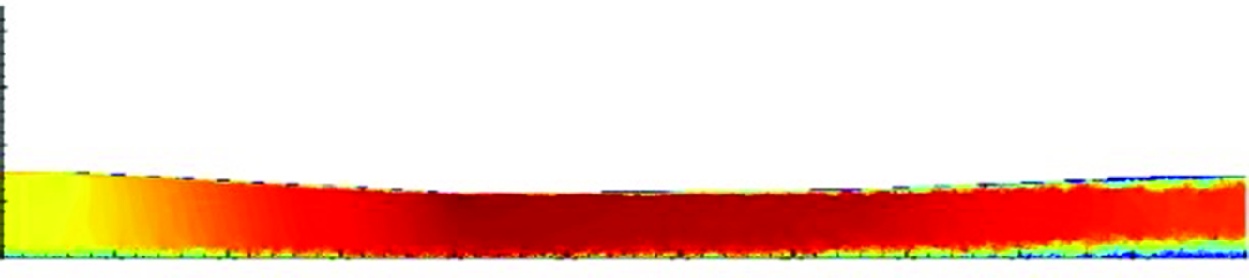
Large-eddy simulation of a non-equilibrium turbulent boundary layer
-
- Journal:
- Journal of Fluid Mechanics / Volume 1014 / 10 July 2025
- Published online by Cambridge University Press:
- 03 July 2025, A20
-
- Article
-
- You have access
- Open access
- HTML
- Export citation
-
Wall-resolved large-eddy simulation (LES) of a non-equilibrium turbulent boundary layer (TBL) is performed. The simulations are based on the experiments of Volino (2020a J. Fluid Mech. 897, A2), who reported profile measurements at several streamwise stations in a spatially developing zero pressure gradient TBL evolving through a region of favourable pressure gradient (FPG), a zero pressure gradient recovery and subsequently an adverse pressure gradient (APG) region. The pressure gradient quantified by the acceleration parameter $K$ was held constant in each of these three regions. Here, $K = -(\nu /\rho U_e^{3}) {\textrm d}P_e/{\textrm d}x$, where $\nu$ is the kinematic viscosity, $\rho$ is density, $U_e$ is the free stream velocity and ${\textrm d}P_e/{\textrm d}x$ is the streamwise pressure gradient at the edge (denoted by the subscript ‘ $e$’) of the TBL. The simulation set-up is carefully designed to mimic the experimental conditions while keeping the computational cost tractable. The computational grid appropriately resolves the increasingly thinning and thickening of the TBL in the FPG and APG regions, respectively. The results are thoroughly compared with the available experimental data at several stations in the domain, showing good agreement. The results show that the computational set-up accurately reproduces the experimental conditions and the results demonstrate the accuracy of LES in predicting the complex flow field of the non-equilibrium TBL. The scaling laws and models proposed in the literature are evaluated and the response of the TBL to non-equilibrium conditions is discussed.


I - The Deterministic KPZ Equation and the Burgers Equation
-
- Book:
- Nonequilibrium Statistical Physics
- Published online:
- 19 June 2025
- Print publication:
- 03 July 2025, pp 440-445
-
- Chapter
- Export citation
G - Reversibility and Ergodicity in a Markov Chain
-
- Book:
- Nonequilibrium Statistical Physics
- Published online:
- 19 June 2025
- Print publication:
- 03 July 2025, pp 429-430
-
- Chapter
- Export citation
U - The Allen–Cahn Equation
-
- Book:
- Nonequilibrium Statistical Physics
- Published online:
- 19 June 2025
- Print publication:
- 03 July 2025, pp 494-495
-
- Chapter
- Export citation
Frontmatter
-
- Book:
- Nonequilibrium Statistical Physics
- Published online:
- 19 June 2025
- Print publication:
- 03 July 2025, pp i-iv
-
- Chapter
- Export citation
5 - From Equilibrium to Out-of-Equilibrium Phase Transitions: Driven Lattice Gases
-
- Book:
- Nonequilibrium Statistical Physics
- Published online:
- 19 June 2025
- Print publication:
- 03 July 2025, pp 198-241
-
- Chapter
- Export citation
Y - Steady States of the One-Dimensional TDGL Equation
-
- Book:
- Nonequilibrium Statistical Physics
- Published online:
- 19 June 2025
- Print publication:
- 03 July 2025, pp 506-506
-
- Chapter
- Export citation
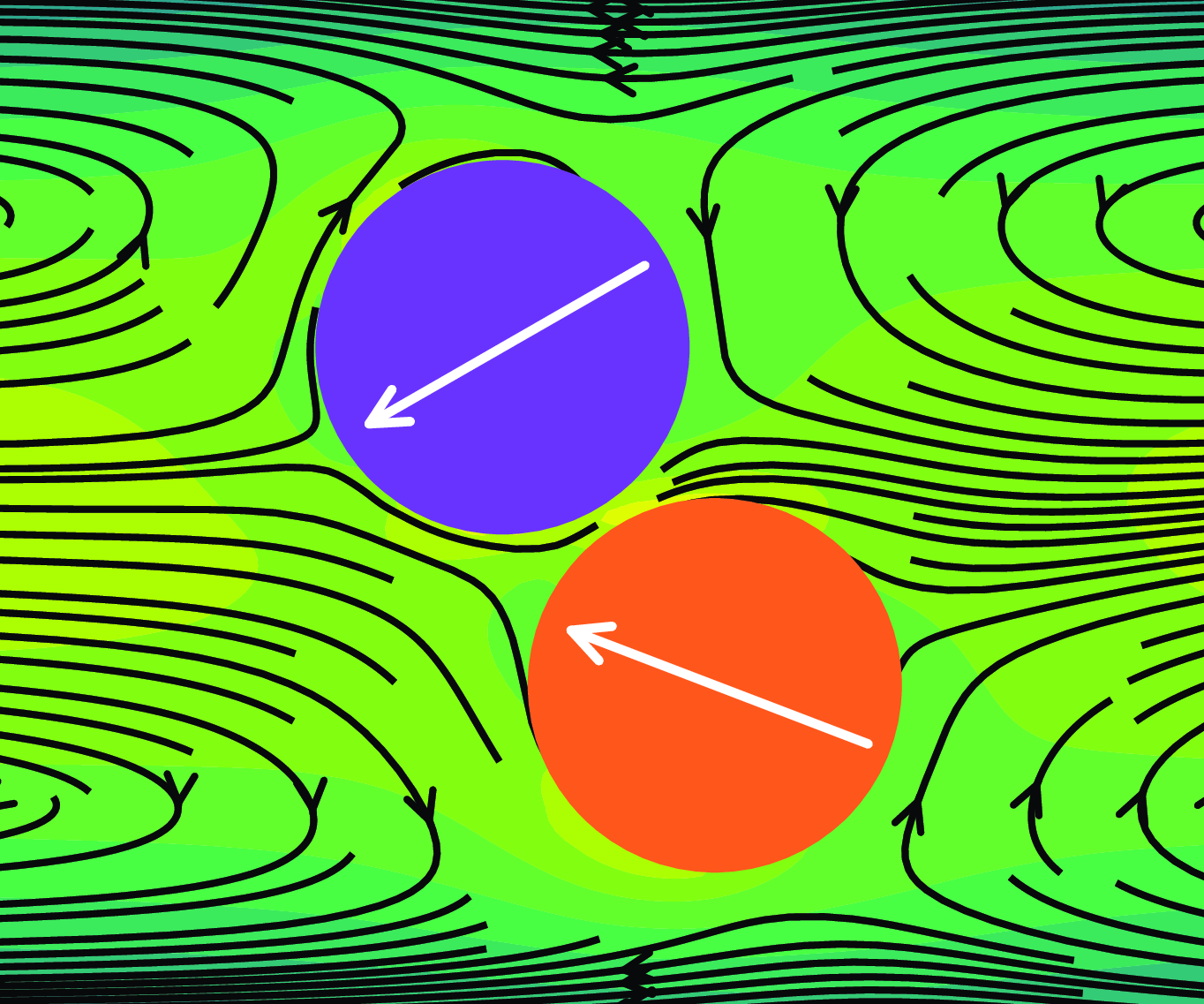
How can two circular self-propelled particles form a stable wedge-like conformation in channel flow?
-
- Journal:
- Journal of Fluid Mechanics / Volume 1014 / 10 July 2025
- Published online by Cambridge University Press:
- 03 July 2025, A19
-
- Article
- Export citation
-
We investigate the dynamics of circular self-propelled particles in channel flow, modelled as squirmers using a two-dimensional lattice Boltzmann method. The simulations explore a wide range of parameters, including channel Reynolds numbers ( $\textit{Re}_c$), squirmer Reynolds numbers ( $\textit{Re}_s$) and squirmer-type factors ( $\beta$). For a single squirmer, four motion regimes are identified: oscillatory motion confined to one side of the channel, oscillatory crossing of the channel centreline, stabilisation at a lateral equilibrium position with the squirmer tilted and stable upstream swimming near the channel centreline. For two squirmers, interactions produce not only these four corresponding regimes but also three additional ones: continuous collisions with repeated position exchanges, progressive separation and drifting apart and, most notably, the formation of a stable wedge-like conformation (regime D). A key finding is the emergence of regime D, which predominantly occurs for weak pullers ( $\beta = 1$) and at moderate to high $\textit{Re}_c$ values. Hydrodynamic interactions align the squirmers with streamline bifurcations near the channel centreline, enabling stability despite transient oscillations. Additionally, the channel blockage ratio critically affects the range of $\textit{Re}_s$ values over which this regime occurs, highlighting the influence of geometric confinement. This study extends the understanding of squirmer dynamics, revealing how hydrodynamic interactions drive collective behaviours. The findings also offer insights into the design of self-propelled particles for biomedical applications and contribute to the theoretical framework for active matter systems. Future work will investigate three-dimensional effects and the stability conditions for spherical squirmers forming stable wedge-like conformations, further generalising these results.


W - The Rayleigh–Bénard Instability
-
- Book:
- Nonequilibrium Statistical Physics
- Published online:
- 19 June 2025
- Print publication:
- 03 July 2025, pp 498-503
-
- Chapter
- Export citation
V - The Gibbs–Thomson Relation
-
- Book:
- Nonequilibrium Statistical Physics
- Published online:
- 19 June 2025
- Print publication:
- 03 July 2025, pp 496-497
-
- Chapter
- Export citation
Q - Derivation of the Ginzburg–Landau Free Energy
-
- Book:
- Nonequilibrium Statistical Physics
- Published online:
- 19 June 2025
- Print publication:
- 03 July 2025, pp 477-479
-
- Chapter
- Export citation
3 - Fluctuations and Their Probability
-
- Book:
- Nonequilibrium Statistical Physics
- Published online:
- 19 June 2025
- Print publication:
- 03 July 2025, pp 91-140
-
- Chapter
- Export citation
7 - Stochastic Dynamics of Surfaces and Interfaces
-
- Book:
- Nonequilibrium Statistical Physics
- Published online:
- 19 June 2025
- Print publication:
- 03 July 2025, pp 271-318
-
- Chapter
- Export citation
2 - Brownian Motion, Langevin, and Fokker–Planck Equations
-
- Book:
- Nonequilibrium Statistical Physics
- Published online:
- 19 June 2025
- Print publication:
- 03 July 2025, pp 39-90
-
- Chapter
- Export citation
T - Bridge Model: Mean-field and Simulations
-
- Book:
- Nonequilibrium Statistical Physics
- Published online:
- 19 June 2025
- Print publication:
- 03 July 2025, pp 489-493
-
- Chapter
- Export citation
A - Binary Elastic Collisions in the Hard Sphere Gas
-
- Book:
- Nonequilibrium Statistical Physics
- Published online:
- 19 June 2025
- Print publication:
- 03 July 2025, pp 410-413
-
- Chapter
- Export citation

Turbulence suppression in plane Couette flow using reduced-order models
-
- Journal:
- Journal of Fluid Mechanics / Volume 1014 / 10 July 2025
- Published online by Cambridge University Press:
- 03 July 2025, A18
-
- Article
- Export citation
-
We explore a reduced-order model (ROM) of plane Couette flow with a view to performing near-wall turbulence control. The ROM is derived through Galerkin projections of the incompressible Navier–Stokes system onto a basis of controllability modes. Such ROMs were found to reproduce key aspects of turbulence dynamics in Couette flow with only a few hundred degrees of freedom, and here we use them to devise a control strategy. We consider a ROM with an extra forcing term whose structure is given by a combination of eigenfunctions of a linear viscous diffusion equation, optimised in order to minimise the total fluctuation energy. The optimisation is performed at Reynolds numbers $Re=1000, 2000, 3000$, and produces a novel control mechanism wherein the optimal forcing leads the flow to laminarisation in all cases. The forcing acts by reducing the shear in a large portion of the channel, hindering the main energy input mechanism. The forced flow possesses a new laminar solution which is linearly stable at $Re=1000$ and unstable at higher $Re$, but whose transient growth of streaky structures is substantially lower than that of laminar Couette flow, leading the flow to full laminarisation when the forcing is removed. Forcings optimised in the ROM are subsequently applied in direct numerical simulations (DNS). The same control mechanisms are observed in the DNS, where laminarisation is also achieved. We show that the ROMs provide an effective framework to design turbulence control strategies, despite the high degree of truncation, which opens up interesting possibilities for turbulence control.


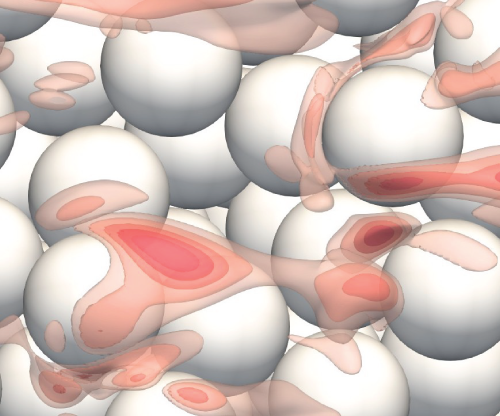
Turbulent flow over random sphere packs – kinetic energy budgets
-
- Journal:
- Journal of Fluid Mechanics / Volume 1014 / 10 July 2025
- Published online by Cambridge University Press:
- 03 July 2025, A17
-
- Article
-
- You have access
- Open access
- HTML
- Export citation
-
Based on data from pore-resolved direct numerical simulation of turbulent flow over mono-disperse random sphere packs, we evaluate the budgets of the double-averaged turbulent kinetic energy (TKE) and the wake kinetic energy (WKE). While TKE results from temporal velocity fluctuations, WKE describes the kinetic energy in spatial variations of the time-averaged flow field. We analyse eight cases which represent sampling points within a parameter space spanned by friction Reynolds numbers $Re_\tau \in [150, 500]$ and permeability Reynolds numbers $Re_K \in [0.4, 2.8]$. A systematic exploration of the parameter space is possible by varying the ratio between flow depth and sphere diameter $h/D \in \{ 3, 5, 10 \}$. With roughness Reynolds numbers of $k_s^+ \in [20,200]$, the simulated cases lie within the transitionally or fully rough regime. Revisiting the budget equations, we identify a WKE production mechanism via viscous interaction of the flow field with solid surfaces. The scaling behaviour of different processes over $Re_K$ and $Re_\tau$ suggests that this previously unexplored mechanism has a non-negligible contribution to the WKE production. With increasing $Re_K$, progressively more WKE is transferred into TKE by wake production. A near-interface peak in the TKE production, however, primarily results from shear production and scales with interface-related scales. Conversely, further above the sediment bed, the TKE budget terms of cases with comparable $Re_\tau$ show similarity under outer-scaling. Most transport processes relocate energy in the near-interface region, whereas pressure diffusion propagates TKE and WKE into deeper regions of the sphere pack.


M - The Diffusion Equation and the Random Walk
-
- Book:
- Nonequilibrium Statistical Physics
- Published online:
- 19 June 2025
- Print publication:
- 03 July 2025, pp 452-459
-
- Chapter
- Export citation
