Refine search
Actions for selected content:
237232 results in Physics and Astronomy

Electromagnetism
- Lectures on Theoretical Physics
-
- Published online:
- 26 June 2025
- Print publication:
- 19 June 2025
-
- Textbook
- Export citation
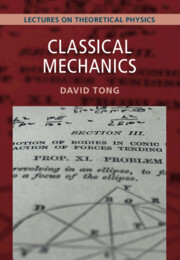
Classical Mechanics
- Lectures on Theoretical Physics
-
- Published online:
- 26 June 2025
- Print publication:
- 19 June 2025
-
- Textbook
- Export citation

Fluid Mechanics
- Lectures on Theoretical Physics
-
- Published online:
- 26 June 2025
- Print publication:
- 19 June 2025
-
- Textbook
- Export citation
Index
-
- Book:
- Quantum Information
- Published online:
- 17 October 2025
- Print publication:
- 26 June 2025, pp 298-302
-
- Chapter
- Export citation
Solutions to Select Exercises
-
- Book:
- Quantum Information
- Published online:
- 17 October 2025
- Print publication:
- 26 June 2025, pp 237-273
-
- Chapter
- Export citation
-
Summary
(since
Appendix A - Derivatives and Differential Equations
-
- Book:
- Quantum Information
- Published online:
- 17 October 2025
- Print publication:
- 26 June 2025, pp 274-275
-
- Chapter
- Export citation
Appendix D - Haar-Distributed Random Unitary Matrices
-
- Book:
- Quantum Information
- Published online:
- 17 October 2025
- Print publication:
- 26 June 2025, pp 281-281
-
- Chapter
- Export citation
7 - Realizations of Qubits: Examples
-
- Book:
- Quantum Information
- Published online:
- 17 October 2025
- Print publication:
- 26 June 2025, pp 139-164
-
- Chapter
- Export citation
Appendix C - Probabilities and Probability Distributions
-
- Book:
- Quantum Information
- Published online:
- 17 October 2025
- Print publication:
- 26 June 2025, pp 279-280
-
- Chapter
- Export citation
Discovery of odd radio circles and other peculiars in the first year of the EMU survey using object detection
-
- Journal:
- Publications of the Astronomical Society of Australia / Volume 42 / 2025
- Published online by Cambridge University Press:
- 26 June 2025, e097
-
- Article
-
- You have access
- Open access
- HTML
- Export citation
8 - The Physics of Two-Qubit Gates
-
- Book:
- Quantum Information
- Published online:
- 17 October 2025
- Print publication:
- 26 June 2025, pp 165-176
-
- Chapter
- Export citation
2 - Quantum Mechanics for Quantum Computers
-
- Book:
- Quantum Information
- Published online:
- 17 October 2025
- Print publication:
- 26 June 2025, pp 18-50
-
- Chapter
- Export citation
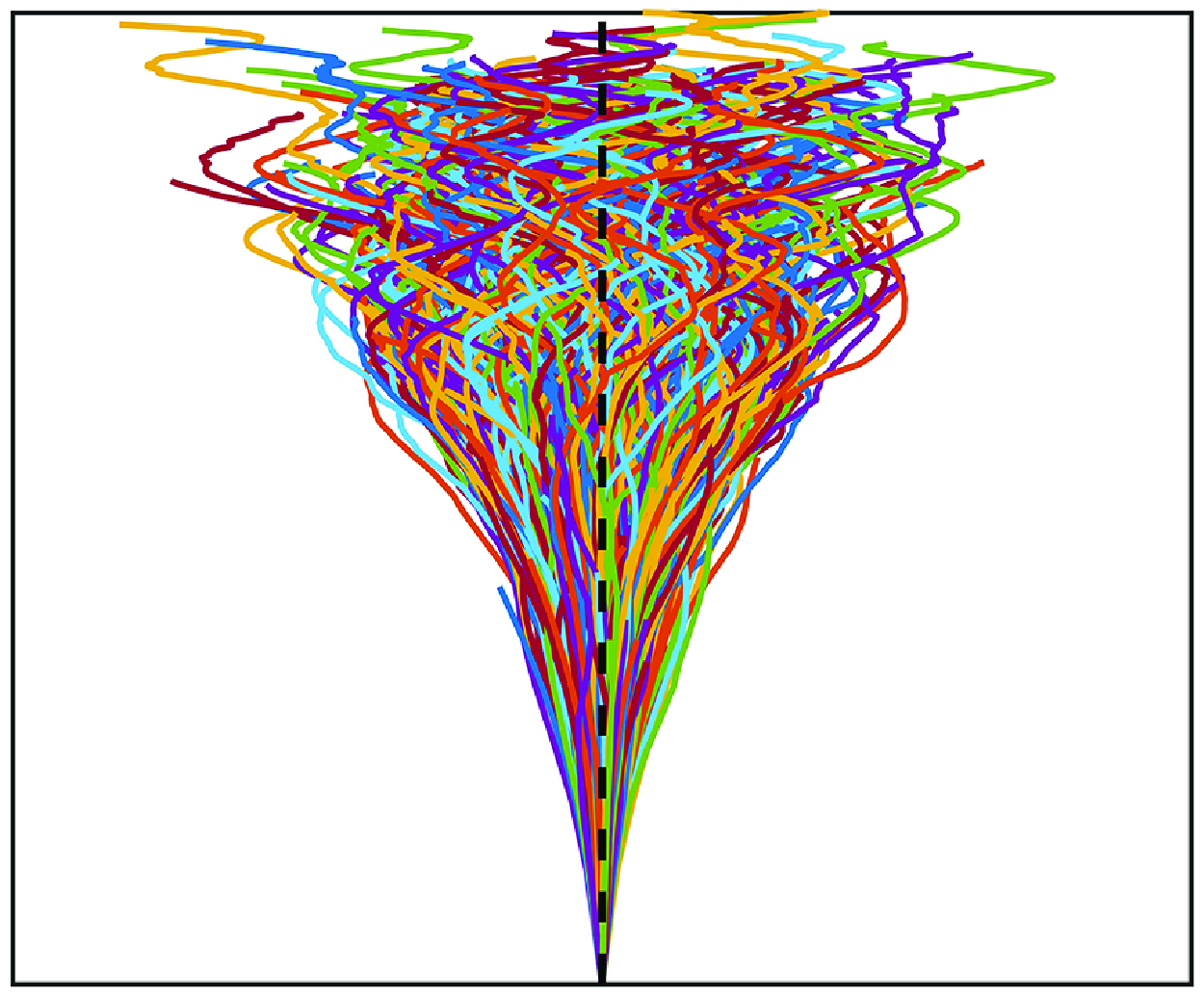
Taylor dispersion of bubble swarms rising in quiescent liquid
-
- Journal:
- Journal of Fluid Mechanics / Volume 1014 / 10 July 2025
- Published online by Cambridge University Press:
- 26 June 2025, R1
-
- Article
-
- You have access
- Open access
- HTML
- Export citation
-
We study the dispersion of bubble swarms rising in initially quiescent water using three-dimensional Lagrangian tracking of deformable bubbles and tracer particles in an octagonal bubble column. Two different bubble sizes (3.5 mm and 4.4 mm) and moderate gas volume fractions ( $0.52\,\%{-}1.20\,\%$) are considered. First, we compare the dispersion inside bubble swarms with that for single-bubble cases, and find that the horizontal mean squared displacement (MSD) in the swarm cases exhibits oscillations around the asymptotic scaling predicted for a diffusive regime. This occurs due to wake-induced bubble motion; however, the oscillatory behaviour is heavily damped compared to the single-bubble cases due to the presence of bubble-induced turbulence (BIT) and bubble–bubble interactions in the swarm. The vertical MSD in bubble swarms is nearly an order of magnitude faster than in the single-bubble cases, due to the much higher vertical fluctuating bubble velocities in the swarms. We also investigate tracer dispersion in BIT, and find that concerning the time to transition away from the ballistic regime, larger bubbles with a higher gas void fraction transition earlier than tracers, consistent with Mathai et al. (2018, Phys. Rev. Lett., vol. 121, 054501). However, for bubble swarms with smaller bubbles and a lower gas void fraction, they transition at the same time. This differing behaviour is due to the turbulence being more well-mixed for the larger bubble case, whereas for the smaller bubble case, the tracer dispersion is highly dependent on the wake fluctuations generated by the oscillating motion of nearby bubbles.
4 - Quantum Algorithms
-
- Book:
- Quantum Information
- Published online:
- 17 October 2025
- Print publication:
- 26 June 2025, pp 78-100
-
- Chapter
- Export citation
Appendix B - Singular Value Decomposition
-
- Book:
- Quantum Information
- Published online:
- 17 October 2025
- Print publication:
- 26 June 2025, pp 276-278
-
- Chapter
- Export citation
Suggestions for Further Reading
-
- Book:
- Quantum Information
- Published online:
- 17 October 2025
- Print publication:
- 26 June 2025, pp 293-297
-
- Chapter
- Export citation
3 - Two Qubits and Entanglement
-
- Book:
- Quantum Information
- Published online:
- 17 October 2025
- Print publication:
- 26 June 2025, pp 51-77
-
- Chapter
- Export citation
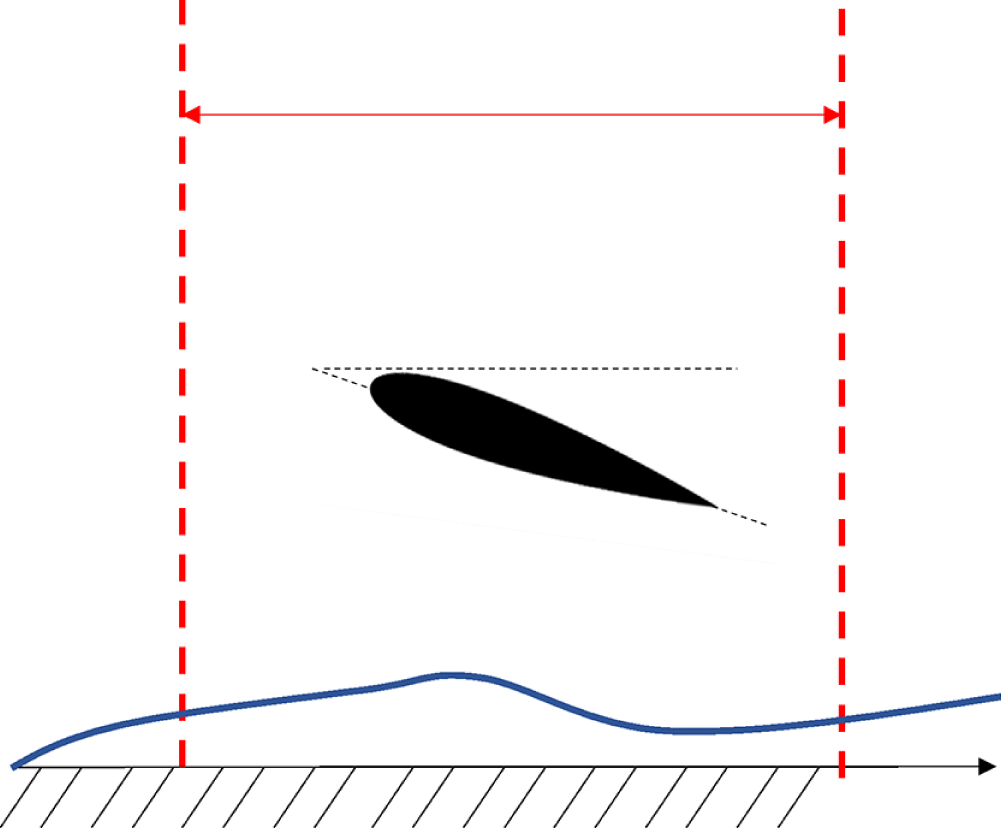
Pressure gradient history effects on integral quantities of turbulent boundary layers: experiments and data-driven models
-
- Journal:
- Journal of Fluid Mechanics / Volume 1014 / 10 July 2025
- Published online by Cambridge University Press:
- 26 June 2025, A2
-
- Article
-
- You have access
- Open access
- HTML
- Export citation
-
Experiments are carried out in a smooth-wall turbulent boundary layer (TBL) ( $\textit{Re}_\tau \geq 3500$) subjected to different pressure gradient (PG) histories. Oil-film interferometry is used to measure the skin friction evolution over the entire history while wide-field particle image velocimetry captures the mean flow field. This data are used to demonstrate the influence of PG history on skin friction as well as other integral quantities such as displacement ( $\delta ^*$) and momentum thickness ( $\theta$). Based on observations from the data, a new set of ordinary differential equations are proposed to model the streamwise evolution of a TBL subjected to different PG histories. The model is calibrated using a limited number of experimental cases and its utility is demonstrated on other cases. Moreover, the model is applied to data from large-eddy simulations of flows in adverse PG conditions (Bobke et al. 2017, J. Fluid Mech. 820, 667–692). The model is subsequently used to identify the impact of PG history length on the boundary layer. This can also be interpreted as determining the spatial frequency response of the boundary layer to PG disturbances. Results suggest that short spatial variations in PGs primarily affect a small portion of the TBL evolution, whereas longer-lasting ones have a more extensive impact.


9 - Device Characterization
-
- Book:
- Quantum Information
- Published online:
- 17 October 2025
- Print publication:
- 26 June 2025, pp 177-192
-
- Chapter
- Export citation
6 - Realizations of Qubits: General Discussion
-
- Book:
- Quantum Information
- Published online:
- 17 October 2025
- Print publication:
- 26 June 2025, pp 124-138
-
- Chapter
- Export citation
