Refine search
Actions for selected content:
237283 results in Physics and Astronomy
T - Bridge Model: Mean-field and Simulations
-
- Book:
- Nonequilibrium Statistical Physics
- Published online:
- 19 June 2025
- Print publication:
- 03 July 2025, pp 489-493
-
- Chapter
- Export citation
A - Binary Elastic Collisions in the Hard Sphere Gas
-
- Book:
- Nonequilibrium Statistical Physics
- Published online:
- 19 June 2025
- Print publication:
- 03 July 2025, pp 410-413
-
- Chapter
- Export citation

Turbulence suppression in plane Couette flow using reduced-order models
-
- Journal:
- Journal of Fluid Mechanics / Volume 1014 / 10 July 2025
- Published online by Cambridge University Press:
- 03 July 2025, A18
-
- Article
- Export citation
-
We explore a reduced-order model (ROM) of plane Couette flow with a view to performing near-wall turbulence control. The ROM is derived through Galerkin projections of the incompressible Navier–Stokes system onto a basis of controllability modes. Such ROMs were found to reproduce key aspects of turbulence dynamics in Couette flow with only a few hundred degrees of freedom, and here we use them to devise a control strategy. We consider a ROM with an extra forcing term whose structure is given by a combination of eigenfunctions of a linear viscous diffusion equation, optimised in order to minimise the total fluctuation energy. The optimisation is performed at Reynolds numbers $Re=1000, 2000, 3000$, and produces a novel control mechanism wherein the optimal forcing leads the flow to laminarisation in all cases. The forcing acts by reducing the shear in a large portion of the channel, hindering the main energy input mechanism. The forced flow possesses a new laminar solution which is linearly stable at $Re=1000$ and unstable at higher $Re$, but whose transient growth of streaky structures is substantially lower than that of laminar Couette flow, leading the flow to full laminarisation when the forcing is removed. Forcings optimised in the ROM are subsequently applied in direct numerical simulations (DNS). The same control mechanisms are observed in the DNS, where laminarisation is also achieved. We show that the ROMs provide an effective framework to design turbulence control strategies, despite the high degree of truncation, which opens up interesting possibilities for turbulence control.


Turbulent flow over random sphere packs – kinetic energy budgets
-
- Journal:
- Journal of Fluid Mechanics / Volume 1014 / 10 July 2025
- Published online by Cambridge University Press:
- 03 July 2025, A17
-
- Article
-
- You have access
- Open access
- HTML
- Export citation
-
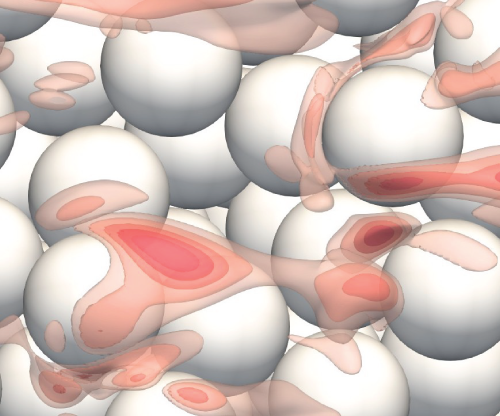
Based on data from pore-resolved direct numerical simulation of turbulent flow over mono-disperse random sphere packs, we evaluate the budgets of the double-averaged turbulent kinetic energy (TKE) and the wake kinetic energy (WKE). While TKE results from temporal velocity fluctuations, WKE describes the kinetic energy in spatial variations of the time-averaged flow field. We analyse eight cases which represent sampling points within a parameter space spanned by friction Reynolds numbers $Re_\tau \in [150, 500]$ and permeability Reynolds numbers $Re_K \in [0.4, 2.8]$. A systematic exploration of the parameter space is possible by varying the ratio between flow depth and sphere diameter $h/D \in \{ 3, 5, 10 \}$. With roughness Reynolds numbers of $k_s^+ \in [20,200]$, the simulated cases lie within the transitionally or fully rough regime. Revisiting the budget equations, we identify a WKE production mechanism via viscous interaction of the flow field with solid surfaces. The scaling behaviour of different processes over $Re_K$ and $Re_\tau$ suggests that this previously unexplored mechanism has a non-negligible contribution to the WKE production. With increasing $Re_K$, progressively more WKE is transferred into TKE by wake production. A near-interface peak in the TKE production, however, primarily results from shear production and scales with interface-related scales. Conversely, further above the sediment bed, the TKE budget terms of cases with comparable $Re_\tau$ show similarity under outer-scaling. Most transport processes relocate energy in the near-interface region, whereas pressure diffusion propagates TKE and WKE into deeper regions of the sphere pack.


M - The Diffusion Equation and the Random Walk
-
- Book:
- Nonequilibrium Statistical Physics
- Published online:
- 19 June 2025
- Print publication:
- 03 July 2025, pp 452-459
-
- Chapter
- Export citation
L - Probability Distributions
-
- Book:
- Nonequilibrium Statistical Physics
- Published online:
- 19 June 2025
- Print publication:
- 03 July 2025, pp 450-451
-
- Chapter
- Export citation
E - First-order Approximation to Hydrodynamics
-
- Book:
- Nonequilibrium Statistical Physics
- Published online:
- 19 June 2025
- Print publication:
- 03 July 2025, pp 424-426
-
- Chapter
- Export citation
9 - Highlights on Pattern Formation
-
- Book:
- Nonequilibrium Statistical Physics
- Published online:
- 19 June 2025
- Print publication:
- 03 July 2025, pp 370-409
-
- Chapter
- Export citation
Acknowledgments
-
- Book:
- Nonequilibrium Statistical Physics
- Published online:
- 19 June 2025
- Print publication:
- 03 July 2025, pp xv-xv
-
- Chapter
- Export citation
P - The Van der Waals Equation
-
- Book:
- Nonequilibrium Statistical Physics
- Published online:
- 19 June 2025
- Print publication:
- 03 July 2025, pp 473-476
-
- Chapter
- Export citation
8 - Phase-Ordering Kinetics
-
- Book:
- Nonequilibrium Statistical Physics
- Published online:
- 19 June 2025
- Print publication:
- 03 July 2025, pp 319-369
-
- Chapter
- Export citation
X - General Conditions for the Turing Instability
-
- Book:
- Nonequilibrium Statistical Physics
- Published online:
- 19 June 2025
- Print publication:
- 03 July 2025, pp 504-505
-
- Chapter
- Export citation
Contents
-
- Book:
- Nonequilibrium Statistical Physics
- Published online:
- 19 June 2025
- Print publication:
- 03 July 2025, pp vii-xii
-
- Chapter
- Export citation
Index
-
- Book:
- Nonequilibrium Statistical Physics
- Published online:
- 19 June 2025
- Print publication:
- 03 July 2025, pp 510-512
-
- Chapter
- Export citation
Abbreviations
-
- Book:
- Nonequilibrium Statistical Physics
- Published online:
- 19 June 2025
- Print publication:
- 03 July 2025, pp xvii-xviii
-
- Chapter
- Export citation
Momentum and energy dynamics across scales in the flow over a rough bed with an array of boulders
-
- Journal:
- Journal of Fluid Mechanics / Volume 1014 / 10 July 2025
- Published online by Cambridge University Press:
- 03 July 2025, A21
-
- Article
-
- You have access
- Open access
- HTML
- Export citation
-
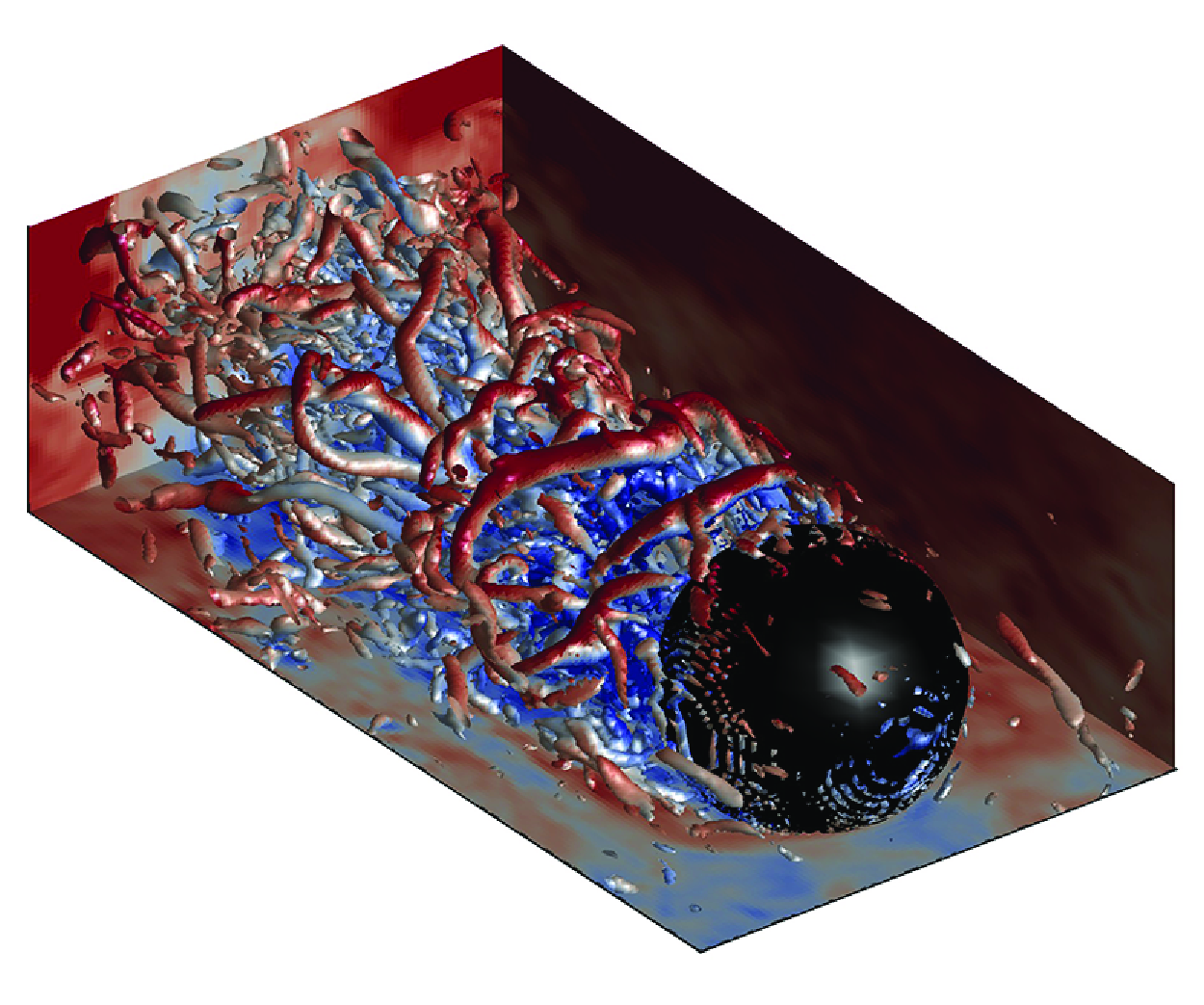
Turbulent flows over rough beds with macroroughness elements of low relative submergence are characteristic of natural river systems. These flows exhibit highly three-dimensional structures, including large-scale coherent patterns, complex nonlinear interactions and significant drag induced by immobile boulders. In this study, large-eddy simulations are conducted of the flow through an array of boulders on a rough bed, based on experiments by Papanicolaou et al. (2012) Acta Geophys. 60 (6), 1502–1546. The analysis includes the instantaneous flow dynamics, the parameterisation of hydrodynamic roughness on the averaged velocity profile and the application of the double-averaged methodology. These upscaling approaches reveal the combined influence of wake turbulence and secondary currents (SCs), and provide insights into momentum and energy conservation mechanisms, which are critical for transport processes in fluvial environments. Results indicate that the boulder array reduces total fluid stress at the rough bed surface to $0.5 \rho u_*^2$, which can have important implications for sediment transport. Form-induced stresses, primarily originating in the boulder wakes, reach up to 37 % of total fluid stress, with peak values comparable to turbulent stresses at mid-boulder elevation. Form-induced kinetic energy (DKE) is shown to have the same magnitude as the turbulent kinetic energy (TKE), highlighting energy transfers from mean flow drag to DKE, then to TKE, before final dissipation. This study underscores the critical role of macroroughness in stress distribution, and the importance of the joint action of SCs and wake turbulence in driving form-induced stresses, which partially counterbalance drag dissipation.


Women in the History of Quantum Physics
- Beyond Knabenphysik
-
- Published online:
- 02 July 2025
- Print publication:
- 19 June 2025
Discovery of Main-sequence Radio Pulse emitters from widefield sky surveys
-
- Journal:
- Publications of the Astronomical Society of Australia / Volume 42 / 2025
- Published online by Cambridge University Press:
- 01 July 2025, e110
-
- Article
-
- You have access
- Open access
- HTML
- Export citation
-
Magnetic AB stars are known to produce periodic radio pulses by the electron cyclotron maser emission (ECME) mechanism. Only 19 such stars, known as ‘Main-sequence Radio Pulse emitters’ (MRPs), are currently known. The majority of MRPs have been discovered through targeted observation campaigns that involve carefully selecting a sample of stars that are likely to produce ECME and which can be detected by a given telescope within reasonable amount of time. These selection criteria inadvertently introduce bias in the resulting sample of MRPs, which affects subsequent investigation of the relation between ECME properties and stellar magnetospheric parameters. The alternative is to use all-sky surveys. Until now, MRP candidates obtained from surveys were identified based on their high circular polarisation ( $\gtrsim 30\%$). In this paper, we introduce a complementary strategy, which does not require polarisation information. Using multi-epoch data from the Australian SKA Pathfinder (ASKAP) telescope, we identify four MRP candidates based on the variability in the total intensity light curves. Follow-up observations with the Australia Telescope Compact Array (ATCA) confirm three of them to be MRPs, thereby demonstrating the effectiveness of our strategy. With the expanded sample, we find that ECME is affected by temperature and the magnetic field strength, consistent with past results. There is, however, a degeneracy regarding how the two parameters govern the ECME luminosity for magnetic A and late-B stars (effective temperature $\lesssim 16$ kK). The current sample is also inadequate to investigate the role of stellar rotation, which has been shown to play a key role in driving incoherent radio emission.


GalProTE: Galactic properties mapping using transformer encoder
-
- Journal:
- Publications of the Astronomical Society of Australia / Volume 42 / 2025
- Published online by Cambridge University Press:
- 01 July 2025, e102
-
- Article
-
- You have access
- Open access
- HTML
- Export citation
EMUSE: Evolutionary Map of the Universe Search Engine
-
- Journal:
- Publications of the Astronomical Society of Australia / Volume 42 / 2025
- Published online by Cambridge University Press:
- 01 July 2025, e099
-
- Article
-
- You have access
- Open access
- HTML
- Export citation
