Refine search
Actions for selected content:
237222 results in Physics and Astronomy
Statistical treatment of dilute suspensions of electrified particles
-
- Journal:
- Journal of Fluid Mechanics / Volume 1014 / 10 July 2025
- Published online by Cambridge University Press:
- 08 July 2025, A38
-
- Article
-
- You have access
- Open access
- HTML
- Export citation
-
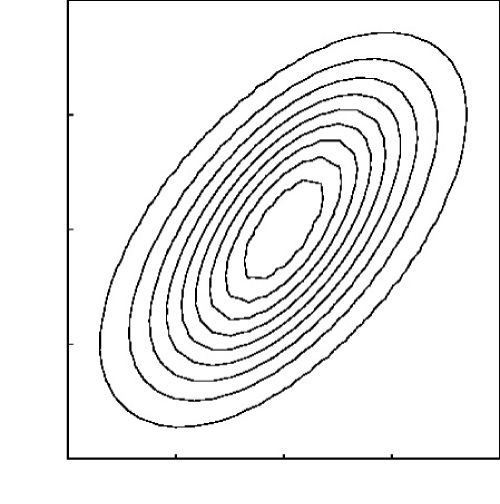
An analysis is presented of the suspensions of small, electrified particles in a gas. Two limits of interest for the electrodynamic particulate suspension technique are considered, corresponding to large and small values of the ratio $t_{coll}/t_s$ of the mean time between particle collisions to the viscous adaptation time required for the particles to reach their terminal velocities. The effect of the particle inertia can be neglected when this ratio is large, and only the distribution of particle charges at each point of the suspension needs to be computed. The way this distribution approaches an equilibrium form, determined elsewhere in the continuum regime when the mean free path of the particles is small compared with the suspension size, is described, as well as the connection between continuum regime and quasi-neutrality of the suspension. In the opposite case when $t_{coll}/t_s$ is small, the inertia of the particles plays an important role, and the joint distribution of particle charges and velocities is required. A Boltzmann equation is proposed for this distribution function, taking advantage of the fact that the charges of the particles have little effect on the redistribution of momentum and energy in the collisions. The equilibrium distribution function in the continuum regime is computed approximately, and hydrodynamic equations for the particle phase analogous to the Euler equations for a monoatomic gas are derived. The simplification of these equations when the particle inertia is negligible at the scale of the suspension is worked out.


Pulse-length dependence of the laser-induced damage behavior of a fused-silica antireflective metasurface
-
- Journal:
- High Power Laser Science and Engineering / Volume 13 / 2025
- Published online by Cambridge University Press:
- 07 July 2025, e64
-
- Article
-
- You have access
- Open access
- HTML
- Export citation
VLBA astrometry of PSRs B0329+54 and B1133+16: Improved pulsar distances and comparison of global ionospheric models
-
- Journal:
- Publications of the Astronomical Society of Australia / Volume 42 / 2025
- Published online by Cambridge University Press:
- 07 July 2025, e098
-
- Article
-
- You have access
- Open access
- HTML
- Export citation
-
Very long baseline interferometry (VLBI) astrometry is used to determine the three-dimensional position and proper motion of astronomical objects. A typical VLBI astrometric campaign generally includes around ten observations, making it challenging to characterise systematic uncertainties. Our study on two bright pulsars, B0329+54 and B1133+16, involves analysis of broadband Very Long Baseline Array (VLBA) data over $\sim30$ epochs (spanning approximately 3.5 yr). This extended dataset has significantly improved the precision of the astrometric estimates of these pulsars. Our broadband study suggests that, as expected, the primary contribution to systematic uncertainties in L-band VLBI astrometry originates from the ionosphere. We have also assessed the effectiveness of the modified total electron content (TEC) mapping function, which converts vertical TEC to slant TEC, in correcting ionospheric dispersive delays using global TEC maps. The astrometric parameters (parallax and proper motion) obtained from the multiple datasets, calibrated using the traditional and the modified TEC mapping functions, are consistent. However, the reduced chi-square values from least-squares fitting and precision of the fitted astrometric parameters show no significant improvement, and hence, the effectiveness of the new TEC mapping function on astrometry is unclear. For B0329+54, the refined parallax estimate is $0.611^{+0.013}_{-0.013}$ mas, with best-fit proper motion of $\mu_{\alpha} = 16.960^{+0.011}_{-0.010}\, \textrm{mas}\,{\rm yr}^{-1}$ in R.A. and and $\mu_{\delta} = -10.382^{+0.022}_{-0.022}\,\textrm{mas}\,{\rm yr}^{-1}$ in Dec. These correspond to a distance of $1.64^{+0.03}_{-0.03}$ kpc and a transverse velocity of $\sim 154\, \textrm{km}\,{\rm s}^{-1}$. For B1133+16, the new estimated parallax is $2.705^{+0.009}_{-0.009}$ mas, with proper motions of $\mu_{\alpha} = -73.777^{+0.008}_{-0.008}\, \textrm{mas}\,{\rm yr}^{-1}$ and $\mu_{\delta} = 366.573^{+0.019}_{-0.019}\, \textrm{mas}\,{\rm yr}^{-1}$, implying a distance of $370^{+1}_{-1}$ pc and a transverse velocity of $\sim 656\, \textrm{km}\,{\rm s}^{-1}$. The proper motions of B0329+54 and B1133+16 are consistent within $1\sigma$ of the most precise values reported in the literature to date while achieving more than a twofold improvement in precision. Similarly, the parallax measurements for both pulsars show a $\sim 73\%$ enhancement in precision, with differences of approximately $\lt 1\sigma$ compared to the most precise published values to date.


Delay of swept-wing transition using a surface hump
-
- Journal:
- Journal of Fluid Mechanics / Volume 1014 / 10 July 2025
- Published online by Cambridge University Press:
- 07 July 2025, A35
-
- Article
-
- You have access
- Open access
- HTML
- Export citation
Hydrodynamically beneficial school configurations in carangiform swimmers: insights from a flow-physics informed model
-
- Journal:
- Journal of Fluid Mechanics / Volume 1014 / 10 July 2025
- Published online by Cambridge University Press:
- 07 July 2025, A32
-
- Article
-
- You have access
- Open access
- HTML
- Export citation

Flow in an electrically conducting drop due to an oscillating magnetic field
-
- Journal:
- Journal of Fluid Mechanics / Volume 1014 / 10 July 2025
- Published online by Cambridge University Press:
- 07 July 2025, A36
-
- Article
-
- You have access
- Open access
- HTML
- Export citation
-
A drop of an electrically conducting non-magnetic fluid of radius $R$, electrical conductivity $\kappa$, density $\rho _i$ and viscosity $\eta _i$ is suspended in a non-conducting medium of density $\rho _o$, viscosity $\eta _o$ and subject to an oscillating magnetic field of magnitude $H_0$ and angular frequency $\omega$. Oscillating eddy currents are induced in the drop due to Faraday’s law. The Lorentz force density, the cross product of the current density and the magnetic field, is the superposition of a steady component and an oscillating component with frequency $2 \omega$. The characteristic velocity due to the Lorentz force density is $(\mu _0 H_0^2 R/\eta _i)$ times a function of the dimensionless parameter $\beta = \sqrt {\mu _0 \kappa \omega R^2}$, the square root of the ratio of the frequency and the current relaxation rate. Here, $\mu _0$ is the magnetic permeability. The characteristic velocities for the steady and oscillatory components increase proportional to $\beta ^{4}$ for $\beta \ll 1$, and decrease proportional to $\beta ^{-1}$ for $\beta \gg 1$. The steady flow field consists of two axisymmetric eddies in the two hemispheres with flow outwards along the magnetic field axis and inwards along the equator. The flow in the drop induces a biaxial extensional flow in the surrounding medium, with compression along the magnetic axis and extension along the equatorial plane. The oscillating component of the velocity depends on $\beta$ and the Reynolds number ${Re}_\omega$ based on the frequency of oscillations. For ${Re}_\omega \gg 1$, the amplitude of the oscillatory velocity decreases proportional to ${Re}_\omega ^{-1}$ for $\beta \ll 1$, and proportional to ${Re}_\omega ^{-1/2}$ for $\beta \gg 1$.


Quantum implicit representation of vortex filaments in turbulence
-
- Journal:
- Journal of Fluid Mechanics / Volume 1014 / 10 July 2025
- Published online by Cambridge University Press:
- 07 July 2025, A31
-
- Article
- Export citation
Direct numerical simulations of turbulent Rayleigh–Bénard convection with polymer additives
-
- Journal:
- Journal of Fluid Mechanics / Volume 1014 / 10 July 2025
- Published online by Cambridge University Press:
- 07 July 2025, A22
-
- Article
-
- You have access
- Open access
- HTML
- Export citation
-
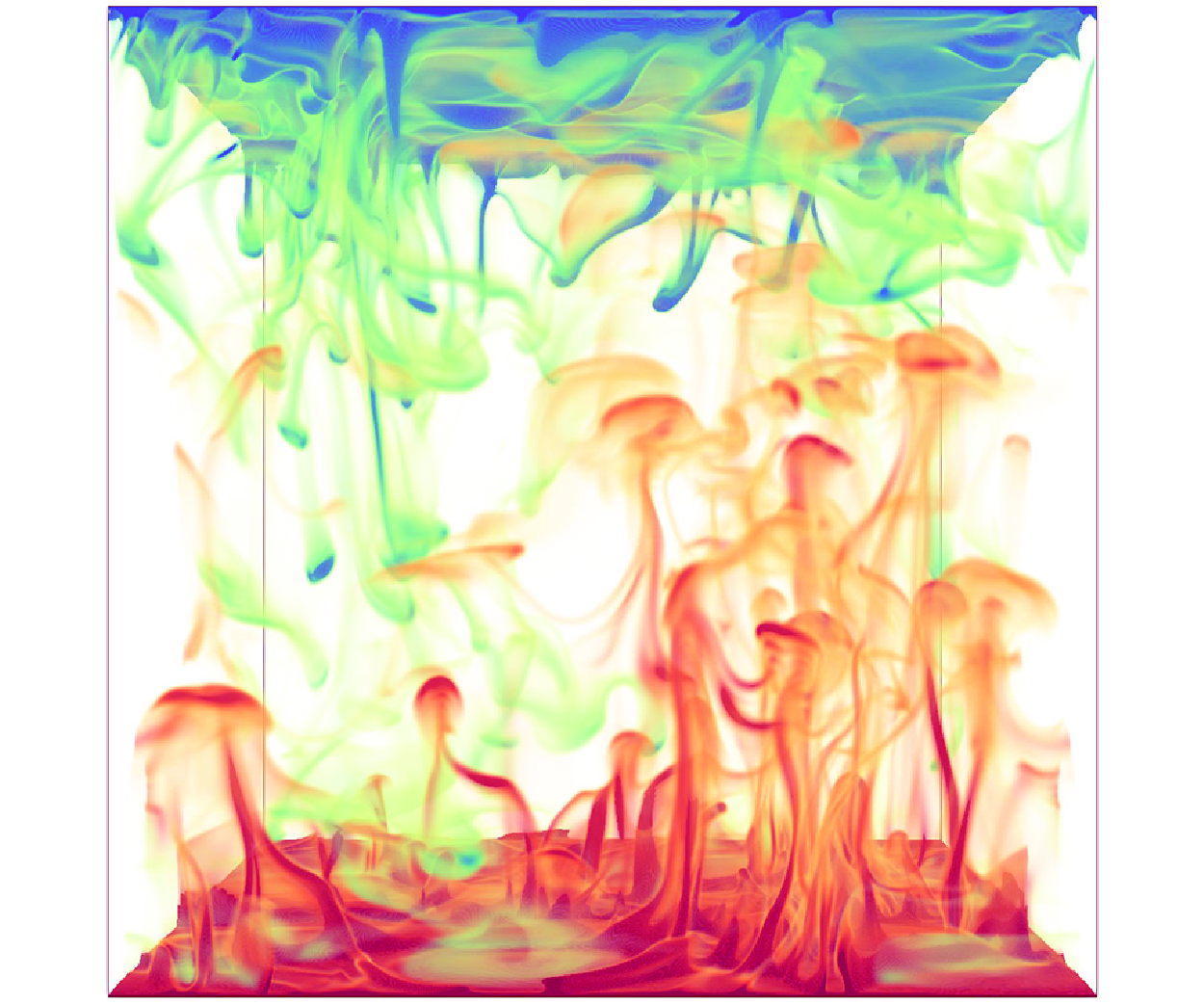
We present results of three-dimensional direct numerical simulations of turbulent Rayleigh–Bénard convection of dilute polymeric solutions for Rayleigh number ( $Ra$) ranging from $10^6$ to $ 10^{10}$, and Prandtl number $Pr=4.3$. The viscoelastic flow is simulated by solving the incompressible Navier–Stokes equations under the Boussinesq approximation coupled with the finitely extensible nonlinear elastic Peterlin constitutive model. The Weissenberg number ( $Wi$) is either $Wi=5$ or $Wi=10$, with the maximum chain extensibility parameter $L=50$, corresponding to moderate fluid elasticity. Our results demonstrate that both heat transport and momentum transport are reduced by the presence of polymer additives in the studied parameter range. Remarkably, the specific parameters used in the current numerical study give similar heat transfer reduction values as observed in experiments. We demonstrate that polymers have different effects in different regions of the flow. The presence of polymers stabilises the boundary layer, which is found to be the primary cause of the overall heat transfer reduction. In the bulk region, the presence of polymers slows down the flow by increasing the effective viscosity, enhances the coherency of thermal plumes, and suppresses the small-scale turbulent fluctuations. For small $Ra$, the heat transfer reduction in the bulk region is associated with plume velocity reduction, while for larger $Ra$, it is caused by the competing effects of suppressed turbulent fluctuations and enhanced plume coherency.



Optimal rigid brush for fluid capture
-
- Journal:
- Journal of Fluid Mechanics / Volume 1014 / 10 July 2025
- Published online by Cambridge University Press:
- 07 July 2025, A29
-
- Article
- Export citation

Elliptic liquid jets in a supersonic cross-flow
-
- Journal:
- Journal of Fluid Mechanics / Volume 1014 / 10 July 2025
- Published online by Cambridge University Press:
- 07 July 2025, A34
-
- Article
- Export citation
-
In the present work, we experimentally investigate the transverse injection of elliptic liquid jets into a supersonic cross-flow ( $M_\infty$ = 2.5). The primary focus is to understand the effect of injection orifice aspect ratio ( $\textit{AR}$ = spanwise/streamwise dimension), on the liquid jet breakup mechanism, the flow field around the liquid jet and the resulting droplet sizes formed downstream, for three $\textit{AR}$ cases ( $\textit{AR}$ = 0.3, 1, 3.3). We find that the $\textit{AR}$ = 0.3 case has large unsteadiness in the spray core due to relatively large wavelength Rayleigh–Taylor (RT) waves formed on the liquid jet surface. However, the primary jet breakup occurs through Kelvin–Helmholtz (KH) instabilities formed on the large lateral surfaces, as in coaxial liquid jet breakup. This leads to a higher Sauter mean diameter (SMD) of the droplets in the spray core with a wider range of droplet sizes compared with the circular case ( $\textit{AR}$ = 1.0). However, in the case of $\textit{AR}$ = 3.3, the RT waves are more intense and of smaller wavelength due to the large drag on the liquid jet, which results in a direct catastrophic breakup of the liquid jet by the RT waves. This results in a relatively steady liquid jet and shock structure with the formation of a fine spray and smaller droplets in the spray core than for the $\textit{AR}=1.0$ case. The study shows the importance of the orifice $\textit{AR}$ on the flow around, and the spray downstream of, the liquid jet injection into supersonic cross-flow.


Direct numerical simulation of particle clustering and turbulence modulation: an Eulerian approach
-
- Journal:
- Journal of Fluid Mechanics / Volume 1014 / 10 July 2025
- Published online by Cambridge University Press:
- 07 July 2025, A37
-
- Article
-
- You have access
- Open access
- HTML
- Export citation
Drawing of weakly viscoelastic fluid tubes
-
- Journal:
- Journal of Fluid Mechanics / Volume 1014 / 10 July 2025
- Published online by Cambridge University Press:
- 07 July 2025, A27
-
- Article
-
- You have access
- Open access
- HTML
- Export citation

Strong Field Physics
- Ultra-Intense Light Interaction with Matter
-
- Published online:
- 05 July 2025
- Print publication:
- 05 June 2025
Experimental investigation of inertial spheres settling in surface gravity waves
-
- Journal:
- Journal of Fluid Mechanics / Volume 1014 / 10 July 2025
- Published online by Cambridge University Press:
- 04 July 2025, A33
-
- Article
-
- You have access
- Open access
- HTML
- Export citation
FLM volume 1013 Cover and Front matter
-
- Journal:
- Journal of Fluid Mechanics / Volume 1013 / 25 June 2025
- Published online by Cambridge University Press:
- 04 July 2025, p. f1
-
- Article
-
- You have access
- Export citation
Angular splitting and selective acceleration in NiO plasmas generated by laser ablation
-
- Journal:
- Journal of Plasma Physics / Volume 91 / Issue 4 / August 2025
- Published online by Cambridge University Press:
- 04 July 2025, E92
-
- Article
-
- You have access
- Open access
- HTML
- Export citation
Two- and three-dimensional wake transitions of a circular cylinder with a rear-attached splitter plate
-
- Journal:
- Journal of Fluid Mechanics / Volume 1014 / 10 July 2025
- Published online by Cambridge University Press:
- 04 July 2025, A28
-
- Article
-
- You have access
- Open access
- HTML
- Export citation
Axisymmetric dynamos sustained by a modified Ohm’s law in a toroidal volume
-
- Journal:
- Journal of Plasma Physics / Volume 91 / Issue 4 / August 2025
- Published online by Cambridge University Press:
- 04 July 2025, E91
-
- Article
-
- You have access
- Open access
- HTML
- Export citation
Small-scale shear layers in isotropic turbulence of viscoelastic fluids – ERRATUM
-
- Journal:
- Journal of Fluid Mechanics / Volume 1014 / 10 July 2025
- Published online by Cambridge University Press:
- 04 July 2025, E1
-
- Article
-
- You have access
- HTML
- Export citation
Measurement and analysis of sub-convective wall pressure fluctuations in turbulent boundary layer flows
-
- Journal:
- Journal of Fluid Mechanics / Volume 1014 / 10 July 2025
- Published online by Cambridge University Press:
- 03 July 2025, A26
-
- Article
-
- You have access
- Open access
- HTML
- Export citation
-
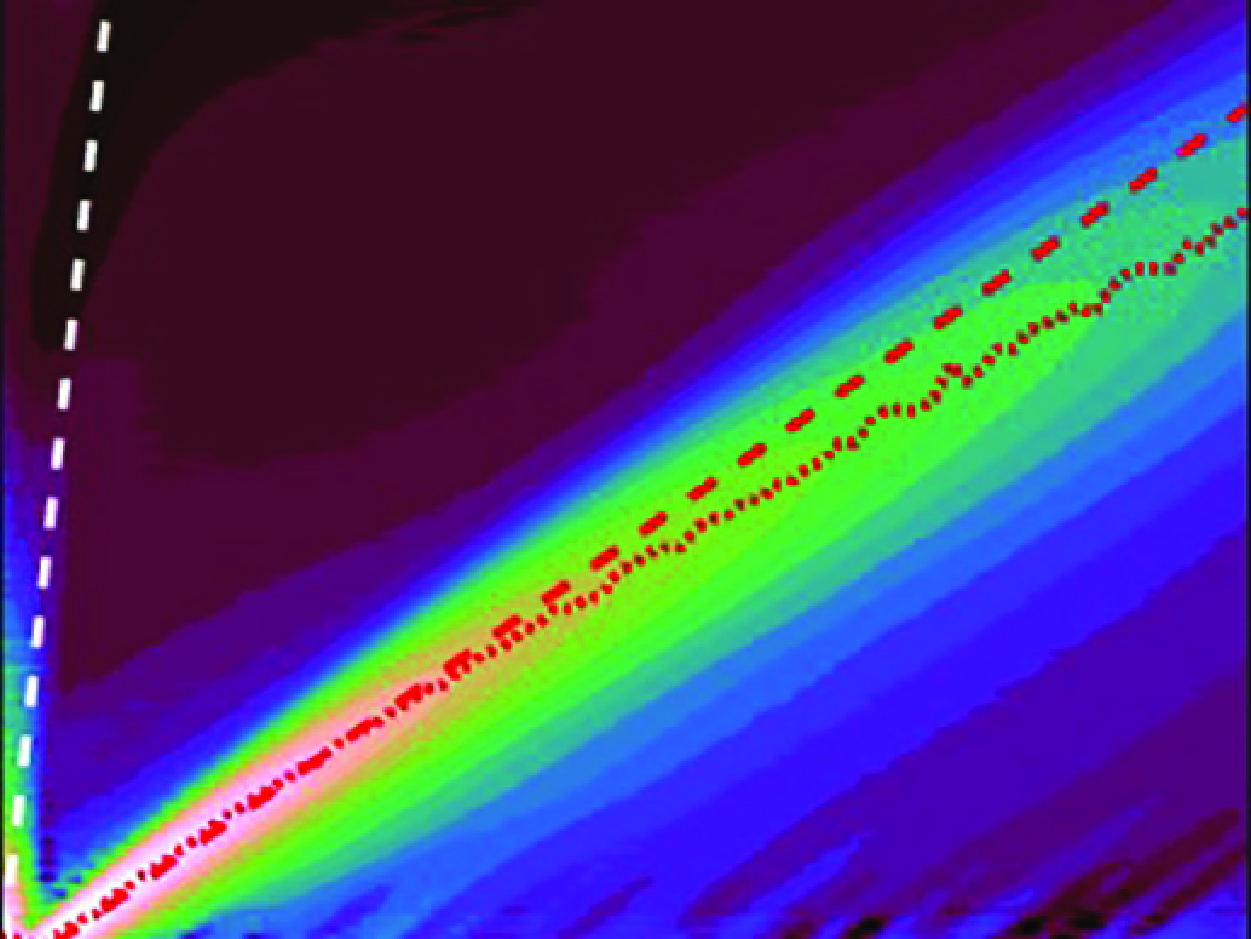
Sub-convective wall pressure fluctuations play a critical role in vibroacoustic and noise analyses of vehicle structures as they serve as the primary forcing function. However, measuring these fluctuations is challenging due to their weak pressure magnitudes, typically $10^{-3}{-}10^{-5}$ of convective fluctuations. This study introduces a non-intrusive measurement technique using an array of multi-pore Helmholtz resonator sensors to capture sub-convective fluctuations with high resolution. The array features large-area, spanwise-oriented sensors arranged linearly for optimal sampling. Results provide a continuous streamwise wavenumber–frequency spectrum, resolving sub-convective fluctuations with sufficient range and accuracy. Convergence analysis indicates that long sampling durations, $\mathcal{O}(10^6 \delta ^*/U_\infty )$, $\delta^*$ is the displacement thickness of the boundary layer. $U_\infty$ is the freestream velocity are necessary to capture true sub-convective levels. Comparisons with four existing wall pressure models, which account for sensor area averaging, reveal discrepancies in predicted levels, convection speed relations and convective ridge characteristics. Notably, the measured data align most closely with the Chase (1980, J. Sound Vib., vol.70, pp. 29–67) model at convective peak levels and in the sub-convective domain. However, the observed roll-off at wavenumbers exceeding the convective wavenumber decays more slowly than predicted, giving the convective ridge an asymmetric profile about the convective line. These findings underscore the need for improved wall pressure models that incorporate frequency-dependent convective speed relations, ridge asymmetry, and more accurate sub-convective levels. Further validation using a microphone array from Farabee & Geib (1991) confirms the accuracy of our measurements, which indicate sub-convective pressure levels lower than reported previously.


