To save content items to your account,
please confirm that you agree to abide by our usage policies.
If this is the first time you use this feature, you will be asked to authorise Cambridge Core to connect with your account.
Find out more about saving content to .
To save content items to your Kindle, first ensure no-reply@cambridge.org
is added to your Approved Personal Document E-mail List under your Personal Document Settings
on the Manage Your Content and Devices page of your Amazon account. Then enter the ‘name’ part
of your Kindle email address below.
Find out more about saving to your Kindle.
Note you can select to save to either the @free.kindle.com or @kindle.com variations.
‘@free.kindle.com’ emails are free but can only be saved to your device when it is connected to wi-fi.
‘@kindle.com’ emails can be delivered even when you are not connected to wi-fi, but note that service fees apply.
This Element introduces the study of forensic linguistics, particularly in southern Africa, but also in Africa more generally. In the past six decades, there has been clear evidence that the discipline of forensic linguistics is, or was, unknown to general linguists, legal linguists, and applied linguists on the African continent. Now, however, the situation is rapidly changing, with forensic linguistics studies gaining momentum in various parts of Africa. In this Element the authors introduce the topic, define the discipline, address the language of record issue in southern Africa, as well as critically debate the state of court interpreting and translation of documentation into African languages, address police interviewing techniques, while also looking at possible future developments in the discipline of forensic linguistics. This title is also available as Open Access on Cambridge Core.
Previous research has mainly explored the relationship between bilingual language control and domain-general cognitive control through behavioral correlations, often revealing epiphenomenal links rather than causality. This study utilizes transcranial magnetic stimulation (TMS) to investigate the causal roles of the left inferior frontal gyrus (LIFG) and left middle temporal gyrus (LMTG) in 33 unbalanced Chinese-English bilinguals. Continuous theta burst stimulation was applied in separate sessions to decrease cortical excitability, with vertex stimulation as a control. LIFG stimulation significantly increased switching costs in nonverbal switching tasks, highlighting its role in domain-general cognitive control. LMTG stimulation did not affect switching or mixing costs in language or nonverbal switching tasks, suggesting no causal involvement, but it reduced reaction times (RTs) during language switching tasks, underscoring its specialization in language processing. These findings highlight distinctions between the neural mechanisms of bilingual language control and domain-general cognitive control, particularly in the LIFG.
Despite abundant studies on motion events and mental simulation in first languages (L1s), research on how cross-linguistic dis/similarity – whether an L1 shares constructions with a second language (L2) – affects mental simulation during incremental L2 processing remains limited. This study used a novel self-paced reading task with video verification to investigate L1 influence on mental imagery of the dual (directional/locational) interpretation of locative prepositions. Participants included native English speakers and advanced L2 English learners whose L1s were either similar (Dutch) or dissimilar (Japanese) to English. Results revealed an L1 dis/similarity effect on the reaction times for the directional interpretation, but not for the locational interpretation, which was readily accessible across all L1 groups. Factors such as L2 proficiency and onset age of L2 acquisition were found to be constrained by L1, suggesting that L1–L2 constructional correspondence limits the influence of learner factors. These findings support the simulation-based model of L2 sentence processing.
This study examines the elicited production of Spanish infinitives versus gerunds among Spanish/English bilingual children and adolescents in the United States. We focus on three contexts: infinitives in subject position, infinitives with the phrasal verb parar de (“to stop doing something”), and infinitives with the prepositional verb parar a (“to stop to do something”). Results showed that children and adolescents produced fewer infinitives than their Spanish-dominant parents in subject position and with parar de, often overextending the gerund. By contrast, all groups performed more accurately with parar a, where English and Spanish align structurally. Language dominance and Spanish experience significantly predicted more target-like infinitive use, while chronological age and English dominance were associated with increased gerund overextension. These findings support the Bilingual Alignment Hypothesis, showing that heritage Spanish morphosyntactic development is gradual and context-sensitive, with greater accuracy in areas of crosslinguistic convergence.
Content and Language Integrated Learning (CLIL) is an educational approach that combines the teaching of subject content with language learning. Originally developed in Europe, CLIL has since been adopted across diverse educational and geographical contexts. This Element offers a comprehensive overview of CLIL, tracing its origins and global development. It examines the theoretical foundations of the approach, as well as key implementation strategies and their impact on language acquisition, content understanding, learner motivation, and attitudes. Special attention is given to how CLIL addresses diversity in the classroom. The text also explores innovative pedagogical practices, such as translanguaging and multimodality, that promote deeper learning and student engagement. It concludes with a discussion on assessment and teacher education within CLIL contexts and outlines the steps needed for its continued growth. This title is also available as Open Access on Cambridge Core.
Scholarship in World Englishes has been prolific over the past several decades, and today, English is accepted as the world’s ‘hypercentral’ language (de Swann 2002). Despite legitimizing varieties of English used in diverse parts of the world, however, the focus of most World Englishes scholarship has been on educated varieties of English, perpetuating the hegemony of the educated elite. Scholarship on varieties of English used by uneducated/less educated users has been neglected, even in contexts like India, where the number of less educated users of English far exceeds the educated. This paper studies the English used at the grassroots by multilingual Indians in urban India and Oman, a country with a large migrant labor population from India. This qualitative study analyses a small corpus of public and restaurant signs and WhatsApp messages produced by Indians at the grassroots levels in urban India and Oman, and focuses on categorizing the features employed to communicate (successfully). Features are categorized as orthographic, lexical, and grammatical. The study concludes with a discussion on the necessity of including English at the grassroots in World Englishes scholarship to capture the reality of the Englishes used around the world.
Previous studies revealed structural differences in cerebellar regions between monolinguals and bilinguals. However, the effect of bilingual experiences on cerebellar functional neuroplasticity remains unclear. Using resting-state functional magnetic resonance imaging (fMRI) data, we compared cerebellar functional connectivity (FC) between monolinguals and bilinguals, and then examined how age of second language acquisition (AoA-L2), immersion of L2 (Immersion-L2), proficiency level of L2 (PL-L2) and usage of L2 (Usage-L2) influence cerebellar FC in bilinguals. We found monolinguals exhibited increased FC between lobules VI, VIIIa and superior temporal gyrus. Increased AoA-L2 was related to decreased cerebello-cortical FC involving lobules VI, CrusI and precentral gyrus. Increased Immersion-L2 was associated with decreased cerebello-orbitofrontal FC. Higher PL-L2 corresponded to stronger cerebellar FC with posterior cingulate gyrus. Bilinguals who used L2 more frequently at home exhibited decreased cerebellar FC, while increased social Usage-L2 was associated with increased FC. These findings highlight bilingualism’s impact on cerebellar functional neuroplasticity, shaped by different bilingual experiences.
The present study investigates whether L1 Spanish-L2 English instructed and immersed adult sequential bilinguals show L1 attrition effects in the oral production of subject referring expressions in topic continuity. We tested the predictions from the Pragmatic Principles Violation Hypothesis and controlled for two factors that modulate rates of overproduction, namely antecedent distance and the number of potential antecedents. The results from two oral retelling tasks showed that instructed and immersed bilinguals significantly employ more overt material where functional monolinguals resort to the use of null pronouns. Moreover, factors such as antecedent distance and the number of potential antecedents arguably influence the production of the bilingual groups more strongly. Overall, L1 attrition effects are observed in both L2-immersed and L2-instructed bilinguals. However, attrition effects appear to be milder in instructed bilinguals, who sometimes pattern with functional monolinguals. These results call for new avenues within L1 attrition.
Sound symbolism refers to a non-arbitrary relationship between speech and non-speech sounds and their meaning. We investigated whether bilingual individuals, due to their exposure to diverse linguistic systems, exhibit an advantage in this domain compared to monolinguals, or whether this ability relies on universal mechanisms independent of linguistic background. Ninety-four bilingual (spoken languages: Italian and at least another language; age ranging from 22 to 66 years, M = 35.31, SE = 1.26) and 101 monolingual participants (all Italian speakers; age ranging from 22 to 64 years, M = 36.05, SE = 1.16) were presented with 120 words from four unknown languages and asked to infer their meaning from three alternatives. Results confirmed the presence of sound symbolism, as overall performance was significantly higher than chance, but no significant differences emerged between monolinguals and bilinguals, suggesting that sound symbolism is an automatic cognitive mechanism, independent of prior linguistic experience.
This article provides an overview of key challenges in second language (L2) pronunciation learning and teaching within the context of instructed second language acquisition (SLA), with the goal of identifying promising directions for future research. It begins by examining persistent difficulties in L2 pronunciation instruction, such as the typically limited quality of input and the dominant emphasis on grammar and vocabulary in communicative language teaching (CLT). These conditions often result in learners having limited awareness of their pronunciation needs and teachers facing challenges in incorporating pronunciation instruction into CLT-based curricula. The article then reviews emerging instructional approaches that aim to integrate attention to phonetic form within CLT, highlighting the need for further empirical investigation. In addition, several pronunciation training techniques, some underexplored (HVPT, shadowing, embodied pronunciation training, captioned video, accent imitation, and pronunciation self-assessment), are briefly described, with an emphasis on their pedagogical potential both inside and outside the classroom. Finally, the article considers the role of individual differences in L2 pronunciation development and proposes directions for future research in instructed SLA.
This study aims to understand how cross-linguistic influence (CLI) and heritage language (HL) use influence children’s HL acquisition of vocabulary, reference, and word order. To this end, we compared elicited production data collected from two groups of child heritage speakers: a group of Greek-English bilingual children (Mean Age: 10;11) residing in North America and a group of Greek-Spanish bilingual children (Mean Age: 10;09) residing in South America. Because Greek is closer to Spanish than to English in all three domains of interest, the ‘Greek-English’ and ‘Greek-Spanish’ dyads are ideal for the study of CLI and its role on HL acquisition. Regression analyses revealed that the South American group outperformed the North American group, despite receiving an overall lower amount of Greek input. Thus, above and beyond input, the typological proximity with the ML may boost children’s HL performance across domains of HL development.
It has been argued that under certain conditions bilingualism can confer adaptations to the human mind and brain. Among the possible moderators of such adaptations, language distance occupies a distinctly ambiguous role. Equally unclear is the directionality of the effect, as juggling different languages may become more or less cognitively costly depending on how (dis)similar competing alternatives are. If different language pairings entail that a different degree of cognitive effort is needed to manage bilingualism, language distance asymmetries are predicted to differentially contribute to the robustness of bilingual adaptations. In this systematic review and Bayesian analysis, we find strong evidence for a distance effect in bilingualism, but mixed evidence concerning its directionality in terms of being more pronounced in similar versus distant languages. We chart the extreme variability that exists across studies, highlighting the need for developing ecologically accepted metrics of what counts as similar in language processing.
This paper explores the complementation of the verb prevent in contemporary English. While the verb is typically followed by from -ing, British English also exhibits a variant without from (e.g. They must carry out a forensic examination of these failings to prevent them happening again [The Daily Mail, 22 December 2020]). In British English, this construction has in fact been reported to be on the increase in recent years. Since previous studies on this topic have tended to rely on a limited number of examples, the present research investigates a larger dataset drawn from the 2010 issues of The Daily Mail (British) and USA Today (American). This study also examines the British Academic Written English (BAWE) corpus as a supplementary resource. The BAWE corpus is a collection of academic assignments and provides insight into unedited uses of the verb prevent. The findings are as follows: the use of from-less -ing is indeed expanding in contemporary British English; the rate of this expansion differs between newspaper texts and unedited academic writing; and the complementation patterns of prevent are more varied in contemporary English than previously assumed. The discussion concludes by situating these present-day uses within the historical development of this verb.
With research showing the benefits of feedback, teachers have come under increasing pressure to provide more, including more personalised, and more detailed responses to students. This often places heavy demands on teachers and with ever-larger class sizes and heavier workloads, teacher fatigue and burn-out are common. Automation has the potential to change all this and new digital resources have already proven to be valuable in supporting L2 writing. In this paper I look at the contribution of Automated Writing Evaluation (AWE) programmes and Generative Artificial Intelligence (GenAI) to feedback. The ability to provide instant local and global feedback across multiple drafts targeted to student needs and in greater quantities promises to increase learner motivation and autonomy while relieving teachers of hours of marking. But haven’t we heard this all before? Are these empty claims which raise our expectations of removing some of the drudgery of mundane grammar correction? Most importantly, what is the role of teachers in all this, and can AI really improve writers and not just texts?
English–medium instruction (EMI) has become a highly contested topic in discussions on the language of instruction policies in the Global South, raising critical questions about whether it truly delivers on the promises made in policy rhetoric and public discourse. While EMI is often promoted as a pathway to social, educational, and economic success for all, its rapid expansion raises concerns about linguistic inequality, social stratification, and unequal educational access. Through a critical synthesis of recent EMI literature, this paper identifies some persistent misconceptions that underpin the promotion and expansion of EMI in the Global South. These include the presumed neutrality of English, the belief in its automatic pedagogical and economic benefits, and the assumption that EMI leads to equitable access and improved content learning. The paper highlights the ideological and material consequences of EMI, such as epistemic injustice, linguistic hierarchies and social reproduction. In doing so, it calls for a rethinking of EMI beyond instrumentalist and Anglocentric logics and urges the centering of linguistic diversity, multilingual pedagogies and critical policy orientations. The article concludes with implications for future EMI scholarship and practices, particularly in contexts marked by deep social, linguistic and educational inequalities.
This study examines the effects of cue validity, proficiency, and immersion experience on the predictive processing of there-associated nouns in expletive sentences. A visual-world eye-tracking task manipulated the validity of the predictive cue by varying verb number (singular; plural) and aspect (simple; perfect): For example, There {is/are/has been/have been} just {one apple/two apples}. The results show that both L1 speakers and L2 learners predicted the target nouns within the predictive region. However, the prediction speed slowed down as cue validity decreased: Singular verbs with the perfect aspect elicited the slowest predictions, followed by singular verbs with the simple aspect and then plural verbs, regardless of the aspect. Furthermore, immersion experience, and not proficiency, affected the L2 predictive processing, with only immersed learners exhibiting predictive patterns. These results suggest that both L1 speakers and L2 learners engage in prediction, but the robustness/timing of their predictions is influenced by linguistic and individual factors.
Cognates’ cross-linguistic formal similarity causes them to be more activated than non-cognates. Based on the Modular Online Growth and Use of Language framework (Sharwood Smith & Truscott, 2014, The Multilingual Mind: A Modular Processing Perspective, Cambridge University Press), the stronger activation of cognates compared to non-cognates should spread to any L2 structures containing them, leading to greater syntax learning. This should occur for cross-linguistically dissimilar structures but not for cross-linguistically similar ones, processed using L1 syntax. In Experiment 1, two groups of Spanish natives learnt Spanish–Basque non-cognate nouns and cognate or non-cognate verbs. Then, they were exposed to L2 structures dissimilar to Spanish via sentence–picture pairs. A picture-description task with non-cognates tested syntax learning. In Experiment 2, the learning targets were L2 structures similar to Spanish. Exposure to the structures with cognates, as opposed to non-cognates, resulted in greater learning only in Experiment 1. From this, we conclude that cognates facilitate L2 syntax acquisition, but only when the structures cannot be processed using the native language.
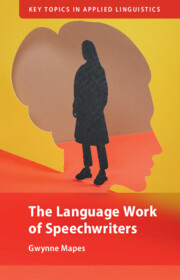
The work of speechwriters is prominent in political discourse, yet the writers themselves remain in the shadows of the powerful, public figures they work for. This book throws the spotlight on these invisible wordsmiths, illuminating not only what they do, but also why it matters. Based on ethnographic research in the US American speechwriting community, it investigates the ways in which speechwriters talk about their professional practices, and also the material procedures which guide the production of their deliverables. Relying on a robust collection of various genres of discursive data, Mapes focuses on the primary rhetorical strategies which characterize speechwriters' discourse, neatly exposing how they are beholden to a linguistic marketplace entrenched in ideological and socioeconomic struggle. Providing fascinating insights into an understudied and relatively misunderstood profession, this book is essential reading for academic researchers and students in applied linguistics, discourse studies, linguistic and cultural anthropology, and sociolinguistics.