To save content items to your account,
please confirm that you agree to abide by our usage policies.
If this is the first time you use this feature, you will be asked to authorise Cambridge Core to connect with your account.
Find out more about saving content to .
To save content items to your Kindle, first ensure no-reply@cambridge.org
is added to your Approved Personal Document E-mail List under your Personal Document Settings
on the Manage Your Content and Devices page of your Amazon account. Then enter the ‘name’ part
of your Kindle email address below.
Find out more about saving to your Kindle.
Note you can select to save to either the @free.kindle.com or @kindle.com variations.
‘@free.kindle.com’ emails are free but can only be saved to your device when it is connected to wi-fi.
‘@kindle.com’ emails can be delivered even when you are not connected to wi-fi, but note that service fees apply.
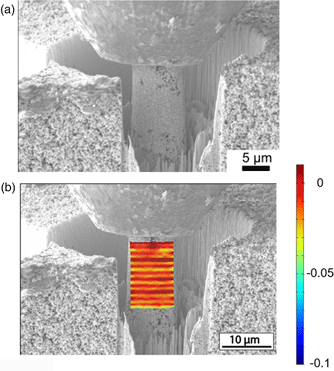
Porous metals represent a class of materials where the interplay of ligament length, width, node structure, and local geometry/curvature offers a rich parameter space for the study of critical length scales on mechanical behavior. Colloidal crystal templating of three-dimensionally ordered macroporous (3DOM, i.e., inverse opal) tungsten provides a unique structure to investigate the mechanical behavior at small length scales across the brittle–ductile transition. Micropillar compression tests show failure at 50 MPa contact pressure at 30 °C, implying a ligament yield strength of approximately 6.1 GPa for a structure with 5% relative density. In situ SEM frustum indentation tests with in-plane strain maps perpendicular to loading indicate local compressive strains of approximately 2% at failure at 30 °C. Increased sustained contact pressure is observed at 225 °C, although large (20%) nonlocal strains appear at 125 °C. The elevated-temperature mechanical performance is limited by cracks that initiate on planes of greatest shear under the indenter.
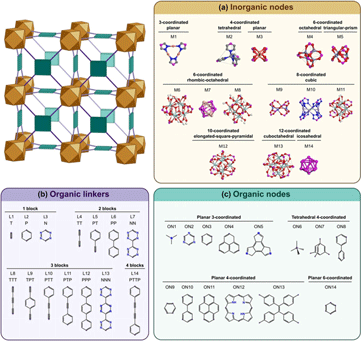
Metal–organic frameworks (MOFs) possess tuneable properties and a variety of important applications in the areas of catalysis, adsorption, gas storage, and separation, among others. Herein, recent computational studies by density functional theory (DFT) applied for simulations of MOF structure and complex architecture determination, prediction of properties, and computational characterization, including large-scale screening and geometrical properties of hypothetical MOFs, diffusion and adsorption processes in MOFs, are reviewed. DFT calculations have been applied in the MOF area to study chemical stability; mechanical, photophysical, optical, and magnetic properties; photoluminescence; porosity; and semiconductor or metallic character. The prediction of MOF analogs with open-metal sites, studies of chemical bonding and the prediction of energies by quantum mechanics allows reducing experimental efforts in the creation of MOF/polymer membranes, adsorbents for CO2 uptake, separation of C2H2/CH4, C2H2/CO2, and inert gases, radionuclides sequestration, and water adsorption, as well as other promising advances. For the MOF-derived carbons, a lack of profound DFT investigations is currently observed, being mainly restricted to the electrocatalysis area (nitrogen reduction reaction, oxygen evolution reaction, and hydrogen evolution reaction), resulting applications in batteries and other storage devices, CO2 sequestration, and absorbance of organic substances.
Gravity is commonly considered negligible when the surface tension is dominant; i.e., the Bond number is less than 1. In this paper, however, the authors present a technique in which drops slide over surfaces with zero effective gravity. Our study compared the sliding motion of water drops on hydrophilic and hydrophobic surfaces in scenarios: one in which effective gravity = 1 (1 g) and one in which it = 0 (0 g). The authors found that the lateral retention force was greater under 1 g than it was under 0 g. Also, the results showed that retention forces calculated by Furmidge equation are higher than the measured forces.
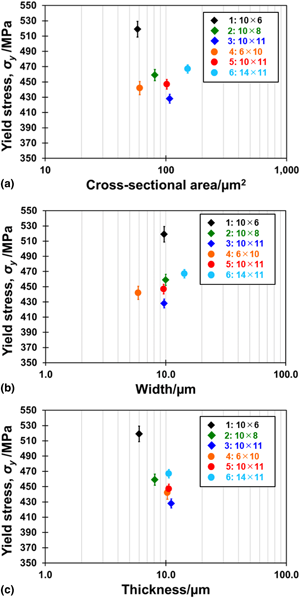
Sample geometry effects on mechanical strengths of gold micro-cantilevers are evaluated by a micro-bending test. Six micro-cantilevers with the same length of 50 μm are prepared, and the width and the thickness are varied to examine individual effects on the yield stress. The yield stress increases from 428 to 519 MPa when the thickness decreases from 11.1 to 6.0 μm. No obvious dependency is observed when varying the width. The results reveal that the thickness and the width each has a different influence on the yield stresses of micro-cantilevers evaluated by the bending test, which is the sample geometry effect.
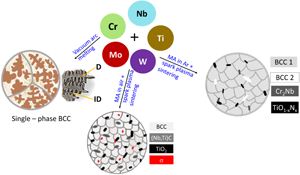
Two different processing routes of mechanical alloying followed by the spark plasma sintering (powder metallurgy) and vacuum arc melting (casting route) were employed to understand the role of processing routes on the phase and microstructural evolution in an equiatomic CrMoNbTiW refractory high-entropy alloy. Besides a major BCC solid solution, a small fraction of carbide, σ phase, nitride, and oxide phases were observed in the alloys prepared by the powder metallurgy route in contrast to a single-phase BCC solid solution in the casting route. The milling atmosphere (dry milling in air and Ar) has significantly influenced the phase and microstructural evolution, illustrating the substantial role of contaminants. Good thermal stability of microstructure at high homologous temperatures was shown based on the long-term heat treatment at 1300 °C for 240 h. The phase evolution predictions via Calphad studies were found to be in reasonable agreement with the experimental observations, albeit with some limitations.
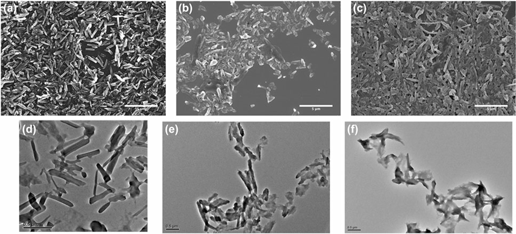
Polysaccharide-based nanoparticles such as pectin had always been of greatest interest because of its excellent solubility and mucoadhesive nature and are highly suitable for oral drug delivery for drug administration. In this study, we used commercially available pectin samples based on their degree of esterification, and nanoparticles were fabricated by the ionotropic gelation method using magnesium (Mg2+) as the divalent cross-linker. We conducted a comparative analysis on the three pectin NPs—high methoxylated pectin (HMP), low methoxylated pectin (LMP), and amidated LMP (AMP)—to examine the difference in characteristics such as shape, size, and biocompatibility. HMP and AMP were found to be similar in size (~850 nm), whereas LMP was found to be of ~700 nm. The three NPs were also tested for their biocompatibility toward THP-1 cells. All three NPs were found to have the potential as a nanocarrier of therapeutic and preventive drugs, especially through oral routes.
Residual strain in electrodeposited Li films may affect safety and performance in Li metal battery anodes, so it is important to understand how to detect residual strain in electrodeposited Li and the conditions under which it arises. To explore this Li films, electrodeposited onto Cu metal substrates, were prepared under an applied pressure of either 10 or 1000 kPa and subsequently tested for the presence or absence of residual strain via sin2(ψ) analysis. X-ray diffraction (XRD) analysis of Li films required preparation and examination within an inert environment; hence, a Be-dome sample holder was employed during XRD characterization. Results show that the Li film grown under 1000 kPa displayed a detectable presence of in-plane compressive strain (−0.066%), whereas the Li film grown under 10 kPa displayed no detectable in-plane strain. The underlying Cu substrate revealed an in-plane residual strain near zero. Texture analysis via pole figure determination was also performed for both Li and Cu and revealed a mild fiber texture for Li metal and a strong bi-axial texture of the Cu substrate. Experimental details concerning sample preparation, alignment, and analysis of the particularly air-sensitive Li films have also been detailed. This work shows that Li metal exhibits residual strain when electrodeposited under compressive stress and that XRD can be used to quantify that strain.
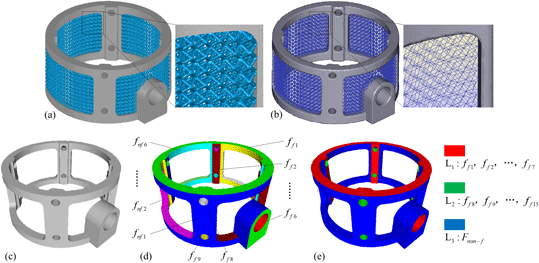
Additive manufacturing has enabled the development of lightweight lattice structures, which are widely used in orthopedic implant, aerospace and filtration fields. The traditional method of optimizing part build orientation has been unable to meet the demand for lightweight lattice parts. This paper proposes a novel method to obtain an optimum build orientation for lightweight lattice parts based on selective laser melting by considering two factors at a time, namely processability of lattice structures and the surface quality of functional features. First, the overhang structure area model for the evaluation of the processability of lattice structures is established; then, mesh segmentation and feature level classification of the lightweight part frame are carried out. On this basis, the adaptive feature roughness model for the evaluation of the surface quality of functional features is established; finally, a multicriteria genetic algorithm is used to solve the build orientation optimization problem of lightweight lattice parts to obtain a Pareto optimal set.
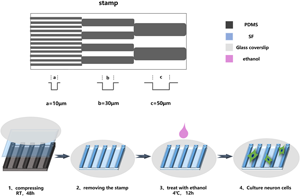
The surface topology of biomaterial has a definite effect on the growth behavior of nerve cells for peripheral nerve regeneration. In this study, the silk fibroin (SF) film with different anisotropic microgroove/ridge was constructed by micropatterning technology. The effects of topologies width on the directional growth of dorsal root ganglion (DRG) neurons were evaluated. The results showed that the topological structure of the SF film with higher SF concentration was more clear and complete. The microtopography of the SF film with a concentration of 15% and a groove width of around 30 μm could effectively guide the directional growth of the nerve fibers of DRG. And nerve fibers could obviously form nerve fiber bundles which may have a certain pavement effect on the recovery of nerve function. The study indicated that the SF film with a specific width of the topological structure may have potential applications in the field of directional nerve regeneration.
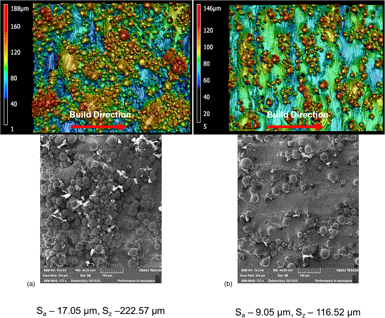
Additively manufactured parts produced via laser powder bed fusion (LPBF) have limitations in their applications due to post-processing requirements caused by high surface roughness. The characteristics of side-skin surfaces are generally assumed to be dominated by adhered powder particles. This work aims to analyze and interpret the effects of LPBF processing parameters on side-skin surfaces. As such, this work has two sections to investigate the effect of (i) core and (ii) border LPBF parameters on side-skin surface roughness for Ti–6Al–4V. The findings show that there is a robust correlation between both core and border LPBF parameters on side-skin surface morphologies. In terms of core LPBF parameters, an interaction between laser power and beam velocity is shown to influence side-skin surface roughness, resulting in Sa values in the range of 11–26 μm. Additionally, a preliminary investigation into the effect of melting mode phenomena at the border leads to a possibility of obtaining Sa values of <10 μm, with reduced effects of adhered and partially fused powder.
The crystal structure of oseltamivir phosphate has been refined using synchrotron X-ray powder diffraction data and optimized using density functional techniques. Oseltamivir phosphate crystallizes in space group P21212 (#18) with a = 24.0079(3), b = 24.6716(2), c = 7.45254(5) Å, V = 4414.24(5) Å3 at 295 K, and Z = 8. Prominent in the crystal structure are hydrogen bonds between the phosphate groups and the ammonium groups of the oseltamivir cations. The strong hydrogen bonds link the cations and the anions into columns parallel to the c-axis, with van der Waals interactions between the columns. Thermal expansion between 120 and 295 K is anisotropic. The powder pattern is included in the Powder Diffraction File™ as entry 00-068-1107.
The formation of shear bands during hot deformation of a two-phase (α2 + γ) titanium aluminide and its consequences on dynamics softening has been investigated. The starting material consists of a colony of lamellar grains along with the segregated vanadium and niobium which was subjected to hot deformation in the temperature range 1000–1175 °C at the strain rate 10 s−1. Microstructures of the deformed samples indicate that, with increase in the deformation temperature, the orientation of shear bands changes. Moreover, the extent of dynamic recrystallization also increases with deformation temperature. The softening behaviour and crystallographic orientation change within lamellae during hot deformation have been explored. The nucleation of newly recrystallized grains has been observed at twin–parent grain boundary and within the twined γ phase. Lamellae of the γ and α2 phase have been also observed to be twisted and tilted, leading to the band formations under the load, whose mechanisms have also been explored in the present study.
The presence of 6s2 (5s2) lone-pair electrons on the B-site Pb (Sn) in all-inorganic and hybrid halide ABX3 perovskites distinguishes these materials from the familiar tetrahedral semiconductors traditionally employed in optoelectronics and is key to many of their appealing properties. These electrons are stereochemically active, albeit often in a hidden fashion, resulting in unusual and highly anharmonic lattice dynamics that are linked to many of the special optoelectronic properties displayed by this material class. This article describes the connections between this atypical electronic configuration and the electronic structure and lattice dynamics of these compounds. We illustrate how the lone pair leads to favorable bandwidths and band alignments, mobile holes, large ionic dielectric response, large positive thermal expansion, and even possibly defect-tolerant electronic transport. Taken together, the evidence suggests that other high-performing semiconductors may be found among compounds with lone-pair-bearing cations in high symmetry environments and a high degree of connectivity between atoms.
The efficiency of halide perovskite solar cells has progressed rapidly through a series of major breakthroughs. Currently, a certified efficiency of 25.2% has been achieved for a solar cell using a polycrystalline thin film. This is the result of having reached 75% of the Shockley–Queisser limit for single-junction solar cells. However, for further improvements, new breakthrough technologies are required. This article reviews the impact of previous breakthrough technologies on the efficiency of halide perovskite solar cells, based on certified efficiencies. We clarify the current status of halide perovskite solar cells and introduce photon recycling as the next technological innovation for higher efficiencies. Photon recycling keeps the photon concentration inside the light-harvesting layer high, and consequently, leads to open-circuit voltages close to the theoretical value. Although photon recycling has not yet been implemented in real halide perovskite solar cells, three key technologies for implementing it are examined.