To save content items to your account,
please confirm that you agree to abide by our usage policies.
If this is the first time you use this feature, you will be asked to authorise Cambridge Core to connect with your account.
Find out more about saving content to .
To save content items to your Kindle, first ensure no-reply@cambridge.org
is added to your Approved Personal Document E-mail List under your Personal Document Settings
on the Manage Your Content and Devices page of your Amazon account. Then enter the ‘name’ part
of your Kindle email address below.
Find out more about saving to your Kindle.
Note you can select to save to either the @free.kindle.com or @kindle.com variations.
‘@free.kindle.com’ emails are free but can only be saved to your device when it is connected to wi-fi.
‘@kindle.com’ emails can be delivered even when you are not connected to wi-fi, but note that service fees apply.
Ammonia can supplement hydrogen gas as a clean fuel to combat climate change. It overcomes hindrances that currently impede the realization of the full potential of hydrogen gas, including economical storage, political commitment, and safety concerns.
Liquid cell transmission electron microscopy (TEM) has become an essential tool for studying the structure and properties of both hard and soft condensed-matter samples, as well as liquids themselves. Liquid cell sample holders, often consisting of two thin window layers separating the liquid sample from the high vacuum of the microscope column, have been designed to control in situ conditions, including temperature, voltage/current, or flow through the window region. While high-resolution and time-resolved TEM imaging probes the structure, shape, and dynamics of liquid cell samples, information about the chemical composition and spatially resolved bonding is often difficult to obtain due to the liquid thickness, the window layers, the holder configuration, or beam-induced radiolysis. In this article, we review different approaches to quantitative liquid cell electron microscopy, including recent developments to perform energy-dispersive x-ray and electron energy-loss spectroscopy experiments on samples in a liquid environment or the liquid itself. We also cover graphene liquid cells and other ultrathin window layer holders.
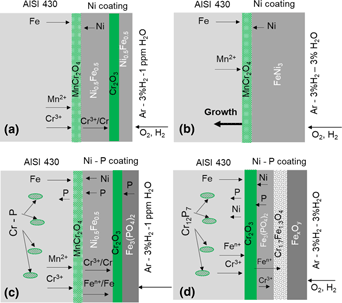
The corrosion behavior of uncoated, nickel (Ni) and nickel–phosphorous (Ni–P)-coated AISI 430 alloy was investigated in Ar–3%H2 and Ar–3%H2–3%H2O atmosphere at 800 °C for 100 h. Microstructure, chemical composition, and reaction products were analyzed by scanning electron microscopy, energy-dispersive spectroscopy, and X-ray diffraction techniques. The corrosion extent of Ni–P-coated AISI 430 is higher than Ni-coated AISI 430. Oxidation promotes corrosion in the uncoated and coated alloy. The oxidation rate of Ni-coated alloy is the lowest in Ar–3%H2 but Ni–P-coated alloy in Ar–3%H2–3%H2O for initial 20 h. The oxidation rate of the Ni–P-coated sample is ~14 times higher in 20–100 h in Ar–3%H2–3%H2O. External growth of Cr2O3 is observed for Ni-coated alloy in Ar–3%H2 and for Ni–P-coated alloy in both the atmospheres. Inward growth of Cr2O3 by AISI 430 alloy consumption attributes to the lowest oxidation rate and the corrosion extent of Ni-coated sample in Ar–3%H2–3%H2O.
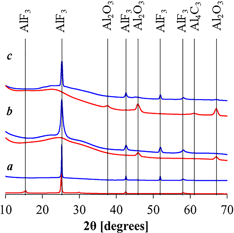
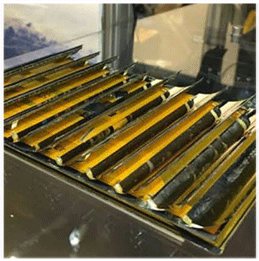
Molecular weight (Mw) effects in poly(vinylidene fluoride) (PVDF) influence both processability and combustion behavior in energetic Al–PVDF filaments. Results show decreased viscosity in unloaded and fuel-lean (i.e., 15 wt% Al) filaments. In highly loaded filaments (i.e., 30 wt% Al), reduced viscosity is minimal due to higher electrostatic interaction between Al particles and low Mw chains as confirmed by Fourier-transform infrared spectroscopy. Thermal and combustion analysis further corroborates this story as exothermic activity decreases in PVDF with smaller Mw chains. Differential scanning calorimetry and Thermogravimetric analysis show reduced reaction enthalpy and lower char yield in low Mw PVDF. Enthalpy reduction trends continued in nonequilibrium burn rate studies, which confirm that burn rate decreases in the presence of low Mw PVDF. Furthermore, powder X-ray patterns of post-burn products suggest that low Mw PVDF decomposition creates a diffusion barrier near the Al particle surface resulting in negligible AlF3 formation in fuel-rich filaments.
Space exemplifies the ultimate test-bed environment for any materials technology. The harsh conditions of space, with extreme temperature changes, lack of gravity and atmosphere, intense solar and cosmic radiation, and mechanical stresses of launch and deployment, represent a multifaceted set of challenges. The materials we engineer must not only meet these challenges, but they need to do so while keeping overall mass to a minimum and guaranteeing performance over long periods of time with no opportunity for repair. Nanophotonic materials—materials that embody structural variations on a scale comparable to the wavelength of light—offer opportunities for addressing some of these difficulties. Here, we examine how advances in nanophotonics and nanofabrication are enabling ultrathin and lightweight structures with unparalleled ability to shape light–matter interactions over a broad electromagnetic spectrum. From solar panels that can be fabricated in space to applications of light for propulsion, the next generation of lightweight and multifunctional photonic materials stands to both impact existing technologies and pave the way for new space technologies.
The effects of the coronavirus global pandemic have rippled through many lives and have upended aspects of health care, transportation, and the economy in virtually every country. The energy materials and renewable generation and conversion market, which includes battery-powered electric vehicles, grid storage, and personal electronic devices, is no exception.
This article addresses recent advances in liquid phase transmission electron microscopy (LPTEM) for studying nanoscale synthetic processes of carbon-based materials that are independent of the electron beam—those driven by nonradiolytic chemical or thermal reactions. In particular, we focus on chemical/physical formations and the assembly of nanostructures composed of organic monomers/polymers, peptides/DNA, and biominerals. The synthesis of carbon-based nanomaterials generally only occurs at specific conditions, which cannot be mimicked by aqueous solution radiolysis. Carbon-based structures themselves are also acutely sensitive to the damaging effects of the irradiating beam, which make studying their synthesis using LPTEM a unique challenge that is possible when beam effects can be quantified and mitigated. With new direct sensing, high frame-rate cameras, and advances in liquid cell holder designs, combined with a growing understanding of irradiation effects and proper experimental controls, microscopists have been able to make strides in observing traditionally problematic carbon-based materials under conditions where synthesis can be controlled, and imaged free from beam effects, or with beam effects quantified and accounted for. These materials systems and LPTEM experimental techniques are discussed, focusing on nonradiolytic chemical and physical transformations relevant to materials synthesis.
Master simple to advanced biomaterials and structures with this essential text. Featuring topics ranging from bionanoengineered materials to bio-inspired structures for spacecraft and bio-inspired robots, and covering issues such as motility, sensing, control and morphology, this highly illustrated text walks the reader through key scientific and practical engineering principles, discussing properties, applications and design. Presenting case studies for the design of materials and structures at the nano, micro, meso and macro-scales, and written by some of the leading experts on the subject, this is the ideal introduction to this emerging field for students in engineering and science as well as researchers.
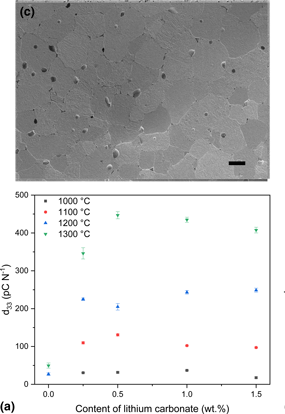
Piezoelectric Ba0.85Ca0.15Zr0.1Ti0.9O3 (BCZT) has been found to be a competitive lead-free piezoceramic candidate and was prepared by a sol–gel technique due to its small particle size and homogeneous particle size distribution, but the sintering temperature is still quite high in the previous reports. In the present paper, lithium carbonate (Li2CO3) was used as a sintering aid and dopant for the sol–gel-derived piezoceramic powder, to facilitate the sintering process and adjust the densification, the microstructures and functional properties. With the addition of 0.5 wt% Li2CO3 sintered at 1300 °C, a high relative density 96% with piezoelectric coefficient d33 ~447 pC/N, planar coupling coefficient kp ~0.51, and Curie point TC ~98.7 °C was obtained. The way to properly define the critical changing points on temperature-dependent dielectric curves were further discussed. By altering sintering temperature and the amount of dopant, the mutual influence between the microstructures and the functional properties was explained, to further guide shaping BCZT in more complexed connectivities.
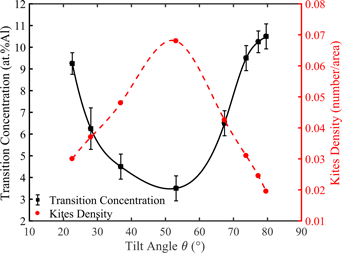
Grain boundary (GB) motions, such as migration, sliding and rotation, have been shown to play a vital role in the mechanical performance of polycrystalline metals. Despite extensive efforts have been made on the pure polycrystalline metals, few attentions have been paid to those in alloys. In this work, taking conventional nanoscale Cu–Al binary alloy system as an example, we intend to shed some light on understanding its GB motions under shear loading by means of molecular dynamics (MD) simulations. It is found that either shear-coupled GB migration or sliding motion can be observed, depending on GB tilt angles, temperatures and Al solute concentrations. By systematical MD simulations, the Al concentration required for transition between shear-coupled migration and sliding is found to decrease with increasing tilt angles (θ ≤ 50°) at fixed temperature, whereas it switches to the opposite trend for larger tilt angles. Furthermore, the GBs migrate much slower comparing with those in pure Cu, which shows the drag effects of the Al solutes in the alloy form. Moreover, the critical stress during shear loading shows a linear dependence on 2/3 power of the temperature.
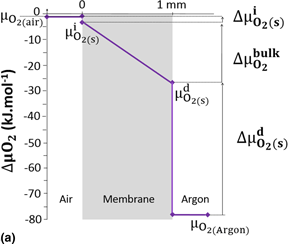
This work is focused on the evaluation of oxygen semi-permeation and electrochemical performances under high oxygen gradient of free cobalt perovskite membrane materials; La1−xSrxFeO3−δ perovskite. For a better understanding of oxygen transport through La1−xSrxFeO3−δ perovskite membranes, the oxygen diffusion, oxygen incorporation, and desorption coefficients were determined under high oxygen gradient in relation to the temperature for La1−xSrxFeO3−δ (with x = 0.1, 0.3, 0.5, and 0.7) by a specific method based on oxygen semi-permeation. The best electrochemical performances were obtained for La0.3Sr0.7FeO3−δ (LSF37) and La0.5Sr0.5FeO3−δ (LSF55) perovskite membranes with oxygen fluxes of 1.7 × 10⁻³ and 1.2 × 10⁻³ mol/m2 s at 900 °C, respectively. The oxygen incorporation and desorption coefficients of LSF55 were two times lower than those of LSF37 and similar to those of La0.5Sr0.5Fe0.7Ga0.3O3−δ. The values of these coefficients are discussed and compared with the data reported in the literature by isotopic exchange for the similar material compositions.
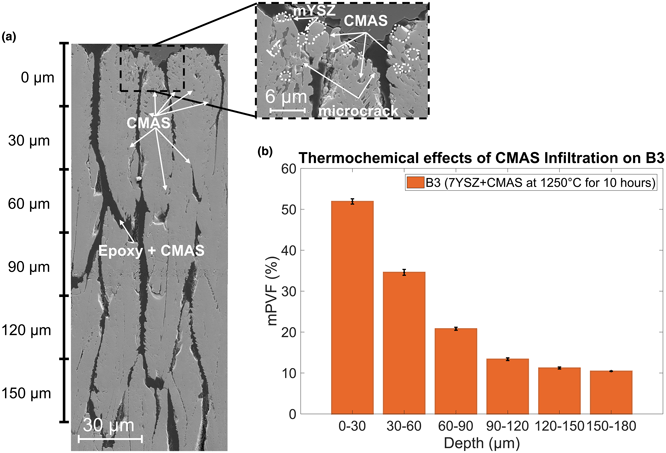
Calcium–magnesium–alumino-silicate (CMAS) particulates enter the aero-engine in a sandy environment, melt and infiltrate into 7 wt% yttria-stabilized zirconia (7YSZ) thermal barrier coatings (TBCs), reducing their lifetime. This leads to chemical degradation in 7YSZ accompanied by tetragonal to monoclinic phase transformation upon cooling. In this work, electron-beam physical vapor deposition coatings were infiltrated with a synthetic CMAS. Synchrotron X-ray diffraction measurements show that CMAS infiltration at 1250 °C has about 43% higher monoclinic phase volume fraction (PVF) at the coating surface compared to 1225 °C and remains consistently higher throughout the coating depth. Additionally, the increase in annealing time from 1 to 10 h results in a 31% higher monoclinic phase at the surface. Scanning electron microscopy revealed the presence of globular monoclinic phases corresponding spatially with the above findings. These results resolve the impact of time and temperature on CMAS infiltration kinetics which is important for mitigation.