To save content items to your account,
please confirm that you agree to abide by our usage policies.
If this is the first time you use this feature, you will be asked to authorise Cambridge Core to connect with your account.
Find out more about saving content to .
To save content items to your Kindle, first ensure no-reply@cambridge.org
is added to your Approved Personal Document E-mail List under your Personal Document Settings
on the Manage Your Content and Devices page of your Amazon account. Then enter the ‘name’ part
of your Kindle email address below.
Find out more about saving to your Kindle.
Note you can select to save to either the @free.kindle.com or @kindle.com variations.
‘@free.kindle.com’ emails are free but can only be saved to your device when it is connected to wi-fi.
‘@kindle.com’ emails can be delivered even when you are not connected to wi-fi, but note that service fees apply.
The history of architecture is laced with examples of bioinspiration, ranging from the use of decorative motifs to the implementation of functional and organizational principles found in plant and animal life. Likewise, a unique feature of our planet, one that allows life to flourish, has been named after a building type: The Greenhouse Effect. Exchanges in vocabulary from the fields of biology and construction occur quite frequently, i.e. building skin and cell wall, concrete shell and vault organelle, steel skeleton and body frame, and so on. As relative new sciences, it is no surprise that the fields of biology and earth sciences refer to things of scale and size more commonly understood, i.e. buildings. As they cope with the same environments and abide with the same physics, biology and architecture have developed similar solutions in their efforts to resist gravity’s pull or provide comfort and protection. The development of buildings is one of trial and error, a slow, evolutionary process that has to date produced very different building forms. Life, as well, is quite diverse in form and has arrived at this diversity using a limited palette of building materials and sources of energy. A seminal work on the development of form in biology is a book by D’Arcy W. Thompson, On Growth and Form, which first appeared in 1917 and has since become a landmark for biologist and bioinspired architects alike [1]. Using mathematical reasoning and physics, Thompson sets out to illustrate nature’s approach to derive shape, and illustrates how the forces at play are the same as those at play in the shaping of all matter, including buildings and bridges. An important tenet of his book concerns the importance of scale, how different physical forces work at different length-scales, and how these forces bring about vastly different results. It follows from his work that physics – the knowledge of nature – is essential to the understanding of biology and also forms a foundation for bioinspired design.
The abundance of flying insects in nature may make them seem ordinary to most of us. However, for approximately 350 million years [1], flying insects have been experimenting successfully with various aspects of flight, including aerodynamics [2,3], wing design [4], sensors [5,6], and flight control [7–9]. As a result, they have developed miniaturized flight apparatus and efficient computation architectures for executing aerobatic feats that are not yet emulated in engineering flight (Figure 11.1). This makes flying insects truly extraordinary small-scale aircraft from nature, and their design and working principles have received wide interest in both engineering and biology communities.
The inverse elasticity problem of identifying elastic modulus distribution based on measured displacement/strain fields plays a key role in various non-destructive evaluation (NDE) techniques used in geological exploration, quality control, and medical diagnosis (e.g., elastography). Conventional methods in this field are often computationally costly and cannot meet the increasing demand for real-time and high-throughput solutions for advanced manufacturing and clinical practices. Here, we propose a deep learning (DL) approach to address this challenge. By constructing representative sampling spaces of shear modulus distribution and adopting a conditional generative adversarial net, we demonstrate that the DL model can learn high-dimensional mapping between strain and modulus via training over a limited portion of the sampling space. The proposed DL approach bypasses the costly iterative solver in conventional methods and can be rapidly deployed with high accuracy, making it particularly suitable for applications such as real-time elastography and high-throughput NDE techniques.
As the minimum feature size of integrated circuit elements has shrunk below 7 nm, chemical mechanical planarization (CMP) technology has grown by leaps and bounds over the past several decades. There has been a growing interest in understanding the fundamental science and technology of CMP, which has continued to lag behind advances in technology. This review paper provides a comprehensive overview of various chemical and mechanical phenomena such as contact mechanics, lubrication models, chemical reaction that occur between slurry components and films being polished, electrochemical reactions, adsorption behavior and mechanism, temperature effects, and the complex interactions occurring at the wafer interface during polishing. It also provides important insights into new strategies and novel concepts for next-generation CMP slurries. Finally, the challenges and future research directions related to the chemical and mechanical process and slurry chemistry are highlighted.
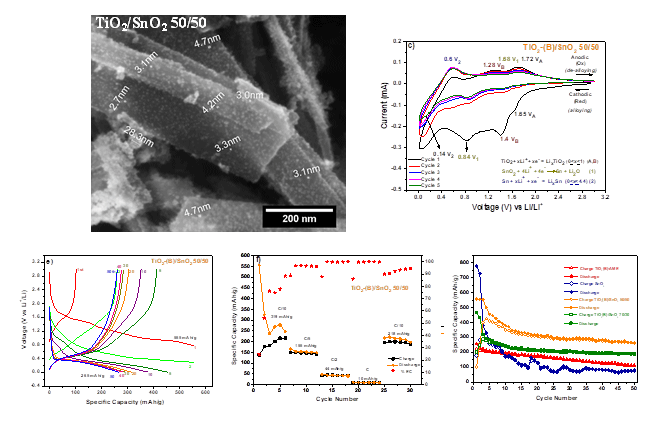
TiO2-(B)/SnO2 nanostructured composites have been prepared by the combination of an oil-in-water (O/W) microemulsion reaction method (MRM) and a hydrothermal method. Its electrochemical properties were investigated as anode materials in lithium-ion battery, and characterization was carried out by XRD, BET, Raman, FE-SEM, EDXS, and TEM. The as-prepared composites consisted of monoclinic phase TiO2-(B) nanoribbons decorated with cassiterite structure SnO2 nanoparticles. The electrochemical performance of the TiO2-(B)/SnO2 50/50 nanocomposite electrode showed higher reversible capacity of 265 mAh/g than that of the pure SnO2 electrode, 79 mAh/g, after 50 cycles at 0.1 C in a voltage range of 0.01-3.0 V at room temperature. In addition, the coulombic efficiency of the TiO2-(B)/SnO2 50/50 nanocomposite remains at an average greater than 90% from the 2nd to the 50th cycles. The TiO2-(B)/SnO2 50/50 nanocomposite presented the best balance between the mechanical support effect provided by TiO2-(B) that also contributes to the LIB capacity and the SnO2 that provides high specific capacity.
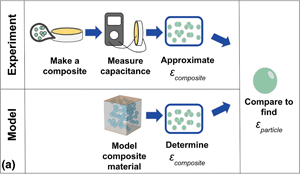
Barium titanate (BTO) is a ferroelectric perovskite with potential in energy storage applications. Previous research suggests that BTO dielectric constant increases as nanoparticle diameter decreases. This report recounts an investigation of this relationship. Injection-molded nanocomposites of 5 vol% BTO nanoparticles incorporated in a low-density polyethylene matrix were fabricated and measured. Finite-element analysis was used to model nanocomposites of all BTO sizes and the results were compared with experimental data. Both indicated a negligible relationship between BTO diameter and dielectric constant at 5 vol%. However, a path for fabricating and testing composites of 30 vol% and higher is presented here.
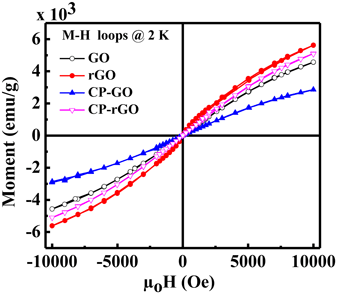
We have synthesized graphene oxide (GO) using Hummer's method which was subsequently reduced (rGO) by hydrazine hydrate. The synthesized GO was coated with poly(3,4-ethylenedioxythiophene)-poly(styrenesulfonate) (PEDOT-PSS) conducting polymer (CP) to obtain CP-GO which was also further reduced using hydrazine hydrate to form CP-rGO. Scanning electron microscopy, Raman spectroscopy, X-ray diffraction, ultraviolet photoelectron spectroscopy, and X-ray photoelectron spectroscopy, X-ray absorption near-edge structure (XANES) techniques were used to study the electronic and structural properties of GO, rGO, CP-GO, and CP-rGO nanocomposites for biomedical applications. The superconducting quantum interference device method was used to investigate the magnetic properties of the nanocomposites. The electrical conductivity of the CP-GO nanocomposites was found to be ~104 times higher than that of GO due to an increase in sp2 content and subsequent decrease in oxygen functional groups. In rGO, we observed an improved paramagnetic saturation magnetization of approximately 5.6 × 0−3 emu/g at 2 K. The electronic and magnetic behavior of PEDOT-PSS-coated nanocomposites, as a result, were successfully tuned for potential biological and biomedical applications.
Gas turbine engines for fixed-wing or rotary-wing aircraft are operated in a variety of harsh weather environments ranging from arctic, volcanic zones, to desert conditions. Operation under these degraded conditions leads to the undesired entrainment of complex particulates resulting in drastic performance losses. Hence, there is a critical need to understand the governing mechanisms to inform the development of durable thermal and environmental barrier coatings. The objective of the current work is to present a novel multiscale physics-based approach to study two-phase flows that take into account the underpinning particle transport and deposition dynamics. Sessile droplet models are presented and used to compute the contact angle at high temperatures and compared with experiments. The study also investigates the sensitivity of deposition patterns to the Stokes number and the results identify local vulnerability regions. The analysis suggests that particle size distributions and the initial trajectories of the particles are critically important in predicting the final deposition pattern.
In the present paper, the authors investigated the microstructures and mechanical properties of dual-phase Co–Ti–V-based superalloys with different additions of Ru. The results showed that with the increase of Ru contents, the size of γ′ precipitates of the alloy gradually raised, the volume fraction of γ′ phase slightly, and the lattice misfit between γ/γ′ phases increased. Ru was enriched in the γ′ phase, and the elemental partition coefficients (KX = Cγ′/Cγ) of Ti and V increased with the increment of Ru. The Ru contents have no remarkable influence on the solvus temperatures of γ′ in the Co–Ti–V alloys. The yield strength at 1000 °C of the Co–10Ti–11V–0.5Ru alloy was the highest, while the yield strength of the 1Ru alloy was the smallest. Transmission electron microscopy and scanning electron microscopy observations showed that the γ′ shape in the compressed specimen containing 0.5Ru remain integrated, while the γ′ in other alloys were cut into several parts.
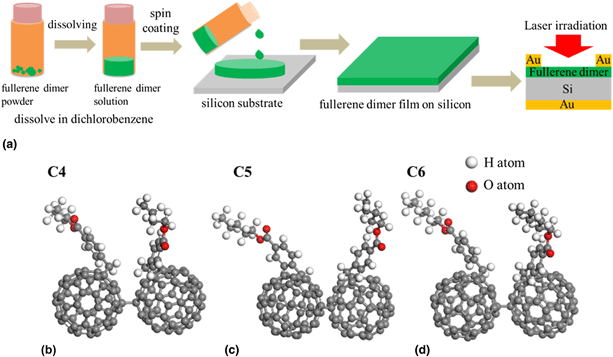
Fullerene dimers have attracted extensive attention due to their unique structures and fascinating properties. Here, fullerene dimer derivatives with four to six carbon atoms in the esters are designed and synthesized. The property differences that caused by the carbon number in the esters of the fullerene dimers are investigated by performing their electrochemical, optical, and photoelectric measurements. As the carbon atom numbers in the esters increase from four to five and six, the absorption intensities increase to 1.6- and 4.4-folds. The intensities of the fluorescence spectra increase to 1.8- and 5.2-folds. Their photocurrent increases to 2- and 7-folds under the irradiation of a 405-nm laser. The LUMO energy levels move downward slightly from −3.89 to −3.90 and −3.92 eV, respectively. Our results indicate that as the carbon number increases, the carbon chain lengths in the ester structures increase, very slight effects produced on the energy levels of the fullerene dimers, but strongly contribute to their chemical activities and thus the photoelectronic efficiencies.
To detect low concentrations of formaldehyde selectively, the sensing properties of SnO2 nanostructured are enhanced by modifying with p-type semiconductor NiO. In this study, a nanostructured SnO2/NiO composite was prepared by a simple hydrothermal method. The X-ray photoelectron spectroscopy (XPS) peak in 532.4 eV proved that the existence of the SnO2/NiO composite structure increased the amount of adsorbed oxygen O− and O2− significantly. Gas-sensing tests showed that these mixed phases SnO2/NiO are highly promising for gas sensor applications, as the gas response for formaldehyde was significantly enhanced in gas response, selectivity at an operating temperature of 230 °C. The sensor fabricated by SnO2/NiO composite can detect as low as 1 ppm of formaldehyde at 230 °C, and the corresponding response is 1.57. The results of physicochemical properties tests of the samples show that the enhancement in sensitivity and selectivity is attributed to the oxygen vacancies and heterojunction between SnO2 and NiO. The SnO2/NiO composites can be applied to sensitive materials of formaldehyde sensors.
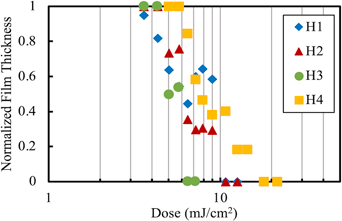
Poly(phthalaldehyde) (pPHA) and copolymers with aliphatic aldehydes were investigated as dry-develop, positive-tone photoresist. Exposure of the films loaded with a photoacid generator to 248 nm radiation creates an acid that depolymerizes the polymer into volatile monomers, allowing the development of features by vaporization rather than solution-based processes. By controlling the acid content, the vaporization rate of the reaction products, and the degree of liquid formation of the decomposed polymer, control of spatial resolution and the quality of polyaldehyde dry-develop photoresist was achieved. Heat, vacuum, and forced convection were evaluated as development techniques in determining the resist sensitivity, contrast, and resolution. Forced convection of heated nitrogen was the most controllable development method for pPHA films. Five-micron lines and spaces were printed. Poly(aldehyde) copolymer resins had slightly lower spatial resolution but were able to be developed faster due to higher vapor pressure of the depolymerized monomers. Cold photo-exposures and development were used to prevent detrimental liquid formation of the decomposed copolymers. In addition to exploring new dry-development methods that have not been tested before, these findings offer insights into designing better material systems and optimizing processes for dry-develop photoresists.