To save content items to your account,
please confirm that you agree to abide by our usage policies.
If this is the first time you use this feature, you will be asked to authorise Cambridge Core to connect with your account.
Find out more about saving content to .
To save content items to your Kindle, first ensure no-reply@cambridge.org
is added to your Approved Personal Document E-mail List under your Personal Document Settings
on the Manage Your Content and Devices page of your Amazon account. Then enter the ‘name’ part
of your Kindle email address below.
Find out more about saving to your Kindle.
Note you can select to save to either the @free.kindle.com or @kindle.com variations.
‘@free.kindle.com’ emails are free but can only be saved to your device when it is connected to wi-fi.
‘@kindle.com’ emails can be delivered even when you are not connected to wi-fi, but note that service fees apply.
Nanoscale materials that contain metallic components can be designed to have excellent light-harvesting capabilities, and can also be used to direct the flow of energy from incident photons into small molecules at or near the surface of metal nanoparticles. One promising route for energy flow is through so-called hot charge carriers, which are optically excited on metal nanoparticles and subsequently transferred to molecules/materials that share an interface with the metal. This article provides an overview of the fundamentals of hot-carrier generation and transfer, discusses both theoretical and experimental means for interrogating these processes, and discusses several potential societally important applications of hot-carrier-driven chemistry to solar fuels and sustainable chemistry.
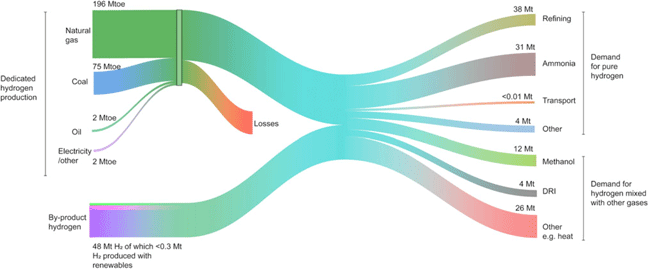
Hydrogen is often touted as the fuel of the future, but hydrogen is already an important feedstock for the chemical industry. This review highlights current means for hydrogen production and use, and the importance of progressing R&D along key technologies and policies to drive a cost reduction in renewable hydrogen production and enable the transition of chemical manufacturing toward green hydrogen as a feedstock and fuel.
The chemical industry is at the core of what is considered a modern economy. It provides commodities and important materials, e.g., fertilizers, synthetic textiles, and drug precursors, supporting economies and more broadly our needs. The chemical sector is to become the major driver for oil production by 2030 as it entirely relies on sufficient oil supply. In this respect, renewable hydrogen has an important role to play beyond its use in the transport sector. Hydrogen not only has three times the energy density of natural gas and using hydrogen as a fuel could help decarbonize the entire chemical manufacturing, but also the use of green hydrogen as an essential reactant at the basis of many chemical products could facilitate the convergence toward virtuous circles. Enabling the production of green hydrogen at cost could not only enable new opportunities but also strengthen economies through a localized production and use of hydrogen. Herein, existing technologies for the production of renewable hydrogen including biomass and water electrolysis, and methods for the effective storage of hydrogen are reviewed with an emphasis on the need for mitigation strategies to enable such a transition.
Circular energy transformation of Turkey is essential to strengthen the national energy security. Turkey will benefit from moving towards a circular economy.
Circular economy (CE) has gained much attention due to global warming and climate change which are the most serious issues faced in the world. The United Nations has been struggling with the issues regarding sustainable development by releasing some programs and legislations, which are mostly supported by the EU. The EU's CE including both economy and energy within the scope of low-carbon world is binding for Turkey's energy transition. Among renewables, solar energy preserved the leading capacity expansion with an increase of 98 GW in 2019 in the world. Solar photovoltaic (PV) has become a mainstream energy source among renewables. Since the PV installation has been growing all around the world, several countries especially China, Germany, and the UK pay special attention to a sustainable PV waste management concept. We present the special case of Turkey within the global CE along with the current status of renewable energy in the global energy transformation. Turkey's energy outlook and the EU's targets are reviewed, and the significant role of solar energy in the CE transition process of Turkey has been revealed. We suggested adding a vision of “More Circular” to her new energy policy “More Domestic, More Renewable.”
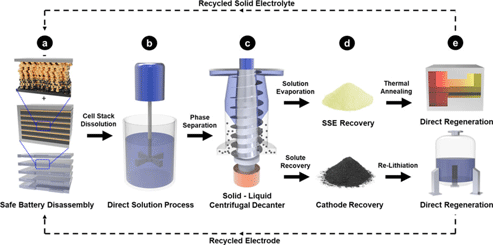
A scalable battery recycling strategy to recover and regenerate solid electrolytes and cathode materials in spent all solid-state batteries, reducing energy consumption and greenhouse gases.
With the rapidly increasing ubiquity of lithium-ion batteries (LIBs), sustainable battery recycling is a matter of growing urgency. The major challenge faced in LIB sustainability lies with the fact that the current LIBs are not designed for recycling, making it difficult to engineer recycling approaches that avoid breaking batteries down into their raw materials. Thus, it is prudent to explore new approaches to both fabricate and recycle next-generation batteries before they enter the market. Here, we developed a sustainable design and scalable recycling strategy for next-generation all solid-state batteries (ASSBs). We use the EverBatt model to analyze the relative energy consumption and environmental impact compared to conventional recycling methods. We demonstrate efficient separation and recovery of spent solid electrolytes and electrodes from a lithium metal ASSB and directly regenerate them into usable formats without damaging their core chemical structure. The recycled materials are then reconstituted to fabricate new batteries, achieving similar performance as pristine ASSBs, completing the cycle. This work demonstrates the first fully recycled ASSB and provides critical design consideration for future sustainable batteries.
We report a significant advance in thermally insulating transparent materials: silica-based monoliths with controlled porosity which exhibit the transparency of windows in combination with a thermal conductivity comparable to aerogels.
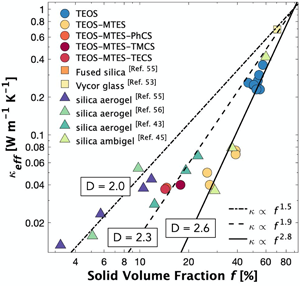
The lack of transparent, thermally insulating windows leads to substantial heat loss in commercial and residential buildings, which accounts for ~4.2% of primary US energy consumption annually. The present study provides a potential solution to this problem by demonstrating that ambiently dried silica aerogel monoliths, i.e., ambigels, can simultaneously achieve high optical transparency and low thermal conductivity without supercritical drying. A combination of tetraethoxysilane, methyltriethoxysilane, and post-gelation surface modification precursors were used to synthesize ambiently dried materials with varying pore fractions and pore sizes. By controlling the synthesis and processing conditions, 0.5–3 mm thick mesoporous monoliths with transmittance >95% and a thermal conductivity of 0.04 W/(m K) were produced. A narrow pore size distribution, <15 nm, led to the excellent transparency and low haze, while porosity in excess of 80% resulted in low thermal conductivity. A thermal transport model considering fractal dimension and phonon-boundary scattering is proposed to explain the low effective thermal conductivity measured. This work offers new insights into the design of transparent, energy saving windows.
A perspective on the current state of battery recycling and future improved designs to promote sustainable, safe, and economically viable battery recycling strategies for sustainable energy storage.
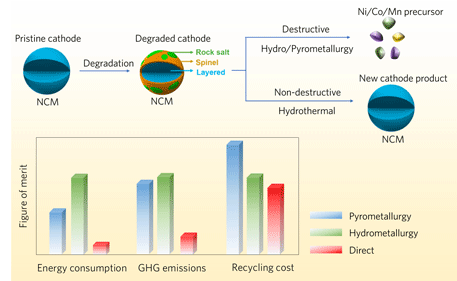
Recent years have seen the rapid growth in lithium-ion battery (LIB) production to serve emerging markets in electric vehicles and grid storage. As large volumes of these batteries reach their end of life, the need for sustainable battery recycling and recovery of critical materials is a matter of utmost importance. Global reserves for critical LIB elements such as lithium, cobalt, and nickel will soon be outstripped by growing cumulative demands. Despite advances in conventional recycling strategies such as pyrometallurgy and hydrometallurgy, they still face limitations in high energy consumption, high greenhouse gas emissions, as well as limited profitability. While new direct recycling methods are promising, they also face obstacles such as the lack of proper battery labeling, logistical challenges of inefficient spent battery collection, and components separation. Here, we discuss the importance of recovering critical materials, and how battery designs can be improved from the cell to module level in order to facilitate recyclability. The economic and environmental implications of various recycling approaches are analyzed, along with policy suggestions to develop a dedicated battery recycling infrastructure. We also discuss promising battery recycling strategies and how these can be applied to existing and future new battery chemistries.
A 250kW hydrogen electrolysis facility was recently installed at the Natural Energy Laboratory of Hawaii Authority's (NELHA's) campus. This facility that will begin operation in 2020 to produce hydrogen for fuel cell buses on the island to demonstrate of the application of hydrogen to decarbonize transportation. Given the size of the electrolysis station, it has the potential to significantly increase electricity costs for the campus, which is subject to energy and peak demand charges from the local utility.
In this paper, we analyze the cost of hydrogen production at NELHA given the rate structure options available from the utility. Production costs are estimated using optimal versus constant scheduling of the facility to meet the buses’ demand. A model of the electrolysis station is used to capture changes in production efficiency over the power range in the optimization routine. The effects of combining the station and campus load versus standalone operation and increasing solar generation are also explored. The analyses surrounding this scenario show the importance of multiple factors on the potential profitability of hydrogen production in behind-the-meter applications and show trends that could have implications for other similar installations.
For energy storage to be part of the transmission solution, storage developers need to work with transmission owners and follow the Regional Transmission Organization (RTO) transmission planning protocols.
Federal Energy Regulatory Commission (FERC) Order 841 mostly treats Electric Storage Resource (ESR) as a generation asset. To date, no FERC order lays out a path for treating energy storage as a transmission asset. One of FERC-jurisdictional RTOs – Midcontinent Independent System Operator (MISO) – has sent a “storage as a transmission-only asset” proposal to FERC, which FERC did not reject but did not approve either. This MISO filing begs the question – how to treat energy storage as a transmission project? The industry needs to understand how RTO cost allocation works for new and existing transmission projects. To appreciate cost allocation, stakeholders need to grasp the fundamentals of transmission project categories. Because to put together a business case for storage, modeling is essential. And modeling for reliability and economic projects vary. Getting into the weeds of transmission planning is what it takes to treat storage as a transmission asset.
Photocatalytic hydrogen production from water is a facile and clean approach to convert rich solar energy into chemical fuel. Developing efficient and robust catalysts to accelerate water-splitting speed is key. Porphyrins exist widely in green plants and are a key photosensitizer to absorb and transfer light energy to other parts of the photosynthesis system of plants. They are considered an ideal model to construct artificial photocatalysts for hot-carrier-mediated hydrogen production. This article discusses recent achievements in constructing porphyrin-based photocatalysts for hydrogen production, including porphyrin molecules, self-assembled porphyrins, metal–organic frameworks, conjugated porphyrin polymers, and hybrid nanomaterial-based photocatalysts. The design and synthesis principles, structure–property relationships, as well as urgent issues to be solved in the future for every type of photocatalyst are also discussed.
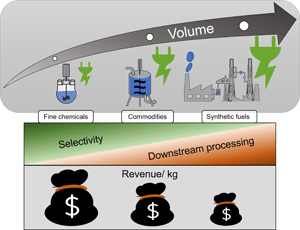
The electrification of organic syntheses is a vividly growing research field and has attracted tremendous attention by the chemical industry. This review highlights aspects of electrosynthesis that are rarely addressed in other articles on the topic: the energy consumption and energy efficiency of technically relevant electro-organic syntheses.
Four examples on different scales are outlined.
Electro-organic synthesis has experienced a renaissance within the past years. This review addresses the energy efficiency or energy demand of electrochemically driven transformations as it is a key parameter taken into account by, for example, decision makers in industry. The influential factors are illustrated that determine the energy efficiency and discussed what it takes for an electrochemical process to be classified as “energy efficient.” Typical advantages of electrosynthetic approaches are summarized and characteristic aspects regarding the efficiency of electro-organic processes, such as electric energy consumption, are defined. Technically well-implemented examples are described to illustrate the possible benefits of electrochemical approaches. Further, promising research examples are highlighted and show that the conversion of fine chemicals is rather attractive than the electrochemical generation of synthetic fuels.