To save content items to your account,
please confirm that you agree to abide by our usage policies.
If this is the first time you use this feature, you will be asked to authorise Cambridge Core to connect with your account.
Find out more about saving content to .
To save content items to your Kindle, first ensure no-reply@cambridge.org
is added to your Approved Personal Document E-mail List under your Personal Document Settings
on the Manage Your Content and Devices page of your Amazon account. Then enter the ‘name’ part
of your Kindle email address below.
Find out more about saving to your Kindle.
Note you can select to save to either the @free.kindle.com or @kindle.com variations.
‘@free.kindle.com’ emails are free but can only be saved to your device when it is connected to wi-fi.
‘@kindle.com’ emails can be delivered even when you are not connected to wi-fi, but note that service fees apply.
In this paper, the atomic resolution high-angle annular dark-field scanning transmission electron microscope (HAADF-STEM) was used as the main research method. Using HAADF-STEM, two types of long-period stacking ordered structure (LPSO)—14H and 18R-LPSO—were observed in Mg96Gd2Y1Ni1 alloy, and the precipitates at various stages of aging were observed. Moreover, a type of rectangular β precipitates were found, and the atomic models of β precipitates along the [0001]Mg and ${\tf="TeXGyrePagella-Bold (TrueType)"\char9001} 11\bar 20\hbox{]}_{{\rm{Mg}}}$ directions were identified. At the aging peak stage, a three-dimensional network structure composed of LPSO/γ′ precipitates and β′ precipitates and β precipitates was observed. The hardness of the unaged homogenized Mg96Gd2Y1Ni1 alloy was only 87 HV and the hardness value of aging peak was 128.4 HV. Compared with the unaged alloy, the hardness of the peak-aged alloy increased by 47.59%. The composite strengthening of the three types of precipitates induced a significant strengthening to the alloy.
Titanium and its alloys are probably the most suitable materials for selective laser melting (SLM) additive manufacturing to process. However, the high cost of raw powder materials limits the industrial application of as-printed Ti products. In this study, we have formulated a cost-affordable Ti–TiB composite powder for SLM, to simultaneously achieve excellent mechanical performance and cost effectiveness. The optimization of the processing parameters will be shown to lead to high relative density (99.3%) for the as-printed Ti–TiB composites containing (0.5, 1, and 2 wt%) TiB2. Furthermore, by incorporating TiB2, the as-printed composites exhibit much improved fracture strength (up to 1813 MPa) and microhardness (up to 412 HV), among which the Ti–0.5 wt% TiB2 has demonstrated a great combination of strength (1007 and 1646 MPa as yield and fracture strengths, respectively) and tensile ductility (~8%). The solidification pathway for the Ti–TiB composite during SLM has been investigated, and the underlying mechanism for achieving high yield strength is discussed based on existing models for shear-lag strengthening, grain refinement, and dispersion strengthening.
Graphene is one of the most intensively studied materials, and has unusual electrical, mechanical and thermal properties, which provide almost unlimited potential applications. This book provides an introduction to the electrical and transport properties of graphene and other two-dimensional nanomaterials, covering ab-initio to multiscale methods. Updated from the first edition, the authors have added chapters on other two-dimensional materials, spin-related phenomena, and an improved overview of Berry phase effects. Other topics include powerful order N electronic structure, transport calculations, and ac transport and multiscale transport methodologies. Chapters are complemented with concrete examples and case studies, questions and exercises, detailed appendices and computational codes. It is a valuable resource for graduate students and researchers working in physics, materials science or engineering who are interested in the field of graphene-based nanomaterials.
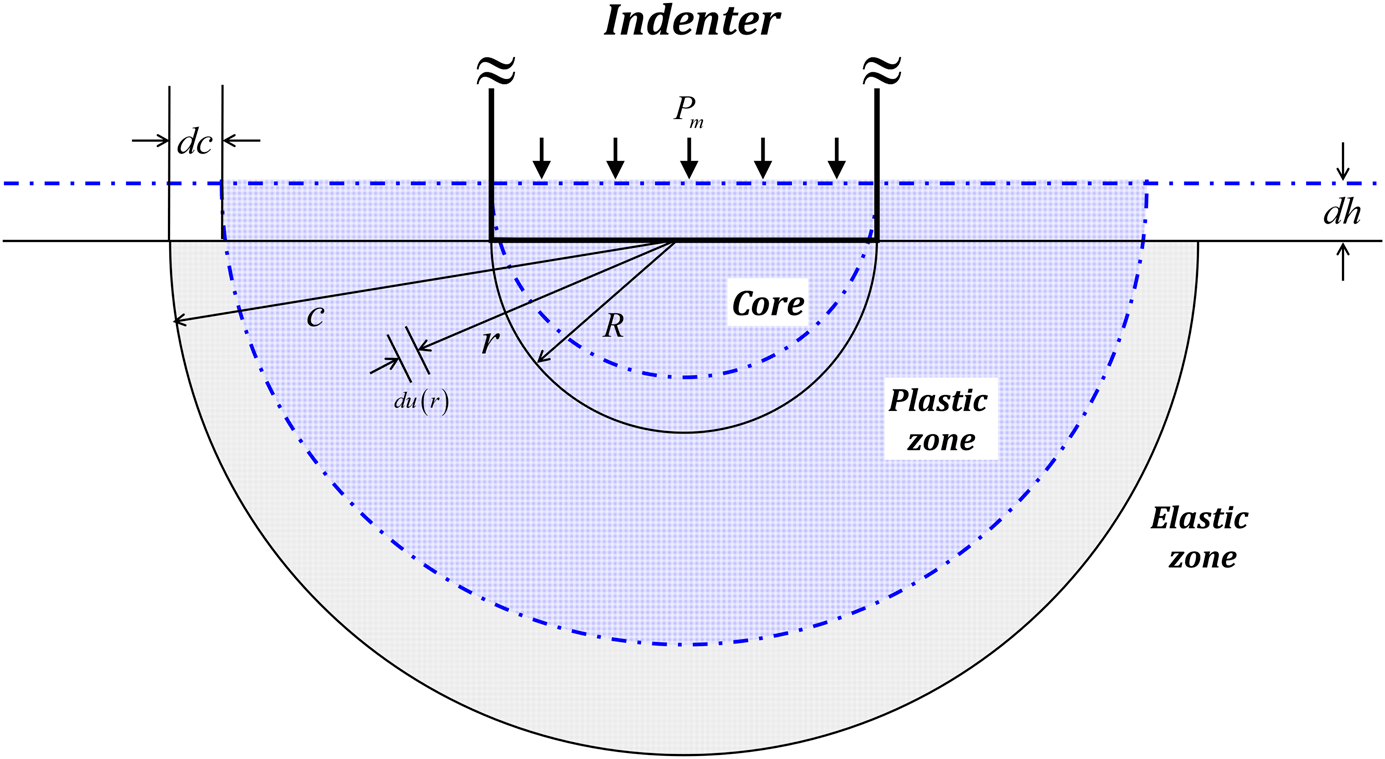
The tensile yield strength of high-density polyethylene using instrumented indentation tests with a flat-ended cylindrical indenter was evaluated. The variation in the field expressed by stress and strain beneath the flat-ended cylindrical indenter is investigated using a new expanding cavity model to study the relation between tension and indentation. This model starts from the separation of forces into the compressive force on the material and the frictional one, which is generated during indentation on the sides of indenter. The authors propose a method to correct the frictional force based on the saturation of indentation hardening and obtain load–depth curve with compressive component only. For conversion of indentation force and displacement, our new representation model is applied. By modifying Johnson's model, the new assumption of conservation of indentation plastic volume is suggested. This model proves and supports conventional relations of the strain rates between indentation and tension theoretically. These are verified through the experiments: instrumented indentation and uniaxial tensile test. The authors find a good agreement between the tensile yield strengths at various strain rates.
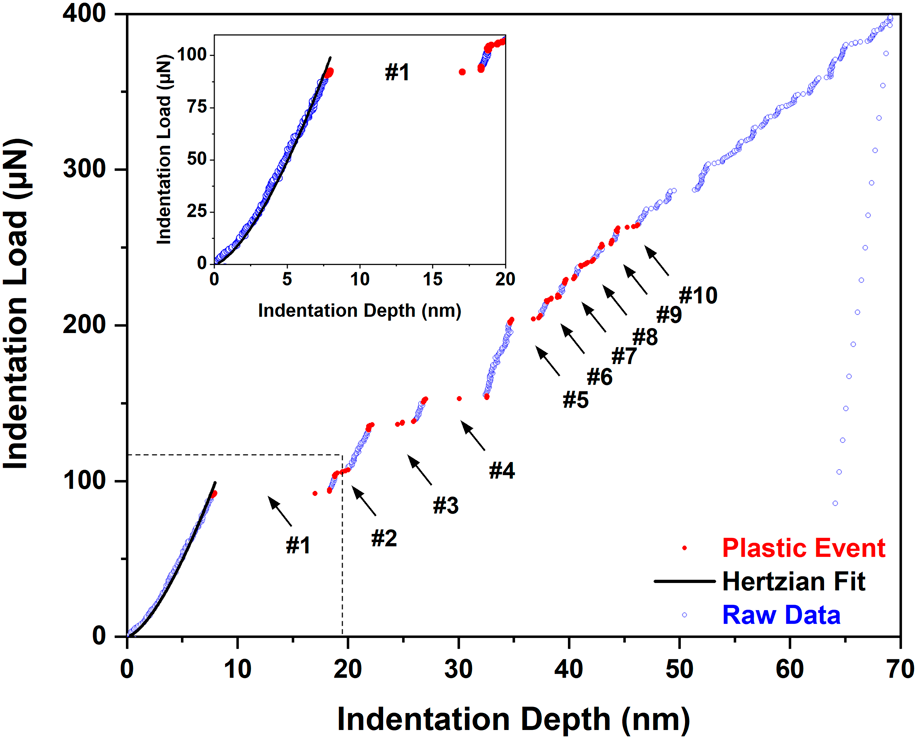
Nanoindentation and microcrystal deformation are two methods that allow probing size effects in crystal plasticity. In many cases of microcrystal deformation, scale-free and potentially universal intermittency of event sizes during plastic flow has been revealed, whereas nanoindentation has been mainly used to assess the stress statistics of the first pop-in. Here, we show that both methods of deformation exhibit fundamentally different event-size statistics obtained from plastic instabilities. Nanoindentation results in scale-dependent intermittent microplasticity best described by Weibull statistics (stress and magnitude of the first pop-in) and lognormal statistics (magnitude of higher-order pop-ins). In contrast, finite-volume microcrystal deformation of the same material exhibits microplastic event-size intermittency of truncated power-law type even when the same plastic volume as in nanoindentation is probed. Furthermore, we successfully test a previously proposed extreme-value statistics model that relates the average first critical stress to the shape and scale parameter of the underlying Weibull distribution.
The expressions for the elastic strain energy and its volumetric and deviatoric parts are derived for three-dimensional states of stress and strain. Betti's reciprocal theorem of linear elasticity is formulated, which yields the Maxwell coefficients, frequently used in structural mechanics. Castigliano's theorem is formulated and applied to axially loaded rods and trusses, twisted bars, and bent beams and frames. The principle of virtual work and the variational principle of linear elasticity are introduced. The differential equation of the deformed shape of the bent beam is derived from the consideration of the principle of virtual work. The approximate Rayleigh–Ritz method is introduced and applied to selected problems of structural mechanics. An introduction to the finite element method in the analysis of beam bending, torsion, and axial loading is then presented. The corresponding stiffness matrices and load vectors are derived for each element and are assembled into the global stiffness matrix and load vector of the entire structure.
Two-dimensional problems of plane stress and plane strain in polar coordinates, both axisymmetric and non-axisymmetric, are considered. Among axisymmetric problems, the bending of a curved beam by two end couples and the problem of a pressurized hollow disk or cylinder are analyzed. Among non-axisymmetric problems, solutions are derived for problems of bending of a curved cantilever beam by a vertical force, loading of a circular hole in an infinite medium,concentrated vertical and tangential forces at the boundary of a half-plane, and a semi-elliptical pressure distribution over the boundary of a half-space. The problems of diametral compression of a circular disk (Michell problem), stretching of a large plate weakened by a small circular hole (Kirsch problem), stretching of a large plate strengthened by a small circular inhomogeneity, and spinning of a circular disk are also analyzed and discussed. The chapter ends with an analysis of the stress field near a crack tip under symmetric and antisymmetric remote loadings, the stress and displacement fields around an edge dislocation in an infinite medium, and around a concentrated force in an infinite plate.
A brief coverage of the mechanics of contact problems is presented. The governing equations for three-dimensional axisymmetric elasticity problems in cylindrical coordinates are first formulated, which is followed by the solutions to classical problems of a concentrated force within an infinite medium (Kelvin problem), and a concentrated force at the boundary of a half-space (Boussinesq problem). The stress fields in a half-space loaded by an elliptical and a uniform pressure distribution over a circular portion of its boundary are presented. Indentation by a spherical ball and by a cylindrical circular indenter are analyzed. The second part of the chapter is devoted to Hertzian contact problems. The nonlinear force–displacement relation is derived for elastic contact of two spherical bodies pressed against each other by two opposite forces. The elastic contact of two circular cylinders is also considered. The contact pressure and the maximum shear stress are determined. The approach of the centers of the cylinders requires the consideration of the local contact stresses, as well as the stresses within the bulk of each cylinder.
The generalized Hooke's law is introduced, which represents six linear relations between the stress and strain components in the case of small elastic deformations. For isotropic materials, only two independent elastic constants appear in these stress–strain relations. Each longitudinal strain component depends linearly on the three orthogonal components of the normal stress; the relationship involves two constants: Young's modulus of elasticity and Poisson's coefficient of lateral contraction. Each shear strain component is proportional to the corresponding shear stress component; the shear modulus relates the two. The volumetric strain is proportional to the mean normal stress, with the elastic bulk modulus relating the two. The inverted form of the generalized Hooke's law is derived, which expresses the stress components as a linear combination of strain components. Lamé elastic constants appear in these relations. The Duhamel–Neumann law of linear thermoelasticity is formulated, which incorporates the effects of temperature on stresses and strains. The Beltrami–Michell compatibility equations with and without temperature effects are derived.
The analysis of normal and shear stresses in a cantilever beam bent by a transverse force is presented. The stress function is introduced and the governing Poisson-type partial differential equation and the accompanying boundary conditions are derived for simply and multiply connected cross sections of a prismatic beam. The exact solution to the boundary value problem is presented for circular, semi-circular, hollow-circular, elliptical, and rectangular cross sections. Approximate, but sufficiently accurate, formulas for shear stresses in thin-walled open and thin-walled closed cross sections, including multicell cross sections, are derived and applied to different profiles of interest in structural engineering. The determination of the shear center of thin-walled profiles, which is the point through which the transverse load must pass in order to have bending without torsion, is discussed in detail. The sectorial coordinate is introduced and conveniently used in this analysis. The formulas are derived with respect to the principal and non-principal centroidal axes of the cross section.
A survey of failure criteria for brittle and ductile materials is presented. The maximum principal stress and the maximum principal strain criterion for brittle materials are introduced. The Tresca maximum shear stress and the von Mises energy criterion for ductile materials are formulated and applied to study the onset of plastic yield in thin-walled tubes and other structural members. The Mohr failure criterion is based on the consideration of Mohr's circles. The Coulomb–Mohr criterion for geomaterials incorporates the normal and shear stress, and the coefficient of internal friction. According to Drucker–Prager’s criterion, plastic yield occurs when the shear stress on octahedral planes overcomes the cohesive and frictional resistance to sliding. The fracture mechanics based failure criterion takes into account the presence of cracks. Failure occurs if the release of potential energy accompanying the crack growth is sufficient to supply the increase of the surface energy of expanded crack faces. The fracture criterion is also formulated in terms of the stress intensity factor K, whose critical value is the fracture toughness of the material.
The components of the infinitesimal strain tensor are defined, which represent measures of the relative length changes (longitudinal strains or dilatations) and the angle changes (shear strains) at a considered material point with respect to the chosen coordinate axes. The principal strains (maximum and minimum dilatations) and the maximum shear strains are determined, as well as the areal and volumetric strains. The expressions for the strain components are derived in terms of the spatial gradients of the displacement components. The Saint-Venant compatibility equations are introduced which assure the existence of single-valued displacements associated with a given strain field. The matrix of local material rotations, which accompany the strain components in producing the displacement gradient matrix, is defined. The determination of the displacement components by integration of the strain components is discussed.
The representation of the stress and strain tensors and the formulation of the boundary-value problem of linear elasticity in cylindrical coordinates is considered. The Cauchy equations of equilibrium, expressed in terms of stresses, the strain–displacement relations, the compatibility equations, the generalized Hooke's law, and the Navier equations of equilibrium, expressed in terms of displacements, are all cast in cylindrical coordinates. The axisymmetric boundary-value problem of a pressurized hollow cylinder with either open or closed ends is formulated and solved. The results are used to obtain the elastic fields for a pressurized circular hole in an infinite medium, and to solve a cylindrical shrink-fit problem. A pressurized hollow sphere and a spherical shrink-fit problem are also considered to illustrate the solution procedure in the case of problems with spherical symmetry.
Antiplane shear is a type of deformation in which the only nonvanishing displacement component is the out-of-plane displacement, orthogonal to the (x,y) plane. The corresponding nonvanishing shear stresses are within that plane. For this type of deformation, the displacement is a harmonic function of (x,y), satisfying the Laplace's equation. We solve and discuss the problems of antiplane shear of a circular annulus, a concentrated line force along the surface of a half-space, antiplane shear of a medium weakened by a circular or an elliptical hole, and the problem of a medium strengthened by a circular inhomogeneity. The stress field near a crack tip under remote antiplane shear loading is derived, as well as the stress field around a screw dislocation in infinite and semi-infinite media. The stresses produced by a screw dislocation near a circular hole or a circular inhomogeneity in an infinite homogeneous medium, and the stresses produced by a screw dislocation in the vicinity of a bimaterial interface are examined.
Two-dimensional problems of plane stress and plane strain are considered. The plane stress problems are the problems of thin plates loaded over their lateral boundary by tractions which are uniform across the thickness of the plate, while its flat faces are traction free. The plane strain problems involve long cylindrical bodies, loaded by tractions which are orthogonal to the longitudinal axis of the body and which do not vary along this axis. The tractions over the bounding curve of each cross section are self-equilibrating. Two rigid smooth constraints at the ends of the body prevent its axial deformation. The stress components are expressed in terms of the Airy stress function such that the equilibrium equations are automatically satisfied. The Beltrami–Michell compatibility equations require that the Airy stress function is a biharmonic function. The Airy theory is applied to analyze pure bending of a thin beam, bending of a cantilever beam by a concentrated force, and bending of a simply supported beam by a distributed load. The approximate character of the plane stress solution is discussed, as well as the transition from the plane stress to the plane strain solution.
The analysis of normal and shear stresses over differently oriented surface elements through a considered material point is presented. The Cauchy relation for traction vectors is introduced, which leads to the concept of a stress tensor. The analysis is presented of one-, two-, and three-dimensional states of stress, the principal stresses (maximum and minimum normal stresses), the maximum shear stress, and the deviatoric and spherical parts of the stress tensor.The equations of equilibrium are derived and the corresponding boundary conditions are formulated.