To save content items to your account,
please confirm that you agree to abide by our usage policies.
If this is the first time you use this feature, you will be asked to authorise Cambridge Core to connect with your account.
Find out more about saving content to .
To save content items to your Kindle, first ensure no-reply@cambridge.org
is added to your Approved Personal Document E-mail List under your Personal Document Settings
on the Manage Your Content and Devices page of your Amazon account. Then enter the ‘name’ part
of your Kindle email address below.
Find out more about saving to your Kindle.
Note you can select to save to either the @free.kindle.com or @kindle.com variations.
‘@free.kindle.com’ emails are free but can only be saved to your device when it is connected to wi-fi.
‘@kindle.com’ emails can be delivered even when you are not connected to wi-fi, but note that service fees apply.
Energy recovery from waste treatment and growing biomass is of great significance for the energy management and sustainable energy supply. It is shown that biomass and various wastes containing carbon are able to significantly contribute to the energy sector.
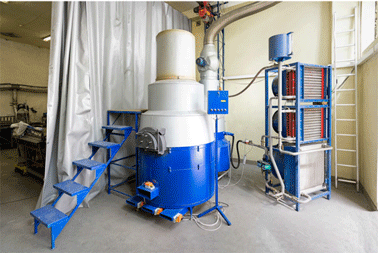
We describe a possible scenario for the energy development of an European country of the future. In addition to solar, wind, and hydrogen energy, priority should also be given to generating energy using small-sized gasifiers. First, it is sustainable energy since biomass and household waste are always available. Second, this approach will allow us to launch local electric power grids instead of the unified state and interstate grids, which will reduce up to three times the consumption of energy raw materials and financial resources. Third, a new design of electric motors, namely torus motors, will allow one almost halve electricity consumption and open a gateway to new technologies.
A liquid-state pyroelectric energy harvester is described and a remarkable capacity to convert a thermal gradient into electrical energy is demonstrated.
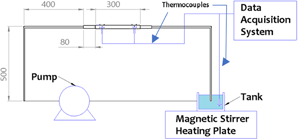
Increasing the sustainability of energy generation can be pursued by harvesting extremely low enthalpy sources: low temperature differences between cold and hot reservoirs are easily achieved in every industrial process, both at large and small scales, in plants as well as in small appliances, vehicles, natural environments, and human bodies. This paper presents the assessment and efficiency estimate of a liquid-state pyroelectric energy harvester, based on a colloid containing barium titanate nanoparticles and ferrofluid as a stabilizer. The liquid is set in motion by an external pump to control velocity, in a range similar to the one achieved by Rayleigh–Bénard convection, and the colloid reservoir is heated. The colloid is injected into a Fluorinated Ethylene Propylene pipe where titanium electrodes are placed to collect electrical charges generated by pyroelectricity on the surface of the nanoparticles, reaching 22.4% of the ideal Carnot efficiency of a thermal machine working on the same temperature drop. The maximum extracted electrical power per unit of volume is above 7 mW/m3 with a ΔT between electrodes of 3.9 K.
Hydrogen is a versatile energy storage medium with significant potential for integration into the modernized grid.
Advanced materials for hydrogen energy storage technologies including adsorbents, metal hydrides, and chemical carriers play a key role in bringing hydrogen to its full potential.
The U.S. Department of Energy Hydrogen and Fuel Cell Technologies Office leads a portfolio of hydrogen and fuel cell research, development, and demonstration activities, including hydrogen energy storage to enable resiliency and optimal use of diverse domestic energy resources.
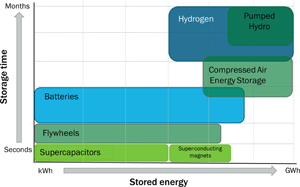
Today, the technology around generating and storing efficient and sustainable energy is rapidly evolving and hydrogen technologies offer versatile options. This perspective provides an overview of the U.S. Department of Energy's (DOE) Hydrogen and Fuel Cell Technologies Office's R&D activities in hydrogen storage technologies within the Office of Energy Efficiency and Renewable Energy, with a focus on their relevance and adaptation to the evolving energy storage needs of a modernized grid, as well as discussion of identified R&D needs and challenges. The role of advanced materials research programs focused on addressing energy storage challenges is framed in the context of DOE's H2@Scale initiative, which will enable innovations to generate cost-competitive hydrogen as an energy carrier, coupling renewables, as well as nuclear, fossil fuels, and the grid, to enhance the economics of both baseload power plants and intermittent solar and wind, to enhance resiliency and avoid curtailment. Continued growth and engagement of domestic and international policy stakeholders, industry partnerships, and economic coalitions supports a positive future outlook for hydrogen in the global energy system.
Nanostructures of plasmonic metals naturally combine strong light–matter interactions with catalytic activity, enabling new opportunities for light harvesting, catalytic chemistry, and artificial photosynthesis. Numerous studies have demonstrated that the optical excitation of localized surface plasmons generates hot electrons that can activate adsorbates triggering or facilitating chemical reactions on the surface of the nanoparticle. Going beyond such hot-electron-activated chemistry, a body of studies has shown that electron and hole carriers can be harvested from a plasmonically excited nanoparticle and utilized as redox equivalents for driving chemical reactions involving charge transfer. This article reviews such photoredox chemistry driven by plasmonic excitation of metal nanoparticles. Under certain conditions, a plasmonically excited nanoparticle can catalyze multielectron, multiproton transformations such as the photosynthesis of CO2 to hydrocarbons. We describe how the free energy of plasmonically generated charge carriers can be harvested and utilized for thermodynamically uphill reactions involving the formation of energy-rich chemical bonds or the development of molecular complexity. We end with a discussion of future opportunities in plasmon-excitation-driven photoredox chemistry.
Detailed report on MOFs for CO2 adsorption on the basis of ligands employed, OMSs, and structures. Systematic report on the high- and low-pressure CO2 capture. Report on the mechanism of CO2 capture.
A review on the promising field of MOF-based carbon capture and storage is presented. We discuss here the main features of MOFs applicable for CO2 capture and separation, the linker functionalization role, and the most important CO2-binding sites as also the most efficient and significant technologies, and a systematic report on the high- and low-pressure CO2 capture.
A comparison between electrochemical carbon dioxide conversion and reforestation is presented. By comparing thermodynamic and forestry data, recommendations for technology development can be made.
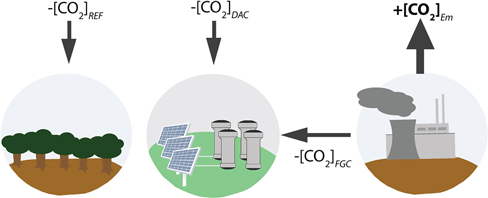
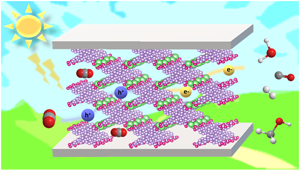
With the global average temperature steadily increasing due to anthropogenic emission of greenhouse gases into the atmosphere, there has been increasing interest worldwide in new technologies for carbon capture, utilization, and storage (CCUS). This coincides with the decrease in cost of deployment of intermittent renewable electricity sources, specifically solar energy, necessitating development of new methods for energy storage. Carbon dioxide conversion technologies driven by photovoltaics aim to address both these needs. To adequately contribute to greenhouse gas reduction, the carbon dioxide conversion technology deployed should have a substantially higher rate of carbon dioxide removal than planting an equivalent-sized forest. Using consistent methodologies, we analyze the effectiveness of model photovoltaic-driven carbon dioxide conversion technologies that produce liquid alcohols as compared to planting an equivalent forest. This analysis serves to establish an energy use boundary for carbon dioxide conversion technology, in order to be a viable alternative as a net carbon negative technology.
Perovskite solar cells are at the edge of commercial success. Device efficiency records break at a regular pace, while stability and optimization are progressing rapidly. The first commercial products could reach the market within the next year, only a decade since perovskite photovoltaics were first discovered. MRS Bulletin presents coverage of the most recent impactful advances in the burgeoning field of perovskite research.
Light absorption in nanoparticles of semiconductors and metals excites electrons from ground states to high-energy levels, generating hot electrons with the addition of kinetic energy, and consequently, complimentary hot holes in the nanoparticles. These hot electrons are capable of injecting themselves into the empty antibonding orbitals of chemical bonds of reactant molecules adsorbed on the surface of the nanoparticles, thereby weakening the chemical bonds to trigger corresponding desirable chemical reactions. Hot-electron chemistry represents a fundamentally different mechanism of solar-to-chemical energy conversion compared to the traditional photochemistry that relies on the direct photo-excitation of electrons in reactant molecules and thermal catalysis. This issue of MRS Bulletin examines the generation and relaxation of hot electrons in typical nanoparticle systems, and the flow of hot electrons across the surfaces of the nanoparticles. The promise of hot-electron chemistry (and the complementary hot-hole chemistry) is supported by its application in many important reactions, including CO2 reduction, water splitting, hydrogenation, and coupling reactions, highlighting its great potential in achieving high energy-conversion efficiency and product selectivity.
Consumer electronics have caused an unsustainable amount of waste electrical and electronic equipment (WEEE). Organic electronics, by means of eco-design, represent an opportunity to manufacture compostable electronic devices.
Waste electrical and electronic equipment (WEEE), or e-waste, is defined as the waste of any device that uses a power source and that has reached its end of life. Disposing of WEEE at landfill sites has been identified as an inefficient solid waste processing strategy as well as a threat to human health and the environment. In the effort to mitigate the problem, practices such as (i) designing products for durability, reparability, and safe recycling, and (ii) promoting closed-loop systems based on systematic collection and reuse/refurbishment have been identified. In this perspective, we introduce a complementary route to making electronics more sustainable: organic electronics based on biodegradable materials and devices. Biodegradable organic electronics lie at the intersection of research in chemistry, materials science, device engineering, bioelectronics, microbiology, and toxicology. The design of organic electronics for standardized biodegradability will allow composting to be an end-of-life option.
Role of MOFs in CO2 chemical conversion; Photocatalytic and electrocatalytic CO2 reduction; Role of linkers and metals in CO2 chemical conversion; and MOF composites and films in CO2 conversion.
In this review, we analyze the emerging field of metal–organic frameworks (MOFs) as catalysts for chemical conversion of CO2, with examples ranging from heterogeneous CO2 organic transformation to heterogeneous CO2 hydrogenation, from photocatalytic to electrocatalytic CO2 reduction. We also discuss the role of MOF composites and films in CO2 transformation. Our goal is to have an instrument useful to identify the best MOFs for CO2 conversion.
A case study of hard disk drives (HDDs) and rare-earth magnets is presented to show the use of decision support tools to identify and assess the barriers and opportunities for circular business models. Pilot demonstration projects, which showcased HDD circular recovery strategies, were useful as a low-risk opportunity for business model experimentation and to build trust among key supply chain actors.
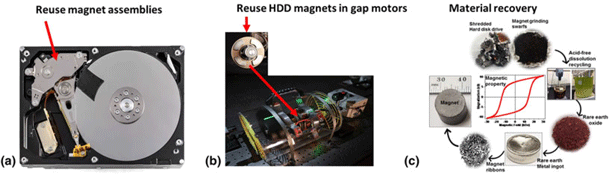
A case study of hard disk drives and rare-earth magnets is presented to show the use of decision support tools (DSTs) to assess the complex interaction of variables that must be considered when demonstrating the viability of circular business models (CBMs). A mix of quantitative and qualitative DSTs such as life cycle assessment, techno-economic assessment, Ostrom's Framework for social-ecological systems, decision trees, and others were implemented by the iNEMI Value Recovery Project team to overcome many of the identified barriers to circular economy. The DSTs were used to guide stakeholder coordination, create and share environmental, logistical and financial data, and generate decision-making flowcharts which promote circular economic strategies. Demonstration projects were used as a low-risk opportunity for business model experimentation and to build trust among key supply chain actors. The tools highlighted by this case study could be useful for establishing or expanding CBMs for other electronic products or components, especially components containing critical materials.
The circular economy aspects of PET (polyethylene terephthalate) waste conversion into value-added products are discussed concerning different governmental policies and industrial protocol for plastic degradation.
The use of microbial enzymes such as PET hydrolase is discussed regarding PET (polyethylene terephthalate) degradation.
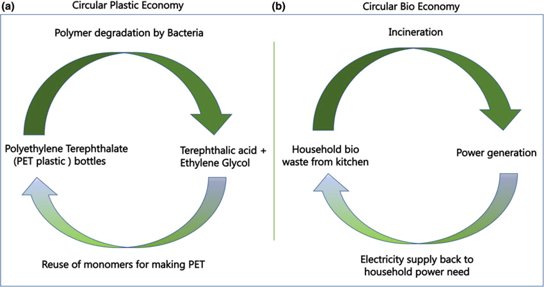
The primary purpose of this perspective is a critical analysis of the correlation of the current state-of-the-art rising circular economy platform enacted across the world with close looping of PET (polyethylene terephthalate)-based plastic polymer disposal and sustainable recycling and upcycling technology. The goal of the upcycling process is to get the low-cost value-added monomer than those obtained from the hydrocarbon industry from the sustainability prospect. A summary of the circular bio-economic opportunities has also been described. Next, how the PET hydrolase enzyme degrades the PET plastic is discussed. It is followed by an additional overview of the effect of the mutant enzyme for converting 90% of plastics into the terephthalate monomer. A site-directed mutagenesis procedure obtains this particular mutant enzyme. The diversity of different microbial organism for producing PET hydrolase enzyme is finally discussed with a suggested outlook of the circular economy goal from the viewpoint of plastic degradation objectives soon.
Environmental concerns deriving from fossil fuel dependency are driving an energy transition based on sustainable processes to make fuels and chemicals. Solar hydrogen is the pillar of this new green economy, but the technological readiness level of PV electrolysis and direct photoelectrochemical (PEC) electrolysis are still too low to allow broad commercialization. Direct conversion through PEC technology has more potential in the medium–long term but must be first guided by the scientific enhancements to improve device efficiencies. For this purpose, in situ and operando photoelectrochemistry will guide the discovery of new materials and processes to make solar fuels and chemicals in PEC cells.
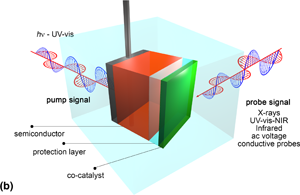
The use of advanced in situ and operando characterizations under working photoelectrochemical (PEC) conditions is reviewed here and anticipated to be a fundamental tool for achieving a basic understanding of new PEC processes and for enabling the large-scale development of PEC technology by 2050, thus delivering fuels and chemicals having zero (or negative) carbon footprint. Hydrogen from solar water splitting is the most popular solar fuel and can be mainly produced by indirect photovoltaic-driven electrolysis (PV electrolysis) and direct photoelectrochemistry. Although PV electrolysis has already been developed on a level of MW-scale pilot plants, PEC technology, which is much less mature, holds several advantages in the long term over PV-electrolysis systems. The key enabling feature to developing PEC technology is the improvement of the photoelectrode materials which are responsible for the absorption of light, and transport of the photo-generated charge carriers to drive the electrochemical surface reaction. These processes are often complex and multistep, spanning multiple timescales and following the simultaneous detection of photoelectrodes modification and formation of reaction intermediates/products can be achieved using eight well-known characterization techniques here presented.