To save content items to your account,
please confirm that you agree to abide by our usage policies.
If this is the first time you use this feature, you will be asked to authorise Cambridge Core to connect with your account.
Find out more about saving content to .
To save content items to your Kindle, first ensure no-reply@cambridge.org
is added to your Approved Personal Document E-mail List under your Personal Document Settings
on the Manage Your Content and Devices page of your Amazon account. Then enter the ‘name’ part
of your Kindle email address below.
Find out more about saving to your Kindle.
Note you can select to save to either the @free.kindle.com or @kindle.com variations.
‘@free.kindle.com’ emails are free but can only be saved to your device when it is connected to wi-fi.
‘@kindle.com’ emails can be delivered even when you are not connected to wi-fi, but note that service fees apply.
Partial shading of Cu(In,Ga)(Se,S)2 (CIGS) photovoltaic (PV) modules is getting more attention, as is witnessed by the increase in publications on this topic in recent years. This review will give an overview of shading tests executed on CIGS modules and focuses on the more fundamental aspects that are often studied on cells. Generally, CIGS modules display very attractive performance under predictable row-to-row shading. However, potential damage could occur under nonoptimal shading orientations: module output after shading tests could reduce due to the formation of local shunts, often called wormlike defects. The influence of many factors on the formation of these defects, including the internal currents and voltages and the shape and intensity of the shade, will be discussed. This review allows an increased insight in the degradation mechanisms caused by partial shading, which would ultimately lead to the introduction of more shade-tolerant CIGS PV products in the future.
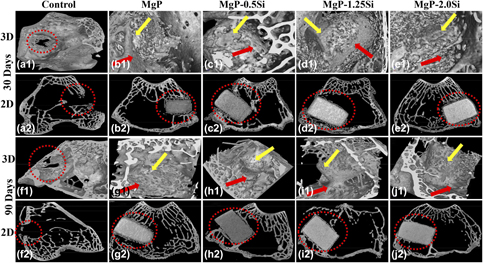
The effects of silicon incorporation on the in vitro and in vivo properties of magnesium phosphate (MgP) bioceramics were studied. Samples were prepared by conventional solid state synthesis method. Scanning electron microscopy and micro-computed tomography (µ-CT) analysis showed that Si doping reduces degradability of MgP. In vitro studies have shown that MG63 cells can attach and proliferate on MgP samples. Live/dead imaging showed that MgP–0.5Si sample had highest cell proliferation, which was also quantitatively confirmed by alamar blue assay. In vivo biocompatibility of MgP ceramics was assessed after implantation in rabbit model. Detailed µ-CT analysis showed new bone tissue formation around the implant after 30 and 90 days. MgP–0.5Si ceramics had 84% bone regeneration compared with 56% for pure MgP ceramics, as confirmed by oxytetracycline labeling. Our finding suggests that Si doping can alter physicochemical properties of MgP ceramics and promotes osseointegration, which can be a useful choice for bone tissue engineering.
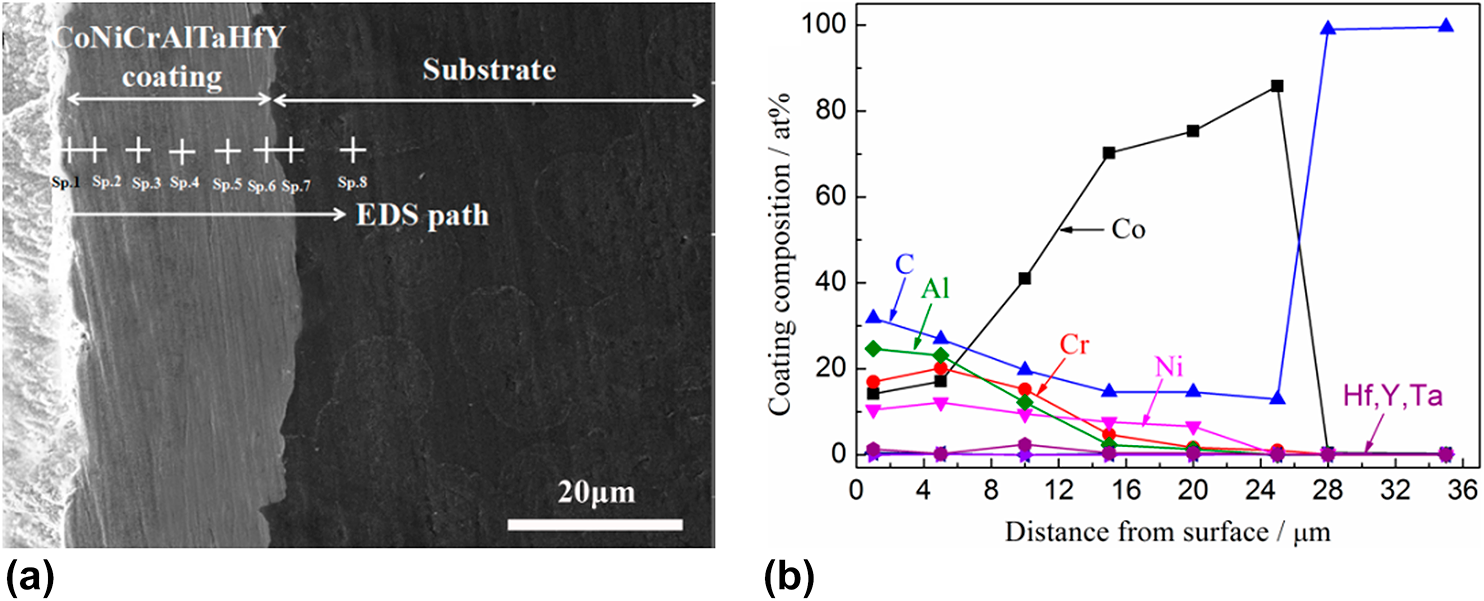
A CoNiCrAlTaHfY/Co composite coating was prepared on the etched C/C composites by using duplex vapor phase surface alloying treatments, i.e., Co alloying and Co–Ni–Cr–Al–Ta–Hf–Y alloying. Microstructures and oxidation behavior of the coated C/C composites were analyzed by scanning electron microscopy, energy-dispersive spectroscopy, and X-ray diffraction. The result showed that the CoNiCrAlTaHfY/Co composite coating, 25 μm in thickness, was compact and composed of CrCoTa, AlCo2Ta, AlxCry, AlxNiy, and Co. The coating adhesion can be enhanced by microwave plasma chemical vapor deposition etching of matrix surface and adding a Co intermediate layer between the CoNiCrAlTaHfY top layer and C/C composites substrate. The honeycomb structure after etching was helpful to alloying element absorb and diffuse into substrate surface, and the composite coating continuation was improved by the Co buffer layer. After exposing in air for 180 min at 1000 °C, the bulk C/C composites volatilized while the loss rate of coated C/C composites was 0.82%, showing an improved oxidation resistance. Mixed oxides mainly containing Al2O3 and Cr2O3 were formed in the composite coating surface and protected the C/C composites from oxidation in air.
Planet–satellite-type supracolloidal clusters represent a comparably young class of nanomaterials, which are unique with regard to structural order. In this prospective article, different approaches for their synthesis are discussed and compared. These synthetic methods enable the engineering of supracolloidal structural and adaptive properties, which in turn enables different emerging applications, such as in sensing and catalysis. These possibilities are explored on the basis of selected recent examples. A perspective about possible future developments is given at the end of this article.
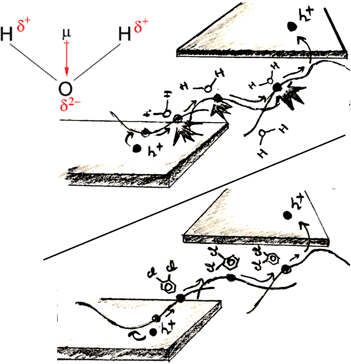
Molecular semiconductors synergize a variety of uniquely advantageous properties such as excellent absorption and emission properties, soft and deformable mechanical properties, and mixed ionic and electrical conduction. Over the past two decades, this outstanding set of features has put molecular semiconductors in the spotlight for a variety of optoelectronics and sensing applications. When it comes to mass-market adaptation, however, a challenge in these soft and van der Waals-bonded materials remains their electrical as well as environmental stability and degradation. This Prospective will summarize some of our current understanding of why organic semiconductors degrade with a strong emphasis put on the quintessential role played by water in this process. Furthermore, it will be revisited by which mechanisms water-related stability shortcomings might be addressed in the future and how these lessons can be translated to relevant hybrid systems such as perovskites and carbon nanotubes. Throughout this discussion, some parallels and key differences between organic and hybrid materials will be highlighted, and it will be elaborated on how this affects the associated device stability.
A hybrid graphene–gold nanomesh, realized through Au deposition on a patterned graphene nanomesh with a focused ion beam, is introduced and illustrated for enhanced light absorption in the visible spectrum. Numerical studies reveal that the hybrid nanomesh with dual resonances in the visible spectrum exhibit ~50% light absorption and enhancement factor as high as ~1 × 10⁸. The simulations also show that the enhanced optical absorption is associated with the excitation of surface plasmons. This is confirmed through the localization of electric fields at the resonant wavelengths. Such a hybrid graphene–gold nanomesh exhibiting enhanced light-matter interactions paves the way toward plasmonics, surface-enhanced Raman scattering applications, etc.
X-ray microscopy is an interdisciplinary topic, both in terms of its technical details and in terms of the scientific and engineering problems it is applied to. While there are a number of books that provide excellent coverage of certain aspects of x-ray physics, optics, and microscopy, it is my opinion that there has not been a single book that one can hand to someone new in the field of x-ray microscopy to give them an introduction to most of the key aspects they should know about. This book is an attempt to fill that need.
Are you a new PhD student entering a research group who will use x-ray microscopy for part of your research? If so, you have probably had at least a year or so of university physics during your studies. You are whom I have written the book for! At times I may push you a bit further in mathematics or physics than what you have learned thus far, but if you are in a PhD program you are a serious enough student so this should be OK. Besides, you can always skim over some of the more detailed points.
Are you an established researcher or engineer who is new to x-ray microscopy? This book is also for you! Your expertise might be with microscopes using other radiation, or on materials you hope to understand better using x-ray microscopy.
What I hope to do in this book is to give you a feel for the fundamental ideas that come into play in a variety of x-ray microscopy approaches and applications, and to do so with enough detail to allow you to go off and invent new approaches of your own. I look forward to seeing your contributions to x-ray microscopy!
What do I mean by x-ray microscopy? I have decided to focus on imaging at a spatial resolution of a few micrometers down to nanometers. This is not a book on medical radiology at 0.1 mm resolution as limited by acceptable radiation exposure, and it is not a book on crystallography.
Janos Kirz and Michael Feser contributed to this chapter.
The first x-ray microscopes were one-of-a-kind instruments that were operated by their builders, in a tradition that continues to this day. Although there was a brief phase in the 1950s where commercial point-projection microscopes were available (see Section 6.2, and [Cosslett 1960, Plates IX.B and X]), up until the year 2000 essentially all microscopes were custom-built. These custom-built microscopes are now joined by commercial instruments offering a wide range of capabilities. No matter whether you are using a commercial instrument where you can pop a sample in and push a button to get an image, or a custom instrument, it is useful to understand what “makes it tick.” Hence this chapter. Section 7.1 discusses x-ray sources, while Section 7.2 discusses the optical transport systems and associated equipment needed to bring the x-ray beam to the imaging system. After some brief comments on nanopositioning systems in Section 7.3, the properties of several types of x-ray detectors are covered in Section 7.4. Finally, Section 7.5 provides a short introduction to specimen environments.
The degree of sophistication in modern x-ray microscopes is worth a moment's pause for thanks. It wasn't always so! What is available today makes the home-built system (Fig. 2.4) that the author first encountered look unbelievably crude, and at that point things had already made significant advances from earlier years [Kirz 1980c, Rarback 1980]. An amusing anecdote was presented by Arne Engström in 1980 [Engström 1980] as he looked back on four decades of work in x-ray microscopy:
Another trend in x-ray microscopy and x-ray microanalysis, especially in the field of the biomedical sciences, is the increasing sophistication and complexity of systems and equipment for the collection and treatment of experimental absorption data. However, this trend is not unique to this field of research. In fact, over the last 20 to 30 years there has been such a fantastic development of commercially available instrumentation for research and development that, in retrospect, the immediate post-war conditions seems very primitive indeed. For example, I remember the presentation of an automatic recording optical microabsorptiometer applicable to cellular analysis at an AAAS meeting in Boston in 1951.
Those who cannot remember the past are condemned to repeat it – George Santayana, Reason in Common Sense (Vol. 1 in The Life of Reason), 1905.
Janos Kirz contributed to this chapter.
Röntgen and the discovery of X rays
The words of discovery are rarely those of Archimedes’ legendary shout of “Eureka!” or “I have found it!” as he supposedly leaped naked from his bathtub (good thing there weren't webcams in those days!). Instead, the words of discovery are more likely to be along the lines of “hmm … that's odd.” Such is the case of the discovery of X rays [Glasser 1933, Mould 1993].
At the time of their discovery, many investigators were carrying out experiments with various types of cathode ray tubes, but it was only Wilhelm Conrad Röntgen, Professor and Director of the Physical Institute at the University of Würzburg, who noticed some curious phenomena and decided to investigate further. Röntgen was 50 years old at the time, with a reputation for care in experiments even though his research in the physics of gases and fluids was not particularly cutting-edge. Cathode rays (which we would now call electron beams) were all the rage at the time, so Röntgen decided to investigate whether they would exit thin-walled Hittorf–Crookes tubes. To make it easier to use a phosphor to try to observe this, he surrounded a tube with black paper and worked in a darkened room. While setting up the experiment late on a Friday afternoon (November 8, 1895), he noticed that the phosphor was flickering in synchrony with the fluctuations of the glowing filament in the tube – even though the phosphor was some distance away, and with black paper in between! The odd phenomena immediately captured Röntgen's attention to the point that he did not notice an assistant entering the room later on to retrieve some equipment. When Röntgen's wife Bertha finally succeeded in getting a servant to coax him upstairs to their apartment on the top floor of the Institute, Röntgen ate little of his supper and spoke even less before returning that evening to the puzzle in the lab.