To save content items to your account,
please confirm that you agree to abide by our usage policies.
If this is the first time you use this feature, you will be asked to authorise Cambridge Core to connect with your account.
Find out more about saving content to .
To save content items to your Kindle, first ensure no-reply@cambridge.org
is added to your Approved Personal Document E-mail List under your Personal Document Settings
on the Manage Your Content and Devices page of your Amazon account. Then enter the ‘name’ part
of your Kindle email address below.
Find out more about saving to your Kindle.
Note you can select to save to either the @free.kindle.com or @kindle.com variations.
‘@free.kindle.com’ emails are free but can only be saved to your device when it is connected to wi-fi.
‘@kindle.com’ emails can be delivered even when you are not connected to wi-fi, but note that service fees apply.
Up until now we have concentrated on two-dimensional (2D) imaging of thin specimens. However, one of the advantages microscopy with X rays offers is great penetrating power. This means that X rays can image much thicker specimens than is possible in, for example, electron microscopy (as discussed in Section 4.10). For this reason, tomography (where one obtains 3D views of 3D objects) plays an important role in x-ray microscopy. There are entire books written on how tomography works [Herman 1980, Kak 1988], and on its application to x-ray microscopy [Stock 2008], so our treatment here will be limited to the essentials. Examples of transmission tomography images are shown in Figs. 12.1, 12.6, and 12.9, while fluorescence tomography is shown in Fig. 12.3.
Our discussion of x-ray tomography will be carried out using several simplifying assumptions:
• We will assume parallel illumination, even though there are reconstruction algorithms [Tuy 1983, Feldkamp 1984] for cone beam tomography where the beam diverges from a point source.
• We will assume that we start with images that provide a linear response to the projected object thickness t(x, y) along each viewing direction. In the case of absorption contrast transmission imaging, this can be done by calculating the optical density D(x, y) = - ln[I(x, y)/I0] = μt(x, y) as given by Eq. 3.83, with μ being the material's linear absorption coefficient (LAC) of Eq. 3.75. In phase contrast imaging, one may have to use phase unwrapping [Goldstein 1988, Volkov 2003] methods to first obtain a projection image which is linear with the projected object thickness since (see Fig. 3.17).
• We will assume that there is no spatial-frequency-dependent reduction in the contrast of image features as seen in a projection image. That is, we will assume that the modulation transfer function (MTF) is 1 at all frequencies u (see Section 4.4.7). One can always approach this condition by doing deconvolution (Section 4.4.8) on individual projection images before tomographic reconstruction, or building in an actual MTF estimate into optimization approaches (Section 8.2.1).
• We will assume that the first Born approximation applies (Section 3.3.4): we can approximate the wavefield that reaches a downstream plane in a 3D object as being essentially the same as the wavefield reaching an upstream plane.
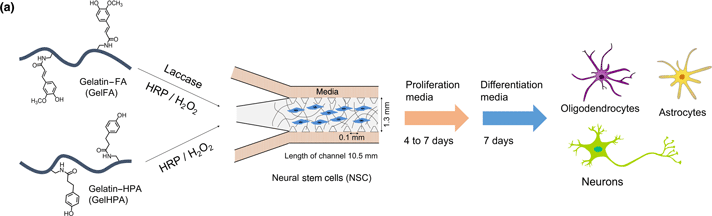
Three-dimensional cultures have exciting potential to mimic aspects of healthy and diseased brain tissue to examine the role of physiological conditions on neural biomarkers, as well as disease onset and progression. Hypoxia is associated with oxidative stress, mitochondrial damage, and inflammation, key processes potentially involved in Alzheimer's and multiple sclerosis. We describe the use of an enzymatically-crosslinkable gelatin hydrogel system within a microfluidic device to explore the effects of hypoxia-induced oxidative stress on rat neuroglia, human astrocyte reactivity, and myelin production. This versatile platform offers new possibilities for drug discovery and modeling disease progression.
Based on class-tested material, this concise yet comprehensive treatment of the fundamentals of solid mechanics is ideal for those taking single-semester courses on the subject. It provides interdisciplinary coverage of the key topics, combining solid mechanics with structural design applications, mechanical behavior of materials, and the finite element method. Part I covers basic theory, including the analysis of stress and strain, Hooke's law, and the formulation of boundary-value problems in Cartesian and cylindrical coordinates. Part II covers applications, from solving boundary-value problems, to energy methods and failure criteria, two-dimensional plane stress and strain problems, antiplane shear, contact problems, and much more. With a wealth of solved examples, assigned exercises, and 130 homework problems, and a solutions manual available online, this is ideal for senior undergraduates studying solid mechanics, and graduates taking introductory courses in solid mechanics and theory of elasticity, across aerospace, civil and mechanical engineering, and materials science.
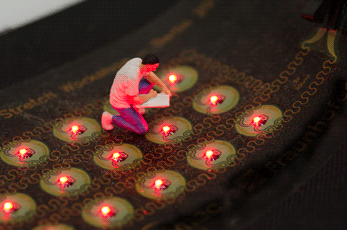
The development of flexible, stretchable, conformal electronics, and smart textiles for wearables and other applications by now lacks a guidance toward environmentally benign product concepts. This article facilitates understanding of environmental implications of material choices and design decisions to help material scientists and product developers alike to consider sustainability implications of their research, innovation, and development. The more such electronics enter the market, the more these composite products will emerge as an ecological problem, unless appropriate measures are taken at the early research stage.
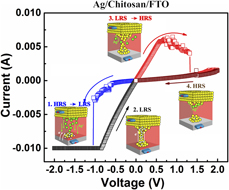
Chitosan has attracted significant attention in the past decade because of its potential applications in water engineering, the food and nutrition technology, the textile and paper industries, and drug delivery. Recently, a particularly interesting application of chitosan has been proposed in transparent flexible electronic devices, including memristors and transistors. In this work, the resistive switching (RS) effect of chitosan thin films in a capacitor-like structure with Ag and Al as alternative top electrodes was studied. Both the devices showed a bistable RS effect under an external electric field with a high endurance of 102. The electrical conduction and RS mechanisms of chitosan-based devices were investigated. The trap-controlled space charge–limited current was responsible for electrical transport at the low-resistance state of both devices, while direct tunneling and Schottky emission at the high-resistance state were related to Ag/chitosan/fluorine-doped tin oxide (FTO) and Al/chitosan/FTO, respectively. The RS mechanism of the Ag/chitosan/FTO device was attributed to the formation and dissociation of Ag filaments through the dielectric layer, whereas the change in the barrier height at the Al and chitosan interface under an external electric field could control the RS mechanism of the Al/chitosan/FTO device.
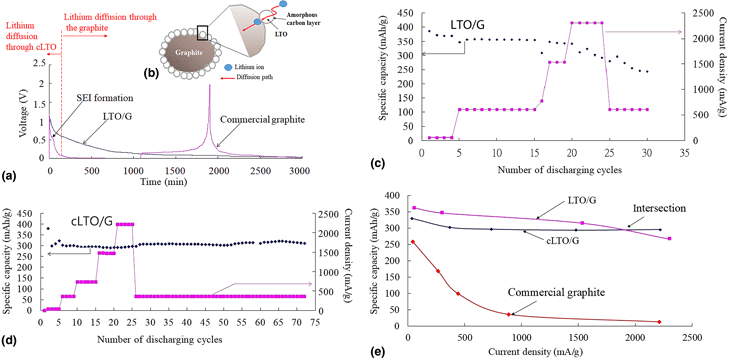
This research utilizes anatase TiO2 incorporated with lithium salt via a simple wet physical method to surface-modified the commercial graphite to form the lithium titanate/graphite composite coated with an amorphous carbon layer on its surface (the double core–shell structure) to enhance its surface conductivity. This double core–shell structure provides a stable specific capacity about 280 mAh/g under the high current density, 2.25 A/g with 15% capacity retention decay. Its intercalation potential is below 1 V that is much lower than that of 1.55 V, the intercalation potential of spinel Li4Ti5O12, to make higher power and energy density for a full cell.
We fabricated a van der Waals heterostructure of WS2–ReSe2 and studied its charge-transfer properties. Monolayers of WS2 and ReSe2 were obtained by mechanical exfoliation and chemical vapor deposition, respectively. The heterostructure sample was fabricated by transferring the WS2 monolayer on top of ReSe2 by a dry transfer process. Photoluminescence quenching was observed in the heterostructure, indicating efficient interlayer charge transfer. Transient absorption measurements show that holes can efficiently transfer from WS2 to ReSe2 on an ultrafast timescale. Meanwhile, electron transfer from ReSe2 to WS2 was also observed. The charge-transfer properties show that monolayers of ReSe2 and WS2 form a type-II band alignment, instead of type-I as predicted by theory. The type-II alignment is further confirmed by the observation of extended photocarrier lifetimes in the heterostructure. These results provide useful information for developing van der Waals heterostructure involving ReSe2 for novel electronic and optoelectronic applications and introduce ReSe2 to the family of two-dimensional materials to construct van der Waals heterostructures.
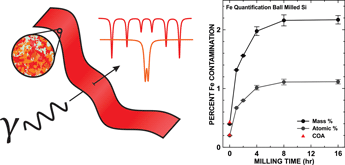
Quantitative Fe content determination of powders by Mössbauer spectroscopy is described. In this method, powder samples and internal standard are combined homogeneously in a plastic film ensuring a thin absorber. This method was verified by quantifying the Fe content of a series of samples and independently confirming by inductively coupled plasma optical emission spectroscopic analysis. Additionally, for the first time, Fe contamination in ball-milled Si as a function of milling time was quantified. It was found that Fe contamination increased with time but surprisingly became steady state at 1.12 ± 0.04 at.% Fe after grain size reduction.
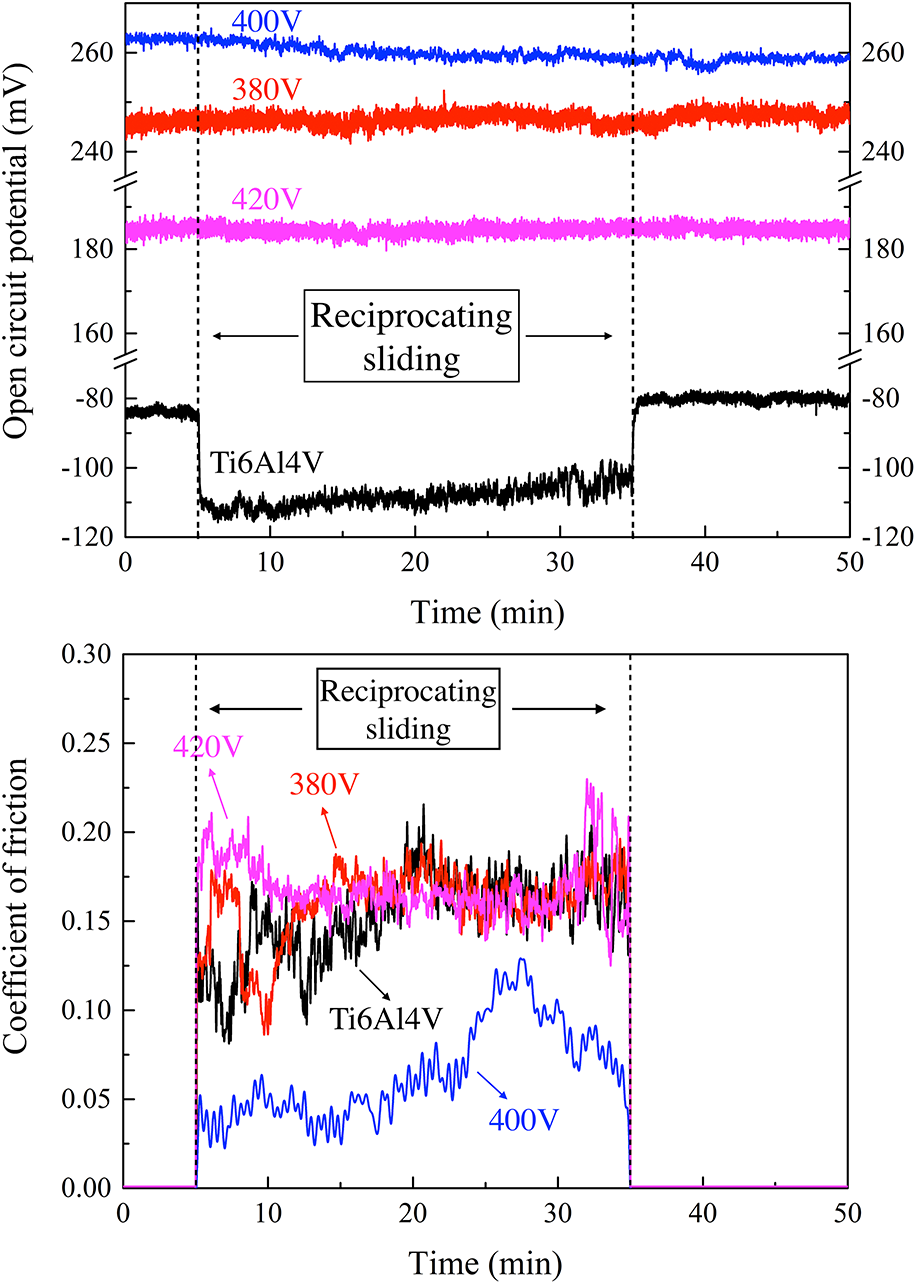
In this study, coatings containing Ca and P elements on Ti6Al4V alloy were fabricated by micro-arc oxidation at different applied voltages. Subsequently, evaluation of the phase structure, morphology, element composition, corrosion mechanism, and tribocorrosion behavior of these coatings was performed. The results showed that the coatings consisted of rutile TiO2 and anatase TiO2. The ratio of rutile/anatase, surface roughness, and hardness increase with the increase of applied voltage. Electrochemical impedance spectroscopy results indicated the corrosion resistance of coatings in simulated body fluid of 400 V > 380 V > 420 V. The open circuit potential of sample 400 V declined during the tribocorrosion test. Sample 420 V possessed the highest wear volume after the tribocorrosion process. The tribocorrosion mechanism of samples 380 and 420 V was mainly confirmed as the wear effect, and the decline of corrosion resistance due to the micro-cracks formed during the abrasive wear of the coating accounts for the tribocorrosion mechanism of sample 400 V.
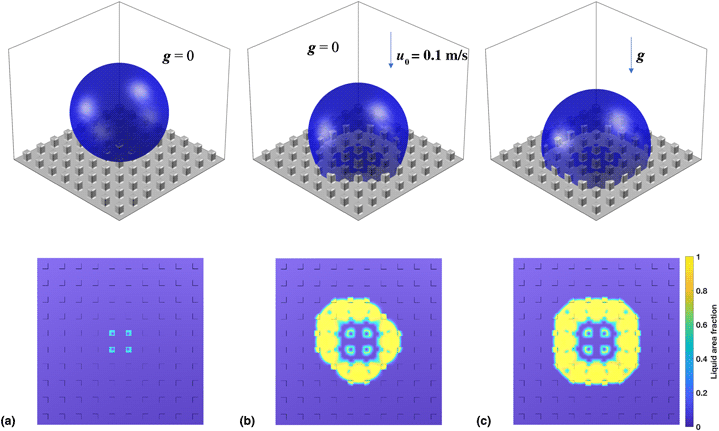
When the Cassie–Baxter and Wenzel states coexist for a liquid droplet on a micropatterned surface, the Cassie-to-Wenzel transition takes place if the energy barrier is overcome. Although multiple metastable states coexist due to the micropattern, this paper presents a simple Cassie-to-Wenzel transition of a 2 µL water droplet on a particular micropillared surface: When the droplet is gently deposited above the surface, it equalizes to the Cassie state at zero gravity; however, it transitions to the Wenzel state at the terrestrial gravity, in which the gravitational potential energy overcomes the energy barrier between the Cassie and Wenzel states.
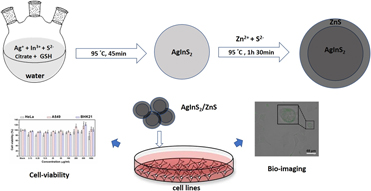
Chalcopyrite quantum dots (QDs) have emerged as a safe alternative to cadmium-based QDs for bio-applications. However, the research on AgInS2 chalcopyrite QDs has not been widely explored in terms of their toxicity. Herein, we report a synthesis of biocompatible AgInS2/ZnS QDs via a greener approach. The emission intensity of the as-synthesized AgInS2 core QDs was enhanced 2-fold after the ZnS shell growth. X-ray diffraction revealed the tetragonal crystal structure of QDs, and high-resolution transmission electron microscope images show that the QDs are spherical in shape and crystalline in nature. Cell viability assays conducted on different cell lines, such as HeLa, A549, and BHK-21 cells, indicated that AgInS2/ZnS QDs are least toxic at a QD concentration range of 100 µg/mL. The fluorescent microscope analysis of A549 cells incubated with AgInS2/ZnS QDs shows that the QDs were accumulated in the cell membranes. The as-synthesized AgInS2/ZnS QDs are less toxic and eco-friendly, and can be used for biolabeling.