A collection of out-of-copyright and rare books from the Cambridge University Library and other world-class institutions that have been digitally scanned, made available online, and reprinted in paperback.
To save content items to your account,
please confirm that you agree to abide by our usage policies.
If this is the first time you use this feature, you will be asked to authorise Cambridge Core to connect with your account.
Find out more about saving content to .
To save content items to your Kindle, first ensure no-reply@cambridge.org
is added to your Approved Personal Document E-mail List under your Personal Document Settings
on the Manage Your Content and Devices page of your Amazon account. Then enter the ‘name’ part
of your Kindle email address below.
Find out more about saving to your Kindle.
Note you can select to save to either the @free.kindle.com or @kindle.com variations.
‘@free.kindle.com’ emails are free but can only be saved to your device when it is connected to wi-fi.
‘@kindle.com’ emails can be delivered even when you are not connected to wi-fi, but note that service fees apply.
Sir James Frazer (1854–1941) is best remembered today for The Golden Bough, widely considered to be one of the most important early texts in the fields of psychology and anthropology. Originally a classical scholar, Frazer also published this five-volume edition of Ovid's Fasti in 1929. It contains the text and a parallel English translation, with commentary on the six books, indexes, illustrations, and plans. Frazer's interest in Ovid's unfinished final poem arose from his wide-ranging studies of ancient literature and the origins of myth. The work describes the origins of the Roman calendar with its sacred days, and ranges from the deeds of major gods and heroes to the strange rites involved in placating the goddess of mildew. Volume 3 contains Frazer's commentary on Books III and IV, dealing with the Roman months of March and April. Other works by Frazer are also reissued in the Cambridge Library Collection.
Following the mysterious disappearance of the La Pérouse expedition after it sailed out of Botany Bay in 1788, the French botanist Jacques-Julien Houtou de Labillardière (1755–1834) took part in the search that departed in 1791 from Brest in two ships, Recherche and Espérance. In the space of three years, the expedition's naturalists collected numerous specimens, with Labillardière focusing on Australian flora, but their missing countrymen were never found. Notwithstanding the later confiscation of the scientific collections by the British - Sir Joseph Banks helped to secure their return - Labillardière was able to publish this narrative to great acclaim in 1800. Reissued here is the English translation of the same year, complete with a volume of finely engraved plates. The work is especially notable for its descriptions and illustrations of the indigenous peoples of Australasia. This volume of illustrations contains more than forty plates depicting people, artefacts, plants and animals.
In 1876 the South Kensington Museum held a major international exhibition of scientific instruments and equipment, both historical and contemporary. Many of the items eventually formed the basis of collections now held at London's Science Museum. In May 1876, organisers arranged a series of conferences at which leading British and European scientists explained and demonstrated some of the items on display. The purpose was to emphasise the exhibition's goal not merely to preserve archaic treasures (such as Galileo's telescopes or Janssen's microscope) but to juxtapose them with current technology and so inspire future scientific developments. Volume 2 of the proceedings covers chemistry, biology, and earth sciences including geology, mining, meteorology and hydrography. The contributors include Joseph Dalton Hooker, William Thiselton-Dyer, Andrew Crombie Ramsay and John Rae, all of whom have other works reissued in the Cambridge Library Collection, which also includes the full catalogue of the exhibition itself.
Harvard's first professor of English, the American scholar Francis James Child (1825–96) had previously prepared a collection of English and Scottish ballads, published in 1857–9, before he embarked on producing this definitive critical edition. Organised into five volumes and published in ten parts between 1882 and 1898, the work includes the text and variants of 305 ballads, with Child's detailed commentary and comparison with ballads and stories from other languages. Although he did not live to fully clarify his methods of selection and classification, modern scholars still refer to the 'Child Ballads' as an essential resource in the study of folk songs and stories in the English language. Volume 5, Part 2 (1898) contains additions and corrections, a helpful glossary of archaic terms, a long list of sources, musical scores for 46 of the ballads, indexes, and a bibliography.
Born near Aachen, Leonhard Schmitz (1807–90) studied at the University of Bonn, from which he received his PhD, before marrying an Englishwoman and becoming a naturalised British citizen. Made famous by the 1844 publication of his translation of Niebuhr's Lectures on the History of Rome, he became rector of the Royal High School, Edinburgh, where he taught Alexander Graham Bell. He also briefly tutored the future Edward VII (and he had previously taught Prince Albert in Bonn). This short-lived quarterly journal, which Schmitz founded and edited between 1844 and 1850, focused exclusively on aspects of classical antiquity - in contrast to the more general literary reviews that were common in the period. It illuminates the development of Classics as a specialist discipline as well as contemporary intellectual links between Britain and Germany. This third volume was published in 1846.
August Boeckh's work, first published in 1817, is still regarded as one of the most thorough treatments of the economic structures of Athenian society. Boeckh makes exhaustive use of the epigraphical and literary sources he has at his disposal and covers a wide range of topics. Volume 2 consists of the source material upon which Boeckh bases his findings about the Athenian economy. There are extracts from the accounts of the 'holy funds', and others from statements that detail the income and expenditure of the Treasury of the Athenians at Delphi. Other documents relate to the upkeep of the Parthenon and other temples; and to trade agreements such as that made between Athens and the island of Kea, detailing the removal of red stone from the island to the city. Boeckh also investigates the effect of the Peloponnesian War on the economy. This reissue is of the 1886 edition.
Founded in 1868 by the Cambridge scholars John Eyton Bickersteth Mayor (1825–1910), William George Clark (1821–78), and William Aldis Wright (1831–1914), this biannual journal was a successor to The Journal of Classical and Sacred Philology (also reissued in the Cambridge Library Collection). Unlike its short-lived precursor, it survived for more than half a century, until 1920, spanning the period in which specialised academic journals developed from more general literary reviews. Predominantly classical in subject matter, with contributions from such scholars as J. P. Postgate, Robinson Ellis and A. E. Housman, the journal also contains articles on historical and literary themes across the 35 volumes, illuminating the growth and scope of philology as a discipline during this period. Volume 13, comprising issues 25 and 26, was published in 1885.
Harvard's first professor of English, the American scholar Francis James Child (1825–96) had previously prepared a collection of English and Scottish ballads, published in 1857–9, before he embarked on producing this definitive critical edition. Organised into five volumes and published in ten parts between 1882 and 1898, the work includes the text and variants of 305 ballads, with Child's detailed commentary and comparison with ballads and stories from other languages. Although he did not live to fully clarify his methods of selection and classification, modern scholars still refer to the 'Child Ballads' as an essential resource in the study of folk songs and stories in the English language. The work also contains a helpful glossary of archaic terms and a long list of sources. Volume 5, Part 1 (1892) contains ballads 266-305, including 'Get Up and Bar the Door' and 'The Outlaw Murray'.
The amateur scientist George John Singer (1786–1817) worked in the family business of artificial flower and feather making, but all his spare time was absorbed in the study of electricity and electromagnetism. He invented his own apparatus, including a gold-leaf electrometer, and built a laboratory-cum-lecture room at the back of his house: his public demonstrations were attended by Faraday and Francis Ronalds, and he was also a friend of the pioneering 'electrician' Andrew Crosse. This significant book, published in 1814, demonstrates the breadth of Singer's knowledge of his subject and of other contemporary work in the field. It describes in detail electric phenomena, in nature and in the laboratory, covering a wide range of experiments with and applications of electricity, and discussing the work of Franklin, Volta, Crosse and Dalton, among others. Sadly, Singer's promising scientific career was brought to an early end by tuberculosis: he died aged only thirty-one.
The Arctic explorer Sir John Richardson (1787–1865), who had accompanied both John Franklin and John Rae on major expeditions, expands here an article which had appeared in the Encyclopaedia Britannica. Organised in two parts, and published in 1861, this work covers first the Arctic and then the largely unexplored Antarctic. Adopting a chronological approach in the first part, Richardson covers Roman knowledge of the far north, Norse voyages, and later exploration by the British, Dutch and Russians. He then deals in detail with the search for the North-West Passage, including the expeditions in search of Sir John Franklin. Later chapters cover Spitsbergen, Arctic weather, ice, currents, geology, vegetation and zoology, as well as the three principal groups of native people: the Inuit, Lapps and Samoyeds. In the second part, Richardson outlines Antarctic exploration since 1576, providing an overview of what little was known of this part of the globe.
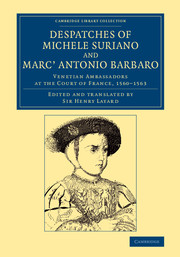
Edited by the retired politician and archaeologist Sir Austen Henry Layard (1817–94), this 1891 publication reproduces the despatches of Michele Suriano and Marcantonio Barbaro, Venetian ambassadors to France in 1560–1 and 1561–4 respectively. Addressed to the doge of Venice, the documents provide valuable accounts of one of the most fascinating periods of French history, covering the death of Francis II, the accession of Charles IX, the regency of Catherine de' Medici, and the negotiations for the marriage of Mary, Queen of Scots. The documents appear in their original Italian and in English translation. Evident in Suriano's and Barbaro's letters is the underlying tension between French Catholics and Protestant Huguenots, which would culminate in the St Bartholomew's Day Massacre of 1572. The book was produced for the Huguenot Society of London, and Layard, the Society's first president, was himself of Huguenot descent.
Founded in 1868 by the Cambridge scholars John Eyton Bickersteth Mayor (1825–1910), William George Clark (1821–78), and William Aldis Wright (1831–1914), this biannual journal was a successor to The Journal of Classical and Sacred Philology (also reissued in the Cambridge Library Collection). Unlike its short-lived precursor, it survived for more than half a century, until 1920, spanning the period in which specialised academic journals developed from more general literary reviews. Predominantly classical in subject matter, with contributions from such scholars as J. P. Postgate, Robinson Ellis and A. E. Housman, the journal also contains articles on historical and literary themes across the 35 volumes, illuminating the growth and scope of philology as a discipline during this period. Volume 29, comprising issues 57 and 58, was published in 1904.
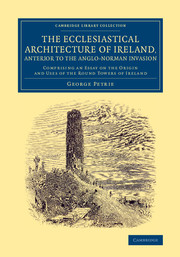
Following in the footsteps of his father, George Petrie (1790–1866) devoted his early life to art. However, as he toured Ireland and painted historic monuments, his interest in his country's antiquities began to grow, and his research into the origin and uses of Irish round towers would help cement his reputation as a founding father of Irish archaeology. This second edition of his major work appeared in 1845, the same year as the first. It expands on his earlier essay on the same topic, which had won him a gold medal from the Royal Irish Academy in 1833. Petrie's illustrated study refuted the various contemporary theories about the round towers and put forward evidence-based arguments which later archaeologists have refined but broadly accepted. The Life and Labours in Art and Archaeology of George Petrie (1868), written by his friend William Stokes, is also reissued in the Cambridge Library Collection.
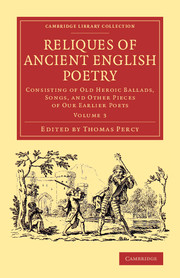
While visiting a friend, the writer and cleric Thomas Percy (1729–1811) noticed a neglected folio whose pages were being used by the maids to light the fire. Upon inspection, this manuscript was found to be a seventeenth-century collection of historical ballads. Following this discovery, Percy collected further ballads and songs from a number of sources, which he published in this three-volume work in 1765, although ultimately only a quarter of the texts he presented came from that original manuscript. Although this work proved to be incredibly popular, Percy's idiosyncratic editorial practices also received much criticism. The collection centres on historical ballads and romances, demonstrating the development of language, customs and traditions, to which Percy added contemporary ballads for his readers' enjoyment. Volume 3 includes ballads of Sir Gawain, King Arthur and St George and the Dragon, and contains the additions and corrections to all three volumes.
Displaying her intellectual and literary abilities from a young age, 'Mrs Taylor of Ongar' (1757–1830) enjoyed writing all her life. She had eleven children, of whom six (four of them writers) survived to adulthood. Her published works began with advice books for her own daughters, produced when increasing deafness made ordinary conversation difficult for her. Given the difficulty of providing advice equally appropriate to girls at all levels of society, this 1815 work is addressed to 'females in the middle ranks'. It is assumed that a girl's aspiration, as well as her destiny, is to be a wife and mother: conduct towards the husband, and the rearing of children, are of prime importance. But there is also a chapter for the husband, pointing out his reciprocal duties to his wife as an equal partner in their relationship. The book offers fascinating insights into the middle-class ideal of domestic happiness.
Born near Aachen, Leonhard Schmitz (1807–90) studied at the University of Bonn, from which he received his PhD, before marrying an Englishwoman and becoming a naturalised British citizen. Made famous by the 1844 publication of his translation of Niebuhr's Lectures on the History of Rome, he became rector of the Royal High School, Edinburgh, where he taught Alexander Graham Bell. He also briefly tutored the future Edward VII (and he had previously taught Prince Albert in Bonn). This short-lived quarterly journal, which Schmitz founded and edited between 1844 and 1850, focused exclusively on aspects of classical antiquity – in contrast to the more general literary reviews that were common in the period. It illuminates the development of Classics as a specialist discipline as well as contemporary intellectual links between Britain and Germany. This first volume was published in 1844.
Clerk of works to an aristocratic landowner, Thomas Potter possessed considerable practical experience when he published this work in 1877. His intention was to provide a source of helpful information relating to a building material that was being increasingly used in Victorian construction, yet not without detractors, who objected on aesthetic as well as technical grounds. Clearly enthusiastic about concrete's potential applications, Potter seeks to give a balanced assessment of its usefulness and versatility. While the text does not discuss the chemical processes involved, it does cover aggregates, matrices, how to mix the two, the apparatus needed, the construction of walls, floors and roofs, and the costs and disadvantages of using concrete. The book also features several contemporary advertisements, including one for 'Potter's Concrete Building Apparatus and Appliances'. Of related interest, Charles William Pasley's Observations on Limes, Calcareous Cements, Mortars, Stuccos, and Concrete (1838) is also reissued in this series.
A precursor of modern academic journals, this quarterly periodical, published between 1810 and 1829 and now reissued in forty volumes, was founded and edited by Abraham John Valpy (1787–1854). Educated at Pembroke College, Oxford, Valpy established himself in London as an editor and publisher, primarily of classical texts. Edmund Henry Barker (1788–1839), who had studied at Trinity College, Cambridge, became a contributor and then co-editor of this journal, which fuelled a scholarly feud with the editors of the Museum criticum (1813–26), a rival periodical (also reissued in the Cambridge Library Collection). Although its coverage overlapped with that of its competitor, the Classical Journal also included general literary and antiquarian articles as well as Oxford and Cambridge prize poems and examination papers. It remains a valuable resource, illuminating the development of nineteenth-century classical scholarship and academic journals. Volume 27 contains the March and June issues for 1823.
The controversy over the route taken by Hannibal, the Carthaginian army and his famous elephants in their crossing of the Alps to attack Rome in 218 BCE began within fifty years of the event and has continued for many centuries. A particular scholarly dispute emerged in the 1850s between Robert Ellis (1819/20–85) and William John Law (1786–1869), and was fought in the pages of the Journal of Classical and Sacred Philology and in books. Ellis, a classical scholar, had surveyed the Alpine passes in 1852 and again in 1853, when he published his Treatise on Hannibal's Passage of the Alps (also reissued in this series), claiming that the Little Mount Cenis route was the one used. Law responded immediately in the Journal, and later published his own theory, to which Ellis riposted in 1867 with this work. Modern scholarship doubts, however, that either man was right.
Professor of civil engineering at University College London, Leveson Francis Vernon-Harcourt (1839–1907) drew on considerable practical experience, having worked most notably on London's East and West India docks. The present work was first published in two volumes in 1885. This reissue combines in one volume the text and the plates, including plans and maps of important examples. The topics discussed include natural and artificial harbours; the impact of waves, tides and currents; and general principles of construction. Furthering Vernon-Harcourt's aim to educate readers on both the theory and practice of hydraulic engineering, the work features case studies on specific projects (including their origins and condition at that time), shedding much light on the history and operation of infrastructure that proved essential for the development of modern trade. Of related interest, Thomas Stevenson's The Design and Construction of Harbours (second edition, 1874) is also reissued in this series.