A collection of out-of-copyright and rare books from the Cambridge University Library and other world-class institutions that have been digitally scanned, made available online, and reprinted in paperback.
To save content items to your account,
please confirm that you agree to abide by our usage policies.
If this is the first time you use this feature, you will be asked to authorise Cambridge Core to connect with your account.
Find out more about saving content to .
To save content items to your Kindle, first ensure no-reply@cambridge.org
is added to your Approved Personal Document E-mail List under your Personal Document Settings
on the Manage Your Content and Devices page of your Amazon account. Then enter the ‘name’ part
of your Kindle email address below.
Find out more about saving to your Kindle.
Note you can select to save to either the @free.kindle.com or @kindle.com variations.
‘@free.kindle.com’ emails are free but can only be saved to your device when it is connected to wi-fi.
‘@kindle.com’ emails can be delivered even when you are not connected to wi-fi, but note that service fees apply.
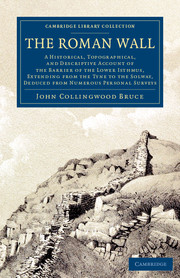
A Historical, Topographical, and Descriptive Account of the Barrier of the Lower Isthmus, Extending from the Tyne to the Solway, Deduced from Numerous Personal Surveys
Brought up in Newcastle-upon-Tyne, John Collingwood Bruce (1805–92) was fascinated by the antiquities of the north of England, and made an especial study of the impressive ruins of the 'Roman Wall'. He published this work in 1851, using both the writings of medieval and recent historians, and his own and others' field surveys and excavations. It describes the route of the wall from the Solway to Wallsend, and the surviving structures such as forts and milecastles along its length. Bruce also discusses and illustrates the Roman artefacts discovered around the wall, from pottery and nails to funerary monuments, which give insights into the lives of the soldiers from across the Roman empire who were stationed at this northern outpost. His argument that Hadrian was the builder of the wall reminds us that, until the mid-nineteenth century, it was thought to have been the idea of the later emperor Septimius Severus.
As first mate aboard an East India Company vessel, James Horsburgh (1762–1836) was shipwrecked in the Indian Ocean in 1786 after faulty charts steered the ship onto a reef. Thereafter he devoted himself to the production of accurate charts of the eastern seas, keeping meticulous notes on extensive voyages, and carefully scrutinising the accounts and journals of other mariners. For his efforts, Horsburgh was elected to the Royal Society in 1806, and appointed hydrographer to the East India Company in 1810. The present work, reissued here in its two-volume first edition of 1809–11, remained a standard navigational reference for half a century (it was aboard the Beagle during Darwin's famous voyage). For given locations, it provides a description of the area and landmarks, and lists prevailing winds and currents, as well as any navigational hazards. Volume 1 covers mostly places on the sailing route to India, via Brazil and the Cape of Good Hope.
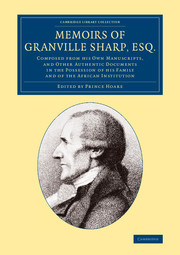
Self-educated in languages and the law, the author Granville Sharp (1735–1813) was a leading anti-slavery campaigner. Though many of his associates in the abolitionist movement were dissenters or freethinkers, he was an Anglican very much concerned with the fate of the church in America after the war of independence. His family consigned his archives to the painter, playwright and author Prince Hoare (1755–1834), who published this biography in 1820. Sharp is less well remembered than other British abolitionists such as Clarkson and Wilberforce, but it was his work which, in 1772, brought the landmark case of James Somerset before Lord Mansfield, who upheld Sharp's legal arguments: as a result, it was henceforth understood that any slave reaching the shores of England became free. Sharp's continuing work for abolition, and his many other charitable and scholarly activities, are detailed in this fascinating work, drawn directly from his own writings.
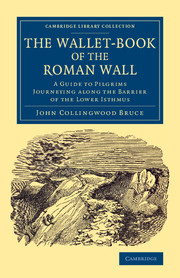
After the success of his 1851 book on the Roman Wall (also reissued in this series), in 1863 John Collingwood Bruce (1805–92) published this shorter work, intended as 'a guide to pilgrims journeying along the Barrier of the Lower Isthmus'. Designed 'for the field, not the library table', it sought 'to inform the traveller what he is to look for, and to assist him in examining it'. Bruce first gives a short history of the wall, including medieval and more recent accounts, and then an overview of the 73-mile structure itself, from Wallsend in the east to Bowness in the west. The remainder of the book, illustrated with maps and line engravings, leads the traveller from section to section, noting details such as the re-use of Roman masonry in more recent buildings. This guide was enormously popular, and newly revised versions continue to be published in the twenty-first century.
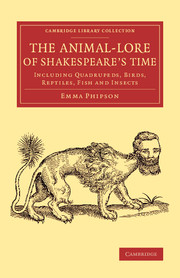
Shakespeare's plays contain a rich abundance of metaphors, similes and phrases relating to animals and the natural world, much of which can seem obscure to us today. First published in 1883, Emma Phipson's classic study sets in context the animal lore of the late sixteenth and early seventeenth centuries to show how it affected the literature of the time. Drawing on a collection of compelling sources, this book explores the beliefs about natural science that influenced the works of Shakespeare and his contemporaries. Phipson considers obscure writings by naturalists and antiquarians on a wide range of animals from the familiar to the exotic, and from the real to the mythical. Whether discussing hedgehogs or unicorns, the text shows how the Elizabethans' understanding of animals was coloured by hunting, travel, folklore and the Bible, and how this had a lasting impact upon language and culture.
Marie Luise Gothein (1863–1931) published this scholarly two-volume history of garden design in German in 1913. Its second edition of 1925 was translated into English by Laura Archer-Hind, edited by gardening author Walter P. Wright (1864–1940), and published in 1928. The highly illustrated work is still regarded as among the most thorough and important surveys of its kind. It begins by examining evidence from both archaeology and literature, as well as climate and soil conditions, to discuss the gardens of ancient Egypt and Assyria, and continues to survey developments worldwide until the twentieth century. Individual gardens, technical innovations, and fashions in horticulture are all discussed in detail. Volume 1 surveys the ancient civilisations of the Near East, Greece and Rome, discusses Byzantine and Islamic gardens, and the importance of monastery gardens in western Europe, and ends with a review of gardening in Europe during the Renaissance.
Travelling in order to recover from a nervous breakdown, Basil Hall Chamberlain (1850–1935) arrived in Yokohama, Japan, in May 1873. He was immediately fascinated by traditional Japanese culture. At the same time, the national drive for modernisation in the wake of the Meiji Restoration had created a demand for teachers of English. Chamberlain was taken on as a tutor in the Imperial Japanese Naval Academy, at the same time studying the Japanese language to such good effect that in 1886 he was made professor of Japanese and philology at the Imperial University (later Tokyo University). This 1888 Japanese primer is split into theoretical and practical parts: a Japanese grammar and a vocabulary of useful words and phrases. Chamberlain gives both literal and free translations of phrases and short texts for the learner. His encyclopaedia of Japan, Things Japanese (1890) is also reissued in the Cambridge Library Collection.
Richard Hakluyt's 12-volume Principal Navigations Voyages Traffiques and Discoveries of the English Nation, originally published at the end of the sixteenth century, and reissued by the Cambridge Library Collection in the edition of 1903–5, was followed in 1625 by Hakluytus Posthumus or, Purchas his Pilgrimes, now reissued in a 20-volume edition published in 1905–7. When first published in four folio volumes, the work was the largest ever printed in England. An Anglican priest, Samuel Purchas (1577–1626) was a friend of Hakluyt, and based his great work in part on papers not published by Hakluyt before his death. As well as being a wide-ranging survey of world exploration, it is notable as an anti-Catholic polemic, and a justification of British settlement in North America. Volume 3 describes voyages sponsored by the East India Company, including those of David Middleton and the merchant Richard Cocks.
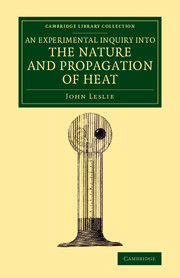
The Scottish mathematician and natural philosopher Sir John Leslie (1766–1832) had set out at the end of the eighteenth century to explore the nature of heat radiation, which he felt was a 'dubious and neglected' area of physics. Leslie's inquiry, published in 1804, details his many experiments, notably the use of two self-devised instruments: Leslie's cube and his differential thermometer. Establishing several basic laws of heat radiation and rejuvenating the debate about the physical composition of heat, Leslie's work gained him the Rumford medal of the Royal Society in 1805. Nevertheless, the same publication jeopardised his chances of obtaining an academic position at Edinburgh. A single, allegedly atheistic endnote, supporting David Hume's views on causation, prompted protests by the local clergymen when his candidature for the chair of mathematics was under consideration. Leslie secured the professorship, however, and remained with the university until his death.
The appearance of the first issue of The Tatler in 1709 is usually regarded as the beginning of periodical publication in England. Its founder, Richard Steele (1672–1729), intended 'a paper, which should observe upon the manners of the pleasurable, as well as the busy part of mankind … by way of a letter of intelligence, consisting of such parts as might gratify the curiosity of persons of all conditions, and of each sex'. The 'datelines' of the reports, on news, literature, and plain gossip, were from the most famous coffee houses of early Georgian London, and the contributors included Jonathan Swift and Joseph Addison. The magazine was published for only two years, from April 1709 to January 1711: shortly afterwards, Steele and Addison co-founded The Spectator. This four-volume edition was issued in 1797 by a consortium of publishers, including John Nichols. Volume 1 contains the first fifty numbers.
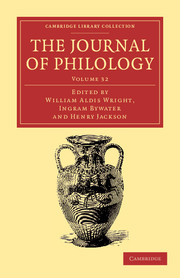
Founded in 1868 by the Cambridge scholars John Eyton Bickersteth Mayor (1825–1910), William George Clark (1821–78), and William Aldis Wright (1831–1914), this biannual journal was a successor to The Journal of Classical and Sacred Philology (also reissued in the Cambridge Library Collection). Unlike its short-lived precursor, it survived for more than half a century, until 1920, spanning the period in which specialised academic journals developed from more general literary reviews. Predominantly classical in subject matter, with contributions from such scholars as J. P. Postgate, Robinson Ellis and A. E. Housman, the journal also contains articles on historical and literary themes across the 35 volumes, illuminating the growth and scope of philology as a discipline during this period. Volume 32, comprising issues 63 and 64, was published in 1913.
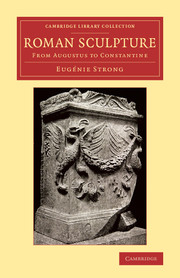
Eugénie Strong (née Sellers, 1860–1943) studied classics at Girton College, Cambridge, and then classical archaeology in London. Her translations of Schuchardt's account of Schliemann's excavations at Troy, and of Fürtwangler's Masterpieces of Greek Sculpture, are also reissued in this series. Among other distinctions, she was the first female student of the British School at Athens, and in 1909 (partly as a result of the 1907 publication of this book) was appointed assistant director of the British School at Rome. Roman sculpture had consistently been regarded as the 'poor relation' of what was seen as the superior art of Greece, but in this highly illustrated work, covering the period from Augustus to Constantine, Strong argues both for its particular aesthetic qualities and also for its importance as occupying a special place 'at the psychological moment when the Antique passes from the service of the Pagan State into that of Christianity'.
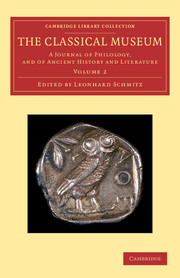
Born near Aachen, Leonhard Schmitz (1807–90) studied at the University of Bonn, from which he received his PhD, before marrying an Englishwoman and becoming a naturalised British citizen. Made famous by the 1844 publication of his translation of Niebuhr's Lectures on the History of Rome, he became rector of the Royal High School, Edinburgh, where he taught Alexander Graham Bell. He also briefly tutored the future Edward VII (and he had previously taught Prince Albert in Bonn). This short-lived quarterly journal, which Schmitz founded and edited between 1844 and 1850, focused exclusively on aspects of classical antiquity - in contrast to the more general literary reviews that were common in the period. It illuminates the development of Classics as a specialist discipline as well as contemporary intellectual links between Britain and Germany. This second volume was published in 1845.
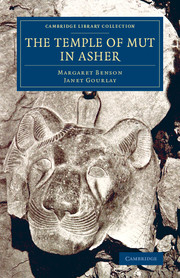
An Account of the Excavation of the Temple and of the Religious Representations and Objects Found Therein, as Illustrating the History of Egypt and the Main Religious Ideas of the Egyptians
Margaret Benson (1865–1916), the fourth of six children of the archbishop of Canterbury E. W. Benson, was a brilliant scholar at Oxford who found an escape from the conventional life of housekeeping for her father when she travelled to Egypt for her health in 1895. She obtained permission to excavate a site, of which she candidly admits that the authorities had no expectations (or they would not have entrusted it to such inexperienced amateurs). She and her close friend Janet Gourlay (1863–1912), who had briefly studied archaeology under Flinders Petrie, published this account of their discoveries at the temple of Mut at Karnak in 1899. It contains an overview of the site and its context in Egyptian history, with an account of the three seasons of excavation and a section on Egyptian religion. The highly illustrated book concludes with translations of the many inscriptions found in the temple remains.
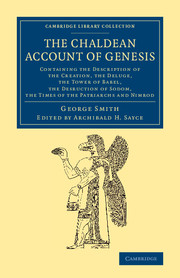
Containing the Description of the Creation, the Fall of Man, the Deluge, the Tower of Babel, the Desruction of Sodom, the Times of the Patriarchs, and Nimrod
The Assyriologist George Smith (1840–76) was trained originally as an engraver, but was enthralled by the discoveries of Layard and Rawlinson. He taught himself cuneiform script, and joined the British Museum as a 'repairer' or matcher of broken cuneiform tablets. Promotion followed, and after one of Smith's most significant discoveries among the material sent to the Museum - a Babylonian story of a great flood - he was sent to the Middle East, where he found more inscriptions which contained other parts of the epic tale of Gilgamesh. In 1876, shortly before his early death, Smith published this work, which drew extraordinary parallels between much earlier cuneiform documents and the biblical book of Genesis. The book was both controversial and very successful. The second edition, reissued here, was published in 1880, with corrections and additional material provided by Archibald Sayce (1846–1933), which reflected recent advances in Middle Eastern studies.
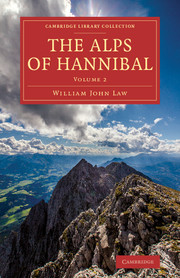
Controversial for centuries, the route across the Alps taken by Hannibal, his Carthaginian army and his famous elephants in 218 BCE formed the basis of an extended scholarly dispute between William John Law (1786–1869) and Robert Ellis (1819/20–85). Fought in the pages of books and the Journal of Classical and Sacred Philology, their exchanges lasted several years. Ellis' Treatise on Hannibal's Passage of the Alps (1853) and An Enquiry into the Ancient Routes between Italy and Gaul (1867) are also reissued in this series. Published in 1866, this two-volume work was Law's major contribution to the debate, examining the various theories and historical accounts. Modern scholarship has questioned, however, whether either man was right. Volume 2 examines the writings of Livy, comparing them to those of Polybius and determining which of the two can be deemed to be the more reliable. Law then draws his final conclusions.
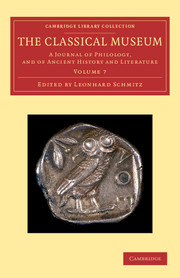
Born near Aachen, Leonhard Schmitz (1807–90) studied at the University of Bonn, from which he received his PhD, before marrying an Englishwoman and becoming a naturalised British citizen. Made famous by the 1844 publication of his translation of Niebuhr's Lectures on the History of Rome, he became rector of the Royal High School, Edinburgh, where he taught Alexander Graham Bell. He also briefly tutored the future Edward VII (and he had previously taught Prince Albert in Bonn). This short-lived quarterly journal, which Schmitz founded and edited between 1844 and 1850, focused exclusively on aspects of classical antiquity - in contrast to the more general literary reviews that were common in the period. It illuminates the development of Classics as a specialist discipline as well as contemporary intellectual links between Britain and Germany. This seventh volume was published in 1850.
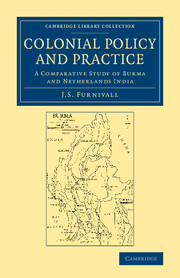
A noted historian of Burma and a founder of the Burma Research Society, John Sydenham Furnivall (1878–1960) supported Burmese independence and freedom from colonial rule. However, he has been considered as Eurocentric and in favour of colonialism, in part because he saw it as a necessary stage in the improvement of certain societies. Stemming from a request in 1942 by the colonial government for Furnivall's views on reconstruction, this influential study was published in 1948. Using the Dutch East Indies as a case study for comparison, Furnivall assesses the effects of the different systems of colonial rule, framed within general surveys of their colonial policies and practices. The book is driven by the goal of consolidating and stabilising Burma's plural society, focusing on the importance of the welfare of the native population. Furnivall's Netherlands India (1939) has also been reissued in the Cambridge Library Collection.
Sir Robert Harry Inglis Palgrave (1827–1919) began his career in country banking, but through assiduous self-education became a leading figure in economic circles. In 1877, he was made an editor of The Economist and formulated plans with other experts to further the general understanding of economics. The most significant result of these plans was the present work. Similar books had already been published in Europe, but a work in English was long overdue. Concerned less with abstract theory and more with practical and historical issues, Palgrave gathered a distinguished group of international contributors, and the three volumes originally appeared in 1894, 1896 and 1899. A landmark in publishing, the work made the discipline of economics accessible to educated adults for the first time. Volume 3, covering N to Z, includes entries on opium, property, Ricardo, Smith, socialism, taxation, and wages.
A participant in the Greek struggle for independence alongside Lord Byron, the philhellene George Finlay (1799–1875) lent his support to the newly liberated nation while diligently studying its past. The monographs he published in his lifetime covered the history of Greece since the Roman conquest, spanning two millennia. His two-volume History of the Greek Revolution (1861) is reissued separately in this series. Edited by the scholar Henry Fanshawe Tozer (1829–1916) and published in 1877, this seven-volume collection brought together Finlay's histories, incorporating significant revisions. Notably, Finlay gives due consideration to social and economic factors as well as high politics. Volume 5 covers the history of Greece under Ottoman and Venetian rule from 1453 to 1821. Finlay gives an overview of the political and military organisation of the Ottoman empire, touching also on the social conditions of the Greeks. He argues that growing national consciousness set the stage for Greek independence.