A collection of out-of-copyright and rare books from the Cambridge University Library and other world-class institutions that have been digitally scanned, made available online, and reprinted in paperback.
To save content items to your account,
please confirm that you agree to abide by our usage policies.
If this is the first time you use this feature, you will be asked to authorise Cambridge Core to connect with your account.
Find out more about saving content to .
To save content items to your Kindle, first ensure no-reply@cambridge.org
is added to your Approved Personal Document E-mail List under your Personal Document Settings
on the Manage Your Content and Devices page of your Amazon account. Then enter the ‘name’ part
of your Kindle email address below.
Find out more about saving to your Kindle.
Note you can select to save to either the @free.kindle.com or @kindle.com variations.
‘@free.kindle.com’ emails are free but can only be saved to your device when it is connected to wi-fi.
‘@kindle.com’ emails can be delivered even when you are not connected to wi-fi, but note that service fees apply.
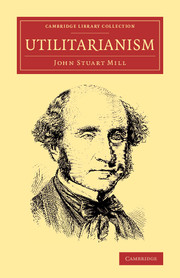
Reissued here in its corrected second edition of 1864, this essay by John Stuart Mill (1806–73) argues for a utilitarian theory of morality. Originally printed as a series of three articles in Fraser's Magazine in 1861, the work sought to refine the 'greatest happiness' principle that had been championed by Jeremy Bentham (1748–1832), defending it from common criticisms, and offering a justification of its validity. Following Bentham, Mill holds that actions can be judged as right or wrong depending on whether they promote happiness or 'the reverse of happiness'. Although attracted by Bentham's consequentialist framework based on empirical evidence rather than intuition, Mill separates happiness into 'higher' and 'lower' pleasures, arguing for a weighted system of measurement when making and judging decisions. Dissected and debated since its first appearance, the essay is Mill's key discussion on the topic and remains a fundamental text in the study of ethics.
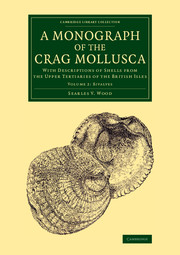
The Pliocene-Pleistocene Crags of East Anglia are an incredibly rich source of fossil shells, many belonging to extant Boreal and Mediterranean genera. Dominated by marine gastropods and bivalves, the deposits also contain evidence of terrestrial and non-marine gastropods and bivalves, brachiopods, and extensive epifauna including bryozoans. Published between 1848 and 1879 in four volumes, the latter two being supplements with further descriptions and geological notes, this monograph by Searles Valentine Wood (1798–1880) covers more than 650 species and varieties of fossil mollusc. For each species Wood gives a synonymy, diagnosis (in Latin), full description, dimensions, occurrence and remarks. The supplements also provide a breakdown of the species and their current distribution. The detailed plates were prepared by the conchologist George Brettingham Sowerby and his namesake son. Volume 2 (1851–61) covers bivalves and brachiopods, illustrated in 31 plates.
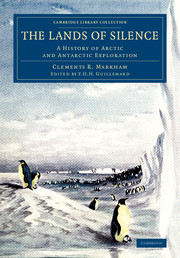
Sir Clements R. Markham (1830–1916) had succumbed to smoke after accidentally igniting his bedclothes while reading by candlelight; the task of completing this history therefore fell to his friend and fellow geographer F. H. H. Guillemard (1852–1933), who published it in 1921. In the course of his long career, Markham had sailed to the Arctic in search of Sir John Franklin, jeopardised his job in the India Office by joining the British attempt to reach the North Pole in 1875–6, and served as president of the Royal Geographical Society, sending Robert Falcon Scott on his first expedition to Antarctica. His extensive knowledge of the prominent polar explorers and expeditions of his day lends this publication an especial interest and authority. Enhanced by a number of maps and illustrations, the book also considers certain scientific and economic developments, notably the growth of the whaling industry.
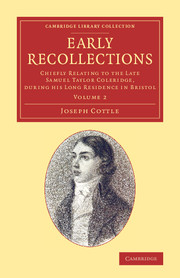
The reminiscences of Bristol bookseller Joseph Cottle (1770–1853) have been described as 'unreliable but essential'. The son of a tailor, Cottle was an avid reader, opening a bookshop in 1791. Three years later he was introduced to Samuel Taylor Coleridge and Robert Southey, and became the earliest publisher of their works: through them, he also knew Wordsworth, and published the Lyrical Ballads in 1798. He later fell out with all three men, and in 1837 published (despite Southey and Coleridge's family attempting to prevent it) this quickly notorious two-volume work, through which Cottle lost an expensive libel case in which he was sued by Hannah More's coachman. Ten years later, he recast the book as Reminiscences of Samuel Taylor Coleridge and Robert Southey (also reissued in this series). Both works contain evasions and distortions, but are valuable for their account of some vital years in the lives of the great Romantic poets.
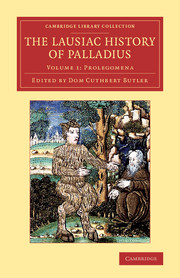
The church historian and Benedictine monk Cuthbert Butler (1858–1934) was known for his expertise on the monastic life and wrote several books on the subject, including Benedictine Monachism (1919) and Western Mysticism (1922). Previously he had produced this two-volume edition of Palladius of Galatia's Lausiac History. Written in the early fifth century, it records the lives of the Egyptian 'Desert Fathers' and is an important source for early monasticism. In Volume 1 (1898), Butler begins with a general introduction to Palladius' work, followed by a critical survey of the various versions of Palladius' text, which survives in Greek, Latin, Syriac, Armenian and Coptic. The volume includes a contribution by Armitage Robinson, later Dean of Westminster, on the Armenian version. The later part of this volume turns to an exploration of Palladius' theology, other related sources for the history of Egyptian monasticism, and a historical discussion of early monasticism.
In 1863, the English architect John Turtle Wood (1821–90) resigned from a railway development project in western Turkey to begin his search at Ephesus for the Temple of Artemis, lost from view since the middle ages. In the first part of this well-illustrated 1877 publication, Wood describes the city and the initial excavations carried out with support from the British Museum. This survey of various structures concludes with Wood's work at the great theatre, where he found the Greek inscription that helped direct him to the correct location of the temple in 1869. Part II focuses on the exhausting four years that Wood spent excavating the temple, which was buried under many layers of sand. The appendix presents Greek and Latin inscriptions, with facing-page translations, from various Ephesian sites. Also reissued in this series, Edward Falkener's Ephesus (1862) includes a review of references to the temple in ancient writings.
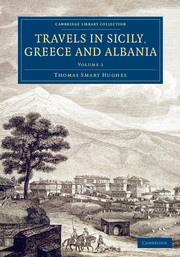
Between 1812 and 1814, Cambridge fellow and cleric Thomas Smart Hughes (1786–1847) and Robert Townley Parker, later an MP for Preston, embarked on a tour of Mediterranean countries, 'those theatres of the most interesting events recorded in the annals of history'. This two-volume account of their travels, illustrated with plates from the drawings of the architect Charles Robert Cockerell, was first published in 1820. In Volume 1, Hughes describes their arrival in Gibraltar, their experiences in Sicily, and their visits to many important classical sites in Greece, noting important historical events that took place at each location and describing the local legends, habits and customs. He quotes freely from other travel writers of the time, as well as from ancient authors and inscriptions encountered on the tour. Included also are anecdotes which render this account vivid and readable, allowing the author's personality and opinions to reveal themselves.
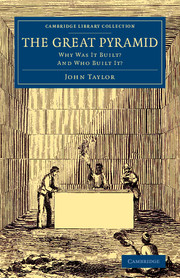
The publisher and author John Taylor (1781–1864), who took an interest in various antiquarian matters, published this work in 1859. Using the measurements taken by the seventeenth-century archaeologist John Greaves and by the French savants who had examined the Great Pyramid at Giza during Napoleon's Egyptian expedition, he deduced the existence of a 'pyramid inch' (fractionally longer than the British inch), which was one twenty-fifth of the so-called 'sacred cubit' and was derived from ancient astronomical and time-measurement observations; and as a convinced Christian, he concluded that the British inch was therefore divinely inspired. His work was very influential and had a considerable following (the astronomer Charles Piazzi Smyth's 1864 book on Our Inheritance in the Great Pyramid is also reissued in this series), but was later debunked by the more accurate surveys and measurements of Flinders Petrie, whose interest in Egypt was partly aroused by reading this book.
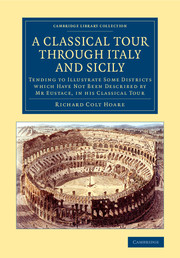
After the death of his wife, antiquarian Sir Richard Colt Hoare (1758–1838) left his only child in England and embarked on a series of journeys through continental Europe in pursuit of 'novelty, pleasure and information' in order to assuage his grief. At the end of the 1780s he deliberately diverged from the more conventional tourist trail in favour of a route through the then less-documented areas of Italy and down into Sicily, using classical authors as his guides. This work, first published in 1819, draws heavily on his daily journal entries to elucidate areas and points of interest that he felt had been overlooked in previous guides to Italy. Quotations from Horace, Tacitus and Pliny pertaining to ancient sites and practices are frequently included in Hoare's narrative, and he meticulously recreates the journey from Rome to Brundisium described by Horace in his Satires.
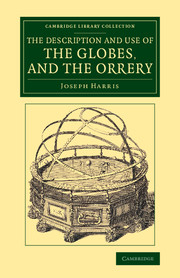
Born in rural Wales, to which he always felt a close connection, Joseph Harris (c.1704–64) moved to London in 1724, presenting the Astronomer Royal, Edmond Halley, with a testimonial of his mathematical ability. Harris then found work as an astronomer and teaching of navigation; his observations of magnetism and solar eclipses taken in Vera Cruz in 1726 and 1727 were relayed to the Royal Society by Halley. Harris' illustrated introduction to the solar system was originally printed for the instrument-maker Thomas Wright and the globe-maker Richard Cushee; it is here reissued in its 1731 first edition. Clearly describing the use of astronomical apparatus such as globes and orreries, it proved very popular, going through fourteen printings by 1793. Harris starts with an overview of the solar system and the fixed stars, and then shows how to solve astronomical problems using globes and orreries.
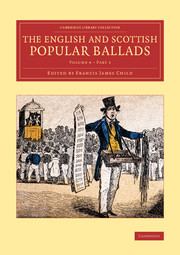
Harvard's first professor of English, the American scholar Francis James Child (1825–96) had previously prepared a collection of English and Scottish ballads, published in 1857–9, before he embarked on producing this definitive critical edition. Organised into five volumes and published in ten parts between 1882 and 1898, the work includes the text and variants of 305 ballads, with Child's detailed commentary and comparison with ballads and stories from other languages. Although he did not live to fully clarify his methods of selection and classification, modern scholars still refer to the 'Child Ballads' as an essential resource in the study of folk songs and stories in the English language. The work also contains a helpful glossary of archaic terms and a long list of sources. Volume 4, Part 1 (1890) contains ballads 189-225, including 'Katharine Jaffray' and 'Rob Roy'.
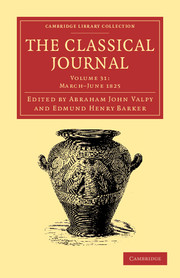
A precursor of modern academic journals, this quarterly periodical, published between 1810 and 1829 and now reissued in forty volumes, was founded and edited by Abraham John Valpy (1787–1854). Educated at Pembroke College, Oxford, Valpy established himself in London as an editor and publisher, primarily of classical texts. Edmund Henry Barker (1788–1839), who had studied at Trinity College, Cambridge, became a contributor and then co-editor of this journal, which fuelled a scholarly feud with the editors of the Museum criticum (1813–26), a rival periodical (also reissued in the Cambridge Library Collection). Although its coverage overlapped with that of its competitor, the Classical Journal also included general literary and antiquarian articles as well as Oxford and Cambridge prize poems and examination papers. It remains a valuable resource, illuminating the development of nineteenth-century classical scholarship and academic journals. Volume 31 contains the March and June issues for 1825.
Founded in 1868 by the Cambridge scholars John Eyton Bickersteth Mayor (1825–1910), William George Clark (1821–78), and William Aldis Wright (1831–1914), this biannual journal was a successor to The Journal of Classical and Sacred Philology (also reissued in the Cambridge Library Collection). Unlike its short-lived precursor, it survived for more than half a century, until 1920, spanning the period in which specialised academic journals developed from more general literary reviews. Predominantly classical in subject matter, with contributions from such scholars as J. P. Postgate, Robinson Ellis and A. E. Housman, the journal also contains articles on historical and literary themes across the 35 volumes, illuminating the growth and scope of philology as a discipline during this period. Volume 5, comprising issues 9 and 10, was published in 1874.
Ludwig van Beethoven (1770–1827) was a prolific letter writer, with thousands of examples surviving to this day. Often written in great haste - 'in der Eile' was a common sign-off - they allow us to follow the great composer's anxieties and preoccupations, revealing the human figure behind some of the greatest music ever written. Despite the fact that 'many of Beethoven's letters slumber in foreign lands, especially in the unapproachable cabinets of curiosities belonging to various close-fisted English collectors', the German musicologist Ludwig Nohl (1831–85) published his collection of letters in 1865, and this two-volume English translation by Grace Jane Wallace (1804–78) appeared the following year, reflecting the fact that interest in Beethoven had not diminished nearly forty years after his death. In Volume 2 we read of Beethoven's despair as his health fails, and of his efforts to fulfil the commission that would become his greatest masterpiece, the Ninth Symphony.
Founded in 1868 by the Cambridge scholars John Eyton Bickersteth Mayor (1825–1910), William George Clark (1821–78), and William Aldis Wright (1831–1914), this biannual journal was a successor to The Journal of Classical and Sacred Philology (also reissued in the Cambridge Library Collection). Unlike its short-lived precursor, it survived for more than half a century, until 1920, spanning the period in which specialised academic journals developed from more general literary reviews. Predominantly classical in subject matter, with contributions from such scholars as J. P. Postgate, Robinson Ellis and A. E. Housman, the journal also contains articles on historical and literary themes across the 35 volumes, illuminating the growth and scope of philology as a discipline during this period. Volume 21, comprising issues 41 and 42, was published in 1893.
A precursor of modern academic journals, this quarterly periodical, published between 1810 and 1829 and now reissued in forty volumes, was founded and edited by Abraham John Valpy (1787–1854). Educated at Pembroke College, Oxford, Valpy established himself in London as an editor and publisher, primarily of classical texts. Edmund Henry Barker (1788–1839), who had studied at Trinity College, Cambridge, became a contributor and then co-editor of this journal, which fuelled a scholarly feud with the editors of the Museum criticum (1813–26), a rival periodical (also reissued in the Cambridge Library Collection). Although its coverage overlapped with that of its competitor, the Classical Journal also included general literary and antiquarian articles as well as Oxford and Cambridge prize poems and examination papers. It remains a valuable resource, illuminating the development of nineteenth-century classical scholarship and academic journals. Volume 35 contains the March and June issues for 1827.
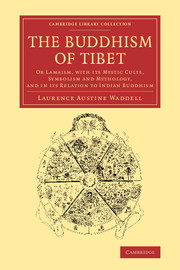
Laurence Austine Waddell (1854–1938) qualified in medicine and chemistry at Glasgow University and in 1880 embarked on a successful career in the colonial Indian Medical Service which took him to Darjeeling, Burma and Tibet, and eventually an academic post at Calcutta Medical College. In addition, Waddell studied Sanskrit and published extensively on Tibet (his books Among the Himalayas (1899) and Lhasa and its Mysteries (1905) are also reissued in the Cambridge Library Collection). This landmark study of Tibetan Buddhism first appeared in 1895. Waddell cites earlier European scholarship, including that of Burnouf (also reissued), but emphasises that his book is based on original field research at temples and among the lay population. It covers the history of Tibetan Buddhism, its relationship with other branches of Buddhism, doctrine, places of worship, rituals and festivals, popular religion and the occult. It also includes around 200 illustrations and a substantial bibliography.
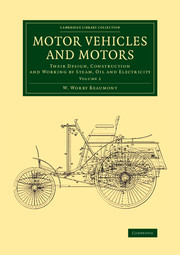
'Cheap or rapid or convenient road transport for man and goods is one of the most important of all contributions to national comfort and prosperity.' An early evangelist for the automobile, William Worby Beaumont (1848–1929) drew on his engineering background to produce the first volume of this work in 1900, when motor vehicles were still relatively new to British roads. Rapid developments in the automotive industry prompted the publication of a second volume in 1906. Replete with technical drawings and photographs, the work describes in great detail the design, construction and operation of the earliest motor vehicles, including those powered by steam, electricity and fuels derived from oil. Volume 2 describes the advances made both in the technological development of automobiles and in the volume produced. Detailed descriptions and illustrations are provided for the leading examples of the time from manufacturers such as Renault, Cadillac, Daimler and Wolseley.
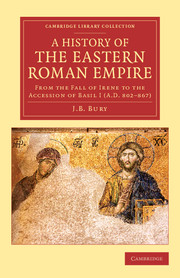
The classical historian J. B. Bury (1861–1927) was the author of a history of Greece which was a standard textbook for over a century. He also wrote on the later history of the Roman empire, and, in this 1912 work, examines the Byzantine empire in the ninth century. The book is a continuation of his two-volume History of the Later Roman Empire of 1889, which covers the period from 395 to 800 (and is also reissued in this series), and reflects Bury's belief that the century-long so-called Amorian epoch 'is not a mere epilogue, and is much more than a prologue' between the better-known periods of Byzantine history that preceded and followed it. In this period, iconoclasm again became a cause of civil strife, and wars on the eastern frontier were a strain on the military resources of the empire, while at least two of the emperors were murdered.
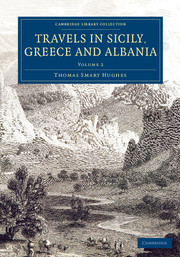
Between 1812 and 1814, Cambridge fellow and cleric Thomas Smart Hughes (1786–1847) and Robert Townley Parker, later an MP for Preston, embarked on a tour of Mediterranean countries, 'those theatres of the most interesting events recorded in the annals of history'. This two-volume account of their travels, illustrated with plates from the drawings of the architect Charles Robert Cockerell, was first published in 1820. In Volume 2, Hughes describes the second leg of the journey, beginning in Epirus in Greece and moving through Albania before returning to England via Italy and France, noting important historical events that took place at each location and describing the local legends, habits and customs. He quotes freely from other travel writers of the time, as well as from ancient authors and inscriptions encountered on the tour. Included also are anecdotes which render this account vivid and readable, allowing the author's personality and opinions to reveal themselves.