A collection of out-of-copyright and rare books from the Cambridge University Library and other world-class institutions that have been digitally scanned, made available online, and reprinted in paperback.
To save content items to your account,
please confirm that you agree to abide by our usage policies.
If this is the first time you use this feature, you will be asked to authorise Cambridge Core to connect with your account.
Find out more about saving content to .
To save content items to your Kindle, first ensure no-reply@cambridge.org
is added to your Approved Personal Document E-mail List under your Personal Document Settings
on the Manage Your Content and Devices page of your Amazon account. Then enter the ‘name’ part
of your Kindle email address below.
Find out more about saving to your Kindle.
Note you can select to save to either the @free.kindle.com or @kindle.com variations.
‘@free.kindle.com’ emails are free but can only be saved to your device when it is connected to wi-fi.
‘@kindle.com’ emails can be delivered even when you are not connected to wi-fi, but note that service fees apply.
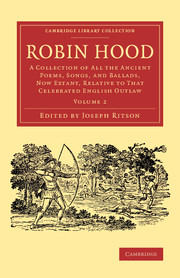
A controversial literary critic and commentator, Joseph Ritson (1752–1803) made his reputation identifying and exposing literary forgeries. His enduring legacy, however, stems from his interest in the legend of Robin Hood. The combination of his passion for collecting literary antiquities, particularly medieval ballad poetry, and his political convictions in support of republican government, drew him to the tale of the English outlaw. This two-volume work, first published in 1795, is an important collection of texts relating to the legend. Ritson's aim was to present all the known poems and songs, and his research was so thorough that very little further material has been found since. This work helped transform the perception of the Robin Hood tradition, encouraging its serious study. As well as a selection of texts, Volume 2 contains an appendix of shorter pieces, including some song lyrics with scores.
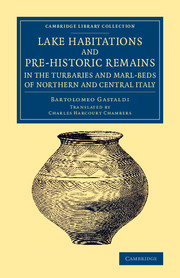
The son of a Turin lawyer, Bartolomeo Gastaldi (1818–79) initially followed in his father's footsteps but then abandoned the law to pursue his passion for geology and palaeontology. Later one of the founders of the Italian Alpine Club, Gastaldi was especially interested in the geology and glaciology of the Alps in his native Piedmont. The mineral gastaldite is named after him. This work, first published in Italian in 1862, is reissued here in the 1865 English translation prepared by Charles Harcourt Chambers (1826–76) for the Anthropological Society of London. Its importance lies in the meticulous descriptions, by Gastaldi and others, of the human remains and artefacts discovered at Stone Age and Bronze Age settlements on the site of lakes and peat bogs to the south of the Alps. Featuring engraved illustrations throughout, the work also includes Gastaldi's summary of discoveries since his book's first appearance.
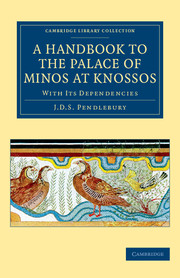
Sir Arthur Evans's excavation at the Cretan site of Knossos from 1900 onwards uncovered a previously unknown civilization. His enthusiastic (though controversial) reconstructions of the site and its fresco decorations made it an attractive destination for travellers and tourists, and Evans thought a simple guidebook for visitors would be desirable alongside his own multi-volume work, The Palace of Minos (also reissued in this series). This was published in 1933 by John Pendlebury (1904–41), a brilliant young archaeologist later killed by German troops during the invasion of Crete in 1941. With a foreword by Evans, the handbook is in two parts: an architectural history of the Palace of Minos, and a guide to the site, with a note of the time needed to explore each building, maps showing the best trail to be followed, plans, and detailed descriptions. The book continues to be of value to both archaeologists and tourists.
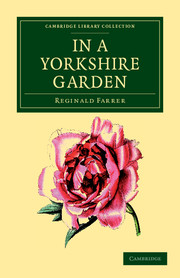
Reginald J. Farrer (1880–1920) was a horticulturalist and plant finder who made a lasting contribution to British gardening, the rockery designs for which he is best known having been greatly influenced by those he discovered in Asia. First published in 1909, this study eloquently describes the author's own garden and its surrounding countryside in his home town of Clapham, Yorkshire. Focusing on the early spring, Farrer reveals through figurative prose the awakening of the flowers and shrubs, the character of the garden as winter disappears, and the aesthetics inherent to the natural world. The study shows his passion for horticulture, and his dedication to an aesthetic that led him to influence generations of gardeners. Featuring an extensive index of plant names and illustrated with photographs taken by the author, it is as informative as it is descriptive, and offers a wealth of anecdotal advice that remains of great interest.
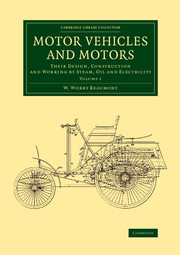
'Cheap or rapid or convenient road transport for man and goods is one of the most important of all contributions to national comfort and prosperity.' An early evangelist for the automobile, William Worby Beaumont (1848–1929) drew on his engineering background to produce the first volume of this work in 1900, when motor vehicles were still relatively new to British roads. Rapid developments in the automotive industry prompted the publication of a second volume in 1906. Replete with technical drawings and photographs, the work describes in great detail the design, construction and operation of the earliest motor vehicles, including those powered by steam, electricity and fuels derived from oil. Volume 1 traces the development of the automobile, from various attempts to produce steam vehicles light enough to run on roads through to the advances of Daimler and Benz. It also includes an overview of attempts to harness electrical power to propel road vehicles.
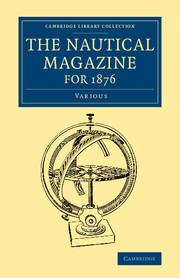
The Nautical Magazine first appeared in 1832, and was published monthly well into the twenty-first century. It covers a wide range of subjects, including navigation, meteorology, technology and safety. An important resource for maritime historians, it also includes reports on military and scientific expeditions and on current affairs. The exceptionally long volume for 1876 devotes much space to the Merchant Shipping Act of that year, and to other legal matters including the recent history of legislation relating to merchant ships, rules for the loading of cargos, and the prevention of collisions at sea. It contains statistics on the year's shipbuilding activity, details of the fleets of several Atlantic shipping lines, and discussion of the recruitment, health and pensions of sailors. Other topics covered include the Suez Canal, Nares' Arctic expedition, the exhibition of scientific apparatus in Kensington, proposals for a Channel tunnel and railway, and solar steam generation.
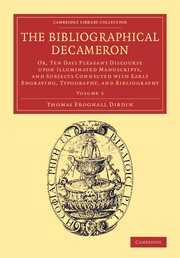
Bibliomania, the almost obsessive collecting of rare books and early editions by the aristocracy, which peaked in 1812 with the sale of the Valdarfer Boccaccio, was fuelled in no small part by the work of the bibliographer Thomas Frognall Dibdin (1776–1847). His most famous book, Bibliomania, popularised the word's use in England. The present work was first published in three volumes in 1817 and may be considered a continuation of Bibliomania in both style and content. Using a dialogue format with extensive footnotes, it covers all aspects of bibliography from early illuminated manuscripts and printed books through to contemporary book collectors and auctions. The work is notable for the number and quality of its illustrations. Volume 3 presents accounts of book collectors and auctions since 1811, and bibliographical and general indexes to the whole work. Dibdin's Bibliomania (revised edition, 1811) and his Reminiscences of a Literary Life (1836) are also reissued in this series.
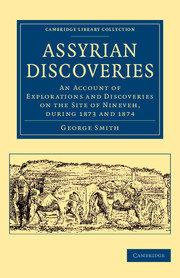
The Assyriologist George Smith (1840–76) was trained originally as an engraver, but was enthralled by the discoveries of Layard and Rawlinson. He taught himself cuneiform script, and joined the British Museum as a 'repairer' or matcher of broken cuneiform tablets. Promotion followed, and after one of Smith's most significant discoveries among the material sent to the Museum - a Babylonian story of a great flood - he was sent to the Middle East, where he found more inscriptions which contained other parts of the epic tale of Gilgamesh. In this 1875 work, a bestseller in its day, Smith describes his expedition, the difficulties encountered, and the discoveries, including hundreds of inscriptions which increased knowledge of the Babylonian and Assyrian civilisations but also had a profound effect on traditional biblical studies. Smith died in Aleppo in 1876, having revolutionised understanding of the ancient Near East.
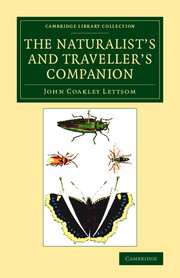
First published in 1772 and reissued here in its 1799 third edition, this work was intended to provide the traveller with advice on collecting and preserving scientific specimens, and on pursuing intellectual investigations. John Coakley Lettsom (1744–1815) was a physician and philanthropist, and on inheriting his family plantation in 1767, his first action was to free all its slaves. He practised medicine in the West Indies and in London, and wrote on topics which he felt would benefit society. This book is divided into two parts, the first describing methods of forming collections of insects, birds and animals, seeds and plants, and minerals. The second part suggests the sorts of questions and enquiries the traveller should ask about the writings, culture, religion, history and natural history of the lands he is visiting. This offers a fascinating insight into the approach and expectations of the educated traveller in the eighteenth century.
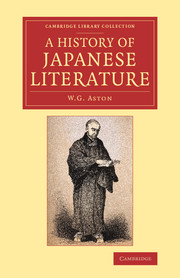
The diplomat and Japanese and Korean scholar William George Aston (1841–1911) wrote several highly regarded publications, particularly on the Japanese language. This work is a chronological survey of Japanese literature from its early songs to the European-influenced works of the nineteenth century. It covers lyrics, poetry, prose and children's stories, and charts the major themes in the history of Japanese learning. At the time of publication in 1899, Japanese literature was little known to European readers, and Aston is careful to assume no prior knowledge of the subject, focusing instead on the most important works and writers, and providing contextual political and religious detail where necessary. His treatment of contemporary literature, and of works not typically discussed for their literary merit, was groundbreaking. The book as a whole remained unsurpassed for eighty years. Aston's introductory survey of traditional Japanese religion, Shinto (1907), is also reissued in this series.
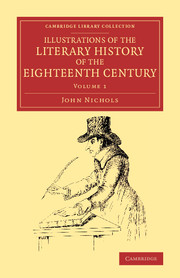
The subtitle of this eight-volume set is Consisting of Authentic Memoirs and Original Letters of Eminent Persons, and Intended as a Sequel to the 'Literary Anecdotes', which had been published in nine volumes by the author, editor and publisher John Nichols (1745–1826) between 1812 and 1815, and are also reissued in this series. Like its predecessor set, these 'illustrations' are a useful source of biographical material on authors and publishers at a time when many of the literary genres we take for granted, such as the novel, the autobiography and the analytical history, were first being developed. The volumes were published between 1817 and 1858, the project being continued after Nichols' death by his son and grandson. Among the 'eminent persons' included in Volume 1 are the prime minister Robert Walpole, the actor David Garrick, the radical politician John Wilkes and the cleric and traveller William Gilpin.
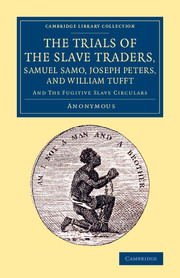
In 1812 a number of slave traders were prosecuted in Sierra Leone, the focus of Britain's efforts to eradicate the trade. First published in 1813, this report is believed to have been written by the presiding judge, Robert Thorpe. The trials provoked debate as Thorpe found one trader guilty, but commuted his sentence on the condition that other traders were persuaded to cease their business. Another was dealt with severely as he displayed complicity in evading the laws. Thorpe's judgments relied upon not only the application of the anti-slavery laws, but also the notion of natural laws transcending those of nations, a notion which came under consideration in the landmark Somerset v. Stewart case of 1772, concerning an escaped slave. Published in 1876, a report on this case is also reissued here. Taken together, these two texts provide valuable source material on the history of the slave trade's abolition.
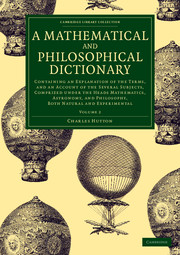
Containing an Explanation of the Terms, and an Account of the Several Subjects, Comprized under the Heads Mathematics, Astronomy, and Philosophy, Both Natural and Experimental
Born into a Newcastle coal mining family, Charles Hutton (1737–1823) displayed mathematical ability from an early age. He rose to become professor of mathematics at the Royal Military Academy and foreign secretary of the Royal Society. First published in 1795–6, this two-volume illustrated encyclopaedia aimed to supplement the great generalist reference works of the Enlightenment by focusing on philosophical and mathematical subjects; the coverage ranges across mathematics, astronomy, natural philosophy and engineering. Almost a century old, the last comparable reference work in English was John Harris' Lexicon Technicum. Hutton's work contains many historical and biographical entries, often with bibliographies, including many for continental analytical mathematicians who would have been relatively unfamiliar to British readers. These features make Hutton's Dictionary a particularly valuable record of eighteenth-century science and mathematics. Volume 2 ranges from kalendar to zone. Among the other topics covered are knots, Newton, magnets, and the Moon.
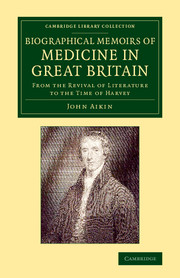
In this absorbing work of medical history, the physician and writer John Aikin (1747–1822) brings together biographical information on a selection of Britain's early medics, shedding light on the lives, works and quirks of more than fifty medical writers, surgeons and physicians between the thirteenth and seventeenth centuries. Outlining the roles played by major figures in the great medical advances that marked this period, the book was first published in 1780, prior to Aikin's move to Great Yarmouth in 1784 to practise medicine. However, his political beliefs and dissenting views regarding the Church of England contributed to his unpopularity in the area, prompting his move to London and greater literary freedom. Over the years, he produced a broad range of published works, including his historically valuable Description of the Country from Thirty to Forty Miles Round Manchester (1795), which is also reissued in the Cambridge Library Collection.
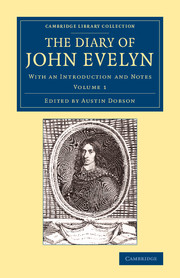
The Stuart writer and gardener John Evelyn (1620–1706), whose two-volume Sylva is also reissued in this series, kept a diary from the age of eleven, and in the 1680s began to compile this memoir from his records. It was first published in 1818 in an edition by the antiquarian William Bray; this three-volume version of 1906 was edited by Austin Dobson (1840–1921), the author and poet who also wrote the volume on Henry Fielding in the 'English Men of Letters' series, among many other literary biographies. In an extensive preface, Dobson explains his reasons for revisiting a work which had already received much editorial attention, and his introduction gives a short biography of its author. Volume 1 begins with Evelyn's own memoir of his early life: regular entries commence in 1637, when he was a student at Oxford, and end in France in 1646.
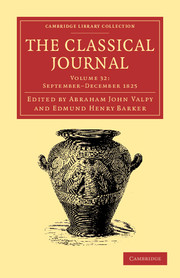
A precursor of modern academic journals, this quarterly periodical, published between 1810 and 1829 and now reissued in forty volumes, was founded and edited by Abraham John Valpy (1787–1854). Educated at Pembroke College, Oxford, Valpy established himself in London as an editor and publisher, primarily of classical texts. Edmund Henry Barker (1788–1839), who had studied at Trinity College, Cambridge, became a contributor and then co-editor of this journal, which fuelled a scholarly feud with the editors of the Museum criticum (1813–26), a rival periodical (also reissued in the Cambridge Library Collection). Although its coverage overlapped with that of its competitor, the Classical Journal also included general literary and antiquarian articles as well as Oxford and Cambridge prize poems and examination papers. It remains a valuable resource, illuminating the development of nineteenth-century classical scholarship and academic journals. Volume 32 contains the September and December issues for 1825.
Richard Hakluyt's 12-volume Principal Navigations Voyages Traffiques and Discoveries of the English Nation, originally published at the end of the sixteenth century, and reissued by the Cambridge Library Collection in the edition of 1903–5, was followed in 1625 by Hakluytus Posthumus or, Purchas his Pilgrimes, now reissued in a 20-volume edition published in 1905–7. When first published in four folio volumes, the work was the largest ever printed in England. An Anglican priest, Samuel Purchas (1577–1626) was a friend of Hakluyt, and based his great work in part on papers not published by Hakluyt before his death. As well as being a wide-ranging survey of world exploration, it is notable as an anti-Catholic polemic, and a justification of British settlement in North America. Volume 19 continues with British exploration and settlement in North America, including Newfoundland and the colonies of Jamestown and Plymouth.
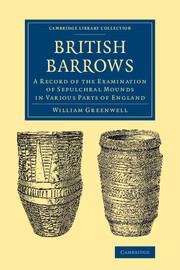
Although best known as an archaeologist, William Greenwell (1820–1918) was also ordained as a priest and served as librarian of Durham Cathedral. A keen angler into his later years, he is known too for his creation of 'Greenwell's glory', a famous British trout fly. As an archaeologist, Greenwell excavated nearly 300 burial mounds, carrying out intensive fieldwork from 1862. First published in 1877, this work is a detailed account of some 230 Bronze Age barrows across England, largely in the East Riding of Yorkshire. Organised by parish, this work records these excavations, giving dimensions and descriptions of their form and finds. Accompanying the survey are contributions by the respected Oxford physician and physiologist George Rolleston (1829–81) describing the skulls found in the barrows. Featuring many illustrations of the finds, including the skulls, the book also contains an appendix discussing prehistoric flora and fauna.
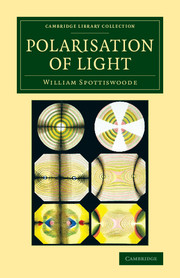
Before his untimely death from typhoid, William Spottiswoode (1825–83) had served as president of the London Mathematical Society, the British Association, and the Royal Society. In addition to publishing widely in mathematics and the experimental physical sciences, he restored the fortunes of his family printing firm, Eyre and Spottiswoode, the Queen's printers. An enthusiast for the popularisation of science, he lectured to large audiences at the Royal Institution, the South Kensington College of Science, and at British Association meetings. He also gave scientific talks at the school set up for the employees of his family firm. This illustrated 1874 work is based on these talks, and provides an introduction to 'this beautiful branch of optics'. Spottiswoode covers methods of polarisation, and the contemporary theory accounting for these effects. He describes various experiments, and explains how polarisation causes patterns and colours to appear in light.
A precursor of modern academic journals, this quarterly periodical, published between 1810 and 1829 and now reissued in forty volumes, was founded and edited by Abraham John Valpy (1787–1854). Educated at Pembroke College, Oxford, Valpy established himself in London as an editor and publisher, primarily of classical texts. Edmund Henry Barker (1788–1839), who had studied at Trinity College, Cambridge, became a contributor and then co-editor of this journal, which fuelled a scholarly feud with the editors of the Museum criticum (1813–26), a rival periodical (also reissued in the Cambridge Library Collection). Although its coverage overlapped with that of its competitor, the Classical Journal also included general literary and antiquarian articles as well as Oxford and Cambridge prize poems and examination papers. It remains a valuable resource, illuminating the development of nineteenth-century classical scholarship and academic journals. Volume 19 contains the March and June issues for 1819.