A collection of out-of-copyright and rare books from the Cambridge University Library and other world-class institutions that have been digitally scanned, made available online, and reprinted in paperback.
To save content items to your account,
please confirm that you agree to abide by our usage policies.
If this is the first time you use this feature, you will be asked to authorise Cambridge Core to connect with your account.
Find out more about saving content to .
To save content items to your Kindle, first ensure no-reply@cambridge.org
is added to your Approved Personal Document E-mail List under your Personal Document Settings
on the Manage Your Content and Devices page of your Amazon account. Then enter the ‘name’ part
of your Kindle email address below.
Find out more about saving to your Kindle.
Note you can select to save to either the @free.kindle.com or @kindle.com variations.
‘@free.kindle.com’ emails are free but can only be saved to your device when it is connected to wi-fi.
‘@kindle.com’ emails can be delivered even when you are not connected to wi-fi, but note that service fees apply.
On several journeys to Italy in the mid-nineteenth century, the Swiss historian Jacob Burckhardt (1818–97) saw in the figures and events of the Italian Renaissance certain traits that he believed to be mirrored in the politics of his own day, notably some aspects of 'an unbridled egoism, outraging every right, and killing every germ of a healthier culture'. Revolutionary in his all-encompassing and unflinching examination of the Italian Renaissance, Burckhardt saw developments in statecraft and war as giving rise to the more publicised artistic progress of the era. First published in 1860, this work is considered to be his magnum opus on the subject, and is here reissued in the accessible two-volume English translation of 1878 by S. G. C. Middlemore. In Volume 2, Burckhardt considers three key themes: scientific discoveries concerning the world and the cosmos, changes in society and festivals, and developments in the fields of morality and religion.
Sir James Frazer (1854–1941) is best remembered today for The Golden Bough, widely considered to be one of the most important early texts in the fields of psychology and anthropology. Originally a classical scholar, Frazer also published this five-volume edition of Ovid's Fasti in 1929. It contains the text and a parallel English translation, with commentary on the six books, indexes, illustrations, and plans. Frazer's interest in Ovid's unfinished final poem arose from his wide-ranging studies of ancient literature and the origins of myth. The work describes the origins of the Roman calendar with its sacred days, and ranges from the deeds of major gods and heroes to the strange rites involved in placating the goddess of mildew. Volume 2 contains Frazer's commentary on Books I and II, dealing with the Roman months of January and February. Other works by Frazer are also reissued in the Cambridge Library Collection.
This collection of Christmas carols was published in 1864 by William Henry Husk (1814–87), a solicitor's clerk and amateur singer who was librarian of the Sacred Harmonic Society in London. He wrote many entries for the first edition of Grove's Dictionary of Music and Musicians, and in 1875 published An Account of the Musical Celebrations on St Cecilia's Day (also reissued in this series). He organises some eighty carols (some of which are familiar, others less known in these versions, and others no longer in common use) in two groups, religious and 'festive'. Each has a headnote explaining its origin, and the general introduction describes Christmas customs, including carol-singing, which Husk fears may be in decline. The songs range from 'A babe is born' and 'Here comes holly', to several variants of 'The boar's head carol', and Husk provides musical settings for twelve of them.
A precursor of modern academic journals, this quarterly periodical, published between 1810 and 1829 and now reissued in forty volumes, was founded and edited by Abraham John Valpy (1787–1854). Educated at Pembroke College, Oxford, Valpy established himself in London as an editor and publisher, primarily of classical texts. Edmund Henry Barker (1788–1839), who had studied at Trinity College, Cambridge, became a contributor and then co-editor of this journal, which fuelled a scholarly feud with the editors of the Museum criticum (1813–26), a rival periodical (also reissued in the Cambridge Library Collection). Although its coverage overlapped with that of its competitor, the Classical Journal also included general literary and antiquarian articles as well as Oxford and Cambridge prize poems and examination papers. It remains a valuable resource, illuminating the development of nineteenth-century classical scholarship and academic journals. Volume 9 contains the March and June issues for 1814.
The Setting Out of the Works, Shaft-Sinking and Heading-Driving, Ranging the Lines and Levelling under Ground, Sub-Excavating, Timbering, and the Construction of the Brickwork of Tunnels
The engineer and technical writer Frederick Walter Simms (1803–65) ranked as a leading authority on tunnel construction for railways. After working for a time at the Royal Observatory, Simms assisted Henry Robinson Palmer and later Sir William Cubitt on the South Eastern Railway. He was awarded the Telford medal by the Institution of Civil Engineers in 1842 for his articles on tunnelling, and further employment on railways in England and France was followed by engineering consultancies to the East India Company and the London, Chatham and Dover Railway. He gained greatest recognition, however, as the author of authoritative engineering textbooks, notably this work, first published in 1844. Considered the standard textbook on the subject at the time, it sets out the approved practices of the day, using the Bletchingley and Saltwood tunnels, whose construction Simms supervised, as key examples. A number of technical illustrations accompany the text.
Richard Hakluyt's 12-volume Principal Navigations Voyages Traffiques and Discoveries of the English Nation, originally published at the end of the sixteenth century, and reissued by the Cambridge Library Collection in the edition of 1903–5, was followed in 1625 by Hakluytus Posthumus or, Purchas his Pilgrimes, now reissued in a 20-volume edition published in 1905–7. When first published in four folio volumes, the work was the largest ever printed in England. An Anglican priest, Samuel Purchas (1577–1626) was a friend of Hakluyt, and based his great work in part on papers not published by Hakluyt before his death. As well as being a wide-ranging survey of world exploration, it is notable as an anti-Catholic polemic, and a justification of British settlement in North America. Volume 14 describes voyages to Greenland, Scandinavia and Russia (including a journey of two Cossacks to China), and begins an account of the West Indies.
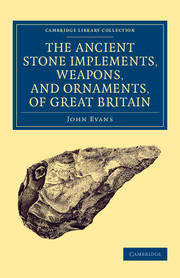
Combining a very active career as a prosperous paper manufacturer with the pursuit of various antiquarian interests, Sir John Evans (1823–1908) began the study of geology in the context of a court case over water rights for his paper mills, but extended his interests to the artefacts found in gravel beds in Britain, and in the Somme valley in France. This work was published in 1872, and was translated into French soon afterwards. Heavily illustrated, it describes stone implements from the Palaeolithic and Neolithic periods, including weapons, tools and ornaments, from cave and river-bed deposits as well as settlement sites. Evans also continued to research fossils, and was highly respected as a numismatist. He was a fellow of the Royal Society, the Geological Society, and the Society of Antiquaries. His son Arthur Evans (1851–1941) discovered the Minoan civilisation of Crete.
John Cam Hobhouse, later Lord Broughton (1786–1869), became a friend of Byron when they were at Cambridge, and was frequently his travelling companion. He first published an account of their journey to Albania and Greece in 1814, and reissued this updated and corrected two-volume version in 1855, after his retirement from public life. (His memoirs are also reissued in the Cambridge Library Collection.) In September 1809 Byron and Hobhouse were in Malta, and took the opportunity of a passing ship to go to Preveza in Epirus, making their way to the court of Ali Pasha, the 'tyrant of Ioannina'. Volume 2 takes the travellers from Smyrna in Asia Minor and up the coast to Istanbul, where they had an audience with Sultan Mahmud II. During their journey, Byron was writing Childe Harold's Pilgrimage: on its publication in 1812, as he said, 'I awoke one morning and found myself famous'.
M. R. James (1862–1936) is probably best remembered as a writer of chilling ghost stories, but he was an outstanding scholar of medieval literature and palaeography, who served both as Provost of King's College, Cambridge, and as Director of the Fitzwilliam Museum, and many of his stories reflect his academic background. His detailed descriptive catalogues of manuscripts owned by colleges, cathedrals and museums are still of value to scholars today. This two-volume catalogue contains James's description of the manuscript holdings of Corpus Christi College, Cambridge and will be welcomed by librarians and researchers alike.
Founded in 1868 by the Cambridge scholars John Eyton Bickersteth Mayor (1825–1910), William George Clark (1821–78), and William Aldis Wright (1831–1914), this biannual journal was a successor to The Journal of Classical and Sacred Philology (also reissued in the Cambridge Library Collection). Unlike its short-lived precursor, it survived for more than half a century, until 1920, spanning the period in which specialised academic journals developed from more general literary reviews. Predominantly classical in subject matter, with contributions from such scholars as J. P. Postgate, Robinson Ellis and A. E. Housman, the journal also contains articles on historical and literary themes across the 35 volumes, illuminating the growth and scope of philology as a discipline during this period. Volume 1, comprising issues 1 and 2, was published in 1868.
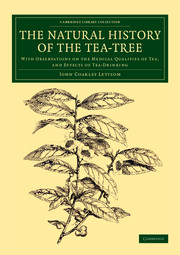
This treatise on the tea bush and the consumption of tea was published in 1772 by John Coakley Lettsom (1744–1815), a physician and philanthropist, whose first action on inheriting his family plantation in 1767 was to free all its slaves. He practised medicine in London, and wrote on topics which he felt would benefit society. The book begins with a description of the plant, using the Linnaean system, discussing tea cultivation and harvesting in China, and the preparation of the leaves for use locally and abroad. In Part II, Lettsom turns to the medical uses of tea, lamenting that so little scientific evidence exists for either its beneficent or its malign properties. After performing various experiments and considering the physical and social consequences of tea-drinking, he concludes that it should be avoided, because its enervating effects lead to weakness and effeminacy, advice which mostly fell on deaf ears.
A precursor of modern academic journals, this quarterly periodical, published between 1810 and 1829 and now reissued in forty volumes, was founded and edited by Abraham John Valpy (1787–1854). Educated at Pembroke College, Oxford, Valpy established himself in London as an editor and publisher, primarily of classical texts. Edmund Henry Barker (1788–1839), who had studied at Trinity College, Cambridge, became a contributor and then co-editor of this journal, which fuelled a scholarly feud with the editors of the Museum criticum (1813–26), a rival periodical (also reissued in the Cambridge Library Collection). Although its coverage overlapped with that of its competitor, the Classical Journal also included general literary and antiquarian articles as well as Oxford and Cambridge prize poems and examination papers. It remains a valuable resource, illuminating the development of nineteenth-century classical scholarship and academic journals. Volume 40 contains the September and December issues for 1829.
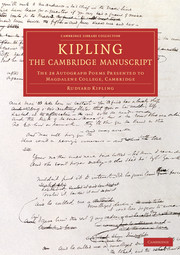
Since 1913 Magdalene College, Cambridge, has elected a succession of outstanding figures in literature and the arts to honorary fellowships of the college. On the occasion of his election in 1932, Rudyard Kipling (1865–1936) presented the college with a manuscript poem entitled 'To the Companion' which celebrated Magdalene's best-known graduate, Samuel Pepys. After his death, his widow, Caroline Kipling, bequeathed the present collection of manuscript poems - many of them redrafted and corrected, and thus giving insights into Kipling's creative process - to the college. The bound volume comprises some twenty-eight poems in all (including multiple versions of key stanzas of 'The White Man's Burden'), together with a fragment of an unpublished poem entitled 'The Song of the Engine'. Its publication in the Cambridge Library Collection makes the poems available to the scholar, the Kipling enthusiast, and the general reader.
Including Those of the Bannatyne, Maitland and Roxburghe Clubs and of the Private Presses at Darlington, Auchinleck, Lee Priory, Newcastle, Middle Hill, and Strawberry Hill
Reissued in its first edition of 1834, this catalogue gives a valuable insight into bibliographical activity in early nineteenth-century Britain. It is the work of the former bookseller John Martin (1791–1855), an antiquary who would later become librarian to the Duke of Bedford at Woburn Abbey. Martin's aim was to assemble a catalogue of books which were never intended for the open market, circulating only among the 'friends and connexions' of those who produced them. Spanning more than two centuries of small-scale British publishing, the resulting work is an extraordinarily eclectic resource, enlivened throughout by an eye for curious detail. The latter portion of the work documents the books, bills and pamphlets which emerged from the regional presses of Martin's own day, and records the early membership and output of the Roxburghe, Maitland and Bannatyne clubs, which would in time become the foremost bibliophilic societies of Victorian Britain.
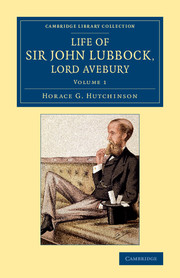
The achievements of the polymath Sir John Lubbock (1834–1913) spanned banking, politics, science and philanthropy. First published in 1914, this two-volume biography by Horace G. Hutchinson (1859–1932) traces Lubbock's extraordinary life and career. Hutchinson, who knew his subject in later years, paints a highly favourable portrait of Lubbock's varied accomplishments. Notably, Lubbock became a partner of his father's bank at twenty-two, a Member of Parliament in 1870, and in 1900 received the title of Baron Avebury. Tutored in natural history by Charles Darwin in his youth, he remained fascinated by evolutionary theory: it influenced his archaeological and anthropological work, including Pre-Historic Times as Illustrated by Ancient Remains (1865) and The Origin of Civilisation and the Primitive Condition of Man (1870), both reissued in the Cambridge Library Collection. Volume 1 covers Lubbock's early childhood and private education, his introduction to banking, and Darwin's influence on his passion for science.
Founded in 1868 by the Cambridge scholars John Eyton Bickersteth Mayor (1825–1910), William George Clark (1821–78), and William Aldis Wright (1831–1914), this biannual journal was a successor to The Journal of Classical and Sacred Philology (also reissued in the Cambridge Library Collection). Unlike its short-lived precursor, it survived for more than half a century, until 1920, spanning the period in which specialised academic journals developed from more general literary reviews. Predominantly classical in subject matter, with contributions from such scholars as J. P. Postgate, Robinson Ellis and A. E. Housman, the journal also contains articles on historical and literary themes across the 35 volumes, illuminating the growth and scope of philology as a discipline during this period. Volume 28, comprising issues 55 and 56, was published in 1903.
Founded in 1868 by the Cambridge scholars John Eyton Bickersteth Mayor (1825–1910), William George Clark (1821–78), and William Aldis Wright (1831–1914), this biannual journal was a successor to The Journal of Classical and Sacred Philology (also reissued in the Cambridge Library Collection). Unlike its short-lived precursor, it survived for more than half a century, until 1920, spanning the period in which specialised academic journals developed from more general literary reviews. Predominantly classical in subject matter, with contributions from such scholars as J. P. Postgate, Robinson Ellis and A. E. Housman, the journal also contains articles on historical and literary themes across the 35 volumes, illuminating the growth and scope of philology as a discipline during this period. Volume 23, comprising issues 45 and 46, was published in 1895.
A participant in the Greek struggle for independence alongside Lord Byron, the philhellene George Finlay (1799–1875) lent his support to the newly liberated nation while diligently studying its past. The monographs he published in his lifetime covered the history of Greece since the Roman conquest, spanning two millennia. His two-volume History of the Greek Revolution (1861) is reissued separately in this series. Edited by the scholar Henry Fanshawe Tozer (1829–1916) and published in 1877, this seven-volume collection brought together Finlay's histories, incorporating significant revisions. Notably, Finlay gives due consideration to social and economic factors as well as high politics. Volume 7 covers the latter part of the Greek war of independence, and the establishment of the Greek monarchy. The coverage extends from the Battle of Navarino in 1827, through the election of King Otto in 1832, up to the constitutional settlements of 1844 and 1864.
Harvard's first professor of English, the American scholar Francis James Child (1825–96) had previously prepared a collection of English and Scottish ballads, published in 1857–9, before he embarked on producing this definitive critical edition. Organised into five volumes and published in ten parts between 1882 and 1898, the work includes the text and variants of 305 ballads, with Child's detailed commentary and comparison with ballads and stories from other languages. Although he did not live to fully clarify his methods of selection and classification, modern scholars still refer to the 'Child Ballads' as an essential resource in the study of folk songs and stories in the English language. The work also contains a helpful glossary of archaic terms and a long list of sources. Volume 2, Part 2 (1886) contains ballads 83-113, including 'Prince Robert' and 'The Baffled Knight'.
The reminiscences of Bristol bookseller Joseph Cottle (1770–1853) have been described as 'unreliable but essential'. The son of a tailor, Cottle was an avid reader, opening a bookshop in 1791. Three years later he was introduced to Samuel Taylor Coleridge and Robert Southey, and became the earliest publisher of their works: through them, he also knew Wordsworth, and published the Lyrical Ballads in 1798. He later fell out with all three men, and in 1837 published (despite Southey and Coleridge's family attempting to prevent it) this quickly notorious two-volume work, through which Cottle lost an expensive libel case in which he was sued by Hannah More's coachman. Ten years later, he recast the book as Reminiscences of Samuel Taylor Coleridge and Robert Southey (also reissued in this series). Both works contain evasions and distortions, but are valuable for their account of some vital years in the lives of the great Romantic poets.