A collection of out-of-copyright and rare books from the Cambridge University Library and other world-class institutions that have been digitally scanned, made available online, and reprinted in paperback.
To save content items to your account,
please confirm that you agree to abide by our usage policies.
If this is the first time you use this feature, you will be asked to authorise Cambridge Core to connect with your account.
Find out more about saving content to .
To save content items to your Kindle, first ensure no-reply@cambridge.org
is added to your Approved Personal Document E-mail List under your Personal Document Settings
on the Manage Your Content and Devices page of your Amazon account. Then enter the ‘name’ part
of your Kindle email address below.
Find out more about saving to your Kindle.
Note you can select to save to either the @free.kindle.com or @kindle.com variations.
‘@free.kindle.com’ emails are free but can only be saved to your device when it is connected to wi-fi.
‘@kindle.com’ emails can be delivered even when you are not connected to wi-fi, but note that service fees apply.
Oimenepthah I, better known to us as Seti I, was regarded as a great pharaoh by his contemporaries, although his son Ramesses II would claim greater renown. Seti's tomb was discovered by Belzoni in 1817 and was the first to be found to have extensive decorations throughout. The huge alabaster coffin found in the tomb was sold to Sir John Soane, who held a three-day party upon its arrival at his London house, where it can still be seen. Written by the noted Egyptologist Samuel Sharpe (1799–1881), this illustrated description of the intricately decorated sarcophagus was published in 1864. By the time of his death, Sharpe was regarded in Britain as one of the most important figures in helping to popularise all things Egyptian. With the artist and sculptor Joseph Bonomi (1796–1878), who provided the drawings here, he collaborated in organising the Egyptian court at the Crystal Palace in 1854.
Charles Roach Smith (1806–90), born on the Isle of Wight and educated in Hampshire, was apprenticed to a lawyer at fifteen, but a year later transferred to a chemist, where he prospered, moving to London and becoming wealthy from a firm of wholesale druggists and his own chemist's shop in Lothbury, in the City of London. Sewerage and other works in the City meant that Roman and medieval artefacts were regularly coming to light, and Smith's collection eventually numbered more than 5,000 pieces. He eventually sold it to the British Museum, at far less than its market value, so that it could remain intact. This book, published in 1859, describes the excavations, and uses the finds he and others acquired to illustrate 'the institutions, the habits, the customs, and the arts of our forefathers'. It remains an invaluable record of finds arising from the Victorian redevelopment of London.
Cecilia, a martyr of the early Christian church, has traditionally been honoured as the patron saint of music. Precisely how that association arose remains uncertain, yet she has inspired many composers over the centuries, notably Henry Purcell and Benjamin Britten. A music scholar and contributor to the first edition of Grove's Dictionary, William Henry Husk (1814–87) joined the Sacred Harmonic Society in 1834 and served as its librarian from 1852. This captivating work, first published in 1857, was prompted by what Husk felt to be unaccountable neglect by music historians of an important aspect of musical life. His carefully researched summary traces the musical celebrations of Cecilia's feast day, 22 November, in Britain and Europe from 1571 to 1846. An appendix gives the texts of numerous odes written for St Cecilia's Day, including pieces by Dryden and Brady, set to music by Handel and Purcell respectively.
Rudolf von Raumer (1815–76) spent his entire career at the University of Erlangen in Bavaria, working independently of the main linguistic controversies of his time. Realising that historical and comparative phonology needed more precise phonetic concepts and terminology, Raumer proposed many refinements and clarifications in that area. He emphasised both the foundational role of Jacob Grimm's work and the need to progress beyond it; the earliest essay in this volume, dating from 1837, offered fresh insights into Grimm's Law. Raumer also did extensive research on German dialectology and orthography. In 1876 his proposals for spelling reform were partly implemented by the Prussian government, and his influence on spelling is acknowledged in Konrad Duden's famous Die deutsche Rechtschreibung (1872). Raumer published this collection of essays in 1863, as a record of the development and first publication date of his theories, which, he says wryly, 'have been frequently used by others'.
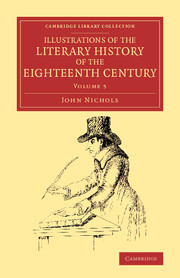
The subtitle of this eight-volume set is Consisting of Authentic Memoirs and Original Letters of Eminent Persons, and Intended as a Sequel to the 'Literary Anecdotes', which had been published in nine volumes by the author, editor and publisher John Nichols (1745–1826) between 1812 and 1815, and are also reissued in this series. Like its predecessor set, these 'illustrations' are a useful source of biographical material on authors and publishers at a time when many of the literary genres we take for granted, such as the novel, the autobiography and the analytical history, were first being developed. The volumes were published between 1817 and 1858, the project being continued after Nichols' death by his son and grandson. Among the 'eminent persons' included in Volume 5 are Jonathan Swift, Alexander Pope, and the Chinese sculptor Chitqua, who visited London in 1769.
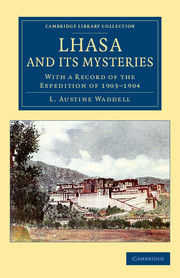
A successful officer in the colonial Indian Medical Service, Glasgow-educated Laurence Austine Waddell (1854–1938) was fascinated by the landscapes and cultures of Darjeeling and Tibet, studied local languages, and spent his leisure time researching and writing on Tibetan topics. His earlier books The Buddhism of Tibet (1895) and Among the Himalayas (1899) are also reissued in the Cambridge Library Collection. Waddell had attempted to enter Lhasa (then closed to foreigners) in disguise in 1892, but did not succeed until he accompanied the controversial British expedition to Tibet in 1903–4; he describes his arrival there as 'the realisation of a vivid and long-cherished dream'. His eyewitness account of how the 'peaceful mission' became an 'invasion' occupies the first half of this 1905 publication. The later chapters vividly portray the city and its inhabitants. The book includes more than a hundred of Waddell's own photographs, as well as maps and line drawings.
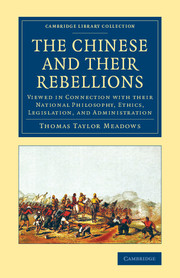
Inspired by the lectures in Munich of the German orientalist Karl Friedrich Neumann, Thomas Taylor Meadows (1815–68) devoted himself to the study of Chinese in 1841, with the aim of entering British service. He arrived in China early in 1843 and rose quickly to the post of consular interpreter at the key treaty port of Canton (Guangzhou), where he remained for several years. His Desultory Notes on the Government and People of China, and on the Chinese Language (1847) is also reissued in this series. The present work, first published in 1856, is an expansive treatment of matters relating to 'the present Chinese rebellion', namely the Taiping Rebellion (1850–64). Meadows discusses the ongoing conflict within its historical and cultural context, offering also observations and recommendations on Anglo-Chinese relations. He closes with a lengthy disquisition on the nature and state of 'civilization' in the East and West.
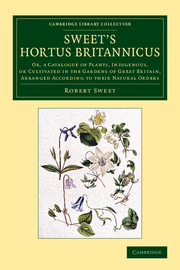
The first career of Robert Sweet (1783–1835) was as a gardener in private employment and as a nurseryman. He turned in 1826 to botanical writing, having already published Hortus suburbanus Londinensis (1818), and the first of the five-volume Geraniaceae (1820–30). The first edition of this work was published in 1826, and this revised second edition in 1830. Sweet uses Jussieu's 'natural' system of classification, but concedes that 'we still consider the addition of the Linnaean classes and orders, of great use, as they are so readily attained by the young Botanist'. He provides nine two-column closely packed pages of source works in which images of the plants cited in this unillustrated work can be found, and which also testify to the breadth of his own research in producing a reference work which is comprehensive as a record of plants then growing and flowering in British gardens.
Founded in 1868 by the Cambridge scholars John Eyton Bickersteth Mayor (1825–1910), William George Clark (1821–78), and William Aldis Wright (1831–1914), this biannual journal was a successor to The Journal of Classical and Sacred Philology (also reissued in the Cambridge Library Collection). Unlike its short-lived precursor, it survived for more than half a century, until 1920, spanning the period in which specialised academic journals developed from more general literary reviews. Predominantly classical in subject matter, with contributions from such scholars as J. P. Postgate, Robinson Ellis and A. E. Housman, the journal also contains articles on historical and literary themes across the 35 volumes, illuminating the growth and scope of philology as a discipline during this period. Volume 34, comprising issues 67 and 68, was published in 1918.
A precursor of modern academic journals, this quarterly periodical, published between 1810 and 1829 and now reissued in forty volumes, was founded and edited by Abraham John Valpy (1787–1854). Educated at Pembroke College, Oxford, Valpy established himself in London as an editor and publisher, primarily of classical texts. Edmund Henry Barker (1788–1839), who had studied at Trinity College, Cambridge, became a contributor and then co-editor of this journal, which fuelled a scholarly feud with the editors of the Museum criticum (1813–26), a rival periodical (also reissued in the Cambridge Library Collection). Although its coverage overlapped with that of its competitor, the Classical Journal also included general literary and antiquarian articles as well as Oxford and Cambridge prize poems and examination papers. It remains a valuable resource, illuminating the development of nineteenth-century classical scholarship and academic journals. Volume 25 contains the March and June issues for 1822.
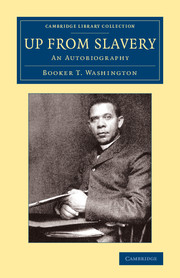
Born into slavery on a Virginia plantation, Booker T. Washington (1856–1915) educated himself tirelessly in the years after the American Civil War. In 1881, he was appointed head of the Tuskegee Institute, a teacher-training college for African Americans. As a writer, orator and fundraiser, he became one of the leading figures of the black community. Washington argued that the best way of bettering the social position of African Americans was through vocational education, which would make them indispensable and productive members of society. In this 1901 autobiography, he uses his life as an example to illustrate these principles, covering particularly the work of the Tuskegee Institute and his fundraising on behalf of black education. The book also contains the full text of his 1895 Atlanta Exposition speech, which created the model for Southern race relations until Washington's death and the emergence of more overtly assertive African-American civil rights leaders.
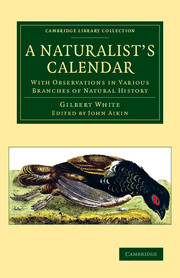
The naturalist Gilbert White (1720–93) was known for his meticulous observations of flora and fauna in their natural environment, primarily around his village of Selborne in Hampshire. This posthumous 1795 publication, edited by the physician and writer John Aikin (1747–1822), comprises a collection of extracts from White's previously unpublished papers from 1768 to his death. Presented here for 'lovers of natural knowledge' is a full year of White's observations. Following the month-by-month record of natural events, the book contains brief studies of birds, quadrupeds, insects, plants and the weather. A lifelong lover of the outdoors, White had kept a near daily record of his activities for more than forty years. Regarded as one of the fathers of ecology, inspiring others to appreciate the natural world, White is best known for The Natural History and Antiquities of Selborne (1789), which is also reissued in the Cambridge Library Collection.
Nathaniel Parker Willis (1806–67) came from a publishing family and began his writing career with contributions to magazines. He also wrote poetry and plays but is best remembered as a travel writer. In this two-volume work of 1840, his contribution (described on the title page as 'the literary department') was to provide a narrative for prints from the engravings of William Henry Bartlett (1809–54), the famous British landscape artist, who followed already established tourist routes in the United States to make his drawings. Each of Bartlett's 119 engravings is accompanied by a short essay by Willis, who states in the preface that it is his intention to bring to the reader at home 'at small cost' the sensations of travel which 'those whose lot is domestic and retired' would never be in a position to experience for themselves. The extremely popular work remained in print for thirty years.
Although the author Anthony Trollope (1815–82) enjoyed great success as a novelist, he was also an eager and perceptive travel writer. In this account of his voyage to the West Indies and Central America, published in 1859, he recounts the many places he visited, including Jamaica, Cuba, Barbados, Trinidad, Panama and Costa Rica. Trollope brings his eye for detail to these islands at an important time: slavery had been abolished in the British colonies, but persisted in Cuba, and he depicts this complex region and its people with all the vividness of his novels. Though sometimes reflecting the beliefs and prejudices of the Victorian period, the work remains essential and engaging reading for those interested in the nineteenth-century Caribbean. Trollope's writings on North America and on Australia and New Zealand are also reissued in the Cambridge Library Collection.
A child prodigy, Henry Brougham (1778–1868), later Lord Brougham and Vaux, entered in 1792 the University of Edinburgh, where he focused on mathematics and then law, while his amateur scientific studies led him to become a fellow of the Royal Society at the age of twenty-five. Called to both the Scottish and English bars, and moving in radical political circles, he became famous as a defender of free speech, a passionate abolitionist, and co-founder of the Edinburgh Review. After many years as an MP, he was given a peerage in 1830 and became Lord Chancellor in Lord Grey's Whig government, where he was instrumental in the passing of the 1832 Reform Act. This three-volume autobiography was published posthumously in 1871, with additional notes. Volume 2 covers the period 1811–28, including the scandal of George IV's marriage, during which Brougham advised Queen Caroline.
The Pliocene-Pleistocene Crags of East Anglia are an incredibly rich source of fossil shells, many belonging to extant Boreal and Mediterranean genera. Dominated by marine gastropods and bivalves, the deposits also contain evidence of terrestrial and non-marine gastropods and bivalves, brachiopods, and extensive epifauna including bryozoans. Published between 1848 and 1879 in four volumes, the latter two being supplements with further descriptions and geological notes, this monograph by Searles Valentine Wood (1798–1880) covers more than 650 species and varieties of fossil mollusc. For each species Wood gives a synonymy, diagnosis (in Latin), full description, dimensions, occurrence and remarks. The supplements also provide a breakdown of the species and their current distribution. The detailed plates were prepared by the conchologist George Brettingham Sowerby and his namesake son. Volume 4 (1879) comprises the second supplement, covering univalves and bivalves. Also included here is a third supplement, published by the late author's son in 1882.
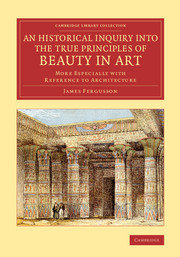
Born in Scotland, James Fergusson (1808–86) spent ten years as an indigo planter in India before embarking upon a second career as an architectural historian. Despite his lack of formal training, he became an expert in the field of Indian architecture, publishing Cave Temples of India and a History of Indian and Eastern Architecture, as well as The Holy Sepulchre and the Temple at Jerusalem, all reissued in the Cambridge Library Collection. In this illustrated work of 1849, he considers beauty in art, expressed chiefly by the architectural styles of different civilisations, beginning with ancient Egypt, and finishing with ancient Rome. (This book is named 'Part the First', but no subsequent volumes were written.) The first section is theoretical, tracing the intellectual development of man and his aesthetic sense, while the second considers the surviving evidence of the ideas of beauty held in the ancient world.
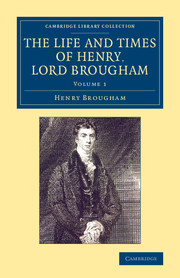
A child prodigy, Henry Brougham (1778–1868), later Lord Brougham and Vaux, entered in 1792 the University of Edinburgh, where he focused on mathematics and then law, while his amateur scientific studies led him to become a fellow of the Royal Society at the age of twenty-five. Called to both the Scottish and English bars, and moving in radical political circles, he became famous as a defender of free speech, a passionate abolitionist, and co-founder of the Edinburgh Review. After many years as an MP, he was given a peerage in 1830 and became Lord Chancellor in Lord Grey's Whig government, where he was instrumental in the passing of the 1832 Reform Act. This three-volume autobiography was published posthumously in 1871, with additional notes. Covering the period up to 1811, Volume 1 describes Brougham's family background, early life, influential teachers, and entry into politics.
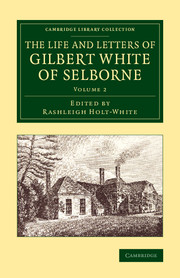
Published in 1901, this illustrated two-volume biography of the renowned English naturalist Gilbert White (1720–93) presents a thorough account of his life and achievements. Prepared by White's great-great-nephew Rashleigh Holt-White (1826–1920), it incorporates a selection of White's correspondence with family and friends, providing valuable insights into his beliefs and character. Included are letters sent by White's lifelong friend John Mulso (1721–91), who praised the naturalist's work, predicting it would 'immortalise' White and his Hampshire village. Still considered a classic text, The Natural History and Antiquities of Selborne (1789), featuring White's careful observations of local flora and fauna, is also reissued in the Cambridge Library Collection. In the present work, Holt-White sought to correct the 'erroneous statements' that had previously been made about his relative. Volume 2 traces White's life from September 1776, considering the impact of the loss of family members, and his legacy after his death.
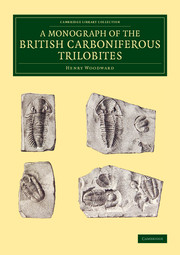
Henry Woodward (1832–1921) intended this monograph, originally published as two parts in 1883–4, to be the first of a series of supplements aimed at completing Salter's unfinished work on British trilobites. In the event, no others were published. As the first monographic treatment of Carboniferous trilobites from Britain and Ireland, it has remained a standard work. Thirty-one species distributed among four genera are described, including the type species of the well-known Phillipsia, Griffithides and Brachymetopus. The specimens are faithfully reproduced in a series of fine illustrations. The monograph concludes with three short appendices: the nature of pores on the trilobite headshield; a new Carboniferous trilobite from Ohio; and a letter from Agassiz on possible affinities between trilobites and a marine isopod. Woodward described further new species of Carboniferous trilobites in a series of papers published between 1884 and 1906, which acted as supplements to his monograph.