A collection of out-of-copyright and rare books from the Cambridge University Library and other world-class institutions that have been digitally scanned, made available online, and reprinted in paperback.
To save content items to your account,
please confirm that you agree to abide by our usage policies.
If this is the first time you use this feature, you will be asked to authorise Cambridge Core to connect with your account.
Find out more about saving content to .
To save content items to your Kindle, first ensure no-reply@cambridge.org
is added to your Approved Personal Document E-mail List under your Personal Document Settings
on the Manage Your Content and Devices page of your Amazon account. Then enter the ‘name’ part
of your Kindle email address below.
Find out more about saving to your Kindle.
Note you can select to save to either the @free.kindle.com or @kindle.com variations.
‘@free.kindle.com’ emails are free but can only be saved to your device when it is connected to wi-fi.
‘@kindle.com’ emails can be delivered even when you are not connected to wi-fi, but note that service fees apply.
Walter Leaf (1852–1927), banker, classicist and alpinist, held various positions as chairman of the Westminster Bank, founder of the London Chamber of Commerce and president of the Hellenic Society, reflecting his wide-ranging professional and scholarly interests. Leaf was educated at Harrow School and Trinity College, Cambridge, of which he became a fellow in 1875. As a scholar, Leaf was concerned with uncovering the physical reality of the classical world, and in this 1912 work he 'aims at testing the tradition of the Trojan War by comparing the text of Homer with the natural conditions described, or more often implicitly assumed, in the Iliad'. This book draws on the archaeological work of Schliemann and Dörpfeld at Troy, but also on Leaf's own expert knowledge of the Iliad (of which his two-volume edition is also reissued in this series), thereby providing a thorough exploration of the historical geography of the Troad.
The appearance of the first issue of The Tatler in 1709 is usually regarded as the beginning of periodical publication in England. Its founder, Richard Steele (1672–1729), intended 'a paper, which should observe upon the manners of the pleasurable, as well as the busy part of mankind … by way of a letter of intelligence, consisting of such parts as might gratify the curiosity of persons of all conditions, and of each sex'. The 'datelines' of the reports, on news, literature, and plain gossip, were from the most famous coffee houses of early Georgian London, and the contributors included Jonathan Swift and Joseph Addison. The magazine was published for only two years, from April 1709 to January 1711: shortly afterwards, Steele and Addison co-founded The Spectator. This four-volume edition was issued in 1797 by a consortium of publishers, including John Nichols. Volume 3 contains numbers 115 to 189.
One of the most popular and prolific writers during the Victorian age, Samuel Smiles (1812–1904) emphasised individual responsibility in the pursuit of personal and social improvement. Among other titles, his acclaimed Lives of the Engineers (1861–2) and insightful Autobiography (1905) are also reissued in the Cambridge Library Collection. He is best known, however, for the present work. First published in 1859, it sold 20,000 copies in its first year, more than a quarter of a million by 1905, and was widely translated. Using hundreds of biographical examples, ranging from George Stephenson to Josiah Wedgwood, Smiles champions the virtues of hard work, perseverance and character in achieving success. While these values appealed to a large readership in the book's heyday, later critics saw the work as promoting a form of selfish materialism. However interpreted, this remains a crucial text for those fascinated by the Victorian drive for self-improvement.
Gabriel Ferrand (1864–1935) travelled widely as a French diplomat and pursued scholarly passions as a polyglot orientalist. He served as consul to Madagascar and published several works about the island, noting the Arab influence that preceded the arrival of Europeans. A member of the Société Asiatique, and editor of its journal from 1920 until his death, Ferrand sought in particular to make Arabic geographical and nautical writings more accessible to fellow scholars and students. Forming part of that project, this work appeared in two volumes in 1913–14. It presents annotated French translations of mainly Arabic texts relating to the Far East. Brief biographical notes on the authors are given for the benefit of non-specialists. Volume 2 contains texts from the thirteenth century onwards, and includes a section of translated extracts from Chinese, Japanese, Tamil, Kawi and Malay texts.
Officially opened in 1682, the Canal du Midi, designed and built by the engineers Pierre-Paul Riquet and François Andréossy, stretched from Toulouse to the Mediterranean. The present work was written by Andréossy's descendant, Antoine-François Andréossy (1761–1828), a French general and diplomat. A member of the Académie des Sciences, he analyses here the terrain of the south of France to show how and why the canal was built. Notably, the work became known for the author's argument that Riquet had usurped the glory that really belonged to his ancestor. Concluding with original documents from the period of the canal's construction, along with an appendix giving details on the canal's route, the book is reissued here in its first edition of 1800. A second edition appeared in 1804, and a third edition was begun but never completed.
This two-volume milestone work, published in 1776, was the first major publication of William Withering (1741–99), a physician who had also trained as an apothecary (his Account of the Foxglove, and Some of its Medical Uses is also reissued in this series). The first systematic botanical guide to British native plants, the present work uses and extends the Linnaean system of classification, but renders the genera and species 'familiar to those who are unacquainted with the Learned Languages'. Withering offers 'an easy introduction to the study of botany', explaining the markers by which the plants are classified in a particular genus, and giving advice on preserving specimens, but the bulk of the work consists of botanical descriptions (in English) of the appearance, qualities, varieties, common English names, and uses of hundreds of plants. The book continued to be revised and reissued for almost a century after Withering's death.
The magnificent monograph of the British Cretaceous echinoids (sea urchins) by Thomas Wright (1809–84) was to be followed by a similar work on the asteroids (starfishes). Sadly, Wright died in the early stages of this project, leaving only notes and some plates, but it was taken up by Walter Percy Sladen (1849–1900), who completed two parts before ill health interrupted his previous productivity. William Kingdon Spencer (1878–1955) became the third authority to be involved, finishing the work in a further three parts and also expanding the scope to include the ophiuroids (brittle stars). All three contributors were amateurs, variously a surgeon (Wright), independently wealthy (Sladen) and HM Inspector of Schools in Suffolk (Spencer). Originally published in five parts between 1891 and 1908, Sladen and Spencer's text, embellished by many fine plates, is a monument to two of the rarer, yet most attractive, groups of Cretaceous fossils.
A participant in the Greek struggle for independence alongside Lord Byron, the philhellene George Finlay (1799–1875) lent his support to the newly liberated nation while diligently studying its past. The monographs he published in his lifetime covered the history of Greece since the Roman conquest, spanning two millennia. His two-volume History of the Greek Revolution (1861) is reissued separately in this series. Edited by the scholar Henry Fanshawe Tozer (1829–1916) and published in 1877, this seven-volume collection brought together Finlay's histories, incorporating significant revisions. Notably, Finlay gives due consideration to social and economic factors as well as high politics. Volume 2 covers the Byzantine empire from 716 to 1057. Finlay traces the stabilisation of the empire under the Isaurian dynasty in the face of Muslim conquests, and the consolidation of Byzantine administration under the later Basilian or Macedonian dynasty, closing with the reign of Michael VI.
Georges Cuvier (1769–1832), one of the founding figures of vertebrate palaeontology, pursued a successful scientific career despite the political upheavals in France during his lifetime. In the 1790s, Cuvier's work on fossils of large mammals including mammoths enabled him to show that extinction was a scientific fact. In 1812 Cuvier published this four-volume illustrated collection of his papers on palaeontology, osteology (notably dentition) and stratigraphy. It was followed in 1817 by his famous Le règne animal, available in the Cambridge Library Collection both in French and in Edward Griffith's expanded English translation (1827–35). Volume 3 of Recherches sur les ossemens fossiles recounts Cuvier's excitement at acquiring fossils from gypsum quarries near Paris, and the challenges of piecing the fragments together correctly. Cuvier describes the methodical reconstruction of the pachyderm fossils and lists other fossils occurring in the same rock formations: carnivores, an opossum, birds, reptiles, and fish.
Isaac Schomberg (1753–1813) had a controversial career in the Royal Navy. Although he distinguished himself at the relief of Gibraltar and the battles of St Kitts and the Saintes, his aggressive temperament and scholarly interests meant he was a poor choice to serve as first lieutenant under the petulant, pleasure-seeking future William IV. Schomberg's career never recovered after they clashed. Retiring to Wiltshire in 1796, he began this long-planned chronology of the Royal Navy. Published in 1802, with detailed descriptions of engagements, events on board, and politics at home, as well as an appendix of facts and figures stretching back to the origins of the Senior Service, this five-volume work remains a classic source of naval history. Concluding the appendix, Volume 5 lists naval losses from 1688, the holders of high naval office since the time of King Alfred, and admirals and captains since the middle of the seventeenth century.
Founded in 1868 by the Cambridge scholars John Eyton Bickersteth Mayor (1825–1910), William George Clark (1821–78), and William Aldis Wright (1831–1914), this biannual journal was a successor to The Journal of Classical and Sacred Philology (also reissued in the Cambridge Library Collection). Unlike its short-lived precursor, it survived for more than half a century, until 1920, spanning the period in which specialised academic journals developed from more general literary reviews. Predominantly classical in subject matter, with contributions from such scholars as J. P. Postgate, Robinson Ellis and A. E. Housman, the journal also contains articles on historical and literary themes across the 35 volumes, illuminating the growth and scope of philology as a discipline during this period. Volume 4, comprising issues 7 and 8, was published in 1872.
Founded in 1868 by the Cambridge scholars John Eyton Bickersteth Mayor (1825–1910), William George Clark (1821–78), and William Aldis Wright (1831–1914), this biannual journal was a successor to The Journal of Classical and Sacred Philology (also reissued in the Cambridge Library Collection). Unlike its short-lived precursor, it survived for more than half a century, until 1920, spanning the period in which specialised academic journals developed from more general literary reviews. Predominantly classical in subject matter, with contributions from such scholars as J. P. Postgate, Robinson Ellis and A. E. Housman, the journal also contains articles on historical and literary themes across the 35 volumes, illuminating the growth and scope of philology as a discipline during this period. Volume 16, comprising issues 31 and 32, was published in 1888.
One of the oldest surviving English-language cookbooks, this fascinating work was originally compiled in the late fourteenth century by the master cooks at the court of Richard II. It contains nearly 200 recipes for the preparation of everyday dishes as well as elaborate banquets. Here we find roasts, stews, jellies and custards alongside dishes that call for highly prized spices or animals such as curlews and porpoises. This 1780 transcription, from the manuscript then belonging to Gustavus Brander and now in the British Library, was made by the Anglican clergyman and antiquary Samuel Pegge (1704–96). Ordained in 1730 and elected a fellow of the Society of Antiquaries in 1751, Pegge briefly discusses in his preface the history of cooking since antiquity, while his annotations to the text elucidate the medieval vocabulary. Among related items forming an intriguing appendix are rolls of provisions from the time of Henry VIII.
While visiting a friend, the writer and cleric Thomas Percy (1729–1811) noticed a neglected folio whose pages were being used by the maids to light the fire. Upon inspection, this manuscript was found to be a seventeenth-century collection of historical ballads. Following this discovery, Percy collected further ballads and songs from a number of sources, which he published in this three-volume work in 1765, although ultimately only a quarter of the texts he presented came from that original manuscript. Although this work proved to be incredibly popular, Percy's idiosyncratic editorial practices also received much criticism. The collection centres on historical ballads and romances, demonstrating the development of language, customs and traditions, to which Percy added contemporary ballads for his readers' enjoyment. Volume 1 contains texts such as 'The Ancient Ballad of Chevy Chase' and 'The Jew's Daughter', as well as ballads which influenced or illuminate the work of Shakespeare.
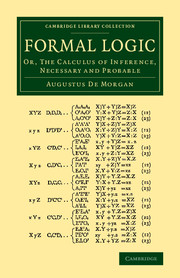
From the end of antiquity to the middle of the nineteenth century it was generally believed that Aristotle had said all that there was to say concerning the rules of logic and inference. One of the ablest British mathematicians of his age, Augustus De Morgan (1806–71) played an important role in overturning that assumption with the publication of this book in 1847. He attempts to do several things with what we now see as varying degrees of success. The first is to treat logic as a branch of mathematics, more specifically as algebra. Here his contributions include his laws of complementation and the notion of a universe set. De Morgan also tries to tie together formal and probabilistic inference. Although he is never less than acute, the major advances in probability and statistics at the beginning of the twentieth century make this part of the book rather less prophetic.
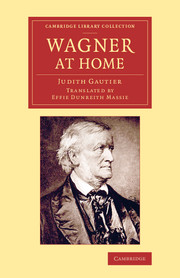
Daughter of the poet Théophile Gautier, Judith Gautier (1845–1917) grew up among Europe's literary avant-garde, quickly establishing her own career as a writer. An unapologetic admirer of Richard Wagner from an early age, she described her moment of revelation on playing through the overture to The Flying Dutchman as 'vertigo of the spirit'. Her enthusiasm led to several works on the composer, including a translation of his poem for Parsifal, during the composition of which an intense intimacy developed between them (gently, but firmly, defused by Cosima). Reissued here is the 1910 English translation by Effie Dunreith Massie of Gautier's highly charged account of her first two visits to Wagner and Cosima in Switzerland in 1869 and 1870. Gautier describes the idyllic atmosphere and offers the reader an effusive pen-portrait of Wagner's complex personality. The work also features facsimile pages of Wagner's letters to Gautier, showing part of the score for Parsifal.
The respected phonetician and philologist Henry Sweet (1845–1912) has had a lasting influence on the study and teaching of linguistics, particularly phonetics and Old English. Sweet is also known for being, in part, the inspiration for Henry Higgins in Shaw's Pygmalion. This two-volume work, first published in 1892–8, marks the start of a new tradition in the study of English, although it received little attention in Britain upon its publication. Building on developments in European linguistics, this was the first grammar of English to adopt a scientific approach to the description of language, in particular of phonology. The work is a thorough description of English grammar in comparison with that of Old English, and covers the parts of speech, phonology, accidence and syntax. Volume 2 (1898) presents a detailed description of English syntax.
Born near Aachen, Leonhard Schmitz (1807–90) studied at the University of Bonn, from which he received his PhD, before marrying an Englishwoman and becoming a naturalised British citizen. Made famous by the 1844 publication of his translation of Niebuhr's Lectures on the History of Rome, he became rector of the Royal High School, Edinburgh, where he taught Alexander Graham Bell. He also briefly tutored the future Edward VII (and he had previously taught Prince Albert in Bonn). This short-lived quarterly journal, which Schmitz founded and edited between 1844 and 1850, focused exclusively on aspects of classical antiquity – in contrast to the more general literary reviews that were common in the period. It illuminates the development of Classics as a specialist discipline as well as contemporary intellectual links between Britain and Germany. This sixth volume was published in 1849.
Harvard's first professor of English, the American scholar Francis James Child (1825–96) had previously prepared a collection of English and Scottish ballads, published in 1857–9, before he embarked on producing this definitive critical edition. Organised into five volumes and published in ten parts between 1882 and 1898, the work includes the text and variants of 305 ballads, with Child's detailed commentary and comparison with ballads and stories from other languages. Although he did not live to fully clarify his methods of selection and classification, modern scholars still refer to the 'Child Ballads' as an essential resource in the study of folk songs and stories in the English language. The work also contains a helpful glossary of archaic terms and a long list of sources. Volume 4, Part 2 (1892) contains ballads 226-265, including 'Lang Johnny More' and 'The Knight's Ghost'.
Sir Henry Thomas De la Beche (1796–1855) served as president of the Geological Society from 1847 to 1849, having contributed greatly to the development of geological science and surveying in the first half of the nineteenth century. He was also instrumental in the establishment of the Museum of Practical Geology in London. Reissued here in its 1831 first edition (which Darwin had with him aboard the Beagle), this work sought to help students to grasp the fundamentals of a rapidly advancing science. The first section considers the Earth's shape, density, temperature and other characteristics. The next part includes discussion of beaches, volcanos, and coastal processes. De la Beche then presents descriptions of various rock types, reflecting the state of contemporary geological knowledge. Highly successful, the book went through two further English editions; the expanded third edition is also reissued in this series.