A collection of out-of-copyright and rare books from the Cambridge University Library and other world-class institutions that have been digitally scanned, made available online, and reprinted in paperback.
To save content items to your account,
please confirm that you agree to abide by our usage policies.
If this is the first time you use this feature, you will be asked to authorise Cambridge Core to connect with your account.
Find out more about saving content to .
To save content items to your Kindle, first ensure no-reply@cambridge.org
is added to your Approved Personal Document E-mail List under your Personal Document Settings
on the Manage Your Content and Devices page of your Amazon account. Then enter the ‘name’ part
of your Kindle email address below.
Find out more about saving to your Kindle.
Note you can select to save to either the @free.kindle.com or @kindle.com variations.
‘@free.kindle.com’ emails are free but can only be saved to your device when it is connected to wi-fi.
‘@kindle.com’ emails can be delivered even when you are not connected to wi-fi, but note that service fees apply.
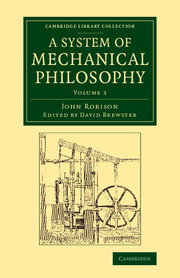
After a brief career at sea, during which he tested Harrison's chronometer for the Board of Longitude, John Robison (1739–1805) became lecturer in chemistry at the University of Glasgow. In 1774, having spent a period teaching mathematics in Russia, he returned to Scotland as professor of natural philosophy at Edinburgh. Despite his busy schedule, he contributed major articles on the sciences to the Encyclopaedia Britannica, giving an overview of contemporary scientific knowledge for the educated layperson. After his death, these and other pieces of his scientific writing were edited by his former pupil David Brewster (1781–1868) and were finally published in four volumes in 1822, with a separate volume of illustrative plates. This reissue incorporates those plates in the relevant volumes of text. Volume 3 reprints Robison's large treatise on astronomy, based on his university lectures, as well as his articles on telescopes and pneumatics.
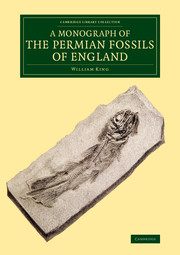
In 1850, William King (1809–86) published the first comprehensive study of fossils from the Permian following the establishment of the system by Murchison in 1841. The monograph is based mainly on King's own collections; the type and figured material now belongs to the James Mitchell Museum, National University of Ireland, Galway, where King was professor of geology and mineralogy for many years. Some 150 species, over one-third identified by King, are carefully described and beautifully illustrated. The fossil biota ranges from foraminiferans to plants and reptiles; but a key focus is the large fauna of fossil invertebrates, notably brachiopods and molluscs, from the Magnesian Limestone. The work includes detailed data on the distribution of the floras and faunas in counties Durham and Northumberland together with elsewhere in the Zechstein province. Data on the numbers of taxa and some notes on the significance of the Permian biota are also provided.
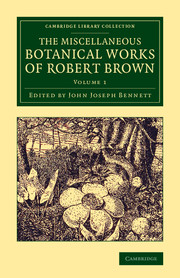
The botanist Robert Brown (1773–1858) is regarded as one of the most significant figures in the advancement of plant science in the nineteenth century. After studying at Aberdeen and Edinburgh, he made the acquaintance of Sir Joseph Banks via William Withering, and in 1801 was appointed as naturalist on Matthew Flinders' expedition to Australia. Brown made extensive collections of animals and minerals, but his 3,400 plant specimens from Australia, Tasmania and Timor were the foundation of his work for the rest of his life, as an active member of the Linnean Society, as Banks's librarian, and as an under-librarian in the British Museum. This two-volume collection of his 'miscellaneous botanical works', edited by John J. Bennett, Brown's assistant at the British Museum, was published in 1866–7. It has not been possible to reissue the accompanying quarto volume of plates. Volume 1 contains 'Geographico-Botanical Memoirs' and 'Structural and Physiological Memoirs'.
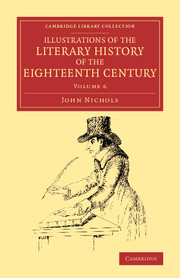
The subtitle of this eight-volume set is Consisting of Authentic Memoirs and Original Letters of Eminent Persons, and Intended as a Sequel to the 'Literary Anecdotes', which had been published in nine volumes by the author, editor and publisher John Nichols (1745–1826) between 1812 and 1815, and are also reissued in this series. Like its predecessor set, these 'illustrations' are a useful source of biographical material on authors and publishers at a time when many of the literary genres we take for granted, such as the novel, the autobiography and the analytical history, were first being developed. The volumes were published between 1817 and 1858, the project being continued after Nichols' death by his son and grandson. Among the 'eminent persons' included in Volume 6 are the poet Anna Seward, Dr Johnson, the bibliographer Thomas Dibdin, and King George III.
Founded in 1868 by the Cambridge scholars John Eyton Bickersteth Mayor (1825–1910), William George Clark (1821–78), and William Aldis Wright (1831–1914), this biannual journal was a successor to The Journal of Classical and Sacred Philology (also reissued in the Cambridge Library Collection). Unlike its short-lived precursor, it survived for more than half a century, until 1920, spanning the period in which specialised academic journals developed from more general literary reviews. Predominantly classical in subject matter, with contributions from such scholars as J. P. Postgate, Robinson Ellis and A. E. Housman, the journal also contains articles on historical and literary themes across the 35 volumes, illuminating the growth and scope of philology as a discipline during this period. Volume 33, comprising issues 65 and 66, was published in 1914.
Published between 1862 and 1932, and reissued here in multiple parts, this monumental calendar of documents remains an essential starting point for the serious study of Tudor history. An experienced editor of historical texts, John Sherren Brewer (1809–79) had no prior training in the history of the period, yet he brought to the project the necessary industriousness and an impeccable command of Latin. Four volumes appeared before his death, whereupon James Gairdner (1828–1912), his former assistant, took up the editorial reins. Continuing Brewer's method of ordering chronologically all available documents from 1509 to 1547, and reproducing some passages while paraphrasing or omitting others, Gairdner brought the project to its conclusion, aided himself by R. H. Brodie (1859–1943) in preparing the later volumes. Volume 1 (1862) has been split into two for this reissue: this first half covers the period from April 1509 to May 1513.
The antiquary and artist George Petrie (1790–1866) was one of the founding fathers of Irish archaeology. Having trained since childhood with his painter father, he began to travel around the country, sketching landscapes, monuments and ruins. He later worked for the Royal Irish Academy, and then for the Ordnance Survey, organising the publication of essays on the historical monuments it mapped. His interests extended from architecture and ecclesiastical history to ancient music and Irish wolfhounds, and he was at the forefront of efforts to preserve endangered historic buildings. In particular, his studies of the round towers of Ireland successfully demolished many myths about their building and purpose. This biography, published in 1868, was written by his friend and companion on many antiquarian expeditions, William Stokes (1804–78), the distinguished physician who was one of the first to introduce Laënnec's stethoscope into the British Isles.
Long before their western counterparts, Chinese astronomers developed remarkably accurate methods for making their measurements, recording detailed observations since ancient times. Of particular interest to John Williams (1797–1874), assistant secretary to the Royal Astronomical Society, were Chinese observations of comets. Noting that previous translations of these records had been incomplete, Williams sought to produce a fuller catalogue. The present work, published in 1871, presents Chinese comet observations between 611 BCE and 1640 CE, using the encyclopaedia of Ma Duanlin and the great historical Shiji as major references. Williams provides useful context in his introductory remarks, mentioning the tests by which the accuracy of the Chinese records can be verified. He also includes chronological tables and a Chinese celestial atlas, enabling comparison between the Chinese and Western systems for dates and stars respectively.
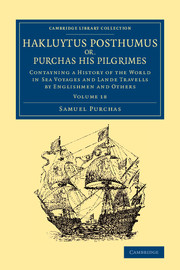
Richard Hakluyt's 12-volume Principal Navigations Voyages Traffiques and Discoveries of the English Nation, originally published at the end of the sixteenth century, and reissued by the Cambridge Library Collection in the edition of 1903–5, was followed in 1625 by Hakluytus Posthumus or, Purchas his Pilgrimes, now reissued in a 20-volume edition published in 1905–7. When first published in four folio volumes, the work was the largest ever printed in England. An Anglican priest, Samuel Purchas (1577–1626) was a friend of Hakluyt, and based his great work in part on papers not published by Hakluyt before his death. As well as being a wide-ranging survey of world exploration, it is notable as an anti-Catholic polemic, and a justification of British settlement in North America. Volume 18 moves from South to North America, with accounts of French expeditions including that of Champlain, British planned colonies and John Smith's description of Virginia.
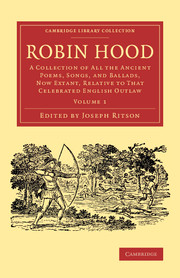
A controversial literary critic and commentator, Joseph Ritson (1752–1803) made his reputation identifying and exposing literary forgeries. His enduring legacy, however, stems from his interest in the legend of Robin Hood. The combination of his passion for collecting literary antiquities, particularly medieval ballad poetry, and his political convictions in support of republican government, drew him to the tale of the English outlaw. This two-volume work, first published in 1795, is an important collection of texts relating to the legend. Ritson's aim was to present all the known poems and songs, and his research was so thorough that very little further material has been found since. This work helped transform the perception of the Robin Hood tradition, encouraging its serious study. As well as a selection of texts, Volume 1 contains a lengthy scholarly discussion of the tradition.
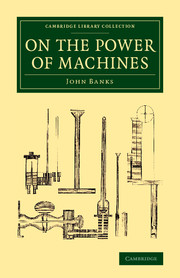
From the 1770s onwards, John Banks (1740–1805) taught natural philosophy and gave courses of public lectures across the north west of England. Much of his work aimed to show engineers, mechanics and artisans how they could benefit from expanding their practical and theoretical knowledge. In this 1803 publication, Banks ranges across mechanics, hydraulics and the strength of materials. He considers various designs for important industrial machines, such as watermills, pumps and steam engines, offering calculations of their power. Drawing on his own experiments, as well as those of others, he shows readers how to estimate the strength of wooden and iron beams, and how to calculate the airflow from a pair of bellows. Diverse in its topics, the book sheds light on how rational calculation came to be applied to the machinery of the industrial revolution. Banks' Treatise on Mills (2nd edition, 1815) is also reissued in this series.
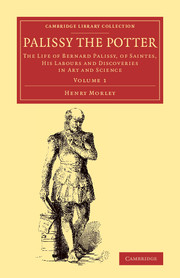
This two-volume biography of the sixteenth-century French potter and natural scientist Bernard Palissy (c.1510–c.1590) was published in 1852, the year after the Great Exhibition, in which Palissy's extraordinary art had been brought before the Victorian public by Minton's highly decorated 'Palissy wares'. Henry Morley (1822–94) trained in medicine but later became an author and editor, writing for Charles Dickens among others. Here he gathers together all the material then available about Palissy, including the potter's own writings and a contemporary biography. Palissy was among the many European ceramicists who attempted to reproduce Chinese porcelain; his lack of success drove his family into poverty, but his highly ornamented wares, encrusted with sea creatures, came to the attention of Catherine de' Medici, who gave him her patronage and protection (he was a convinced Protestant). After her death he was sent to the Bastille, and died there.
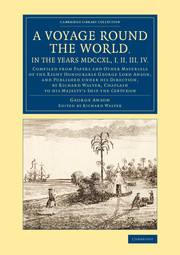
Compiled from Papers and Other Materials of the Right Honourable George Lord Anson, and Published under his Direction, by Richard Walter, Chaplain to his Majesty's Ship the Centurion
Compiled by the naval chaplain Richard Walter (1717–85), though the extent of his editorial contribution is not certain, this 1748 publication documents the extraordinary circumnavigation accomplished by the British naval officer George Anson (1697–1762) between 1740 and 1744. During the Anglo-Spanish conflict which Thomas Carlyle later described as the War of Jenkins' Ear, Anson was chosen to command a squadron to raid and plunder the Pacific coast of South America. After a delayed departure, the expedition struggled with terrible weather, rough seas and outbreaks of scurvy as it rounded Cape Horn. Hundreds of men were lost and eventually only the warship Centurion remained, badly battered and undermanned. Despite the disaster, the expedition became famous for its capture in 1743 of a Spanish treasure galleon laden with silver. Anson won much acclaim for this feat, and he entered into politics. This account, meanwhile, became a bestseller.
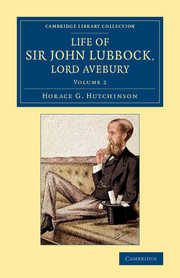
The achievements of the polymath Sir John Lubbock (1834–1913) spanned banking, politics, science and philanthropy. First published in 1914, this two-volume biography by Horace G. Hutchinson (1859–1932) traces Lubbock's extraordinary life and career. Hutchinson, who knew his subject in later years, paints a highly favourable portrait of Lubbock's varied accomplishments. Notably, Lubbock became a partner of his father's bank at twenty-two, a Member of Parliament in 1870, and in 1900 received the title of Baron Avebury. Tutored in natural history by Charles Darwin in his youth, he remained fascinated by evolutionary theory: it influenced his archaeological and anthropological work, including Pre-Historic Times as Illustrated by Ancient Remains (1865) and The Origin of Civilisation and the Primitive Condition of Man (1870), both reissued in the Cambridge Library Collection. Volume 2 focuses on Lubbock's later life, with Hutchinson remarking that by seventy Lubbock was still politically active and in good health.
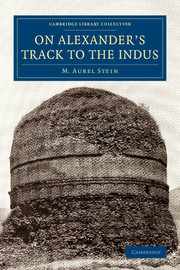
The Hungarian-born archaeologist Marc Aurel Stein (1862–1943) is probably best remembered today for his explorations in Chinese Turkestan, and especially his discovery of the Buddhist treasure of Dunhuang, described in his earlier works, Sand-Buried Ruins of Khotan and Ruins of Desert Cathay (also reissued in this series). Stein was equally interested in the territory north-west of the North-West Frontier, and in this highly illustrated 1929 work he describes an expedition to survey the route of Alexander the Great's invasion of India in 326 BCE. Having long been intrigued by 'that comparatively small area to the west of the Indus which Alexander's march of conquest towards India for a brief span of time illuminates as it were with the light of a meteor', and by archaeological remains showing a blend of Hellenistic and Buddhist art, Stein offers a fascinating account of an ancient clash of civilisations.
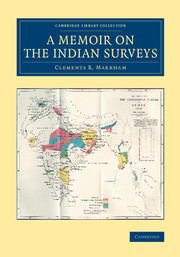
Sir Clements R. Markham (1830–1916), the doyen of historical geography in the late nineteenth century, published this comprehensive work on British surveys of India in 1871, at the request of the Indian Office. As he states in his preface, the object of his book is 'to furnish a general view of all the surveying and other geographical operations in India from their first commencement', so that there was a ready source of information on work already done, both for readers of current surveys and also for the surveyors themselves. Markham begins with the earliest European exploration of the Indian Ocean, including the earliest voyages of the East India Company. Systematic land surveying in India, begun by Major James Rennell, remained in military hands through the period of the trigonometric and topographical surveys, and Markham also covers the geological, archaeological and astronomical surveys of the subcontinent in the nineteenth century.
Sir James Frazer (1854–1941) is best remembered today for The Golden Bough, widely considered to be one of the most important early texts in the fields of psychology and anthropology. Originally a classical scholar, Frazer also published this five-volume edition of Ovid's Fasti in 1929. It contains the text and a parallel English translation, with commentary on the six books, indexes, illustrations, and plans. Frazer's interest in Ovid's unfinished final poem arose from his wide-ranging studies of ancient literature and the origins of myth. The work describes the origins of the Roman calendar with its sacred, feast, and remembrance days, and ranges from the deeds of major gods and heroes to the strange rites involved in placating the goddess of mildew. Volume 1 contains the text and translation of all six books. Other works by Frazer are also reissued in the Cambridge Library Collection.
Or, New University Guide to the Academical Customs, and Colloquial or Cant Terms Peculiar to the University of Cambridge, Observing Wherein It Differs from Oxford
This anonymous and light-hearted work was first published in 1803: reissued here is the edition of 1824, of which the authors describe themselves as 'a Brace of Cantabs'. It claims both to be a guide to 'the academical customs' of the University of Cambridge and to its 'colloquial or cant terms' with notes on those that differ from the usage of Oxford. The balance of information is given to the less serious aspects of university life: for example, considerably more space is given, in the definition of 'bishop', to a recipe for mulled port wine than to the clerical role. The work abounds in puns (in English and Latin), anecdotes, and extracts (mostly amusing) from more serious histories of the university, and ends with a tailpiece on how to graduate 'the reading way' and 'the varmint way'. This fascinating work demonstrates that the publication of spoof 'guides to freshmen' is nothing new.
Born near Aachen, Leonhard Schmitz (1807–90) studied at the University of Bonn, from which he received his PhD, before marrying an Englishwoman and becoming a naturalised British citizen. Made famous by the 1844 publication of his translation of Niebuhr's Lectures on the History of Rome, he became rector of the Royal High School, Edinburgh, where he taught Alexander Graham Bell. He also briefly tutored the future Edward VII (and he had previously taught Prince Albert in Bonn). This short-lived quarterly journal, which Schmitz founded and edited between 1844 and 1850, focused exclusively on aspects of classical antiquity - in contrast to the more general literary reviews that were common in the period. It illuminates the development of Classics as a specialist discipline as well as contemporary intellectual links between Britain and Germany. This fifth volume was published in 1848.
William Marshall (1745–1818), an experienced farmer and land agent, published this work in 1795, and early in 1796 produced a second edition (reissued here), 'with large additions'. The two-volume work was intended as a practical guide for the owners or managers of large estates on how to establish and maintain timber plantations, both for their financial value and also as important decorative elements in the landscaping of the surroundings of the owner's house. The work covers the practical issues of planting, propagating and transplanting, and discusses the choice of trees for different commercial purposes, and the planning and maintenance of hedgerows, as well as ornamental buildings. Volume 1 includes a review of the writings on landscape by such figures as Horace Walpole, (one of whose essays is reproduced), giving insights into the economic as well as the aesthetic aspects of landscape gardening in its golden age.