A collection of out-of-copyright and rare books from the Cambridge University Library and other world-class institutions that have been digitally scanned, made available online, and reprinted in paperback.
To save content items to your account,
please confirm that you agree to abide by our usage policies.
If this is the first time you use this feature, you will be asked to authorise Cambridge Core to connect with your account.
Find out more about saving content to .
To save content items to your Kindle, first ensure no-reply@cambridge.org
is added to your Approved Personal Document E-mail List under your Personal Document Settings
on the Manage Your Content and Devices page of your Amazon account. Then enter the ‘name’ part
of your Kindle email address below.
Find out more about saving to your Kindle.
Note you can select to save to either the @free.kindle.com or @kindle.com variations.
‘@free.kindle.com’ emails are free but can only be saved to your device when it is connected to wi-fi.
‘@kindle.com’ emails can be delivered even when you are not connected to wi-fi, but note that service fees apply.
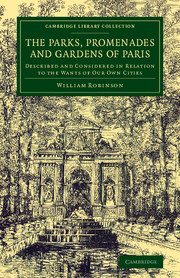
The innovative gardener and writer William Robinson (1838–1935), many of whose other works are reissued in this series, was sent by The Times as its horticultural correspondent to the Paris International Exposition of 1867. As a result of his visit, he produced two books, one on gardening trends in France, and this work of 1869 on the parks and gardens of Paris and its environs (including Versailles), and on the fruit and vegetable farming which fed the famous Parisian food markets such as Les Halles. Robinson admired especially the small planted open spaces, squares and courtyards in Paris, which had no equivalent in London, and which he claimed were 'saving [its inhabitants] from pestilential overcrowding, and making their city something besides a place for all to live out of who can afford it'. This highly illustrated work will interest not only historians of horticulture but also lovers of Paris.
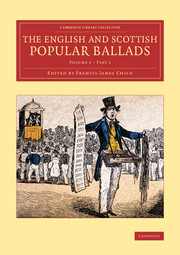
Harvard's first professor of English, the American scholar Francis James Child (1825–96) had previously prepared a collection of English and Scottish ballads, published in 1857–9, before he embarked on producing this definitive critical edition. Organised into five volumes and published in ten parts between 1882 and 1898, the work includes the text and variants of 305 ballads, with Child's detailed commentary and comparison with ballads and stories from other languages. Although he did not live to fully clarify his methods of selection and classification, modern scholars still refer to the 'Child Ballads' as an essential resource in the study of folk songs and stories in the English language. The work also contains a helpful glossary of archaic terms and a long list of sources. Volume 2, Part 1 (1885) contains ballads 54-82, including 'Fair Annie' and 'The Bonny Birdy'.
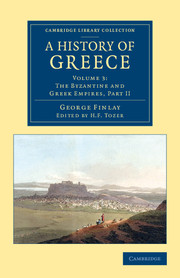
A participant in the Greek struggle for independence alongside Lord Byron, the philhellene George Finlay (1799–1875) lent his support to the newly liberated nation while diligently studying its past. The monographs he published in his lifetime covered the history of Greece since the Roman conquest, spanning two millennia. His two-volume History of the Greek Revolution (1861) is reissued separately in this series. Edited by the scholar Henry Fanshawe Tozer (1829–1916) and published in 1877, this seven-volume collection brought together Finlay's histories, incorporating significant revisions. Notably, Finlay gives due consideration to social and economic factors as well as high politics. Volume 3 gives a history of the Byzantine empire from 1057 until the fall of Constantinople in 1453. Finlay argues that despite the regaining of lost territories under the Komnenian dynasty, a lack of administrative reform led ultimately to the decay and dissolution of the Byzantine empire.
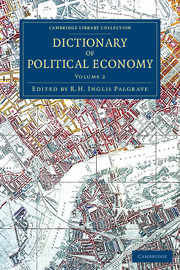
Sir Robert Harry Inglis Palgrave (1827–1919) began his career in country banking, but through assiduous self-education became a leading figure in economic circles. In 1877, he was made an editor of The Economist and formulated plans with other experts to further the general understanding of economics. The most significant result of these plans was the present work. Similar books had already been published in Europe, but a work in English was long overdue. Concerned less with abstract theory and more with practical and historical issues, Palgrave gathered a distinguished group of international contributors, and the three volumes originally appeared in 1894, 1896 and 1899. A landmark in publishing, the work made the discipline of economics accessible to educated adults for the first time. Volume 2, covering F to M, includes entries on free trade, gilds, income tax, labour, and Malthus.
Emily Eden's childhood prepared her well for her role as companion to her brother, the Governor-General of India. Outwardly all that a minor aristocrat should be, the observant and sharp-tongued Eden (1797–1869) never censored her letters for the sake of diplomacy. This two-volume collection of letters, edited by her niece Eleanor Eden, was published posthumously in 1872 after the success of her 1866 collection, Up the Country (also reissued in this series). Volume 1 begins in England, with an account of preparations (including lessons in Hindi) for the voyage and subsequent seven-year stay in India, about which Emily was originally apprehensive. In spite of suffering from the heat (and from considerable boredom at her formal duties as Lord Auckland's hostess) she produces a series of light-hearted and engaging letters to friends and family, from 'At Sea, Nowhere in Particular' to the Governor-General's palatial residence in Calcutta.
A precursor of modern academic journals, this quarterly periodical, published between 1810 and 1829 and now reissued in forty volumes, was founded and edited by Abraham John Valpy (1787–1854). Educated at Pembroke College, Oxford, Valpy established himself in London as an editor and publisher, primarily of classical texts. Edmund Henry Barker (1788–1839), who had studied at Trinity College, Cambridge, became a contributor and then co-editor of this journal, which fuelled a scholarly feud with the editors of the Museum criticum (1813–26), a rival periodical (also reissued in the Cambridge Library Collection). Although its coverage overlapped with that of its competitor, the Classical Journal also included general literary and antiquarian articles as well as Oxford and Cambridge prize poems and examination papers. It remains a valuable resource, illuminating the development of nineteenth-century classical scholarship and academic journals. Volume 20 contains the September and December issues for 1819.
The pre-eminent historian of his day, Edward Gibbon (1737–94) produced his magnum opus in six volumes between 1776 and 1788. Reissued here is the authoritative seven-volume edition prepared by J. B. Bury (1861–1927) between 1896 and 1900. Immediately and widely acclaimed, Gibbon's work remains justly famous for its magisterial account of Roman imperialism and Christianity from the first century CE through to the fall of Constantinople and beyond. Innovative in its use of primary sources and notable for its tone of religious scepticism, this epic narrative stands as a masterpiece of English literature and historical scholarship. Volume 6 covers the period from the seventh to the fourteenth centuries CE, addressing the Arab sieges of Constantinople, the culture of the Eastern Empire at the end of the first millennium, the origins of the Bulgarian, Hungarian and Russian peoples, the rise of the Turks and the conquest of Asia Minor, and the Crusades.
Born and educated in Florence, Arnold Henry Savage Landor (1867–1925) abandoned his art studies in Paris in favour of adventurous expeditions across Asia, Africa, the Middle East and South America. A fellow of the Royal Geographical Society from 1892, Landor was also made a member of the Royal Institution in 1897. Dismissive of specialist equipment, he embarked on extraordinary trips that often required considerable courage and endurance. Another of his publications, Alone with the Hairy Ainu (1893), is also reissued in the Cambridge Library Collection. The present work, first published in 1895, is an absorbing account of the geography, people and culture of Korea. While Landor's grasp of the forces of change at work in the country may be partial, the work nevertheless demonstrates a valuable understanding of Korean culture and customs not found in earlier accounts. Many fine illustrations by Landor himself increase the book's appeal.
Brought up among the extensive grounds of her family home at Didlington Hall in Norfolk, Alicia Amherst (1865–1941) was a keen gardener from an early age. Especially interested in socially beneficial gardening, she sat on the board of the Chelsea Physic Garden from 1900, encouraged the growing of smoke-resistant flowers in poor urban areas, and promoted the greater use of allotments and school gardens during the First World War. Long regarded as a significant work for its thorough yet accessible approach, this well-researched historical and horticultural survey first appeared in 1907 under her married name of the Honourable Mrs Evelyn Cecil. Beautifully illustrated throughout, it covers London's royal and other parks as well as less obvious green spaces such as squares, burial grounds, and Inns of Court. A map and plant lists are also included. Amherst's History of Gardening in England (1895) is also reissued in this series.
A Benedictine scholar and naturalist, Antoine-Joseph Pernety (1716–96) produced this early and invaluable description of the natural history of the Falkland Islands (or isles Malouines). He had arrived there as part of the 1763–4 expedition led by Louis-Antoine de Bougainville, claiming the islands for France. A small colony was established, allowing Pernety to provide an account of an ecosystem as yet unaffected by a human population. He spent some months studying the landscape, flora, fauna and climate, and his observations and drawings were published in these two volumes in 1770 (a one-volume English translation of 1771 is also reissued in this series). Additional material from other voyages, to Patagonia and the Straits of Magellan, provides information on contact with indigenous peoples in South America. Volume 2 includes this material from other authors. A series of detailed maps and drawings conclude the volume.
Born near Aachen, Leonhard Schmitz (1807–90) studied at the University of Bonn, from which he received his PhD, before marrying an Englishwoman and becoming a naturalised British citizen. Made famous by the 1844 publication of his translation of Niebuhr's Lectures on the History of Rome, he became rector of the Royal High School, Edinburgh, where he taught Alexander Graham Bell. He also briefly tutored the future Edward VII (and he had previously taught Prince Albert in Bonn). This short-lived quarterly journal, which Schmitz founded and edited between 1844 and 1850, focused exclusively on aspects of classical antiquity – in contrast to the more general literary reviews that were common in the period. It illuminates the development of Classics as a specialist discipline as well as contemporary intellectual links between Britain and Germany. This fourth volume was published in 1847.
A precursor of modern academic journals, this quarterly periodical, published between 1810 and 1829 and now reissued in forty volumes, was founded and edited by Abraham John Valpy (1787–1854). Educated at Pembroke College, Oxford, Valpy established himself in London as an editor and publisher, primarily of classical texts. Edmund Henry Barker (1788–1839), who had studied at Trinity College, Cambridge, became a contributor and then co-editor of this journal, which fuelled a scholarly feud with the editors of the Museum criticum (1813–26), a rival periodical (also reissued in the Cambridge Library Collection). Although its coverage overlapped with that of its competitor, the Classical Journal also included general literary and antiquarian articles as well as Oxford and Cambridge prize poems and examination papers. It remains a valuable resource, illuminating the development of nineteenth-century classical scholarship and academic journals. Volume 16 contains the September and December issues for 1817.
Containing Words from the English Writers Previous to the Nineteenth Century Which Are No Longer in Use, or Are Not Used in the Same Sense; and Words Which Are Now Used Only in Provincial Dialects
Thomas Wright (1810–77), a respected folklorist and medievalist, wrote prolifically on a wide range of subjects. His work is, however, considered broad rather than deep, and his extensive output, while impressive, sometimes came at the expense of quality. Wright was involved in many academic societies, and co-founded the British Archaeological Association in 1843. Much of his work promoted the use of vernacular literature for research into the Middle Ages, and this dictionary, first published in 1857, was compiled to help readers of historical literature navigate unfamiliar vocabulary. It lists obsolete words and phrases, with particular emphasis on those of Old English and Anglo-Norman origin, and obscure or dialectal words. Many of the definitions include illustrative examples or quotes as well as etymologies. Examples include belly-timber, meaning 'food', and dweezle, a Northamptonshire word that means 'to dwindle away'. Volume 2 covers the letters G–Z.
A Narrative of the Search for Lieut-Commander De Long and his Companions, Followed by an Account of the Greely Relief Expedition and a Proposed Method of Reaching the North Pole
George W. Melville (1841–1912) was a member of an 1879 American Arctic expedition seeking a northern passage from the Bering Strait to the Atlantic. Its ship was trapped in ice for nearly two years, and was eventually crushed and sank. The crew, stranded in three small boats, were left with few provisions and little hope of rescue. Melville was the only boat commander to bring his men to safety, assuming leadership of the survivors after landing in Siberia in 1881. He returned to search for other survivors, trekking over a thousand miles, but found only the bodies of his former companions in a frozen campsite, from which, however, he recovered the expedition's records. This account also includes details of Melville's role in the Greely Relief Expedition of 1884, from which he returned shortly before the book's British publication in 1885, and a detailed proposal for reaching the North Pole.
The Pliocene-Pleistocene Crags of East Anglia are an incredibly rich source of fossil shells, many belonging to extant Boreal and Mediterranean genera. Dominated by marine gastropods and bivalves, the deposits also contain evidence of terrestrial and non-marine gastropods and bivalves, brachiopods, and extensive epifauna including bryozoans. Published between 1848 and 1879 in four volumes, the latter two being supplements with further descriptions and geological notes, this monograph by Searles Valentine Wood (1798–1880) covers more than 650 species and varieties of fossil mollusc. For each species Wood gives a synonymy, diagnosis (in Latin), full description, dimensions, occurrence and remarks. The supplements also provide a breakdown of the species and their current distribution. The detailed plates were prepared by the conchologist George Brettingham Sowerby and his namesake son. Volume 3 (1872–4) comprises the first supplement, covering univalves and bivalves, and includes an important map of the Crag district.
The American inventor Samuel Morse (1791–1872) spent decades fighting to be recognised for his key role in devising the electromagnetic telegraph. While he will always be remembered in the history of telecommunications, and for co-developing the code which bears his name, Morse started out as a painter and also involved himself in matters of politics over the course of his career. Published in 1914, this two-volume collection of personal papers was edited by his son, who provides helpful commentary throughout, illuminating the struggles and successes of a remarkable life. Volume 2 begins with Morse's return voyage to the United States; following a conversation with a fellow passenger regarding electromagnetism, Morse began to develop the concept of the single-wire telegraph. The rest of the volume gives much personal background to the development of the invention and particularly to Morse's efforts to gain the recognition he believed he deserved.
Sir James Frazer (1854–1941) is best remembered today for The Golden Bough, widely considered to be one of the most important early texts in the fields of psychology and anthropology. Originally a classical scholar, Frazer also published this five-volume edition of Ovid's Fasti in 1929. It contains the text and a parallel English translation, with commentary on the six books, indexes, illustrations, and plans. Frazer's interest in Ovid's unfinished final poem arose from his wide-ranging studies of ancient literature and the origins of myth. The work describes the origins of the Roman calendar with its sacred days, and ranges from the deeds of major gods and heroes to the strange rites involved in placating the goddess of mildew. Volume 5 contains indexes to the translation and commentary, 88 plates, and maps of Rome. Other works by Frazer are also reissued in the Cambridge Library Collection.
The acclaimed Prussian naturalist Alexander von Humboldt (1769–1859) was referred to by Charles Darwin as 'the greatest scientific traveller who ever lived'. Several of his works were in the library aboard the Beagle, including the multi-volume Personal Narrative of Travels, two books on geology and Tableaux de la nature (all reissued in the Cambridge Library Collection). Darwin's copy of this two-volume 1811 New York edition of Humboldt's Political Essay (originally published in French earlier that year) is inscribed 'Buenos Ayres', suggesting he acquired it there in 1832–3, without its accompanying atlas (forthcoming). Humboldt had spent a year in Mexico in 1803–4, and was struck by its 'civilization' as compared to regions of South America that he had visited earlier on his expedition. Volume 2 of his account contains information about the population, language and key features of each district of Mexico, and about the country's agriculture.
Ludwig van Beethoven (1770–1827) was a prolific letter writer, with thousands of examples surviving to this day. Often written in great haste - 'in der Eile' was a common sign-off - they allow us to follow the great composer's anxieties and preoccupations, revealing the human figure behind some of the greatest music ever written. Despite the fact that 'many of Beethoven's letters slumber in foreign lands, especially in the unapproachable cabinets of curiosities belonging to various close-fisted English collectors', the German musicologist Ludwig Nohl (1831–85) published his collection of letters in 1865, and this two-volume English translation by Grace Jane Wallace (1804–78) appeared the following year, reflecting the fact that interest in Beethoven had not diminished nearly forty years after his death. Volume 1 includes the letter by the thirteen-year-old Beethoven which declares his life's commitment to the craft of music, and the still poignant 'Heiligenstadt Testament'.
Born in Hamburg to Jewish parents, Julius Oppert (1825–1905) later moved to France, where he established a reputation as a remarkably gifted Assyriologist, making significant contributions to the decipherment of cuneiform Akkadian. Between 1851 and 1854, he accompanied the orientalist Fulgence Fresnel (1795–1855) on the French expedition to Mesopotamia. In recognition of his role, involving important excavations at the site of the ancient city of Babylon, Oppert was granted French citizenship. In May 1855, however, a great many of the discovered antiquities were lost when the raft transporting them sank in the Tigris under the weight of its priceless cargo. The present work appeared in two volumes between 1859 and 1863; the publication of the second volume preceded that of the first, as Oppert prioritised the analysis of the cuneiform inscriptions. Volume 1 (1863) contains an account of the journey and the archaeological results.