A collection of out-of-copyright and rare books from the Cambridge University Library and other world-class institutions that have been digitally scanned, made available online, and reprinted in paperback.
To save content items to your account,
please confirm that you agree to abide by our usage policies.
If this is the first time you use this feature, you will be asked to authorise Cambridge Core to connect with your account.
Find out more about saving content to .
To save content items to your Kindle, first ensure no-reply@cambridge.org
is added to your Approved Personal Document E-mail List under your Personal Document Settings
on the Manage Your Content and Devices page of your Amazon account. Then enter the ‘name’ part
of your Kindle email address below.
Find out more about saving to your Kindle.
Note you can select to save to either the @free.kindle.com or @kindle.com variations.
‘@free.kindle.com’ emails are free but can only be saved to your device when it is connected to wi-fi.
‘@kindle.com’ emails can be delivered even when you are not connected to wi-fi, but note that service fees apply.
A precursor of modern academic journals, this quarterly periodical, published between 1810 and 1829 and now reissued in forty volumes, was founded and edited by Abraham John Valpy (1787–1854). Educated at Pembroke College, Oxford, Valpy established himself in London as an editor and publisher, primarily of classical texts. Edmund Henry Barker (1788–1839), who had studied at Trinity College, Cambridge, became a contributor and then co-editor of this journal, which fuelled a scholarly feud with the editors of the Museum criticum (1813–26), a rival periodical (also reissued in the Cambridge Library Collection). Although its coverage overlapped with that of its competitor, the Classical Journal also included general literary and antiquarian articles as well as Oxford and Cambridge prize poems and examination papers. It remains a valuable resource, illuminating the development of nineteenth-century classical scholarship and academic journals. Volume 15 contains the March and June issues for 1817.
The late eighteenth century saw Manchester and its surrounding areas undergo significant change as industrialisation fuelled urbanisation and population growth. In this classic 1795 account, the physician and prolific writer John Aikin (1747–1822) gathers together information on the settlements at the heart of manufacturing and trade in north-west England, covering the vital network of waterways as well as the surrounding countryside. Revealing the fundamental importance of the textile industry, this survey provides a detailed portrait of an evolving region and its human geography. It is complemented by a number of illustrations, including maps, plans, and engravings of notable landmarks. Referred to by Karl Marx in his writings, the book remains a historically valuable resource. Also reissued in this series is Aikin's Biographical Memoirs of Medicine in Great Britain from the Revival of Literature to the Time of Harvey (1780).
Richard Hakluyt's 12-volume Principal Navigations Voyages Traffiques and Discoveries of the English Nation, originally published at the end of the sixteenth century, and reissued by the Cambridge Library Collection in the edition of 1903–5, was followed in 1625 by Hakluytus Posthumus or, Purchas his Pilgrimes, now reissued in a 20-volume edition published in 1905–7. When first published in four folio volumes, the work was the largest ever printed in England. An Anglican priest, Samuel Purchas (1577–1626) was a friend of Hakluyt, and based his great work in part on papers not published by Hakluyt before his death. As well as being a wide-ranging survey of world exploration, it is notable as an anti-Catholic polemic, and a justification of British settlement in North America. Volume 20 covers the capture of Cadiz by the earl of Essex in 1596, and a voyage to the Azores; it concludes with an index to all twenty volumes.
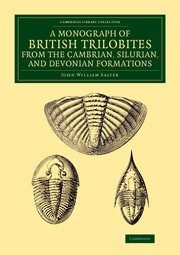
At the time of his death, John William Salter (1820–69) was dubbed 'the prince of palaeontologists'. A true naturalist with a particular interest in Trilobita, he started publishing this monograph in 1864, and three further parts were issued in 1865–7. But his heath failed and he died, leaving around half of the trilobites then known from Britain unclassified; the work was wound up in 1883. Though unfinished, Salter's monograph has thirty excellent plates which make it an essential starting point for the study of British Devonian, Silurian and Ordovician trilobites. The monograph is also frequently cited because Salter's 'preliminary classification of trilobites', though brief, was the best devised up to that time, and has since served as a framework for the classifications used today. Salter introduced four orders of trilobites, three of which - Phacopida, Asaphida, Agnostida - are generally recognised today; only his group 'Ampycini' is not now used.
As first mate aboard an East India Company vessel, James Horsburgh (1762–1836) was shipwrecked in the Indian Ocean in 1786 after faulty charts steered the ship onto a reef. Thereafter he devoted himself to the production of accurate charts of the eastern seas, keeping meticulous notes on extensive voyages, and carefully scrutinising the accounts and journals of other mariners. For his efforts, Horsburgh was elected to the Royal Society in 1806, and appointed hydrographer to the East India Company in 1810. The present work, reissued here in its two-volume first edition of 1809–11, remained a standard navigational reference for half a century (it was aboard the Beagle during Darwin's famous voyage). For given locations, it provides a description of the area and landmarks, and lists prevailing winds and currents, as well as any navigational hazards. Volume 2 covers mainly the seas between India and China, including those around Indonesia and the Philippines.
In the latter part of the nineteenth century, as technological progress enabled the exploration of hitherto neglected territory, the powers of Western Europe embarked on a process of imperial expansion into the African continent. As a journalist for The Times, geographer John Scott Keltie (1840–1927) wrote articles on the 'scramble' at the time, and in 1893 published this authoritative text on the subject, here reissued in its revised and augmented second edition of 1895. Keltie's presentation of the topic was well received and remained of lasting relevance, being described in his obituary as 'the best text-book of that exploration and division of a forgotten continent'. Early chapters address certain aspects of African history, but the bulk of the book deals with European attempts at settlement, partition and commercial exploitation. The future of Africa, as a site of ongoing European contention and competition, is also considered.
After a brief career at sea, during which he tested Harrison's chronometer for the Board of Longitude, John Robison (1739–1805) became lecturer in chemistry at the University of Glasgow. In 1774, having spent a period teaching mathematics in Russia, he returned to Scotland as professor of natural philosophy at Edinburgh. Despite his busy schedule, he contributed major articles on the sciences to the Encyclopaedia Britannica, giving an overview of contemporary scientific knowledge for the educated layperson. After his death, these and other pieces of his scientific writing were edited by his former pupil David Brewster (1781–1868) and were finally published in four volumes in 1822, with a separate volume of illustrative plates. This reissue incorporates those plates in the relevant volumes of text. Volume 2 contains Robison's articles on the steam engine (revised and expanded by his friend James Watt), on other machinery, and on fluid flows.
Mrs C. W. Earle (1836–1925) was born into the minor aristocracy as Maria Theresa Villiers. After training as an artist, she married Captain C. W. Earle, who inherited family wealth which enabled a comfortable lifestyle with a town house in London and a small property with a large garden in Surrey. Earle's designs for her garden were much admired by her circle, and she was encouraged to write down her gardening advice. She published three volumes of Pot-Pourri from a Surrey Garden (also reissued in this series) between 1897 and 1903, but these works were not restricted to gardening, and contained thoughts on travel and art, and also on the importance of diet to health. Published in 1911, these reminiscences are dedicated to her grandchildren, and contain her parents' history as well as her own memories of a privileged upbringing among the literary and artistic giants of mid-Victorian England.
Gabriel Ferrand (1864–1935) travelled widely as a French diplomat and pursued scholarly passions as a polyglot orientalist. He served as consul to Madagascar and published several works about the island, noting the Arab influence that preceded the arrival of Europeans. A member of the Société Asiatique, and editor of its journal from 1920 until his death, Ferrand sought in particular to make Arabic geographical and nautical writings more accessible to fellow scholars and students. Forming part of that project, this work appeared in two volumes in 1913–14. It presents annotated French translations of mainly Arabic texts relating to the Far East. Brief biographical notes on the authors are given for the benefit of non-specialists. Volume 1 contains the preliminary matter explaining Ferrand's approach to transcription and translation. This is followed by texts up to the thirteenth century, including extracts from the ninth-century author Sulaiman al-Tajir.
In this supplementary monograph, originally published 1866–72, the English geologist Peter Martin Duncan (1824–91) treats only those British fossil corals that were unknown to Edwards and Haime in their preceding monograph (also reissued in this series), and those that needed revision. The two works were meant to be used together, and Duncan includes combined indexes. Featuring similar white-on-black engravings, the work starts with the Eocene and proceeds stratigraphically downwards, ending with corals from around the Triassic–Jurassic boundary. The intention to cover Palaeozoic corals was never fulfilled, so this monograph concerns scleractinians. Duncan includes an introductory treatment of the anatomy of living scleractinians, in support of his claim to offer a new taxonomical approach. He also draws attention to 'the entirely new [Eocene (Bartonian)] Coral-fauna of Brockenhurst'. This was auspicious, since recent study of this fauna sheds light on the origin of the modern Indo-Pacific coral hotspot.
The first reliable maps of the Chilean and Peruvian coasts were drawn by the French explorer Amédée-François Frézier (1682–1773). In 1712, he was sent on a spying mission to the Spanish ports and fortifications of South America, travelling along the Pacific coastline as far as Callao, the port of Lima. His maps were later used by two of France's most famous explorers, Bougainville and Lapérouse. Frézier also took a keen interest in botany, mineralogy, economics and anthropology. His most celebrated achievement is the introduction to Europe of the Chilean strawberry, which was used to create the hybrid species known today as the garden strawberry. Frézier's observations and illustrations of the people, plants and animals he encountered on his South American travels are given in this popular account, published in Paris in 1716 and reissued here in the English translation of 1717.
Eleanor Vere Boyle (1825–1916), who re-created the gardens of Huntercombe Manor in Berkshire in the 1870s, was a talented artist as well as an author, illustrating both poetry and books for children. Coming from an aristocratic family, and in later life a friend of Queen Alexandra, she produced sketches and watercolours admired by Ruskin and Landseer, and Tennyson and Bulwer Lytton contributed to her anthologies of poetry. One of a number of late nineteenth-century female writers on gardens (many of whose works have been reissued in this series), she was interested in the natural history of the garden rather than in botanical principles. This work, published in 1895, describes the sights, sounds and smells of her garden through the seasons of 1894, with frequent digressions on the weather, birds and animals, the folklore connected with individual plants, literary references, and observations on other gardens visited, in both Britain and Europe.
The American writer and diplomat John Lloyd Stephens (1805–52) was effectively the founder of Mesoamerican archaeology, through his rediscovery of the Mayan civilization (his two-volume Incidents of Travel in Central America, Chiapas, and Yucatan is also reissued in this series). But before that, having qualified and practised as a lawyer in New York, he went on a two-year journey through Egypt and the Near East, publishing an account of his experiences in 1837 (under the name of George Stephens): this reissue is of the expanded 1838 edition. The work was extremely popular, possibly because, as he states in the preface, Stephens writes 'without perplexing himself with any deep speculations upon the rise and fall of empires', nor does he give much archaeological detail. Volume 1 begins with Stephens' arrival at Alexandria in Egypt, and his journey down the Nile to the Cataracts; it ends with a visit to St Catherine's monastery in Sinai.
In the mid-nineteenth century, two outstanding French zoologists, Henri Milne-Edwards (1800–85) and Jules Haime (1824–56), carried out the most comprehensive study of coral taxonomy and classification that had yet been attempted. They covered all known examples, ranging from the oldest fossil corals to those living in modern oceans. Although many of the taxa have now been revised, and many forms since discovered, this integrated approach was not emulated until multi-author treatises appeared a century later. Originally published 1850–4, this monograph begins with an account of coral classification. The authors then deal with British corals, working stratigraphically downwards from the Crag (Plio–Pleistocene), through all the known coral-bearing strata of the Cenozoic and Mesozoic, continuing down to the 'Silurian', from which the Ordovician had not yet been separated. A magnificent achievement for its time, and still important for researchers, the work is embellished by 72 white-on-black engraved plates.
Two years after Thomas Edison patented his electric light bulb, the 1881 International Exposition of Electricity in Paris, featuring many spectacular lighting displays, showcased the potential of this technology for commercial and domestic use. The accompanying International Congress of Electricians also agreed on international standards for units of electrical resistance, potential and current. In its wake, James Dredge (1840–1906), editor of the British periodical Engineering, compiled this illustrated overview of electrical technology and its application to lighting. First published in two volumes between 1882 and 1885, and using material that had previously appeared in Engineering, as well as new articles by various contributors, this substantial work reflects the complexities and possibilities of a propitious technological development. Among other topics, Volume 2 covers electrical measurement, standard textbooks, photometry, and recent developments in lamps and dynamos. The appendices give abstracts of British electrical patents from 1873 to 1882.
Richard Hakluyt's 12-volume Principal Navigations Voyages Traffiques and Discoveries of the English Nation, originally published at the end of the sixteenth century, and reissued by the Cambridge Library Collection in the edition of 1903–5, was followed in 1625 by Hakluytus Posthumus or, Purchas his Pilgrimes, now reissued in a 20-volume edition published in 1905–7. When first published in four folio volumes, the work was the largest ever printed in England. An Anglican priest, Samuel Purchas (1577–1626) was a friend of Hakluyt, and based his great work in part on papers not published by Hakluyt before his death. As well as being a wide-ranging survey of world exploration, it is notable as an anti-Catholic polemic, and a justification of British settlement in North America. Volume 7 describes expeditions to Ethiopia, and various pilgrimages to the Holy Land.
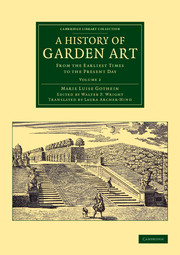
Marie Luise Gothein (1863–1931) published this scholarly two-volume history of garden design in German in 1913. Its second edition of 1925 was translated into English by Laura Archer-Hind, edited by gardening author Walter P. Wright (1864–1940), and published in 1928. The highly illustrated work is still regarded as among the most thorough and important surveys of its kind. It begins by examining evidence from both archaeology and literature, as well as climate and soil conditions, to discuss the gardens of ancient Egypt and Assyria, and continues to survey developments worldwide until the twentieth century. Individual gardens, technical innovations, and fashions in horticulture are all discussed in detail. Volume 2 considers northern European gardens of the Renaissance, the cultural importance of Louis XIV's France, the impact of the introduction of foreign plants, and gardening in Europe, the Far East and North America up to the early twentieth century.
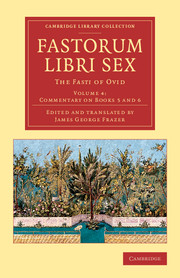
Sir James Frazer (1854–1941) is best remembered today for The Golden Bough, widely considered to be one of the most important early texts in the fields of psychology and anthropology. Originally a classical scholar, Frazer also published this five-volume edition of Ovid's Fasti in 1929. It contains the text and a parallel English translation, with commentary on the six books, indexes, illustrations, and plans. Frazer's interest in Ovid's unfinished final poem arose from his wide-ranging studies of ancient literature and the origins of myth. The work describes the origins of the Roman calendar with its sacred days, and ranges from the deeds of major gods and heroes to the strange rites involved in placating the goddess of mildew. Volume 4 contains Frazer's commentary on Books V and VI, dealing with the Roman months of May and June. Other works by Frazer are also reissued in the Cambridge Library Collection.
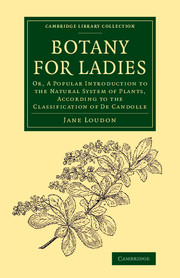
Jane Loudon (1807–58), the Mrs Beeton of the Victorian gardening world, wrote several popular books on horticulture and botany specifically for women. Her enthusiasm for plants and gardening was encouraged by her husband, the landscape designer John Claudius Loudon, whom she married in 1830. Her Instructions in Gardening for Ladies (also reissued in this series) was enormously successful, and she followed it up in 1842 with this volume on botany, in which she uses the natural system of classification. The 'grand object' of the work is 'to enable my readers to find out the name of a plant when they see it … or, if they hear or read the name … to make that name intelligible to them'. She takes her readers through the botanical orders, using a familiar plant as an exemplar for each, and then presents de Candolle's systematic description of plant species.
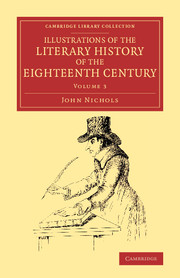
The subtitle of this eight-volume set is Consisting of Authentic Memoirs and Original Letters of Eminent Persons, and Intended as a Sequel to the 'Literary Anecdotes', which had been published in nine volumes by the author, editor and publisher John Nichols (1745–1826) between 1812 and 1815, and are also reissued in this series. Like its predecessor set, these 'illustrations' are a useful source of biographical material on authors and publishers at a time when many of the literary genres we take for granted, such as the novel, the autobiography and the analytical history, were first being developed. The volumes were published between 1817 and 1858, the project being continued after Nichols' death by his son and grandson. Volume 3 focuses on the judge and writer George Hardinge (1743–1816) and his family, but also includes material on Samuel Pepys, Robert Burns and the botanist Richard Pulteney.