A collection of out-of-copyright and rare books from the Cambridge University Library and other world-class institutions that have been digitally scanned, made available online, and reprinted in paperback.
To save content items to your account,
please confirm that you agree to abide by our usage policies.
If this is the first time you use this feature, you will be asked to authorise Cambridge Core to connect with your account.
Find out more about saving content to .
To save content items to your Kindle, first ensure no-reply@cambridge.org
is added to your Approved Personal Document E-mail List under your Personal Document Settings
on the Manage Your Content and Devices page of your Amazon account. Then enter the ‘name’ part
of your Kindle email address below.
Find out more about saving to your Kindle.
Note you can select to save to either the @free.kindle.com or @kindle.com variations.
‘@free.kindle.com’ emails are free but can only be saved to your device when it is connected to wi-fi.
‘@kindle.com’ emails can be delivered even when you are not connected to wi-fi, but note that service fees apply.
The decipherment of the ancient cuneiform scripts was one of the major breakthroughs in nineteenth-century archaeology and linguistics. Among the scholars working on Old Persian was Christian Lassen (1800–76), professor of Sanskrit at Bonn. Lassen's book on cuneiform inscriptions from Persepolis appeared in 1836, a month before his friend Eugène Burnouf independently published very similar conclusions. Lassen's account gives vivid insights into the detective work involved, as he painstakingly compares individual words and grammatical forms with their Avestan and Sanskrit equivalents, and proposes sounds for the symbols. The book uses a specially designed cuneiform font, and credits the printer, Georgi of Bonn. This Cambridge Library Collection volume also includes a short monograph on Old Persian phonology published in Berlin in 1847 by the Assyriologist Julius Oppert (1825–1905). Oppert revisits Lassen's conclusions in the light of Henry Creswicke Rawlinson's important 1846 memoir on the trilingual Behistun inscription.
Richard Hakluyt's 12-volume Principal Navigations Voyages Traffiques and Discoveries of the English Nation, originally published at the end of the sixteenth century, and reissued by the Cambridge Library Collection in the edition of 1903–5, was followed in 1625 by Hakluytus Posthumus or, Purchas his Pilgrimes, now reissued in a 20-volume edition published in 1905–7. When first published in four folio volumes, the work was the largest ever printed in England. An Anglican priest, Samuel Purchas (1577–1626) was a friend of Hakluyt, and based his great work in part on papers not published by Hakluyt before his death. As well as being a wide-ranging survey of world exploration, it is notable as an anti-Catholic polemic, and a justification of British settlement in North America. Volume 8 contains narratives of travel through Syria and Persia, including the story of Benjamin of Tudela, who visited Jewish communities in Europe and the Middle East.
First published in 1925, this selection of letters throws light upon the life and character of Constance Lytton (1869–1923), a brave and influential figure in the movement for women's suffrage. From an aristocratic background, she became a member of the Women's Social and Political Union in 1909, calling on the support of her many contacts. Among her achievements was the first-hand exposure of the poor treatment and force-feeding of working-class women on hunger strike in prison: she deliberately had herself arrested and imprisoned in disguise and under an alias. Compiled by her sister, Betty Balfour (1867–1942), these letters cover her adult life, mainly comprising correspondence from Lytton to close family members, interspersed with illustrations of her and her family. Despite omissions - particularly details relating to her personal relationships - this collection remains an important tribute to her life and to the history of suffrage and prison reform.
This 1911 publication, translated from the French, vividly describes the varied hardships and satisfactions of Antarctic exploration and scientific research in the early twentieth century. Son of the famed neurologist, Jean-Baptiste Charcot (1867–1936) commanded the Pourquoi-Pas? on its hazardous journey into the ice-bound regions south of Cape Horn. Illustrated with numerous photographs, his journal entries provide a rich account of daily life aboard the ship and out on the ice, including encounters with seals and penguins, and Christmases gathered around a cardboard tree. Building on the advances made by previous expeditions, including his own on the Français (1903–5), Charcot and his men, ranging in their expertise from astronomy to zoology, set out to further push back the boundaries of the unknown 'for the honour of French science'. The precise mapping of more than a thousand miles of Antarctic coastline ranked as one of the expedition's foremost achievements.
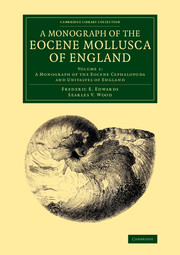
The Eocene sediments of the London and Hampshire basins in southern England are rich in fossil invertebrates, plants and vertebrates; in particular, they yield a great diversity of often well-preserved fossil mollusc shells. Seeking to provide a methodical treatment of known specimens, Frederick E. Edwards (1799–1875) and Searles V. Wood (1798–1880) had divided the workload of describing the Mollusca found in the English Tertiary formations, with Edwards taking the older formations and Wood the newer. When Edwards became ill, however, Wood took on the Eocene bivalves, yet he was unable to add much to the treatment of cephalopods and gastropods. Featuring detailed illustrations, the two volumes provide for each species a synonymy, diagnosis (in Latin), full description, dimensions, occurrence, and well-informed remarks. Volume 1 comprises the Monograph of the Eocene Cephalopoda and Univalves of England, originally published in several parts between 1849 and 1877.
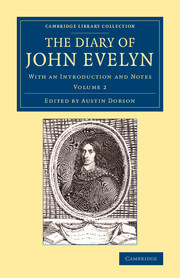
The Stuart writer and gardener John Evelyn (1620–1706), whose two-volume Sylva is also reissued in this series, kept a diary from the age of eleven, and in the 1680s began to compile this memoir from his records. It was first published in 1818 in an edition by the antiquarian William Bray; this three-volume version of 1906 was edited by Austin Dobson (1840–1921), the author and poet who also wrote the volume on Henry Fielding in the 'English Men of Letters' series, among many other literary biographies. In an extensive preface, Dobson explains his reasons for revisiting a work which had already received much editorial attention, and his introduction gives a short biography of its author. Volume 2 covers the period 1647–76, beginning with Evelyn still in self-exile in Europe; it records his return to England, the Interregnum and Restoration, as well as the Plague and the Fire of London.
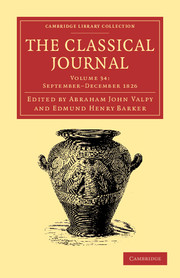
A precursor of modern academic journals, this quarterly periodical, published between 1810 and 1829 and now reissued in forty volumes, was founded and edited by Abraham John Valpy (1787–1854). Educated at Pembroke College, Oxford, Valpy established himself in London as an editor and publisher, primarily of classical texts. Edmund Henry Barker (1788–1839), who had studied at Trinity College, Cambridge, became a contributor and then co-editor of this journal, which fuelled a scholarly feud with the editors of the Museum criticum (1813–26), a rival periodical (also reissued in the Cambridge Library Collection). Although its coverage overlapped with that of its competitor, the Classical Journal also included general literary and antiquarian articles as well as Oxford and Cambridge prize poems and examination papers. It remains a valuable resource, illuminating the development of nineteenth-century classical scholarship and academic journals. Volume 34 contains the September and December issues for 1826.
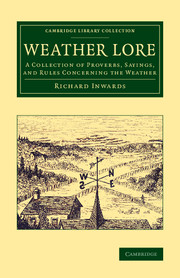
Richard Inwards (1840–1937) trained as a mining engineer, working on projects in Europe and South America (his book on Tiwanaku in Bolivia, The Temple of the Andes, is also reissued in the Cambridge Library Collection). A fellow of the Royal Meteorological Society and the Royal Astronomical Society, Inwards became well known in scientific circles. Weather Lore was first published in 1869, with this 1893 second edition including new entries from the United States. Compiled from sources as diverse as Hesiod, the Bible and Francis Bacon, the collection includes the notable observations that 'if spaniels sleep more than usual, it foretells wet weather', but 'if rats are more restless than usual, rain is at hand'. Often entertaining, always fascinating, the book does not pretend to be scientifically accurate; as the author was to remark later, 'no human being can correctly predict the weather, even for a week to come'.
Leicester Fitzgerald Charles Stanhope (1784–1862) played a controversial role in the struggle for Greek independence. After a career in the Indian army, he offered his services to the London Greek Committee in 1823, and was sent as its agent to Greece. However, his paternalistic view of the Greeks, as childlike 'natives' in need of guidance, was resented both by the Greeks themselves and by other members of the Committee. His approach, which supported the imposition of a unified constitutional system from above, alienated the Greek factions, especially Alexandros Mavrokordatos, whose otherwise pro-British stance was undermined by Stanhope's actions (which also disrupted the delivery of the Committee's loan to the Greeks). Stanhope was recalled by the British government (travelling home with Byron's body) and immediately released his correspondence with the Committee, which was edited and published in 1824, to deflect criticism of his conduct.
The American inventor Samuel Morse (1791–1872) spent decades fighting to be recognised for his key role in devising the electromagnetic telegraph. While he will always be remembered in the history of telecommunications, and for co-developing the code which bears his name, Morse started out as a painter and also involved himself in matters of politics over the course of his career. Published in 1914, this two-volume collection of personal papers was edited by his son, who provides helpful commentary throughout, illuminating the struggles and successes of a remarkable life. Volume 1 includes observations made in Europe while Morse studied painting. During the Napoleonic wars, he writes letters home describing the rising level of crime and social unrest in London, mentioning that he sleeps with a pistol. He is in London when Spencer Perceval is assassinated and later writes of meeting Turner, 'the best landscape painter living'.
The preface to this work describes how its authors, Charles Irby (1789–1845) and James Mangles (1786–1867), both officers in the Royal Navy, left England in 1816 for a tour of the continent. 'Curiosity at first, and an increasing admiration of antiquities as they advanced, carried them at length through several parts of the Levant.' On their return to England, interest in Egypt being at its height, they were persuaded to compile this book from their letters to friends and family at home, and had it privately printed in 1823. Their account begins in Cairo, whence they made a journey down the Nile, meeting with Giovanni Belzoni at Abu Simbel. They then travelled from Cairo across the desert and along the coast of the Holy Land, reaching Aleppo and exploring Syria. This detailed account of their two-year travels provides much information of continuing interest to archaeologists and historians.
This book, originally published in 1900, was the major work of the classical historian J. B. Bury. It became a standard textbook on the topic of ancient Greek history to the death of Alexander the Great for almost a century, and in its updated form is still studied today. Bury had studied philosophy as well as classics at Trinity College, Dublin, and had travelled widely in Greece, but until the publication of this work was better known for his two-volume History of the Later Roman Empire (also reissued in this series), and many of his other works also deal with the Byzantine period. He describes in the preface his decision to limit the extent of his history: 'compression into a single volume often produces a more useful book'. This magisterial and very readable synthesis of political and military history encompasses nearly three millennia and the whole of the Mediterranean and Near East.
Though raised in Newcastle's coal-mining community, Charles Hutton (1737–1823) went on to make his mark as a teacher and mathematician. A fellow of the Royal Society (and recipient of the Copley medal), he carried out research into the convergence of series, ballistics, and the density of the earth. After flooding destroyed several bridges across the Tyne in November 1771, he began to study the design of bridges, and published this mathematical treatment in 1772. It demonstrates the ideal properties of arches and piers, with due consideration given to the force of water flowing against these structures. Hutton's practical observations also enhance a section that provides definitions of relevant terms. Not merely a solution to the demands of transport and trade, a well-designed bridge, in Hutton's eyes, stands as a structure of elegance and beauty.
The horticulturalist John Lindley (1799–1865) worked for Sir Joseph Banks, and was later instrumental in saving the Royal Horticultural Society from financial disaster. He was a prolific author of works for gardening practitioners but also for a non-specialist readership, and many of his books have been reissued in this series. The first volume of this two-volume work was published in 1834, and the second in 1837. At a time when botany was regarded as the only science suitable for study by women and girls, Lindley felt that there was a lack of books for 'those who would become acquainted with Botany as an amusement and a relaxation', and attempted to meet this need. The first volume, in the form of engaging letters to a lady, was originally intended to stand alone. Illustrated with detailed botanical drawings, it schools the student in botanical form and taxonomy as well as nomenclature.
A precursor of modern academic journals, this quarterly periodical, published between 1810 and 1829 and now reissued in forty volumes, was founded and edited by Abraham John Valpy (1787–1854). Educated at Pembroke College, Oxford, Valpy established himself in London as an editor and publisher, primarily of classical texts. Edmund Henry Barker (1788–1839), who had studied at Trinity College, Cambridge, became a contributor and then co-editor of this journal, which fuelled a scholarly feud with the editors of the Museum criticum (1813–26), a rival periodical (also reissued in the Cambridge Library Collection). Although its coverage overlapped with that of its competitor, the Classical Journal also included general literary and antiquarian articles as well as Oxford and Cambridge prize poems and examination papers. It remains a valuable resource, illuminating the development of nineteenth-century classical scholarship and academic journals. Volume 5 contains the March and June issues for 1812.
Mrs C. W. Earle (1836–1925) was born into the minor aristocracy as Maria Theresa Villiers. After training as an artist, she married Captain C. W. Earle, who inherited family property which enabled a comfortable lifestyle with a town house in London and a small property with a large garden in Surrey. Earle's designs for her garden were much admired by her artistic and literary circle, and she was encouraged to write down her gardening advice. With the help of her niece, Lady Constance Lytton (who provides an appendix on Japanese flower arranging), she published this book, the first of three, in 1897, and it was a great and immediate success. The reader is addressed directly and engagingly on topics ranging from gardening and cookery books to planting schemes, healthy recipes, interior decoration, and the rearing of boys and girls, together with plenty of practical advice on all aspects of gardening.
William Ashton Ellis (1852–1919) abandoned his medical career in order to devote himself to his Wagner studies. Best known for his translations of Wagner's prose works, Ellis also translated Wagner's letters to family and friends. In this 1899 publication, most of the letters are those which Wagner wrote to the wealthy retired silk merchant Otto Wesendonck, who provided Wagner with generous financial support and whose wife, Mathilde, provided the words for the Wesendonck Lieder. Also included here are letters to the German writer Malwida von Meysenbug, who was also a friend of Nietzsche, and to the novelist Eliza Wille, at whose house in Zurich, a meeting place for the cognoscenti, Wagner was a regular guest. She later published her memories of the composer. Despite the stylistic idiosyncrasies of the translations, these letters remain of value because they capture something of the colour of Wagner's prose and personality.
Fellow of the Society of Antiquaries, William John Thoms (1803–85) pursued literary and bibliographical interests and conversed with the likes of Thomas Macaulay and Charles Dickens. Most notably, he coined the term 'folklore' in 1846 and founded the scholarly periodical Notes and Queries in 1849. Having been published separately, these three essays on Shakespeare were brought together in this 1865 work. 'Shakespeare in Germany' (1840) spells out how German drama was influenced by English playwrights and by English actors performing plays in Germany from the late sixteenth century onwards. 'The Folk-Lore of Shakespeare' (1847) considers fairy lore and names, with particular attention paid to the characters of Puck and Queen Mab. In 'Was Shakespeare Ever a Soldier?' (1859), Thoms acknowledges that little is known for sure about Shakespeare's life, but careful scrutiny of the evidence has made him 'morally certain' that the dramatist had seen military service.
A member of the Académie française, Henri Poincaré (1854–1912) was one of the greatest mathematicians and theoretical physicists of the late nineteenth and early twentieth centuries. His discovery of chaotic motion laid the foundations of modern chaos theory, and he was acknowledged by Einstein as a key contributor in the field of special relativity. He earned his enduring reputation as a philosopher of mathematics and science with this elegantly written work, which was first published in French as three separate essays: Science and Hypothesis (1902), The Value of Science (1905), and Science and Method (1908). Poincaré asserts that much scientific work is a matter of convention, and that intuition and prediction play key roles. George Halsted's authorised 1913 English translation retains Poincaré's lucid prose style, presenting complex ideas for both professional scientists and those readers interested in the history of mathematics and the philosophy of science.
Founded in 1868 by the Cambridge scholars John Eyton Bickersteth Mayor (1825–1910), William George Clark (1821–78), and William Aldis Wright (1831–1914), this biannual journal was a successor to The Journal of Classical and Sacred Philology (also reissued in the Cambridge Library Collection). Unlike its short-lived precursor, it survived for more than half a century, until 1920, spanning the period in which specialised academic journals developed from more general literary reviews. Predominantly classical in subject matter, with contributions from such scholars as J. P. Postgate, Robinson Ellis and A. E. Housman, the journal also contains articles on historical and literary themes across the 35 volumes, illuminating the growth and scope of philology as a discipline during this period. Volume 19, comprising issues 37 and 38, was published in 1891.