A collection of out-of-copyright and rare books from the Cambridge University Library and other world-class institutions that have been digitally scanned, made available online, and reprinted in paperback.
To save content items to your account,
please confirm that you agree to abide by our usage policies.
If this is the first time you use this feature, you will be asked to authorise Cambridge Core to connect with your account.
Find out more about saving content to .
To save content items to your Kindle, first ensure no-reply@cambridge.org
is added to your Approved Personal Document E-mail List under your Personal Document Settings
on the Manage Your Content and Devices page of your Amazon account. Then enter the ‘name’ part
of your Kindle email address below.
Find out more about saving to your Kindle.
Note you can select to save to either the @free.kindle.com or @kindle.com variations.
‘@free.kindle.com’ emails are free but can only be saved to your device when it is connected to wi-fi.
‘@kindle.com’ emails can be delivered even when you are not connected to wi-fi, but note that service fees apply.
Violinist and conductor Anton Schindler (1795–1864) became Beethoven's unpaid private secretary for two periods in the 1820s, notably caring for the composer in his last months. Schindler published his biography of Beethoven in 1840, and in 1841 this English translation appeared, with a preface and additional letters provided by the pianist Ignaz Moscheles (1794–1870), who in 1814 had prepared the piano version of Fidelio for publication by Artaria. That the biography is unreliable has long been recognised, as it presents Schindler's idealised, romantic view of Beethoven, whom he revered, and contains inaccuracies and fabrications uncovered by later research. While the work must therefore be approached with care, it remains nonetheless an important source of first-hand information through its use of documents unavailable to other early biographers. Volume 2 covers the period 1824–7, and includes Schindler's observations on Beethoven's music and character.
Controversial for centuries, the route across the Alps taken by Hannibal, his Carthaginian army and his famous elephants in 218 BCE formed the basis of an extended scholarly dispute between William John Law (1786–1869) and Robert Ellis (1819/20–85). Fought in the pages of books and the Journal of Classical and Sacred Philology, their exchanges lasted several years. Ellis' Treatise on Hannibal's Passage of the Alps (1853) and An Enquiry into the Ancient Routes between Italy and Gaul (1867) are also reissued in this series. Published in 1866, this two-volume work was Law's major contribution to the debate, examining the various theories and historical accounts. Modern scholarship has questioned, however, whether either man was right. Volume 1 examines the accounts of Polybius, using numerous modern measurements to try to gauge their accuracy. It also evaluates the reliability of previous suggestions for Hannibal's route at each stage of the journey.
In this illustrated 1900 publication, Frederick Cook (1865–1940) gives a detailed account of his experiences on the Belgian Antarctic Expedition, the first to endure the harsh winter of the Antarctic. The goal of the expedition was scientific discovery, and Cook, the ship's doctor, tells an engaging story of 'new human experience in a new, inhuman world of ice'. Boarding the Belgica in Rio de Janeiro, he joined a crew that included Roald Amundsen, who would later lead a Norwegian expedition to the South Pole. Cook describes the challenging conditions in the Antarctic Circle, where the ship became ice-bound for almost a year, with over two months of total darkness. When crew members developed scurvy, Cook took over command from the Belgian naval officer Adrien de Gerlache. Notably, he helped save lives by promoting the consumption of penguin and seal meat at a time when Vitamin C had yet to be discovered.
The classical historian J. B. Bury (1861–1927) was the author of a history of Greece which was a standard textbook for over a century. He also wrote on later periods, and, in this two-volume work of 1889, examines Byzantine history from 395 to 800. Arguing for the underlying continuity of the Roman empire from the time of Augustus until 1453, Bury nevertheless begins his account in the year in which, on the death of Theodosius I, the empire was divided into eastern and western parts, and Constantinople began to take on the metropolitan role formerly held by Rome. Broadly chronological, but with an extended section on the state of the empire at the end of the fourth century, Volume 1 covers the period to the deaths of Belisarius and Justinian in 565, examining the decline of paganism, the inroads of 'barbarians', and the cultural milieu of the early Byzantine empire.
The traveller and archaeologist Sir Charles Fellows (1799–1860) made several trips through Asia Minor. This work is an account of the first of these, recording his careful observations of the lands he travelled through. On this trip, he found ancient cities which were unknown to Europeans at that time, including Xanthos, the capital of ancient Lycia, dating from the fifth century BCE. Fellows' narrative brings the journey to life with vivid descriptions of the people and places he encountered, and detailed sketches of notable antiquities and inscriptions. First published in 1839, this work generated significant interest, fuelling the British Museum's eagerness to acquire antiquities from the region. Fellows was later knighted for his role in these acquisitions, though controversy surrounds their removal. Two of his later works, An Account of Discoveries in Lycia (1841) and The Xanthian Marbles (1843), are also reissued in this series.
Remarkable yet controversial, the Prussian-born Protestant missionary Karl Friedrich August Gützlaff (1803–51) sought to spread Christianity in the Far East. A gifted linguist, he sailed to Siam and worked on translating the Bible into Thai. The British missionary Robert Morrison had fired his interest in China, and Gützlaff later focused his evangelising efforts there, learning several dialects and distributing translated literature. He also worked for the East India Company, notably serving as an interpreter during negotiations for the Treaty of Nanking. Also reissued in this series are his Journal of Three Voyages along the Coast of China (1834) and China Opened (1838). The present work, published in two volumes in 1834, aimed to diminish Anglophone ignorance of China's vast history. Volume 1 surveys contemporary Chinese geography, government and culture before tracing Chinese history from mythological times to the end of the Ming dynasty in 1644.
This children's history of England by Maria Callcott (1785–1842) was written as though she were telling a series of stories to a young boy known as 'Little Arthur'. Having travelled widely during her first marriage, publishing accounts under the name Maria Graham, she had become an invalid by 1831 owing to a burst blood vessel. Nevertheless, she continued her literary activity and became best known for this highly popular work. The first edition, published by John Murray in two volumes in 1835, is reissued here in a single volume. In the course of the century after its appearance, the book went through seventy editions and sold some 80,000 copies. Its success stemmed partly from its romantic and patriotic depiction of the protagonists of English history. Also reissued in the Cambridge Library Collection are Callcott's travel journals describing her time in India, Brazil and Chile.
Sir Robert Harry Inglis Palgrave (1827–1919) began his career in country banking, but through assiduous self-education became a leading figure in economic circles. In 1877, he was made an editor of The Economist and formulated plans with other experts to further the general understanding of economics. The most significant result of these plans was the present work. Similar books had already been published in Europe, but a work in English was long overdue. Concerned less with abstract theory and more with practical and historical issues, Palgrave gathered a distinguished group of international contributors, and the three volumes originally appeared in 1894, 1896 and 1899. A landmark in publishing, the work made the discipline of economics accessible to educated adults for the first time. Volume 1, reissued here in the revised edition of 1915, covers A to E, including entries on anarchism, Bentham, communism, and division of labour.
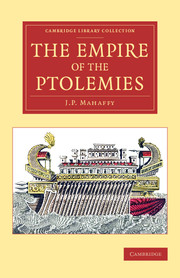
The classical scholar J. P. Mahaffy (1839–1919) is known equally for his work on Greek texts and Egyptian papyri (his edition of The Flinders Petrie Papyri is reissued in the Cambridge Library Collection). This illustrated work of 1895 is a sort of sequel to his Alexander's Empire of 1887 (also reissued in this series), in which he focuses specifically on the dynasty of the Ptolemies, rulers of Egypt, but also, as he points out, of wider territories and subject kingdoms. The study of the successor states of Alexander was in its infancy at this period, and Mahaffy regards this work as a pioneering discussion of various problems raised by the limited literary record, hoping this will stimulate further research, in the welcome context of an increasing number of archaeological discoveries relevant to this late period in the long history of ancient Egypt.
Richard Hakluyt's 12-volume Principal Navigations Voyages Traffiques and Discoveries of the English Nation, originally published at the end of the sixteenth century, and reissued by the Cambridge Library Collection in the edition of 1903–5, was followed in 1625 by Hakluytus Posthumus or, Purchas his Pilgrimes, now reissued in a 20-volume edition published in 1905–7. When first published in four folio volumes, the work was the largest ever printed in England. An Anglican priest, Samuel Purchas (1577–1626) was a friend of Hakluyt, and based his great work in part on papers not published by Hakluyt before his death. As well as being a wide-ranging survey of world exploration, it is notable as an anti-Catholic polemic, and a justification of British settlement in North America. Volume 16 includes accounts of the West Indies, Puerto Rico, Guiana, and Brazil, and of the discovery of the river Amazon.
Published in 1901, this illustrated two-volume biography of the renowned English naturalist Gilbert White (1720–93) presents a thorough account of his life and achievements. Prepared by White's great-great-nephew Rashleigh Holt-White (1826–1920), it incorporates a selection of White's correspondence with family and friends, providing valuable insights into his beliefs and character. Included are letters sent by White's lifelong friend John Mulso (1721–91), who praised the naturalist's work, predicting it would 'immortalise' White and his Hampshire village. Still considered a classic text, The Natural History and Antiquities of Selborne (1789), featuring White's careful observations of local flora and fauna, is also reissued in the Cambridge Library Collection. In the present work, Holt-White sought to correct the 'erroneous statements' that had previously been made about his relative. Volume 1 covers White's life and achievements up to August 1776, including his studies at Oxford and his ordination as a priest.
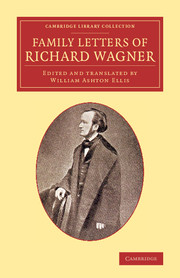
William Ashton Ellis (1852–1919) abandoned his medical career in order to devote himself to his Wagner studies. Best known for his translations of Wagner's prose works and of Carl Friedrich Glasenapp's multi-volume biography of the composer, Ellis published in 1911 this English translation of Wagner's Familienbriefe, spanning the years 1832–74. An inveterate letter writer, Wagner was the youngest-but-one of ten children and Ellis describes the character of these letters to his sisters, his mother, his brother-in-law and his nieces as a reflection of the composer in the 'driest and most neutral of lights', claiming that within the family it is impossible to be pretentious. An appendix by Glasenapp, giving brief biographical details of family members, is also included. Despite the stylistic idiosyncrasies of the translations, these letters remain of importance, capturing something of the tone of Wagner's prose style and shedding light on his extraordinary life.
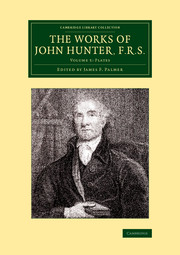
The surgeon and anatomist John Hunter (1728–93) left a famous legacy in the Hunterian Museum of medical specimens now in the Royal College of Surgeons, and in this collection of his writings, edited by James Palmer, with a biography by Drewry Ottley, published between 1835 and 1837. The first four volumes are of text, and the larger Volume 5 contains plates. Hunter had begun his career as a demonstrator in the anatomy classes of his brother William, before qualifying as a surgeon. He regarded surgery as evidence of failure - the mutilation of a patient who could not be cured by other means - and his studies of anatomy and natural history were driven by his belief that it was necessary to understand the normal physiological processes before attempting to cure the abnormal ones. Volume 5 contains the plates which accompany the works in the other volumes, along with notes.
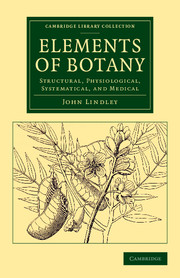
Employed early in his career by Sir Joseph Banks, the botanist John Lindley (1799–1865) is best known for his recommendation that Kew Gardens should become a national botanical institution, and for saving the Royal Horticultural Society from financial disaster. As an author, he is best remembered for his works on taxonomy and classification. A partisan of the 'natural' system rather than the Linnaean, Lindley published this 1841 work, the fourth edition of his Outline of the First Principles of Botany, under a new title to emphasise not only that it was 'much extended, and, it is hoped, improved', but also that it was a textbook for students of 'structural, physiological, systematical, and medical' botany. He defines the different elements of a plant, and provides a checklist for identification of plant families, before discussing the various 'natural' systems of classification, including his own, and the different practical uses of plants.
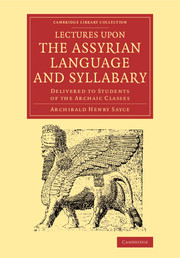
Archibald Henry Sayce (1845–1933) became interested in Middle Eastern languages and scripts while still a teenager. Old Persian and Akkadian cuneiform had recently been deciphered, and popular enthusiasm for these discoveries was running high when Sayce began his academic career at Oxford in 1869. He had already published two grammars of Assyrian (both reissued in this series) by the time these lively and engaging lectures, given in 1875 and 1876, were published in 1877. The introduction expresses optimism that Assyrian and Egyptian would establish themselves as core components of the university curriculum alongside Greek and Hebrew. Acknowledging the 'repellent difficulties' of learning the Assyrian syllabary, Sayce devotes three lectures to discussing the building blocks of this ancient mode of writing. He then addresses the phonology, pronouns, verbs and syntax of the language. The last of his nine lectures considers the place of Assyrian within the Semitic language family.
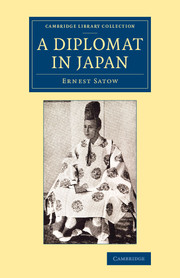
A brilliant linguist, Sir Ernest Satow (1843–1929) was recruited into the British consular service as a student interpreter in 1861. The following year he arrived in Japan, where he witnessed the overthrow of the Tokugawa Shogunate and the Meiji restoration of imperial rule. Drafted in the 1880s while he was consul-general in Bangkok, this 1921 account is based on the voluminous diaries Satow kept whilst in Japan between 1862 and 1869. As an interpreter he was present at many of the meetings between the diplomatic and military representatives of the Great Powers and of the Shogunate. Satow gives his opinions of the various officials he met, and describes the rising tensions that led to conflict between the Shogunate and the Emperor, civil war, and the reassertion of the Emperor's power. Satow's classic Guide to Diplomatic Practice (1917) is also reissued in the Cambridge Library Collection.
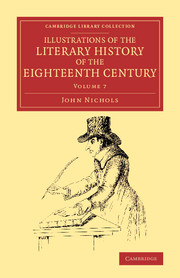
The subtitle of this eight-volume set is Consisting of Authentic Memoirs and Original Letters of Eminent Persons, and Intended as a Sequel to the 'Literary Anecdotes', which had been published in nine volumes by the author, editor and publisher John Nichols (1745–1826) between 1812 and 1815, and are also reissued in this series. Like its predecessor set, these 'illustrations' are a useful source of biographical material on authors and publishers at a time when many of the literary genres we take for granted, such as the novel, the autobiography and the analytical history, were first being developed. The volumes were published between 1817 and 1858, the project being continued after Nichols' death by his son and grandson. Among the 'eminent persons' included in Volume 7 are the scholar and literary editor George Steevens, Bishop Thomas Percy, Dr Johnson and James Boswell.
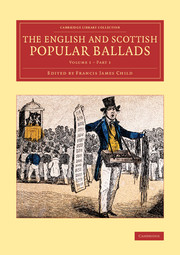
Harvard's first professor of English, the American scholar Francis James Child (1825–96) had previously prepared a collection of English and Scottish ballads, published in 1857–9, before he embarked on producing this definitive critical edition. Organised into five volumes and published in ten parts between 1882 and 1898, the work includes the text and variants of 305 ballads, with Child's detailed commentary and comparison with ballads and stories from other languages. Although he did not live to fully clarify his methods of selection and classification, modern scholars still refer to the 'Child Ballads' as an essential resource in the study of folk songs and stories in the English language. The work also contains a helpful glossary of archaic terms and a long list of sources. Volume 1, Part 1 originally appeared in 1882. This reissue from 1898 contains a biographical sketch of Child, along with ballads 1-28.
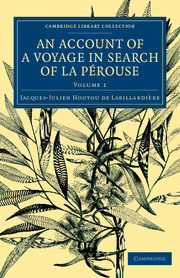
Following the mysterious disappearance of the La Pérouse expedition after it sailed out of Botany Bay in 1788, the French botanist Jacques-Julien Houtou de Labillardière (1755–1834) took part in the search that departed in 1791 from Brest in two ships, Recherche and Espérance. In the space of three years, the expedition's naturalists collected numerous specimens, with Labillardière focusing on Australian flora, but their missing countrymen were never found. Notwithstanding the later confiscation of the scientific collections by the British - Sir Joseph Banks helped to secure their return - Labillardière was able to publish this narrative to great acclaim in 1800. Reissued here is the English translation of the same year, complete with a volume of finely engraved plates. The work is especially notable for its descriptions and illustrations of the indigenous peoples of Australasia. Volume 1 covers the expedition from September 1791 through to January 1793, when it reached Tasmania.
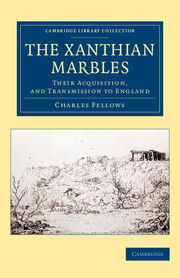
The traveller and archaeologist Sir Charles Fellows (1799–1860) made several trips through Asia Minor. His careful observations of ancient cities that were at that time unknown to Europeans captured the attention of readers of his published journals and fuelled the British Museum's desire to acquire antiquities from the region. This brief work, first published in 1843, seeks to explain and justify how Fellows shipped dozens of cases of sculptures and architectural remains to Malta from Xanthos, an important city in ancient Lycia. It includes correspondence relating to the practicalities of carrying out the expedition and securing permission to do so from the Ottoman authorities. Fellows was later knighted for his role in these acquisitions, though controversy surrounds their removal. His well-illustrated accounts of his two previous trips to Asia Minor are also reissued in this series.