A collection of out-of-copyright and rare books from the Cambridge University Library and other world-class institutions that have been digitally scanned, made available online, and reprinted in paperback.
To save content items to your account,
please confirm that you agree to abide by our usage policies.
If this is the first time you use this feature, you will be asked to authorise Cambridge Core to connect with your account.
Find out more about saving content to .
To save content items to your Kindle, first ensure no-reply@cambridge.org
is added to your Approved Personal Document E-mail List under your Personal Document Settings
on the Manage Your Content and Devices page of your Amazon account. Then enter the ‘name’ part
of your Kindle email address below.
Find out more about saving to your Kindle.
Note you can select to save to either the @free.kindle.com or @kindle.com variations.
‘@free.kindle.com’ emails are free but can only be saved to your device when it is connected to wi-fi.
‘@kindle.com’ emails can be delivered even when you are not connected to wi-fi, but note that service fees apply.
The appearance of the first issue of The Tatler in 1709 is usually regarded as the beginning of periodical publication in England. Its founder, Richard Steele (1672–1729), intended 'a paper, which should observe upon the manners of the pleasurable, as well as the busy part of mankind … by way of a letter of intelligence, consisting of such parts as might gratify the curiosity of persons of all conditions, and of each sex'. The 'datelines' of the reports, on news, literature, and plain gossip, were from the most famous coffee houses of early Georgian London, and the contributors included Jonathan Swift and Joseph Addison. The magazine was published for only two years, from April 1709 to January 1711: shortly afterwards, Steele and Addison co-founded The Spectator. This four-volume edition was issued in 1797 by a consortium of publishers, including John Nichols. Volume 4 contains numbers 190 to 271.
Begun in 1874 and published in 1880, a detailed survey of the stones of Stonehenge was one of the earliest works of William Matthew Flinders Petrie (1853–1942), the energetic archaeologist who is remembered as a pioneering Egyptologist. It is reissued here alongside Sir Richard Colt Hoare's 1829 analysis of the barrows surrounding Stonehenge, thus giving modern readers a valuable two-part snapshot of nineteenth-century investigations into this famous site. Hoare (1758–1838), a Wiltshire baronet with a keen interest in archaeology and topography, conducted excavations on the site of the stones in the early 1800s, which were later referred to by Petrie, whose measurements were much more accurate (up to one tenth of an inch). Petrie's numbering system for the stones, as set out in this publication, is still in use today. Many of his groundbreaking works in Egyptology are also reissued in the Cambridge Library Collection.
The philologist Georg Friedrich Grotefend (1775–1853) combined his career as a senior master at schools in Frankfurt and Hannover with the publication of school textbooks on German and Latin, and academic research in ancient history and languages. He was a co-founder of the Monumenta Germaniae Historica series of historical sources, still widely consulted today, and is also remembered for his role in deciphering Old Persian cuneiform. During his lifetime he was best known for his study of the geography and history of pre-Roman Italy (published 1840–2 and also reissued in the Cambridge Library Collection) and his analyses of the fragmentary evidence for the Umbrian and Oscan languages, published in Latin in 1835–9 and now reissued in this volume. Inscriptions from buildings, tablets, coins and vessels allow Grotefend to reconstruct significant portions of the grammars of these early languages belonging to the Italic branch of the Indo-European family.
Founded in 1868 by the Cambridge scholars John Eyton Bickersteth Mayor (1825–1910), William George Clark (1821–78), and William Aldis Wright (1831–1914), this biannual journal was a successor to The Journal of Classical and Sacred Philology (also reissued in the Cambridge Library Collection). Unlike its short-lived precursor, it survived for more than half a century, until 1920, spanning the period in which specialised academic journals developed from more general literary reviews. Predominantly classical in subject matter, with contributions from such scholars as J. P. Postgate, Robinson Ellis and A. E. Housman, the journal also contains articles on historical and literary themes across the 35 volumes, illuminating the growth and scope of philology as a discipline during this period. Volume 22, comprising issues 43 and 44, was published in 1894.
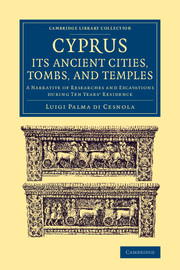
Born in Italy, Luigi Palma di Cesnola (1832–1904) settled in the United States and fought for the North in the American Civil War, becoming a cavalry colonel. Appointed by Abraham Lincoln, he then served as consul to Cyprus from 1865 to 1877. As an amateur archaeologist, he directed excavations throughout the island. In this 1877 publication, including maps and illustrations, Cesnola gives a useful sketch of Cypriot history and contemporary customs in addition to providing an important record of his archaeological practices and discoveries. He covers a number of ancient settlements where significant finds were made, notably Paphos, Amathus and Kourion. Many of the uncovered artefacts were controversially removed from Cyprus and sold to New York's Metropolitan Museum of Art; Cesnola served as its first director. His brother Alessandro's Salaminia (1882), recording his own excavations and discoveries in Cyprus, is also reissued in this series.
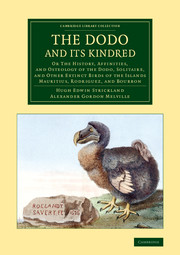
Well versed in natural history, particularly geology and ornithology, Hugh Edwin Strickland (1811–53) became fascinated by the dodo and mankind's influence on its extinction. Seeking to investigate this flightless bird and other extinct species from islands in the Indian Ocean, he invited the comparative anatomist Alexander Gordon Melville (1819–1901) to help him separate myth from reality. Divided into two sections, this 1848 monograph begins with Strickland's evaluation of the evidence, including historical reports as well as paintings and sketches, many of which are reproduced. Melville then analyses the osteology of the dodo and Rodrigues solitaire, describing his findings from dissections of the few available specimens and making comparisons with similar species. A seminal work, it correctly concluded that the dodo was more closely related to pigeons than vultures, and the book also inspired others to take up the search for new fossil evidence.
Richard Hakluyt's 12-volume Principal Navigations Voyages Traffiques and Discoveries of the English Nation, originally published at the end of the sixteenth century, and reissued by the Cambridge Library Collection in the edition of 1903–5, was followed in 1625 by Hakluytus Posthumus or, Purchas his Pilgrimes, now reissued in a 20-volume edition published in 1905–7. When first published in four folio volumes, the work was the largest ever printed in England. An Anglican priest, Samuel Purchas (1577–1626) was a friend of Hakluyt, and based his great work in part on papers not published by Hakluyt before his death. As well as being a wide-ranging survey of world exploration, it is notable as an anti-Catholic polemic, and a justification of British settlement in North America. Volume 10 includes voyages to India, the East Indies and Japan, as well as the notes of the famous traveller Thomas Coryat 'on his last and fatal voyage'.
Displaying her intellectual and literary abilities from a young age, 'Mrs Taylor of Ongar' (1757–1830) enjoyed writing all her life. She had eleven children, of whom six (four of them writers) survived to adulthood. Her published works began with advice books for her own daughters, produced when increasing deafness made ordinary conversation difficult for her. This book, published in 1818, follows her earlier works for young women with a guide to conduct and 'reciprocal duties' within the family. Stern warnings and cautionary tales are given to show the importance of duty to and respect for parents by children, but the parental duties of care in rearing and especially in education are emphasised. Early discipline, lovingly applied, is seen as the key to successful parenting, and its absence is deemed disastrous. Like Ann Taylor's Practical Hints to Young Females (also reissued in this series), the book offers fascinating insights into the middle-class ideal of domestic happiness.
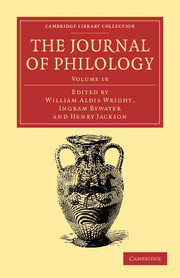
Founded in 1868 by the Cambridge scholars John Eyton Bickersteth Mayor (1825–1910), William George Clark (1821–78), and William Aldis Wright (1831–1914), this biannual journal was a successor to The Journal of Classical and Sacred Philology (also reissued in the Cambridge Library Collection). Unlike its short-lived precursor, it survived for more than half a century, until 1920, spanning the period in which specialised academic journals developed from more general literary reviews. Predominantly classical in subject matter, with contributions from such scholars as J. P. Postgate, Robinson Ellis and A. E. Housman, the journal also contains articles on historical and literary themes across the 35 volumes, illuminating the growth and scope of philology as a discipline during this period. Volume 18, comprising issues 35 and 36, was published in 1890.
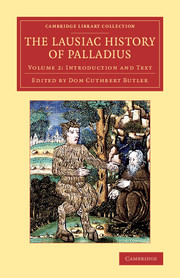
The church historian and Benedictine monk Cuthbert Butler (1858–1934) was known for his expertise on the monastic life and wrote several books on the subject, including Benedictine Monachism (1919) and Western Mysticism (1922). Previously he had produced this two-volume edition of Palladius of Galatia's Lausiac History. Written in the early fifth century, it records the lives of the Egyptian 'Desert Fathers' and is an important source for early monasticism. Volume 2 (1904) contains Butler's edition of the Greek text, supported by an extensive critical apparatus. Butler's substantial introduction first surveys the various Greek manuscripts and earlier editions of the text, before outlining the method he adopted in editing the work. His text is supported by detailed critical and historical notes. The volume also includes a reassessment of the chronology of Palladius' life and helpful supporting material in the form of a map and chronological table.
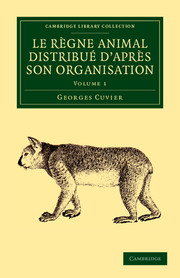
French zoologist and naturalist Georges Cuvier (1769–1832), one of the most eminent scientific figures of the early nineteenth century, is best known for laying the foundations of comparative anatomy and palaeontology. He spent his lifetime studying the anatomy of animals, and broke new ground by comparing living and fossil specimens - many he uncovered himself. However, Cuvier always opposed evolutionary theories and was during his day the foremost proponent of catastrophism, a doctrine contending that geological changes were caused by sudden cataclysms. He received universal acclaim when he published his monumental Le règne animal, which made significant advances over the Linnaean taxonomic system of classification and arranged animals into four large groups. The sixteen-volume English translation and expansion, The Animal Kingdom (1827–35), is also reissued in the Cambridge Library Collection. First published in 1817, Volume 1 of the original version covers mammals and birds.
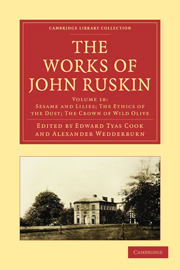
The influence of John Ruskin (1819–1900), both on his own time and on artistic and social developments in the twentieth century, cannot be over-stated. He changed Victorian perceptions of art, and was the main influence behind 'Gothic revival' architecture. As a social critic, he argued for the improvement of the condition of the poor, and against the increasing mechanisation of work in factories, which he believed was dull and soul-destroying. The thirty-nine volumes of the Library Edition of his works, published between 1903 and 1912, are themselves a remarkable achievement, in which his books and essays - almost all highly illustrated - are given a biographical and critical context in extended introductory essays and in the 'Minor Ruskiniana' - extracts from letters, articles and reminiscences both by and about Ruskin. This eighteenth volume contains Ruskin's writings on the nature of society, including Sesame and Lilies.
Mrs C. W. Earle (1836–1925) was born into the minor aristocracy as Maria Theresa Villiers. After training as an artist, she married Captain C. W. Earle, who inherited family property which enabled a comfortable lifestyle with a town house in London and a small property with a large garden in Surrey. Earle's designs for her garden were much admired by her artistic and literary circle, and she was encouraged to write down her gardening advice. This work, published in 1899, followed on from the success of her Pot-Pourri from a Surrey Garden (1897). It contains a similar collection of writings on gardening, cookery, travel and art, in chapters which follow the horticultural year from September to August. An introductory section describes with verve and good humour the critical reception of Earle's earlier book, and her reasons for writing another.
This two-volume work was originally published in French, and anonymously, in 1868. In 1869, Richard Bentley published an English translation by Hubert E. H. Jerningham, in which he stated that the work 'is the production of the celebrated Countess Guiccioli'. Teresa Guiccioli (1800–73) was nineteen, and married to a much older man, when she first met Byron in Venice. Their subsequent love affair lasted until Byron left for Greece, together with her brother Pietro Gamba, whose account of Byron's last days is also reissued in this series. Anxious to restore Byron's reputation, which she believed to be tainted by a conflation in the public mind between the poet and his more notorious characters, she attempts to refute some of the more scandalous assertions about his life. Volume 2 continues to describe Byron's qualities: his generosity, courage and modesty, but also his faults, including vanity and misanthropy.
Edward Blaquiere (1779–1832), an Irishman of Huguenot descent, joined the Royal Navy in 1794 and served, chiefly in the Mediterranean, throughout the Napoleonic wars. In 1820, influenced by Jeremy Bentham, he went on his behalf to Spain to observe the revolution there. On the fall of the liberal regime in Spain in 1823, Blaquiere and his friend John Bowring formed the London Greek Committee to raise money for the Greek war of independence and to lobby the British government for support. (It was under the auspices of the Committee, and recruited by Blaquiere, that Lord Byron made his famous, and fatal, journey to Greece.) Blaquiere published this book in 1824, emphasising his credentials as an eyewitness of events. An account of his second visit in 1824 is also reissued in this series, and the two works describe both events in Greece and the internal quarrels among its philhellene supporters.
A naval officer and man of science, Basil Hall (1788–1844) commanded the brig HMS Lyra as part of Lord Amherst's 1816 embassy to the Qing court in China. While Amherst was engaged on his ultimately abortive venture, the mission's ships visited the west coast of Korea, and then travelled to the island of Okinawa (then known as the Great Loo-Choo Island), where they stayed for several weeks. Little was known about these regions in Britain, and this illustrated account of the journey offered many insights. As well as providing nautical data, such as surveys, soundings and meteorological observations, Hall also comments on geography and culture. A substantial vocabulary and primer on the Okinawan language, compiled by fellow naval officer H. J. Clifford, is included in the appendix. Hall's narratives of his later travels to both North and South America are also reissued in the Cambridge Library Collection.
This book contains two works by William Kennett Loftus (1821–58) in which he describes his archaeological surveying and excavations in Mesopotamia between 1849 and 1855. An enthusiastic antiquarian and geologist, Loftus was appointed to the staff of the Turco-Persian Frontier Commission. On his travels, he located many ruins later identified as biblical cities, including Warkah (Uruk) and Tell el-Muqayyar (Ur). In 1854 Loftus was enabled by the newly formed Assyrian Excavation Fund to return to Warkah, and he excavated over a three-month period, discovering artefacts and cuneiform tablets which he sent to the British Museum. His Travels and Researches, describing his work in Mesopotamia up to 1852, was published in 1857, and his short account of his later work at Warkah in 1859, after his early death. These texts remain a record of the first discoveries in a region significant for its biblical history, but previously hardly visited by Europeans.
Founded in 1868 by the Cambridge scholars John Eyton Bickersteth Mayor (1825–1910), William George Clark (1821–78), and William Aldis Wright (1831–1914), this biannual journal was a successor to The Journal of Classical and Sacred Philology (also reissued in the Cambridge Library Collection). Unlike its short-lived precursor, it survived for more than half a century, until 1920, spanning the period in which specialised academic journals developed from more general literary reviews. Predominantly classical in subject matter, with contributions from such scholars as J. P. Postgate, Robinson Ellis and A. E. Housman, the journal also contains articles on historical and literary themes across the 35 volumes, illuminating the growth and scope of philology as a discipline during this period. Volume 30, comprising issues 59 and 60, was published in 1907.
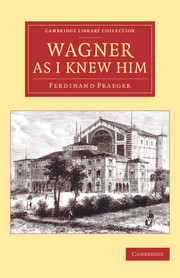
The German composer, performer and critic Ferdinand Praeger (1815–91) moved to London in 1834, and served as the London correspondent of the Neue Zeitschrift für Musik from 1842. A lifelong devotee of Wagner, he helped engage the composer to conduct eight concerts at the Philharmonic Society in 1855. His enthusiasm for Wagner led to the publication of this work in English in 1892, although it was soon claimed that he had greatly overplayed his role in the composer's career. There were accusations of invented stories, distorted facts and altered letters, subsequently supported by evidence obtained by biographers such as William Ashton Ellis, and also by Houston Stewart Chamberlain's comparison of original letters with those featured in this biography. Such negative publicity caused the publishers of the German edition to withdraw the book. Nonetheless, it contains personal impressions which remain of interest, and is now considered less exaggerated than previously thought.
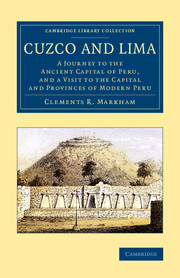
Clements R. Markham (1830–1916) began his career in the Royal Navy, sailing to South America, learning Spanish, and participating in the Arctic search for Sir John Franklin. In 1852, determined to succeed as an explorer and geographer, he travelled to Peru and visited the site of the ancient city of Cuzco, previously little known in Europe. Published in 1856, this is Markham's lively account of his travels. In his description of arriving in Panama we see a picture of the mid-nineteenth-century eagerness to explore (or exploit) Latin America. Markham's stay in Cuzco allowed him ample time to study the ruins and research the lost Inca civilisation, and also gave him his introduction to the properties of the cinchona plant, a source of quinine, which he later returned to collect and introduce to India, as described in his 1862 Travels in Peru and India (also reissued in the Cambridge Library Collection).