A collection of out-of-copyright and rare books from the Cambridge University Library and other world-class institutions that have been digitally scanned, made available online, and reprinted in paperback.
To save content items to your account,
please confirm that you agree to abide by our usage policies.
If this is the first time you use this feature, you will be asked to authorise Cambridge Core to connect with your account.
Find out more about saving content to .
To save content items to your Kindle, first ensure no-reply@cambridge.org
is added to your Approved Personal Document E-mail List under your Personal Document Settings
on the Manage Your Content and Devices page of your Amazon account. Then enter the ‘name’ part
of your Kindle email address below.
Find out more about saving to your Kindle.
Note you can select to save to either the @free.kindle.com or @kindle.com variations.
‘@free.kindle.com’ emails are free but can only be saved to your device when it is connected to wi-fi.
‘@kindle.com’ emails can be delivered even when you are not connected to wi-fi, but note that service fees apply.
This short-lived (1813–26) classical journal was edited by James Henry Monk (1784–1856) and Charles James Blomfield (1786–1857), who were contemporaries at Trinity College, Cambridge. Both went on to ecclesiastical careers: Monk left his position as Regius Professor of Greek at Cambridge to become Dean of Peterborough and subsequently Bishop of Gloucester and Bristol, while Blomfeld, who already held the country living of Quarrington in Lincolnshire when the journal was founded, became Bishop of London. Encapsulating the dominant contemporary style of English classical scholarship - the close linguistic analysis of (primarily Greek) texts, as practised by Richard Porson (1759–1808), Monk's predecessor as Regius Professor - the Museum criticum became a rival to The Classical Journal (also reissued in this series) and was collected in two volumes in 1826. Illuminating the early development of academic journals, Volume 1 contains issues 1–4.
First published between 1932 and 1940, this is a three-volume study of the historical development of literature. It explores the oral and written literatures of regions from Iceland and the British Isles, to Russia, the Balkans, Africa, India and the Pacific, placing them in their historical context and examining similarities between them. The authors discuss both ancient and recent texts, illustrating the connections within each group and considering the question of whether all literary growth is influenced by common factors. Praised on publication as '… a work that is not, probably could not be, superseded' (International Journal of Comparative Sociology), the book remains a benchmark for those studying comparative literature or the history of literary criticism. Volume 3, which includes a summary of the literary categories used in the book, surveys the oral literature of the Tatar and Polynesian peoples, along with that of a selection of African ethnic groups.
In 1807, the Directors of the East India Company ordered a survey of the nine districts, covering 60,000 square miles and containing 15,000,000 British subjects, which formed the Eastern territories of British India. In this three-volume work, published in 1838, Irish civil servant and author Robert Montgomery Martin (1801–68) compiled and collated the original survey material at East India House to describe the geography, geology, meteorology, natural history, agriculture and manufactures, population, history, architecture, fine arts, religion and education of this huge area. Martin, the first colonial Treasurer of Hong Kong, founder of the East India Association, author of History of the British Colonies (1834–5), and later publisher of the Duke of Wellington's dispatches, carried out his work to alert the British public to the growing social and political problems he perceived in India. Volume 2 (reissued in two parts) covers the districts of Bhagalpur, Gorakhpur and Dinajpur.
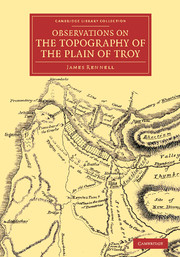
James Rennell (1742–1830) could be claimed as the father of historical geography. After a long career at sea and in India, during which he had learned surveying and cartography, he returned to England and entered the circle of Sir Joseph Banks, who encouraged him to widen his interests to include the geography of the ancient world. In this work, published in 1814, Rennell compares the actual topography of the area in which Troy was believed to be located with the accounts of ancient commentators on Homer, with the Homeric accounts themselves, and finally with the work of ancient geographers. Without offering his own solution to the problem, he demolishes with zest the then current theory that Troy was located at the village of Bournabashi - a conclusion with which Heinrich Schliemann later agreed. Rennell's posthumously published work on the topography of Western Asia is also reissued in this series.
A precursor of modern academic journals, this quarterly periodical, published between 1810 and 1829 and now reissued in forty volumes, was founded and edited by Abraham John Valpy (1787–1854). Educated at Pembroke College, Oxford, Valpy established himself in London as an editor and publisher, primarily of classical texts. Edmund Henry Barker (1788–1839), who had studied at Trinity College, Cambridge, became a contributor and then co-editor of this journal, which fuelled a scholarly feud with the editors of the Museum criticum (1813–26), a rival periodical (also reissued in the Cambridge Library Collection). Although its coverage overlapped with that of its competitor, the Classical Journal also included general literary and antiquarian articles as well as Oxford and Cambridge prize poems and examination papers. It remains a valuable resource, illuminating the development of nineteenth-century classical scholarship and academic journals. Volume 33 contains the March and June issues for 1826.
A precursor of modern academic journals, this quarterly periodical, published between 1810 and 1829 and now reissued in forty volumes, was founded and edited by Abraham John Valpy (1787–1854). Educated at Pembroke College, Oxford, Valpy established himself in London as an editor and publisher, primarily of classical texts. Edmund Henry Barker (1788–1839), who had studied at Trinity College, Cambridge, became a contributor and then co-editor of this journal, which fuelled a scholarly feud with the editors of the Museum criticum (1813–26), a rival periodical (also reissued in the Cambridge Library Collection). Although its coverage overlapped with that of its competitor, the Classical Journal also included general literary and antiquarian articles as well as Oxford and Cambridge prize poems and examination papers. It remains a valuable resource, illuminating the development of nineteenth-century classical scholarship and academic journals. Volume 10 contains the September and December issues for 1814.
A precursor of modern academic journals, this quarterly periodical, published between 1810 and 1829 and now reissued in forty volumes, was founded and edited by Abraham John Valpy (1787–1854). Educated at Pembroke College, Oxford, Valpy established himself in London as an editor and publisher, primarily of classical texts. Edmund Henry Barker (1788–1839), who had studied at Trinity College, Cambridge, became a contributor and then co-editor of this journal, which fuelled a scholarly feud with the editors of the Museum criticum (1813–26), a rival periodical (also reissued in the Cambridge Library Collection). Although its coverage overlapped with that of its competitor, the Classical Journal also included general literary and antiquarian articles as well as Oxford and Cambridge prize poems and examination papers. It remains a valuable resource, illuminating the development of nineteenth-century classical scholarship and academic journals. Volume 2 contains the September and December issues for 1810.
Founded in 1868 by the Cambridge scholars John Eyton Bickersteth Mayor (1825–1910), William George Clark (1821–78), and William Aldis Wright (1831–1914), this biannual journal was a successor to The Journal of Classical and Sacred Philology (also reissued in the Cambridge Library Collection). Unlike its short-lived precursor, it survived for more than half a century, until 1920, spanning the period in which specialised academic journals developed from more general literary reviews. Predominantly classical in subject matter, with contributions from such scholars as J. P. Postgate, Robinson Ellis and A. E. Housman, the journal also contains articles on historical and literary themes across the 35 volumes, illuminating the growth and scope of philology as a discipline during this period. Volume 3, comprising issues 5 and 6, was published in 1871.
A precursor of modern academic journals, this quarterly periodical, published between 1810 and 1829 and now reissued in forty volumes, was founded and edited by Abraham John Valpy (1787–1854). Educated at Pembroke College, Oxford, Valpy established himself in London as an editor and publisher, primarily of classical texts. Edmund Henry Barker (1788–1839), who had studied at Trinity College, Cambridge, became a contributor and then co-editor of this journal, which fuelled a scholarly feud with the editors of the Museum criticum (1813–26), a rival periodical (also reissued in the Cambridge Library Collection). Although its coverage overlapped with that of its competitor, the Classical Journal also included general literary and antiquarian articles as well as Oxford and Cambridge prize poems and examination papers. It remains a valuable resource, illuminating the development of nineteenth-century classical scholarship and academic journals. Volume 7 contains the March and June issues for 1813.
A precursor of modern academic journals, this quarterly periodical, published between 1810 and 1829 and now reissued in forty volumes, was founded and edited by Abraham John Valpy (1787–1854). Educated at Pembroke College, Oxford, Valpy established himself in London as an editor and publisher, primarily of classical texts. Edmund Henry Barker (1788–1839), who had studied at Trinity College, Cambridge, became a contributor and then co-editor of this journal, which fuelled a scholarly feud with the editors of the Museum criticum (1813–26), a rival periodical (also reissued in the Cambridge Library Collection). Although its coverage overlapped with that of its competitor, the Classical Journal also included general literary and antiquarian articles as well as Oxford and Cambridge prize poems and examination papers. It remains a valuable resource, illuminating the development of nineteenth-century classical scholarship and academic journals. Volume 14 contains the September and December issues for 1816.
Dr Samuel Johnson (1709–84) is regarded as one of the outstanding figures of English literature, as a poet, essayist, moralist, critic, biographer, editor and lexicographer. This collected edition of his works - commissioned by the publisher within hours of Johnson's death, such was his celebrity - was published in 1787 in eleven volumes, edited by his literary executor, the musicologist Sir John Hawkins. Volume 8 contains The Idler, the 103 essays originally published by Johnson in the Universal Chronicle between 1758 and 1760, and published in one volume in 1761. These were more relaxed and rambling in style than those published in The Rambler, and were very popular. A common thread is the follies of the literary world - Johnson defines criticism as 'a study by which men grow important and formidable at very small expense'. Others touch on marriage, scholarship, and travelling.
Volume 1 of The Old Testament in Greek According to the Septuagint, edited by the Cambridge scholar Henry Barclay Swete (1835–1917), was first published in 1887. It contains the first fourteen books of the Greek Old Testament: Genesis to 4 Kings. Swete set an important precedent for later editors by using an actual manuscript text as the edition's base. He selected the fourth-century Codex Vaticanus, which is still widely considered to contain the earliest and most valuable form of the Septuagint text; many later editors have followed suit. Where Vaticanus was defective the text was supplemented by the fifth-century Alexandrinus. The critical apparatus gives the readings of other important ancient manuscripts: Sinaiticus, Alexandrinus, Cottonianus Geneseos, Bodleianus Geneseos, and Ambrosianus. The edition's convenient size and ease of use assured its place as one of the most widely used versions of the Septuagint, and it is still consulted today.
The foundation for the modern study of Titus Maccius Plautus rests on this monumental four-volume edition, begun by the eminent German philologist Friedrich Ritschl and completed by his colleagues Gustav Loewe, Georg Goetz, and Fritz Schöll. Scrupulously edited from existing manuscripts, including the famed Ambrosian palimpsest, this edition offers valuable insights into the metrics, literary and historical contexts, and textual history of the Latin comedic playwright. Volume 4 (1890–1894) contains editions of Casina, Miles Gloriosus, Persa, Mostellaria, Cistellaria, and various fragments. Each play is provided with a thorough preface, analysing the work's structures and themes and explaining its reconstruction from manuscript. A central contribution to the study of Plautine drama, Ritschl's Comoediae is also a remarkable achievement of textual criticism, a model of nineteenth-century philology at its most ambitious.
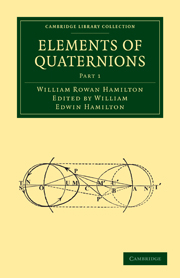
Sir William Rowan Hamilton (1805–65) was a distinguished Irish mathematician who worked in the fields of classical mechanics, optics and algebra, as well as in physics and astronomy. Hamilton was the discoverer of quaternions, which are defined as a non-commutative number system which extends the complex numbers. He first described them in 1843, and devoted much of his subsequent life to studying and lecturing on the concept. This book was published posthumously in 1866, with the final editing by his son. Until they were replaced, from the mid–1880s, by vector analysis, quaternions were taught as a major topic in advanced mathematics at most universities, and their utility in describing spatial relations has led to a revival of interest in them since the late twentieth century.
Founded in 1868 by the Cambridge scholars John Eyton Bickersteth Mayor (1825–1910), William George Clark (1821–78), and William Aldis Wright (1831–1914), this biannual journal was a successor to The Journal of Classical and Sacred Philology (also reissued in the Cambridge Library Collection). Unlike its short-lived precursor, it survived for more than half a century, until 1920, spanning the period in which specialised academic journals developed from more general literary reviews. Predominantly classical in subject matter, with contributions from such scholars as J. P. Postgate, Robinson Ellis and A. E. Housman, the journal also contains articles on historical and literary themes across the 35 volumes, illuminating the growth and scope of philology as a discipline during this period. Volume 8, comprising issues 15 and 16, was published in 1879.
Founded in 1868 by the Cambridge scholars John Eyton Bickersteth Mayor (1825–1910), William George Clark (1821–78), and William Aldis Wright (1831–1914), this biannual journal was a successor to The Journal of Classical and Sacred Philology (also reissued in the Cambridge Library Collection). Unlike its short-lived precursor, it survived for more than half a century, until 1920, spanning the period in which specialised academic journals developed from more general literary reviews. Predominantly classical in subject matter, with contributions from such scholars as J. P. Postgate, Robinson Ellis and A. E. Housman, the journal also contains articles on historical and literary themes across the 35 volumes, illuminating the growth and scope of philology as a discipline during this period. Volume 2, comprising issues 3 and 4, was published in 1869.
A. B. Cook (1868–1952) published the first volume of his monumental Zeus: A Study in Ancient Religion in 1914. This comprehensive work traces the genesis, development and growth of the cult of Zeus from Hellenic worship of the 'bright sky' to the personified and anthropomorphised Zeus, the god of the sky. It focuses on the development of mountain-cults, religious syncretism with solar cults, and the importance of the sun, moon and stars to the worship of Zeus. Cook skilfully integrates both archaeological and ancient literary evidence as well as offering a synthesis of scholarly knowledge. This sumptuous work is a treasure-trove of primary texts, epigraphic material and archaeological data. It contains over 600 illustrations and the most important literary sources, both Greek and Latin, are quoted in full. It is an indispensable tool for students of classics, mythology and ancient religion.
The foundation for the modern study of Titus Maccius Plautus rests on this monumental four-volume edition, begun by the eminent German philologist Friedrich Ritschl and completed by his colleagues Gustav Loewe, Georg Goetz, and Fritz Schöll. Scrupulously edited from existing manuscripts, including the famed Ambrosian palimpsest, this edition offers valuable insights into the metrics, literary and historical contexts, and textual history of the Latin comedic playwright. Volume 3 (1886–1889) contains editions of Bacchides, Captivi, Rudens, Pseudolus, and Menaechmi. Each play is provided with a thorough preface, analysing the work's structures and themes and explaining its reconstruction from manuscript. A central contribution to the study of Plautine drama, Ritschl's Comoediae is also a remarkable achievement of textual criticism, a model of nineteenth-century philology at its most ambitious.
A precursor of modern academic journals, this quarterly periodical, published between 1810 and 1829 and now reissued in forty volumes, was founded and edited by Abraham John Valpy (1787–1854). Educated at Pembroke College, Oxford, Valpy established himself in London as an editor and publisher, primarily of classical texts. Edmund Henry Barker (1788–1839), who had studied at Trinity College, Cambridge, became a contributor and then co-editor of this journal, which fuelled a scholarly feud with the editors of the Museum criticum (1813–26), a rival periodical (also reissued in the Cambridge Library Collection). Although its coverage overlapped with that of its competitor, the Classical Journal also included general literary and antiquarian articles as well as Oxford and Cambridge prize poems and examination papers. It remains a valuable resource, illuminating the development of nineteenth-century classical scholarship and academic journals. Volume 3 contains the March and June issues for 1811.
A precursor of modern academic journals, this quarterly periodical, published between 1810 and 1829 and now reissued in forty volumes, was founded and edited by Abraham John Valpy (1787–1854). Educated at Pembroke College, Oxford, Valpy established himself in London as an editor and publisher, primarily of classical texts. Edmund Henry Barker (1788–1839), who had studied at Trinity College, Cambridge, became a contributor and then co-editor of this journal, which fuelled a scholarly feud with the editors of the Museum criticum (1813–26), a rival periodical (also reissued in the Cambridge Library Collection). Although its coverage overlapped with that of its competitor, the Classical Journal also included general literary and antiquarian articles as well as Oxford and Cambridge prize poems and examination papers. It remains a valuable resource, illuminating the development of nineteenth-century classical scholarship and academic journals. Volume 8 contains the September and December issues for 1813.