A collection of out-of-copyright and rare books from the Cambridge University Library and other world-class institutions that have been digitally scanned, made available online, and reprinted in paperback.
To save content items to your account,
please confirm that you agree to abide by our usage policies.
If this is the first time you use this feature, you will be asked to authorise Cambridge Core to connect with your account.
Find out more about saving content to .
To save content items to your Kindle, first ensure no-reply@cambridge.org
is added to your Approved Personal Document E-mail List under your Personal Document Settings
on the Manage Your Content and Devices page of your Amazon account. Then enter the ‘name’ part
of your Kindle email address below.
Find out more about saving to your Kindle.
Note you can select to save to either the @free.kindle.com or @kindle.com variations.
‘@free.kindle.com’ emails are free but can only be saved to your device when it is connected to wi-fi.
‘@kindle.com’ emails can be delivered even when you are not connected to wi-fi, but note that service fees apply.
Friar Bernardino Sahagûn was in 1529 one of the first Catholic missionaries to the Aztecs. During his sojourn in Mexico he came to speak Nahuatl (the native language) fluently and to understand the Aztec culture, customs, religion and infrastructure intimately. He compiled the largest and most richly detailed record of the Aztecs and their history before the civilisation was wiped out by the Spanish conquest, and Sahagûn is sometimes considered 'the father of ethnology', as his study was the first to derive from the subjects' own point of view, through using native informants in his research. The work, written in 1540, was originally an illustrated manuscript of twelve books in a combination of Nahuatl and Spanish; this version, in Spanish only, was first published in 1829. Volume 2 examines the government and monarchy, the gold and precious stone industry, sacrificial divination, and Aztec theology and moral philosophy.
Friedrich Gottlieb Welcker (1784–1868) was one of the most engaging and creative of German philologists during the formative period of modern classical scholarship; 'one of the heroes', Wilamowitz called him. Art, poetry and religion were to him all the same object of study, and a key to the world of Greek imagination and feeling. His attempt to grasp the meaning of all Greek mythology gave impetus to a still vigorous tradition. This work (in two volumes, first published 1835 and 1849) is his effort to recover the lost epics of the archaic period, and the conditions of their performance and transmission. If his adventurous reconstructions, here and in his companion work on Greek tragedy, do not always command assent, they offer many brilliant observations and insights. His influence has been as diffuse as it is unacknowledged; again and again one finds on reading him that Welcker said it first.
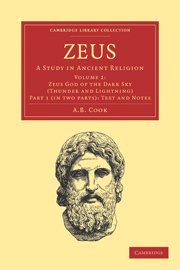
The renowned classical scholar and archaeologist A. B. Cook (1868–1952) published the second volume of his monumental Zeus: A Study in Ancient Religion in two parts in 1925. Part I, containing the main text of the study, surveys the theme of Zeus as god of lightning and thunder, an idea that became common during the classical period. Weaving together archaeological, artistic and ancient literary evidence, Cook investigates in detail the concept of the 'Diosemia' or the Zeus-sign; the ideas of the Zeus-struck man, the heavenly road of Zeus and Greek sky-pillars; the relationship between Zeus and Dionysus; and the role of the shrine at Delphi (usually associated with Apollo) in Zeus worship. This sumptuous work is a treasure of primary texts, epigraph material and archaeological data. It contains hundreds of illustrations, and is an indispensable tool for students of classics, mythology and ancient religion.
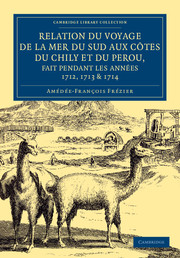
The first reliable maps of the Chilean and Peruvian coasts were drawn by the French explorer Amédée-François Frézier (1682–1773). In 1712, he was sent on a spying mission to the Spanish ports and fortifications of South America, travelling along the Pacific coastline as far as Callao, the port of Lima. His maps were later used by two of France's most famous explorers, Bougainville and Lapérouse. Frézier also took a keen interest in botany, mineralogy, economics and anthropology. His most celebrated achievement is the introduction to Europe of the Chilean strawberry, which was used to create the hybrid species known today as the garden strawberry. Frézier's observations and illustrations of the people, plants and animals he encountered on his South American travels are given in this popular account, published in Paris in 1716 and subsequently translated into several European languages.
A precursor of modern academic journals, this quarterly periodical, published between 1810 and 1829 and now reissued in forty volumes, was founded and edited by Abraham John Valpy (1787–1854). Educated at Pembroke College, Oxford, Valpy established himself in London as an editor and publisher, primarily of classical texts. Edmund Henry Barker (1788–1839), who had studied at Trinity College, Cambridge, became a contributor and then co-editor of this journal, which fuelled a scholarly feud with the editors of the Museum criticum (1813–26), a rival periodical (also reissued in the Cambridge Library Collection). Although its coverage overlapped with that of its competitor, the Classical Journal also included general literary and antiquarian articles as well as Oxford and Cambridge prize poems and examination papers. It remains a valuable resource, illuminating the development of nineteenth-century classical scholarship and academic journals. Volume 17 contains the March and June issues for 1818.
The influence of John Ruskin (1819–1900), both on his own time and on artistic and social developments in the twentieth century, cannot be over-stated. He changed Victorian perceptions of art, and was the main influence behind 'Gothic revival' architecture. As a social critic, he argued for the improvement of the condition of the poor, and against the increasing mechanisation of work in factories, which he believed was dull and soul-destroying. The thirty-nine volumes of the Library Edition of his works, published between 1903 and 1912, are themselves a remarkable achievement, in which his books and essays - almost all highly illustrated - are given a biographical and critical context in extended introductory essays and in the 'Minor Ruskiniana' - extracts from letters, articles and reminiscences both by and about Ruskin. Volume 28, in two parts, contains the fourth, fifth and sixth volumes of Fors Clavigera.
The pre-eminent historian of his day, Edward Gibbon (1737–94) produced his magnum opus in six volumes between 1776 and 1788. Reissued here is the authoritative seven-volume edition prepared by J. B. Bury (1861–1927) between 1896 and 1900. Immediately and widely acclaimed, Gibbon's work remains justly famous for its magisterial account of Roman imperialism and Christianity from the first century CE through to the fall of Constantinople and beyond. Innovative in its use of primary sources and notable for its tone of religious scepticism, this epic narrative stands as a masterpiece of English literature and historical scholarship. Volume 3 mainly covers the period 363–455 CE, including the division of the Eastern and Western Empires, the rise of the Huns, the end of paganism, the German invasion of Gaul, the Vandal conquest of Africa, and the life of Attila the Hun.
Henry Fynes Clinton (1781–1852) made an innovative contribution to classical scholarship with this history of the Roman Empire, published in two volumes in 1845 and 1850. Applying a scientific method of analysis to the study of ancient history, he organises the information chronologically in tables, demonstrating the connection between different spheres at various phases of development of the empire. Volume 1 lists the Roman Consuls and the events that took place under their mandate, including significant Greek and Roman literary and cultural achievements. Among Clinton's sources were chronicles, law codes, medals and coins, and classic literature, covering a period of over five hundred years. Beginning with the death of Augustus in 14 CE, this volume ends in 578 CE, a century after the conventional date of the empire's fall. An index to the tables gives the reader a chronological overview which is still of great value today.
Volume 3 of The Old Testament in Greek According to the Septuagint, edited by the Cambridge scholar Henry Barclay Swete (1835-1917), was first published in 1894. It contains the books from Hosea to 4 Maccabees with the Psalms of Solomon as an appendix. Swete set an important precedent for later editors by using an actual manuscript text as the edition's base. He selected the fourth-century Codex Vaticanus, which is still widely considered to contain the earliest and most valuable form of Septuagint text; many later editors have followed suit. Where Vaticanus was defective the text was supplemented by Codex Alexandrinus or another important uncial manuscript. A critical apparatus contains the readings of eleven manuscripts for the Prophets and Maccabees, three for the Psalms, and five minuscules for the Psalms of Solomon. The edition's clarity helped it become one of the most widely used versions of the Septuagint.
Founded in 1868 by the Cambridge scholars John Eyton Bickersteth Mayor (1825–1910), William George Clark (1821–78), and William Aldis Wright (1831–1914), this biannual journal was a successor to The Journal of Classical and Sacred Philology (also reissued in the Cambridge Library Collection). Unlike its short-lived precursor, it survived for more than half a century, until 1920, spanning the period in which specialised academic journals developed from more general literary reviews. Predominantly classical in subject matter, with contributions from such scholars as J. P. Postgate, Robinson Ellis and A. E. Housman, the journal also contains articles on historical and literary themes across the 35 volumes, illuminating the growth and scope of philology as a discipline during this period. Volume 9, comprising issues 17 and 18, was published in 1880.
A precursor of modern academic journals, this quarterly periodical, published between 1810 and 1829 and now reissued in forty volumes, was founded and edited by Abraham John Valpy (1787–1854). Educated at Pembroke College, Oxford, Valpy established himself in London as an editor and publisher, primarily of classical texts. Edmund Henry Barker (1788–1839), who had studied at Trinity College, Cambridge, became a contributor and then co-editor of this journal, which fuelled a scholarly feud with the editors of the Museum criticum (1813–26), a rival periodical (also reissued in the Cambridge Library Collection). Although its coverage overlapped with that of its competitor, the Classical Journal also included general literary and antiquarian articles as well as Oxford and Cambridge prize poems and examination papers. It remains a valuable resource, illuminating the development of nineteenth-century classical scholarship and academic journals. Volume 22 contains the September and December issues for 1820.
T. C. Hansard (1776–1833) succeeded his father Luke as parliamentary printer. His fascination with the art of printing led to the publication of Typographia in 1825. This monumental study of the history and practice of printing is an important source for historians of printing, and is very clearly written. It is aimed both at young printers and at amateurs, and explains all the different aspects of running a printing business. Hansard acknowledges his debt to earlier writers such as Moxon and Stower, and to the unpublished papers of Earl Stanhope (1753–1816) who did much to modernise printing techniques. The book is particularly valuable for its discussion of recent developments in print technology and lithography, and for details about the business and financial side of printing. Part 1 contains the historical background and details of type-founding and fonts. Part 2 contains details of printing machinery, organisation, and lithography.
Founded in 1868 by the Cambridge scholars John Eyton Bickersteth Mayor (1825–1910), William George Clark (1821–78), and William Aldis Wright (1831–1914), this biannual journal was a successor to The Journal of Classical and Sacred Philology (also reissued in the Cambridge Library Collection). Unlike its short-lived precursor, it survived for more than half a century, until 1920, spanning the period in which specialised academic journals developed from more general literary reviews. Predominantly classical in subject matter, with contributions from such scholars as J. P. Postgate, Robinson Ellis and A. E. Housman, the journal also contains articles on historical and literary themes across the 35 volumes, illuminating the growth and scope of philology as a discipline during this period. Volume 10, comprising issues 19 and 20, was published in 1882.
Archibald Alison (1792–1867) was a Scottish historian with a particular interest in the French Revolution. He wrote from a deeply conservative standpoint and was a fierce opponent of the 1832 Reform Act. Although mocked by Disraeli in Coningsby as 'Mr Wordy', he wrote works which became bestsellers in the nineteenth century. This ten-volume History of Europe during the French Revolution, published between 1833 and 1842, regarded the French Revolution as the origin of all that was wrong with modern Europe. Alison feared that while Britain had escaped revolution in 1789, democratic reform could still lead to anarchy, as in the French July Revolution of 1830. Although criticised by Acton and J. S. Mill for his methodology, Alison has more recently been studied by scholars for insights into nineteenth-century historiography. Volume 10 covers the final eighteen months of the Napoleonic Wars, and offers Alison's concluding remarks.
This short-lived (1813–26) classical journal was edited by James Henry Monk (1784–1856) and Charles James Blomfield (1786–1857), who were contemporaries at Trinity College, Cambridge. Both went on to ecclesiastical careers: Monk left his position as Regius Professor of Greek at Cambridge to become Dean of Peterborough and subsequently Bishop of Gloucester and Bristol, while Blomfeld, who already held the country living of Quarrington in Lincolnshire when the journal was founded, became Bishop of London. Encapsulating the dominant contemporary style of English classical scholarship - the close linguistic analysis of (primarily Greek) texts, as practised by Richard Porson (1759–1808), Monk's predecessor as Regius Professor - the Museum criticum became a rival to The Classical Journal (also reissued in this series) and was collected in two volumes in 1826. Illuminating the early development of academic journals, Volume 2 contains issues 5–8.
The influence of John Ruskin (1819–1900), both on his own time and on artistic and social developments in the twentieth century, cannot be over-stated. He changed Victorian perceptions of art, and was the main influence behind 'Gothic revival' architecture. As a social critic, he argued for the improvement of the condition of the poor, and against the increasing mechanisation of work in factories, which he believed was dull and soul-destroying. The thirty-nine volumes of the Library Edition of his works, published between 1903 and 1912, are themselves a remarkable achievement, in which his books and essays – almost all highly illustrated – are given a biographical and critical context in extended introductory essays and in the 'Minor Ruskiniana' – extracts from letters, articles and reminiscences both by and about Ruskin. Volume 27, in two parts, contains the first three volumes of Fors Clavigera.
Founded in 1868 by the Cambridge scholars John Eyton Bickersteth Mayor (1825–1910), William George Clark (1821–78), and William Aldis Wright (1831–1914), this biannual journal was a successor to The Journal of Classical and Sacred Philology (also reissued in the Cambridge Library Collection). Unlike its short-lived precursor, it survived for more than half a century, until 1920, spanning the period in which specialised academic journals developed from more general literary reviews. Predominantly classical in subject matter, with contributions from such scholars as J. P. Postgate, Robinson Ellis and A. E. Housman, the journal also contains articles on historical and literary themes across the 35 volumes, illuminating the growth and scope of philology as a discipline during this period. Volume 7, comprising issues 13 and 14, was published in 1877.
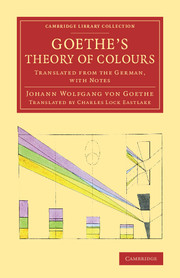
This work by Johann Wolfgang von Goethe (1749–1832) was translated into English in 1840 by Sir Charles Eastlake (1793–1865), painter and later keeper of the National Gallery. Goethe's 1810 work was rejected by many contemporary scientists because it appeared to contradict the physical laws laid down by Newton. However, its focus on the human perception of the colour spectrum, as opposed to the observable optical phenomenon, was attractive to, and influential upon, artists and philosophers. As Eastlake says in his preface, the work's dismissal on scientific grounds had caused 'a well-arranged mass of observations and experiments, many of which are important and interesting', to be overlooked. Eastlake also puts Goethe's work into its aesthetic and scientific context and describes its original reception. His clear translation of Goethe's observations and experiments on colour and light will appeal to anyone interested in our responses to art.
A precursor of modern academic journals, this quarterly periodical, published between 1810 and 1829 and now reissued in forty volumes, was founded and edited by Abraham John Valpy (1787–1854). Educated at Pembroke College, Oxford, Valpy established himself in London as an editor and publisher, primarily of classical texts. Edmund Henry Barker (1788–1839), who had studied at Trinity College, Cambridge, became a contributor and then co-editor of this journal, which fuelled a scholarly feud with the editors of the Museum criticum (1813–26), a rival periodical (also reissued in the Cambridge Library Collection). Although its coverage overlapped with that of its competitor, the Classical Journal also included general literary and antiquarian articles as well as Oxford and Cambridge prize poems and examination papers. It remains a valuable resource, illuminating the development of nineteenth-century classical scholarship and academic journals. Volume 23 contains the March and June issues for 1821.
Volume 2 of The Old Testament in Greek According to the Septuagint, edited by the Cambridge scholar Henry Barclay Swete (1835-1917), was first published in 1891. It contains the books from 1 Chronicles to Tobit. Swete set an important precedent for later editors by using an actual manuscript text as the edition's base. He selected the fourth-century Codex Vaticanus, which is still widely considered to contain the earliest and most valuable form of Septuagint text; many later editors have followed suit. Where Vaticanus was defective the text was supplemented by Codex Sinaiticus or Codex Alexandrinus. The critical apparatus gives the readings of seven other important ancient manuscripts and fragments. The edition's convenient size and ease of use assured its place as one of the most widely used versions of the Septuagint, and it is still consulted today.