A collection of out-of-copyright and rare books from the Cambridge University Library and other world-class institutions that have been digitally scanned, made available online, and reprinted in paperback.
To save content items to your account,
please confirm that you agree to abide by our usage policies.
If this is the first time you use this feature, you will be asked to authorise Cambridge Core to connect with your account.
Find out more about saving content to .
To save content items to your Kindle, first ensure no-reply@cambridge.org
is added to your Approved Personal Document E-mail List under your Personal Document Settings
on the Manage Your Content and Devices page of your Amazon account. Then enter the ‘name’ part
of your Kindle email address below.
Find out more about saving to your Kindle.
Note you can select to save to either the @free.kindle.com or @kindle.com variations.
‘@free.kindle.com’ emails are free but can only be saved to your device when it is connected to wi-fi.
‘@kindle.com’ emails can be delivered even when you are not connected to wi-fi, but note that service fees apply.
This two-volume biography of the sixteenth-century French potter and natural scientist Bernard Palissy (c.1510–c.1590) was published in 1852, the year after the Great Exhibition, in which Palissy's extraordinary art had been brought before the Victorian public by Minton's highly decorated 'Palissy wares'. Henry Morley (1822–94) trained in medicine but later became an author and editor, writing for Charles Dickens among others. Here he gathers together all the material then available about Palissy, including the potter's own writings and a contemporary biography. Palissy was among the many European ceramicists who attempted to reproduce Chinese porcelain; his lack of success drove his family into poverty, but his highly ornamented wares, encrusted with sea creatures, came to the attention of Catherine de' Medici, who gave him her patronage and protection (he was a convinced Protestant). After her death he was sent to the Bastille, and died there.
Originally issued between 1887 and 1907, this monograph by Sydney Savory Buckman (1860–1929) remains the most comprehensive record of British Aalenian to Lower Bajocian ammonites. Reissued here in two volumes, it features superb, accurately drawn illustrations, with some photography. Buckman's early ideas on biochronological subdivision and zonal succession are presented along with refinements in the supplement based on later research. Exhaustive descriptions of numerous morphospecies are given, many prepared when Buckman resided in Dorset and was thoroughly familiar with the local succession. He observed that it was possible to further subdivide strata beyond the zonal scheme of the day. This work laid the foundations for further writings on natural evolutionary classification and time-rock duality. Unfortunately, the monograph was discontinued before the remaining part concerning the Lower to Upper Bajocian and Lower Bathonian was completed. Nevertheless, it remains essential reading for establishing an understanding of Inferior Oolite ammonites.
This three-volume compilation by the Oxford antiquary John Walker (1770–1831) consists mainly of manuscripts from the Bodleian Library and the Ashmolean Museum, but is significant because it contains the biographical notes on the 'lives of eminent men' furnished by John Aubrey (1626–97) to Anthony à Wood, who was at the time compiling his Athenae Oxonienses. Aubrey's subsequently famous Brief Lives were published for the first time in this 1813 work, and, although described as the fourth appendix to it, in fact comprise slightly less than half of the second volume and the entirety of the third. Volume 2, Part 2 consists of the remainder of Aubrey's 'lives', organised alphabetically from Foote to Wright, together with his extended biography of Thomas Hobbes, which the famous philosopher had asked his friend Aubrey to write, but which again existed only in manuscript form until it was published in this compilation.
This short work contains texts and maps relating to early exploration and trade routes. Included here are descriptions of Russia and Siberia by Isaac Massa (1586–1643), a Dutch merchant and diplomat; one of the memorials relating to Pacific discoveries by the Portuguese explorer Pedro Fernandes de Queirós (c.1565–1615); and maps by the cartographer Hessel Gerritsz (c.1581–1632) showing the discoveries of the English navigator Henry Hudson (d.1611). Gerritsz originally compiled these materials and published them in Dutch, and they were soon translated into Latin to increase their readership. In the present work, first published in 1878, reproductions of the Dutch and Latin editions from 1612 and 1613 are presented together by Frederik Muller (1817–81). To encourage research on these texts, Muller also included a new English translation, and an explanatory essay by his son Samuel Muller (1848–1922).
This four-volume edition of the letters of Mrs Elizabeth Montagu (1718–1800), the 'Queen of the Bluestockings', was edited by her nephew and adopted son Matthew (1762–1831) and published in 1809–13. The daughter of wealthy parents, and well educated in history and languages, at the age of twenty-one she married Edward Montagu, a grandson of the earl of Sandwich whose income derived from northern estates and coal mines, and began to establish a London salon attended by the intellectual cream of British society, including Johnson, Burke, Garrick, Hannah More and Hester Chapone. The letters (and some correspondence from her circle) are arranged chronologically. Volume 2 covers the period from 1741 to 1744, including her marriage to the fifty-year-old Edward Montagu in August 1742, and the sudden death of her beloved only son in 1744.
A Slovenian citizen of the Austro-Hungarian Empire, Franz Miklosich (1813–91) studied at the University of Graz before moving to Vienna in 1838. Indo-European philology was a growing area for research, and in 1844 Miklosich reviewed Bopp's Comparative Grammar (also reissued in this series) and embarked upon extending the comparative method across the whole Slavonic language family. Miklosich's work marked a watershed in Slavonic studies; in 1849 he became Austria's first professor of Slavonic philology. His publications included editions of historical sources; work on loan words, place names, and Romany dialects; a dictionary of Old Church Slavonic; and an etymological dictionary of the Slavonic languages (1886, also available). His four-volume comparative grammar of the Slavonic languages (originally published 1852–74, updated reprints 1875–83) was one of his most influential works. Volume 3 (1856, reissued in the 1876 second edition) describes the declension of nouns and the conjugation of verbs in each language.
American philologist Edward Robinson (1794–1863) is considered a founding figure in the field of biblical geography and archaeology. In 1838 he explored Palestine with Eli Smith (1801–57), a Yale graduate and Protestant missionary, and co-author of Missionary Researches in Armenia (also reissued in this series). Smith had settled in Beirut and was proficient in Arabic. The authors succeeded in identifying many biblical locations, and the original edition of their book, structured as a travel journal, was published in 1841. It was awarded the gold medal of the Royal Geographical Society the following year. Robinson and Smith returned to Palestine in 1852 and published an enlarged edition in 1856. This reissue is of the 1857 third edition, which was slightly abridged but contained new maps and plans. Volume 2 describes their visits to Gaza, Hebron, Nazareth, Tyre and Beirut, and the religious communities of the region, Christian and Muslim.
First published in 1839, this work was edited by the evangelist and noted abolitionist Theodore Dwight Weld (1803–95). It is an extensive collection of first-hand testimony and narratives by slaveholders describing the facts and highlighting the cruelty of the slave trade. One of the most influential books of the anti-slavery movement, it aimed to document the current condition of slaves in the United States, covering all aspects of their lives, in order to further the abolition movement. Weld presents accounts of slaves' food, clothing, living conditions, working hours, and their punishments and suffering. This is interspersed with personal narratives from contributors which corroborate each other, presented in a detached, unsensational manner. Great pains were taken in compiling this work to emphasise the trustworthy nature of Weld's contributors so that there could be no doubt of the authenticity of their claims and the need for an end to slavery.
The Egyptologist Samuel Birch (1813–85) began to study Chinese at school, and obtained his first post at the British Museum cataloguing Chinese coins. He maintained his interest in Chinese civilisation throughout his life, but also collaborated with C. T. Newton on a catalogue of Greek and Etruscan vases, and with Sir Henry Rawlinson on cuneiform inscriptions, while also specialising in the examination and cataloguing of the Museum's growing collection of Egyptian papyri and other artefacts. Birch describes this two-volume, highly illustrated work on ancient pottery, published in 1858, as filling a perceived need: 'A work has long been required which should embody the general history of the fictile art of the ancients.' Volume 2 continues to examine Greek pottery, including the work of named or identified individual craftsmen, and then moves on to Etruscan and Roman wares, with a short final section on 'Celtic, Teutonic, and Scandinavian pottery'.
Published between 1862 and 1932, and reissued here in multiple parts, this monumental calendar of documents remains an essential starting point for the serious study of Tudor history. An experienced editor of historical texts, John Sherren Brewer (1809–79) had no prior training in the history of the period, yet he brought to the project the necessary industriousness and an impeccable command of Latin. Four volumes appeared before his death, whereupon James Gairdner (1828–1912), his former assistant, took up the editorial reins. Continuing Brewer's method of ordering chronologically all available documents from 1509 to 1547, and reproducing some passages while paraphrasing or omitting others, Gairdner brought the project to its conclusion, aided himself by R. H. Brodie (1859–1943) in preparing the later volumes. Part 1 of Volume 2 (1864) has been split into two for this reissue: this second half covers the period from November 1515 to December 1516.
This work, first published in 1789, is an edited compilation of official papers, journals and illustrations relevant to the voyage of the First Fleet to Australia and the founding of Port Jackson on Sydney Cove, and of the penal colony of Norfolk Island. Arthur Phillip (1738–1814), a sailor of wide experience in both the Royal Navy and the Portuguese fleet, accepted the post of commander of the fleet and governor of the new colony in 1786, and the eleven ships arrived in Botany Bay in January 1788. This account begins with a note on Phillip's career, and discusses earlier British colonisation, before describing the preparations for, and progress of, the voyage. The fascinating documentation continues with materials on the founding of the colony, problems with the convict workmen, encounters with native Australians, and with the local wildlife, all illustrations of the birth of one of the world's great cities.
The journalist and politician Edward Baines (1800–90) succeeded his father as editor of the Leeds Mercury and as MP for Leeds. From a dissenting family, he was a social reformer but passionately believed that the state should not interfere in matters such as working hours and education. In this 1835 work, he sees the cotton industry as an exemplar of the unity of 'the manufactory, the laboratory, and the study of the natural philosopher', in making practical use of creative ideas and scientific discoveries. He surveys cotton manufacture from its origins to its 'second birth' in England, and focuses on the current state of machinery, trade and working conditions in all aspects of the business, and its outputs, including cloth, lace, stockings and cotton wool. This comprehensive work was important for its detailed analysis of a vital commercial activity, and remains so today for the historical information it contains.
The writer and translator Anne Plumptre (1760–1818) and her sister Annabella, also a writer, divided their time between Norwich and London, where they moved in radical and dissenting circles. Anne also travelled abroad, publishing this three-volume description of three years' residence in France in 1810. (Her 1817 volume on Ireland is also reissued in this series.) Like many other Britons, Plumptre took the opportunity of the Peace of Amiens to visit post-revolutionary France, and she stayed in the country until hostilities recommenced in 1805. Sympathetic to the revolution, she intended to examine for herself the state of the country and its people, and compare her first-hand impressions (especially of Napoleon) with the generally hostile information about France then currently available in Britain. In Volume 2, Plumptre is based at Marseilles, and describes both the city and its recent history during the Reign of Terror; she then travels to Aix-en-Provence.
Containing an Explanation of the Terms, and an Account of the Several Subjects, Comprized under the Heads Mathematics, Astronomy, and Philosophy, Both Natural and Experimental
Born into a Newcastle coal mining family, Charles Hutton (1737–1823) displayed mathematical ability from an early age. He rose to become professor of mathematics at the Royal Military Academy and foreign secretary of the Royal Society. First published in 1795–6, this two-volume illustrated encyclopaedia aimed to supplement the great generalist reference works of the Enlightenment by focusing on philosophical and mathematical subjects; the coverage ranges across mathematics, astronomy, natural philosophy and engineering. Almost a century old, the last comparable reference work in English was John Harris' Lexicon Technicum. Hutton's work contains many historical and biographical entries, often with bibliographies, including many for continental analytical mathematicians who would have been relatively unfamiliar to British readers. These features make Hutton's Dictionary a particularly valuable record of eighteenth-century science and mathematics. Volume 1 ranges from abacist (a user of an abacus) to the English physician and Newtonian scientist James Jurin.
A Slovenian citizen of the Austro-Hungarian Empire, Franz Miklosich (1813–91) studied at the University of Graz before moving to Vienna in 1838. Indo-European philology was a growing area for research, and in 1844 Miklosich reviewed Bopp's Comparative Grammar (also reissued in this series) and embarked upon extending the comparative method across the whole Slavonic language family. Miklosich's work marked a watershed in Slavonic studies; in 1849 he became Austria's first professor of Slavonic philology. His publications included editions of historical sources; work on loan words, place names, and Romany dialects; a dictionary of Old Church Slavonic; and an etymological dictionary of the Slavonic languages (1886, also available). His four-volume comparative grammar of the Slavonic languages (originally published 1852–74, updated reprints 1875–83) was one of his most influential works. Volume 4 (reissued in the 1868–74 edition) describes the word classes and syntax of the Slavonic languages.
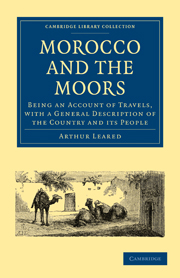
This travelogue by Dr Arthur Leared (1822–1879) follows his journey through Morocco during 1872, giving a comprehensive picture of the country and its people. At this time, Morocco was a French protectorate, ruled by the Alouite dynasty, comprising a mix of tribes, cultures, races and religions. Following Leared's route south, the geography, people, culture, legal and religious practices of Morocco are all explored thoroughly, with personal memories and anecdotes of daily life. As a physician and the inventor of the binaural stethoscope, Leared was interested in the advantages of the climate for treating respiratory diseases, particularly tuberculosis, and in native medical materials and practices. He subsequently became the physician at the Portuguese embassy, and planned the foundation of a sanatorium in Tangier. A vivid and balanced account of the country, as viewed from the stance of an objective traveller as the country began to open up to Europeans.
The publication between 1887 and 1897 of these letters, which form part of the archive of the Dutch Church at Austin Friars in London, was a remarkable feat of bibliography. The archive had been deposited in 1866 with the Library Committee of the Corporation of London, and in 1884 Jan Hendrick Hessels began to prepare them for the press. The letters, written in Dutch, French, English, Italian and Latin between 1524 and 1723, throw light on the religious, intellectual and political ferment of the period. The third volume (now reissued in five parts) consists of documents from a further cache discovered in the church while the second volume was being prepared for press. These include documents relevant to the beginning of the Thirty Years' War, the dealings of Archbishop Laud with foreign churches in England, and the status of foreigners in England in the sixteenth and seventeenth centuries.
The German archaeologist Ernst Curtius (1814–1896) published this seminal work in three volumes between 1857 and 1867. It quickly became a bestseller and was republished in numerous German editions. The work was translated into English by the eminent British historian Adolphus William Ward (1837–1924) who divided it into five volumes, published between 1868 and 1873. Volume 2 focuses on the themes of conflict and unity, with the second part of Book 2, and Book 3 which covers the Ionian revolt and the events that led to the outbreak of the Peloponnesian War. Curtius' History was a pioneering work of nineteenth-century classical scholarship. For many generations it provided an indispensable guide through the complex history of the ancient Greek world, and it continues to inspire researchers today.
This eight-volume set of summaries of state documents (commemoriali) of the Republic of Venice, compiled and edited by Riccardo Predelli (1842–1909), appeared between 1876 and 1914 as part of a wider series, 'Monumenti Storici', devoted to publishing the content of the nine-hundred-year-old archives of Venice at a time when the original documents seemed in danger of being lost through decay. Predelli notes in his preface that a similar concern was expressed by Doge Iacopo Tiepolo, who in 1248 ordered a commission to sort and codify the legal statutes of the city, which were in complete confusion. The works, arranged roughly in chronological order, provide summaries (and sometimes complete documents) of the political, diplomatic, commercial and legal activities of the Republic. Volume 8, completed after Predelli's death by Pietro Bosmin and published in 1914, contains books 29–33 of the Commemoriali, covering the period from the 1570s to 1787.
William L. Newman (1834–1923) published Volume 3 of Politics of Aristotle in 1902. It contains his reconstructed text of books 3-5 with critical notes, commentary, and an introduction to the manuscript sources. Newman's reconstructed text is based on the edition of Susemihl (1872) and his own fresh collations of a number of manuscripts, including MS. Phillipps 891 (z), which contains William of Moerbeke's Latin translation. Newman's cautious text, always supported by extensive manuscript evidence, was widely regarded as an improvement on Bekker's more conjectural 1837 version. Newman's detailed commentary was highly praised and has been used for over a century by students of the Politics. As a scholar and pedagogue Newman had a significant impact on nineteenth-century classical studies. His four-volume edition of the Politics stands as a monument of Victorian scholarship and will continue to be read and studied by scholars and students of Aristotle.