A collection of out-of-copyright and rare books from the Cambridge University Library and other world-class institutions that have been digitally scanned, made available online, and reprinted in paperback.
To save content items to your account,
please confirm that you agree to abide by our usage policies.
If this is the first time you use this feature, you will be asked to authorise Cambridge Core to connect with your account.
Find out more about saving content to .
To save content items to your Kindle, first ensure no-reply@cambridge.org
is added to your Approved Personal Document E-mail List under your Personal Document Settings
on the Manage Your Content and Devices page of your Amazon account. Then enter the ‘name’ part
of your Kindle email address below.
Find out more about saving to your Kindle.
Note you can select to save to either the @free.kindle.com or @kindle.com variations.
‘@free.kindle.com’ emails are free but can only be saved to your device when it is connected to wi-fi.
‘@kindle.com’ emails can be delivered even when you are not connected to wi-fi, but note that service fees apply.
The botanist and horticulturalist John Lindley (1799–1865) worked for Sir Joseph Banks, and was later instrumental in saving the Royal Horticultural Society from financial disaster. He was a prolific author of works for gardening practitioners but also for a non-specialist readership, and many of his books have been reissued in this series. This 1829 work is a classification of British plants using the 'natural' system of the French botanist Antoine Laurent de Jussieu, which Lindley firmly supported, believing that the Linnaean system was both inaccurate and had 'almost disappeared from every country but our own'. Lindley describes genera and species in English, but using a uniform, standard vocabulary, and gives the alternative Latin names proposed by taxonomists including Smith, Curtis, Linnaeus, and the Hortus Kewensis. He also offers tables showing the components of each genus, and substantial indexes giving both Latin and English common names of the plants discussed.
Remarkable yet controversial, the Prussian-born Protestant missionary Karl Friedrich August Gützlaff (1803–51) sought to spread Christianity in the Far East. A gifted linguist, he sailed to Siam and worked on translating the Bible into Thai. The British missionary Robert Morrison had fired his interest in China, and Gützlaff later focused his evangelising efforts there, learning several dialects and distributing translated literature. He also worked for the East India Company, notably serving as an interpreter during negotiations for the Treaty of Nanking. Also reissued in this series are his Journal of Three Voyages along the Coast of China (1834) and China Opened (1838). The present work, published in two volumes in 1834, aimed to diminish Anglophone ignorance of China's vast history. Volume 2 traces events since the beginning of the Qing dynasty in 1644. Gützlaff then discusses Christianity's introduction and other foreign influence, chiefly the commercial activities of European powers.
The British colonial administrator and scholar Sir Reginald Fleming Johnston (1874–1938) travelled extensively in the Far East, developing a keen intellectual interest in Chinese culture and spirituality. His fourteen-year posting to the relatively quiet port of Weihaiwei allowed him to indulge this interest and to travel to places not usually visited by Europeans. In 1918, he was appointed tutor to the young Puyi (1906–67), who had been China's last emperor before his forced abdication. Deeply interested in Mahayana Buddhism, Johnston played an important role in raising Western awareness of its philosophy and practice in China. This work, first published in 1913, provides valuable insight into the history of this branch of Buddhism as well as fascinating accounts of notable centres of Chinese monasticism. Among other works, Johnston's Confucianism and Modern China (1934) and Twilight in the Forbidden City (1934) are also reissued in this series.
Critic, poet and philosopher Friedrich von Schlegel (1772–1829) was a leading figure of German Romanticism. In the two years before his untimely death, he wrote three cycles of lectures intended as part of a larger project to lay the foundations of a new general philosophy. Two of these cycles, 'Philosophie des Lebens' (given in 1827, published 1828) and 'Philosophie des Sprache und des Wortes' (given in December 1828 and published posthumously), are reissued here in an 1847 English translation. The first presents Schlegel's understanding of philosophy as independent of theology or politics, concerned with the 'inner spiritual life' of humankind. The second explores the nature of communication through language and art. Schlegel argues that full human consciousness cannot be restored by Enlightenment science, but only by divine revelation and redemption. He offers no ready-made solutions, but encourages his listeners to develop their own responses to these questions.
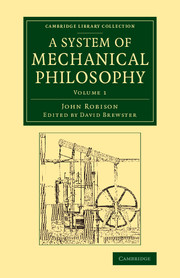
After a brief career at sea, during which he tested Harrison's chronometer for the Board of Longitude, John Robison (1739–1805) became lecturer in chemistry at the University of Glasgow. In 1774, having spent a period teaching mathematics in Russia, he returned to Scotland as professor of natural philosophy at Edinburgh. Despite his busy schedule, he contributed major articles on the sciences to the Encyclopaedia Britannica, giving an overview of contemporary scientific knowledge for the educated layperson. After his death, these and other pieces of his scientific writing were edited by his former pupil David Brewster (1781–1868) and were finally published in four volumes in 1822, with a separate volume of illustrative plates. This reissue incorporates those plates in the relevant volumes of text. Volume 1 contains articles on dynamics and on the construction of roofs, arches and bridges, as well as a previously unpublished manuscript on projectile motion.
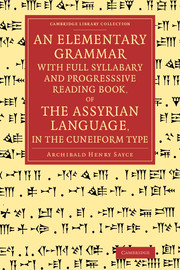
Archibald Henry Sayce (1845–1933) became interested in Middle Eastern languages and scripts while still a teenager. Old Persian and Akkadian cuneiform had recently been deciphered, and in the early 1870s the translation of part of the epic tale of Gilgamesh attracted considerable publicity. Based at Oxford, the young philologist Sayce published several books on Assyrian in quick succession. In the preface to this 1875 teaching grammar/reader, he notes that in just three years since the publication of his grammar for specialists (also reissued in this series), Assyrian had become a 'popular' subject, with students 'flocking in from all sides'. His book was written in response to the demand for beginners' books that were similar to those available for Greek or Hebrew. The texts that follow the syllabary and outline grammar are accompanied by transliterations and translations, with substantial accompanying notes on vocabulary, grammar points, and Hebrew cognates.
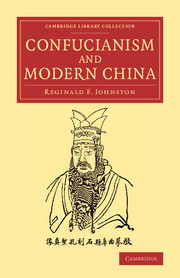
The British colonial administrator and scholar Sir Reginald Fleming Johnston (1874–1938) travelled extensively in the Far East, developing a deep interest in Chinese culture and spirituality. His fourteen-year posting to the relatively quiet port of Weihaiwei allowed him to indulge this interest and to travel to places not usually visited by Europeans. Well acquainted with the philosophy of Confucius, Johnston had happily quoted the Confucian classics in his court judgments at Weihaiwei. In 1918, he was appointed tutor to the young Puyi (1906–67), who had been China's last emperor before his forced abdication. This 1934 publication, developed from lectures, presents an accessible interpretation of the tenets and fortunes of Confucianism, notably the impact of the New Culture Movement on the philosophy's place in Chinese society. Among other works, Johnston's Buddhist China (1913) and Twilight in the Forbidden City (1934) are also reissued in this series.
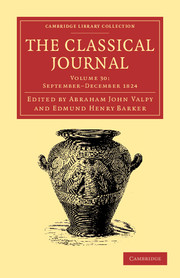
A precursor of modern academic journals, this quarterly periodical, published between 1810 and 1829 and now reissued in forty volumes, was founded and edited by Abraham John Valpy (1787–1854). Educated at Pembroke College, Oxford, Valpy established himself in London as an editor and publisher, primarily of classical texts. Edmund Henry Barker (1788–1839), who had studied at Trinity College, Cambridge, became a contributor and then co-editor of this journal, which fuelled a scholarly feud with the editors of the Museum criticum (1813–26), a rival periodical (also reissued in the Cambridge Library Collection). Although its coverage overlapped with that of its competitor, the Classical Journal also included general literary and antiquarian articles as well as Oxford and Cambridge prize poems and examination papers. It remains a valuable resource, illuminating the development of nineteenth-century classical scholarship and academic journals. Volume 30 contains the September and December issues for 1824.
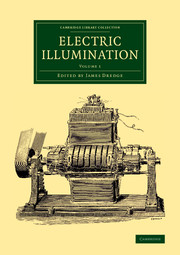
Two years after Thomas Edison patented his electric light bulb, the 1881 International Exposition of Electricity in Paris, featuring many spectacular lighting displays, showcased the potential of this technology for commercial and domestic use. The accompanying International Congress of Electricians also agreed on international standards for units of electrical resistance, potential and current. In its wake, James Dredge (1840–1906), editor of the British periodical Engineering, compiled this illustrated overview of electrical technology and its application to lighting. First published in two volumes between 1882 and 1885, and using material that had previously appeared in Engineering, as well as new articles by various contributors, this substantial work reflects the complexities and possibilities of a propitious technological development. Among other topics, Volume 1 covers electrical units, methods of generation, conductors, and various kinds of lamp. The appendices give abstracts of British electrical patents from 1837 to 1872.
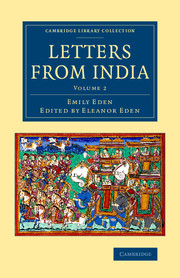
Emily Eden's childhood prepared her well for her role as companion to her brother, the Governor-General of India. Outwardly all that a minor aristocrat should be, the observant and sharp-tongued Eden (1797–1869) never censored her letters for the sake of diplomacy. This two-volume collection of letters, edited by her niece Eleanor Eden, was published posthumously in 1872 after the success of her 1866 collection, Up the Country (also reissued in this series). In Volume 2, which also contains several letters from Emily's sister Frances (1801–49), the round of engagements, days in an opulent houseboat, and biting observations on Anglo-Indian society, continue, but the generally cheerful tone begins to darken: 'It is very odd that no letters whatever have come from Cabul for three weeks, but the reports are all favourable' she notes, at the outset of the disastrous Anglo-Afghan War, which led to her brother's dismissal from India.
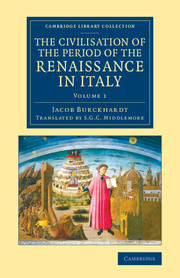
On several journeys to Italy in the mid-nineteenth century, the Swiss historian Jacob Burckhardt (1818–97) saw in the figures and events of the Italian Renaissance certain traits that he believed to be mirrored in the politics of his own day, notably some aspects of 'an unbridled egoism, outraging every right, and killing every germ of a healthier culture'. Revolutionary in his all-encompassing and unflinching examination of the Italian Renaissance, Burckhardt saw developments in statecraft and war as giving rise to the more publicised artistic progress of the era. First published in 1860, this work is considered to be his magnum opus on the subject, and is here reissued in the accessible two-volume English translation of 1878 by S. G. C. Middlemore. In Volume 1, Burckhardt considers three key themes: the state as a work of art, the development of the individual, and the revival of antiquity in education and philosophy.
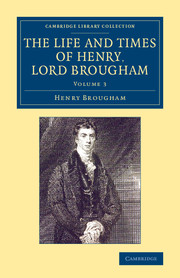
A child prodigy, Henry Brougham (1778–1868), later Lord Brougham and Vaux, entered in 1792 the University of Edinburgh, where he focused on mathematics and then law, while his amateur scientific studies led him to become a fellow of the Royal Society at the age of twenty-five. Called to both the Scottish and English bars, and moving in radical political circles, he became famous as a defender of free speech, a passionate abolitionist, and co-founder of the Edinburgh Review. After many years as an MP, he was given a peerage in 1830 and became Lord Chancellor in Lord Grey's Whig government, where he was instrumental in the passing of the 1832 Reform Act. This three-volume autobiography was published posthumously in 1871, with additional notes. Volume 3 covers the period of Brougham's chancellorship, and his later career as a radical politician, ending with some pen-portraits of notable contemporaries, including Lords Holland and Palmerston.
Founded in 1868 by the Cambridge scholars John Eyton Bickersteth Mayor (1825–1910), William George Clark (1821–78), and William Aldis Wright (1831–1914), this biannual journal was a successor to The Journal of Classical and Sacred Philology (also reissued in the Cambridge Library Collection). Unlike its short-lived precursor, it survived for more than half a century, until 1920, spanning the period in which specialised academic journals developed from more general literary reviews. Predominantly classical in subject matter, with contributions from such scholars as J. P. Postgate, Robinson Ellis and A. E. Housman, the journal also contains articles on historical and literary themes across the 35 volumes, illuminating the growth and scope of philology as a discipline during this period. Volume 24, comprising issues 47 and 48, was published in 1896.
Henry John Roby (1830–1915) was a Cambridge-educated classicist whose influential career included periods as a schoolmaster, professor of Roman law, businessman, educational reformer and Member of Parliament. His two-volume Grammar of the Latin Language went through seven editions during his lifetime. It provides in-depth analysis of Latin phonetics, noun and verb construction, and syntax and morphology, taking a descriptive approach. Drawing examples from the corpus of classical writings dating from circa 200 BCE. to 120 CE, this first volume (1872) discusses sounds and syllable quantities, noun and verb inflexions, and the basic elements of word formation, organized according to noun and verb stems. Appendices include pronoun tables, lists of weights and measures, and a chronological compilation of inscriptions from the republican era. A work of remarkable breadth and depth, Roby's book remains an essential resource for both historical linguistics and the study of Latin grammar.
John Cam Hobhouse, later Lord Broughton (1786–1869), became a friend of Byron when they were at Cambridge, and was frequently his travelling companion. He first published an account of their journey to Albania and Greece in 1814, and reissued this updated and corrected two-volume version in 1855, after his retirement from public life. (His memoirs are also reissued in the Cambridge Library Collection.) In September 1809 Byron and Hobhouse were in Malta, and took the opportunity of a passing ship to go to Preveza in Epirus, making their way to the court of Ali Pasha, the 'tyrant of Ioannina'. Volume 1 continues the account of travels through Greece to Athens, and ends with a review of the modern Greek language and its emerging literature. During their journey, Byron was writing Childe Harold's Pilgrimage: on its publication in 1812, as he said, 'I awoke one morning and found myself famous'.
Much of eastern England is below sea level, resulting in wide swathes of marshland that are easily flooded. In the seventeenth century, the Bedford Level Corporation was set up by Francis Russell, fourth earl of Bedford, in order to manage the drainage of the Great Level of the Fens, which became known as the Bedford Level and is the largest region of fenland in eastern England. Between 1828 and 1830, Samuel Wells, the corporation's registrar, published his well-documented history of the Bedford Level and the attempts made at various points to clear it of water using a variety of methods, from earthworks raised by the Romans to the strategies of Sir Cornelius Vermuyden and the eventual introduction of steam-powered technology. Volume 1, published in 1830, contains a historical account of the area and of the commission set up to address the perennial problem of flooding.
A great admirer of Richard Wagner, the music publisher Emil Heckel (1831–1908) founded the first Wagner Society in Mannheim in 1871. His purpose was to inspire others to help raise the necessary funds for the inaugural Bayreuth Festival. William Ashton Ellis (1852–1919) abandoned his medical career in order to devote himself to his Wagner studies. Best known for his translations of Wagner's prose works, he published in 1899 this English translation of Heckel's memoirs (originally edited by his son Karl), interwoven with letters from Wagner to Heckel, who is described by the composer as his 'energetic friend'. Notwithstanding the stylistic idiosyncrasies of the translation, the work provides a valuable first-hand account of the progress made towards establishing what would become one of the world's most prestigious music festivals. The letters span the years 1871 to 1883.
The Nautical Magazine first appeared in 1832, and was published monthly well into the twenty-first century. It covers a wide range of subjects, including navigation, meteorology, technology and safety. An important resource for maritime historians, it also includes reports on military and scientific expeditions and on current affairs. Under new editorship from 1871, the magazine grew substantially in length; the 1872 volume was the first to exceed 1,000 pages. Part 2 includes 'the first Christmas number', which is made up of several short stories and poems by popular writers, introduced by a promotional note mentioning that the circulation had quadrupled during the year. Poetry and fiction regularly appear, alongside other recently introduced material such as reports from learned societies, government departments and court cases, but the magazine also continues to report on steam technology, weather, wrecks and salvage, and distant regions such as Africa and Iceland.
A precursor of modern academic journals, this quarterly periodical, published between 1810 and 1829 and now reissued in forty volumes, was founded and edited by Abraham John Valpy (1787–1854). Educated at Pembroke College, Oxford, Valpy established himself in London as an editor and publisher, primarily of classical texts. Edmund Henry Barker (1788–1839), who had studied at Trinity College, Cambridge, became a contributor and then co-editor of this journal, which fuelled a scholarly feud with the editors of the Museum criticum (1813–26), a rival periodical (also reissued in the Cambridge Library Collection). Although its coverage overlapped with that of its competitor, the Classical Journal also included general literary and antiquarian articles as well as Oxford and Cambridge prize poems and examination papers. It remains a valuable resource, illuminating the development of nineteenth-century classical scholarship and academic journals. Volume 11 contains the March and June issues for 1815.
Known for developing the concept of Müllerian mimicry, whereby poisonous species with a common predator display similar warning signals, the naturalist Johann Friedrich Theodor (Fritz) Müller (1821–97) spent most of his working life in Brazil. Having emigrated from Germany, owing partly to his radical atheism, he became a strong early supporter of Darwinism. Drawing on his studies of crustaceans, he originally published this work in German as Für Darwin (1864), and sent the great naturalist a copy. Müller became a regular correspondent, and Darwin supported the translation of Müller's work, firstly for his personal use and also in the published 1869 version that is reissued here, rendered into English by the naturalist William Sweetland Dallas (1824–90), with several updates by Müller. Using case studies of crustaceans to provide evidence for certain aspects of Darwinian theory, Müller draws up evolutionary classifications of the various species examined.