A collection of out-of-copyright and rare books from the Cambridge University Library and other world-class institutions that have been digitally scanned, made available online, and reprinted in paperback.
To save content items to your account,
please confirm that you agree to abide by our usage policies.
If this is the first time you use this feature, you will be asked to authorise Cambridge Core to connect with your account.
Find out more about saving content to .
To save content items to your Kindle, first ensure no-reply@cambridge.org
is added to your Approved Personal Document E-mail List under your Personal Document Settings
on the Manage Your Content and Devices page of your Amazon account. Then enter the ‘name’ part
of your Kindle email address below.
Find out more about saving to your Kindle.
Note you can select to save to either the @free.kindle.com or @kindle.com variations.
‘@free.kindle.com’ emails are free but can only be saved to your device when it is connected to wi-fi.
‘@kindle.com’ emails can be delivered even when you are not connected to wi-fi, but note that service fees apply.
Isaac Schomberg (1753–1813) had a controversial career in the Royal Navy. Although he distinguished himself at the relief of Gibraltar and the battles of St Kitts and the Saintes, his aggressive temperament and scholarly interests meant he was a poor choice to serve as first lieutenant under the petulant, pleasure-seeking future William IV. Schomberg's career never recovered after they clashed. Retiring to Wiltshire in 1796, he began this long-planned chronology of the Royal Navy. Published in 1802, with detailed descriptions of engagements, events on board, and politics at home, as well as an appendix of facts and figures stretching back to the origins of the Senior Service, this five-volume work remains a classic source of naval history. Volume 2 covers the period 1780–96, and includes the 1795 list of county quotas for supplying naval personnel, as well as details of the American Revolutionary War and the Bounty mutiny.
The classical historian J. B. Bury (1861–1927) was the author of a history of Greece which was a standard textbook for over a century. He also wrote on later periods, and, in this two-volume work of 1889, examines Byzantine history from 395 to 800. Arguing for the underlying continuity of the Roman empire from the time of Augustus until 1453, Bury nevertheless begins his account in the year in which, on the death of Theodosius I, the empire was divided into eastern and western parts, and Constantinople began to take on the metropolitan role formerly held by Rome. Volume 2, after reviewing Justinian's legacy, takes the history down from the accession of Justin II to the death of Irene in 803. Topics examined include civil strife, including the period of iconoclasm, and the increasing problems of maintaining the imperial borders against incursions from both east and west.
Richard Hakluyt's 12-volume Principal Navigations Voyages Traffiques and Discoveries of the English Nation, originally published at the end of the sixteenth century, and reissued by the Cambridge Library Collection in the edition of 1903–5, was followed in 1625 by Hakluytus Posthumus or, Purchas his Pilgrimes, now reissued in a 20-volume edition published in 1905–7. When first published in four folio volumes, the work was the largest ever printed in England. An Anglican priest, Samuel Purchas (1577–1626) was a friend of Hakluyt, and based his great work in part on papers not published by Hakluyt before his death. As well as being a wide-ranging survey of world exploration, it is notable as an anti-Catholic polemic, and a justification of British settlement in North America. Volume 1 considers ancient exploration, beginning with the navy of King Solomon, and moving to the classical period, before discussing the world's religions.
An army officer and politician, Richard William Howard Vyse (1784–53) also made his mark as an Egyptologist. This three-volume work, published in 1840–2, has remained an instructive resource in Egyptology up to the present day. Adopting the style of a journal, with illustrations and diagrams throughout, it narrates in detail his excavations at Giza, surveying and measuring the pyramids. Following Vyse's return to England, the work was continued by the engineer and surveyor John Shae Perring (1813–69). Vyse gives observations of his travels, and of the landscape, people and architecture he encountered, as well as details of the important work he carried out. Most notable was his discovery, using gunpowder, of four new chambers in the Great Pyramid containing 'quarry marks' - graffiti by the pyramid builders. Volume 1 (1840) covers the start of his travels in Egypt and the early excavations on the Great Pyramid.
A prolific author and bibliographer, Henry Benjamin Wheatley (1838–1917) wrote or edited dozens of works during a distinguished literary career. First published in 1898 as the fourth volume in Richard Garnett's 'Library Series', Prices of Books traces the market value of books in England from the seventeenth century to the late nineteenth century. Wheatley recounts the history of booksellers, and manuscript and book pricing in England, providing detailed analyses of significant auction sales over three centuries. He also devotes chapters to the pricing history of Shakespeare's works and other notable English publications. Serving as a fascinating micro-history of England's reading and book-collecting habits, this work will appeal to those interested in antiquarian culture and the history of the book. Several other works by Wheatley are also reissued in the Cambridge Library Collection, including the delightful Literary Blunders (1893).
Isaac Schomberg (1753–1813) had a controversial career in the Royal Navy. Although he distinguished himself at the relief of Gibraltar and the battles of St Kitts and the Saintes, his aggressive temperament and scholarly interests meant he was a poor choice to serve as first lieutenant under the petulant, pleasure-seeking future William IV. Schomberg's career never recovered after they clashed. Retiring to Wiltshire in 1796, he began this long-planned chronology of the Royal Navy. Published in 1802, with detailed descriptions of engagements, events on board, and politics at home, as well as an appendix of facts and figures stretching back to the origins of the Senior Service, this five-volume work remains a classic source of naval history. Volume 3 covers a golden era for the Royal Navy, 1797–1802. Horatio Nelson came to the fore, but the period also saw the infamous mutinies at the Nore and on the Hermione.
Much of eastern England is below sea level, resulting in wide swathes of marshland that are easily flooded. In the seventeenth century, the Bedford Level Corporation was set up by Francis Russell, fourth earl of Bedford, in order to manage the drainage of the Great Level of the Fens, which became known as the Bedford Level and is the largest region of fenland in eastern England. Between 1828 and 1830, Samuel Wells, the corporation's registrar, published his well-documented history of the Bedford Level and the attempts made at various points to clear it of water using a variety of methods, from earthworks raised by the Romans to the strategies of Sir Cornelius Vermuyden and the eventual introduction of steam-powered technology. Volume 2, published in 1828, contains the necessary documents and appendices for the proper understanding of Volume 1, which appeared two years later.
A precursor of modern academic journals, this quarterly periodical, published between 1810 and 1829 and now reissued in forty volumes, was founded and edited by Abraham John Valpy (1787–1854). Educated at Pembroke College, Oxford, Valpy established himself in London as an editor and publisher, primarily of classical texts. Edmund Henry Barker (1788–1839), who had studied at Trinity College, Cambridge, became a contributor and then co-editor of this journal, which fuelled a scholarly feud with the editors of the Museum criticum (1813–26), a rival periodical (also reissued in the Cambridge Library Collection). Although its coverage overlapped with that of its competitor, the Classical Journal also included general literary and antiquarian articles as well as Oxford and Cambridge prize poems and examination papers. It remains a valuable resource, illuminating the development of nineteenth-century classical scholarship and academic journals. Volume 18 contains the September and December issues for 1818.
Wherein the Principles on Which Roads Should Be Made Are Explained and Illustrated, by the Plans, Specifications, and Contracts Made Use of by Thomas Telford, Esq., on the Holyhead Road
The politician Sir Henry Parnell (1776–1842) was instrumental in drafting legislation to improve the important road linking London with Holyhead in Anglesey, a major port for communication with Dublin. He was aided by the pioneering civil engineer Thomas Telford, and in 1833 Parnell published the first edition of this thorough work on road construction and maintenance. Reissued here is the second edition of 1838. Drawing on his experiences with Telford, who called the work 'the most valuable Treatise which has appeared in England' on the subject, Parnell outlines not only the rules governing the planning of a new road, but also addresses the practical aspects of building and repairing roads, noting the various tools and materials needed. Parnell, later Baron Congleton, also highlights the connection between road construction and national development, and includes a number of appendices relating to contemporary legislation on the subject of roads.
A precursor of modern academic journals, this quarterly periodical, published between 1810 and 1829 and now reissued in forty volumes, was founded and edited by Abraham John Valpy (1787–1854). Educated at Pembroke College, Oxford, Valpy established himself in London as an editor and publisher, primarily of classical texts. Edmund Henry Barker (1788–1839), who had studied at Trinity College, Cambridge, became a contributor and then co-editor of this journal, which fuelled a scholarly feud with the editors of the Museum criticum (1813–26), a rival periodical (also reissued in the Cambridge Library Collection). Although its coverage overlapped with that of its competitor, the Classical Journal also included general literary and antiquarian articles as well as Oxford and Cambridge prize poems and examination papers. It remains a valuable resource, illuminating the development of nineteenth-century classical scholarship and academic journals. Volume 38 contains the September and December issues for 1828.
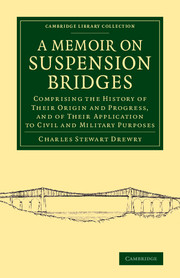
Published in 1832, this was the first English textbook dedicated to the topic of suspension bridges in Britain and continental Europe. Having assisted the naval officer and civil engineer Samuel Brown in preparing plans for the Clifton Suspension Bridge, Charles Stewart Drewry (1805–81) used information supplied directly by his engineering contemporaries to give an overview of the principles and challenges involved in the construction of suspension bridges. A key reference for the early history of this type of structure, the book discusses various methods and materials, ranging across rope, wood, chain and wire. Details regarding experiments on the strength of iron bars and wires are also given. Enhanced by lithographic plates and woodcut illustrations, the work is notable for its discussion of many examples of important bridges, such as Thomas Telford's Menai Suspension Bridge and the first such construction over the Thames at Hammersmith, as well as designs from overseas.
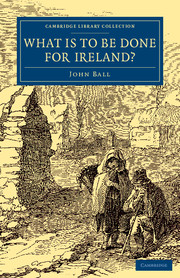
The Irish scientist John Ball (1818–89), active in the study of natural history and glaciology, held fellowships of both the Royal Society and the Linnean Society. When the Irish Potato Famine took hold, Ball returned from European travel and study intent on helping his countrymen. In 1846 he became an assistant poor law commissioner, and witnessed the deepening crisis at first hand. The first edition of this pamphlet was published in 1847. Reissued here is the second edition of 1849, the year when Ball assumed the more senior office of second poor law commissioner. He uses the pamphlet to argue passionately for the urgent revision of government legislation relating to poor relief, the public works programme, land improvement, labour and taxation, which he felt had exacerbated matters. He also believed the famine had been forgotten by the English and calls for them to show more sympathy towards the Irish.
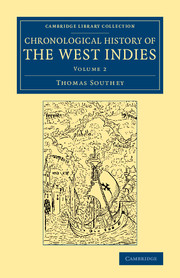
Thomas Southey (1777–1838) joined the navy at the age of twelve, saw action during the French Revolutionary Wars, and was first posted to the West Indies in early 1804. Promoted to captain in 1811 and later employed as a customs officer, he died on the voyage home from his last posting in Demerara. His only book, published in 1827, is dedicated to his older brother, Robert, a Romantic poet, who also wrote on historical subjects (his books on Nelson, the Duke of Wellington, and Brazil are also available in the Cambridge Library Collection). Thomas's three-volume work draws on extensive reading, with substantial passages quoted verbatim from his sources. He concludes that the history of the West Indies presents 'little more than a melancholy series of calamities and crimes', but commends the British government's efforts to put an end to slavery. Volume 2 covers the period from 1655 to 1783.
Julia Pardoe (1804–62) was famous for her historical biographies (some of which are also reissued in the Cambridge Library Collection), but this two-volume work, first published in 1837, arose from a visit to Turkey made by Pardoe and her father in 1836. It was very successful, with new editions appearing over the next twenty years, while Pardoe was considered to be second only to Lady Mary Wortley Montagu among female writers on Turkey. Attempting to give her readers 'a more just and complete insight into Turkish domestic life, than they have hitherto been enabled to obtain', in Volume 1 Pardoe describes the inhabitants of Istanbul, both the Ottoman governing elite and the expatriate community of Greeks, Italians, Russians and French, with their constant political intrigues. Her lively and observant account of life in the declining but still powerful Ottoman empire remains of great interest.
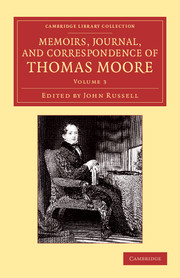
Throughout his professional life, the poet Thomas Moore (1779–1852) was variously celebrated and vilified for both his verse and his politics. Born in Dublin, he remained an ardent Irish patriot until his death. This eight-volume collection of Moore's memoirs, diaries and letters, edited by his friend Lord John Russell (1792–1878) and first published between 1853 and 1856, provides rare insights into a man whose genius was applauded by the Morning Chronicle as 'embracing almost all sides of imaginative literature, of criticism and philosophy'. Opening with a portrait of Sir John Stevenson, with whom Moore worked on the successful series Irish Melodies between 1808 and 1834, Volume 3 contains Moore's diary for the period 1819–22. During this time, Moore was effectively exiled to France and Italy, where he developed a close friendship with Lord Byron.
Julia Pardoe (1804–62) was famous for her historical biographies (some of which are also reissued in the Cambridge Library Collection), but this two-volume work, first published in 1837, arose from a visit to Turkey made by Pardoe and her father in 1836. It was very successful, with new editions appearing over the next twenty years, while Pardoe was considered to be second only to Lady Mary Wortley Montagu among female writers on Turkey. Attempting to give her readers 'a more just and complete insight into Turkish domestic life, than they have hitherto been enabled to obtain', in Volume 2 Pardoe travels in western Turkey, visiting Bursa, the former Ottoman capital, and encountering dervishes, hot springs and tortoises, before returning to Europe via the Black Sea and the Danube. Her lively and observant account of life in the declining but still powerful Ottoman empire remains of great interest.