Refine search
Actions for selected content:
26204 results in Theoretical Physics and Mathematical Physics
On the fractional parts of the powers of a number (II)
-
- Journal:
- Mathematical Proceedings of the Cambridge Philosophical Society / Volume 37 / Issue 4 / October 1941
- Published online by Cambridge University Press:
- 24 October 2008, pp. 349-357
- Print publication:
- October 1941
-
- Article
- Export citation
Deuteron bombardment of the heavy elements: II. Platinum
-
- Journal:
- Mathematical Proceedings of the Cambridge Philosophical Society / Volume 37 / Issue 4 / October 1941
- Published online by Cambridge University Press:
- 24 October 2008, pp. 422-432
- Print publication:
- October 1941
-
- Article
- Export citation
-
Experiments on the bombardment of platinum with 9 M.e.V. deuterons are reported. Radioactive isotopes of platinum of periods 32 min., 18 hr. and 2·8 days, and isotopes of gold of periods 2·6 and 5·6 days are reported. The 2·6 day gold isotope is formed directly by deuteron bombardment as well as by decay of the 32 min. platinum isotope. The absorption of the β-rays in aluminium and of the γ-rays in lead has been measured, and assignments have been made for most of the isotopes reported. Excitation function measurements have been made for the 32 min. and 18 hr. platinum isotopes, and the form of the energy-yield curve is the same for both these elements. The form of the curve seems to favour the Oppenheimer-Phillips process for the formation of these radioelements by the
 reaction.
 reaction.
The sputtering of platinum in hydrogen and deuterium
-
- Journal:
- Mathematical Proceedings of the Cambridge Philosophical Society / Volume 37 / Issue 4 / October 1941
- Published online by Cambridge University Press:
- 24 October 2008, pp. 438-439
- Print publication:
- October 1941
-
- Article
- Export citation
A method of making stream-lines momentarily visible
-
- Journal:
- Mathematical Proceedings of the Cambridge Philosophical Society / Volume 37 / Issue 4 / October 1941
- Published online by Cambridge University Press:
- 24 October 2008, pp. 436-437
- Print publication:
- October 1941
-
- Article
- Export citation
Notes on special systems of orthogonal functions (IV): the orthogonal functions of whittaker's cardinal series
-
- Journal:
- Mathematical Proceedings of the Cambridge Philosophical Society / Volume 37 / Issue 4 / October 1941
- Published online by Cambridge University Press:
- 24 October 2008, pp. 331-348
- Print publication:
- October 1941
-
- Article
- Export citation
-
Suppose that n runs through all integral values, that (øn) is a system of normal orthogonal functions for the interval (−∞, ∞), and that ψn is the Fourier transform of øn. Then, by Parseval's theorem for Fourier transforms,
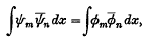
and (ψn) is also a normal orthogonal system.
Surface motion of sputtered particles
-
- Journal:
- Mathematical Proceedings of the Cambridge Philosophical Society / Volume 37 / Issue 4 / October 1941
- Published online by Cambridge University Press:
- 24 October 2008, pp. 440-442
- Print publication:
- October 1941
-
- Article
- Export citation
On a conjecture of Mordell concerning binary cubic forms
-
- Journal:
- Mathematical Proceedings of the Cambridge Philosophical Society / Volume 37 / Issue 4 / October 1941
- Published online by Cambridge University Press:
- 24 October 2008, pp. 325-330
- Print publication:
- October 1941
-
- Article
- Export citation
-
Let f(x, y) be a binary cubic form with real coefficients and determinant D ≠ 0. In a recent paper, Mordell has proved that there exist integral values of x, y, not both zero, for which


These inequalities are best possible, since they cannot be satisfied with the sign of strict inequality when f(x, y) is equivalent to

for the case D < 0, or to

for the case D > 0.
PSP volume 37 issue 4 Cover and Back matter
-
- Journal:
- Mathematical Proceedings of the Cambridge Philosophical Society / Volume 37 / Issue 4 / October 1941
- Published online by Cambridge University Press:
- 24 October 2008, pp. b1-b10
- Print publication:
- October 1941
-
- Article
-
- You have access
- Export citation
Proceedings at the Meetings held during the Session 1940–1941
-
- Journal:
- Mathematical Proceedings of the Cambridge Philosophical Society / Volume 37 / Issue 4 / October 1941
- Published online by Cambridge University Press:
- 24 October 2008, pp. 443-445
- Print publication:
- October 1941
-
- Article
- Export citation
The Cambridge Philosophical Society Statement of Accounts for the Period 1 August 1939 to 31 July 1940
-
- Journal:
- Mathematical Proceedings of the Cambridge Philosophical Society / Volume 37 / Issue 4 / October 1941
- Published online by Cambridge University Press:
- 24 October 2008, pp. 446-447
- Print publication:
- October 1941
-
- Article
- Export citation
PSP volume 37 issue 4 Cover and Front matter
-
- Journal:
- Mathematical Proceedings of the Cambridge Philosophical Society / Volume 37 / Issue 4 / October 1941
- Published online by Cambridge University Press:
- 24 October 2008, pp. f1-f2
- Print publication:
- October 1941
-
- Article
-
- You have access
- Export citation
Momentum distribution in molecular systems: Part IV. The hydrogen molecular ion
-
- Journal:
- Mathematical Proceedings of the Cambridge Philosophical Society / Volume 37 / Issue 4 / October 1941
- Published online by Cambridge University Press:
- 24 October 2008, pp. 397-405
- Print publication:
- October 1941
-
- Article
- Export citation
Notes on the two-centre problem in wave mechanics: II. Some new solutions of the wave equation
-
- Journal:
- Mathematical Proceedings of the Cambridge Philosophical Society / Volume 37 / Issue 4 / October 1941
- Published online by Cambridge University Press:
- 24 October 2008, pp. 384-396
- Print publication:
- October 1941
-
- Article
- Export citation
Momentum distribution in molecular systems: Part V. Momentum distribution and the shape of the Compton line for CH4, C2H6, C2H4 and C2H2
-
- Journal:
- Mathematical Proceedings of the Cambridge Philosophical Society / Volume 37 / Issue 4 / October 1941
- Published online by Cambridge University Press:
- 24 October 2008, pp. 406-421
- Print publication:
- October 1941
-
- Article
- Export citation
Note on semi-groups
-
- Journal:
- Mathematical Proceedings of the Cambridge Philosophical Society / Volume 37 / Issue 4 / October 1941
- Published online by Cambridge University Press:
- 24 October 2008, pp. 434-435
- Print publication:
- October 1941
-
- Article
- Export citation
A proof of the theorem of the double-six
-
- Journal:
- Mathematical Proceedings of the Cambridge Philosophical Society / Volume 37 / Issue 4 / October 1941
- Published online by Cambridge University Press:
- 24 October 2008, pp. 433-434
- Print publication:
- October 1941
-
- Article
- Export citation
On the subadditivity of the transfinite diameter
-
- Journal:
- Mathematical Proceedings of the Cambridge Philosophical Society / Volume 37 / Issue 4 / October 1941
- Published online by Cambridge University Press:
- 24 October 2008, pp. 373-383
- Print publication:
- October 1941
-
- Article
- Export citation
-
Let M be a bounded and closed set of points in the complex z plane; d(M), a set-function which is of great importance in potential and function theory, may then be defined as follows. n points z1, z2, …, zn in M are so chosen that the product of the mutual distances

has the greatest possible value
 Then it can be proved that
exists. Thus the set-function d(M), named by Fekete the transfinite diameter of M, is defined.
 Then it can be proved that
On average values of arithmetic functions
-
- Journal:
- Mathematical Proceedings of the Cambridge Philosophical Society / Volume 37 / Issue 4 / October 1941
- Published online by Cambridge University Press:
- 24 October 2008, pp. 358-372
- Print publication:
- October 1941
-
- Article
- Export citation
-
The problem considered in this paper is that of finding the least possible h = h(x) such that a given arithmetic function a(n) should keep its average order in the interval x, x + h, i.e. that we have

and

as x → ∞.
The quantum theory of radiation damping‡
-
- Journal:
- Mathematical Proceedings of the Cambridge Philosophical Society / Volume 37 / Issue 3 / July 1941
- Published online by Cambridge University Press:
- 24 October 2008, pp. 301-316
- Print publication:
- July 1941
-
- Article
- Export citation
The probability distribution of the extent of a random chain
-
- Journal:
- Mathematical Proceedings of the Cambridge Philosophical Society / Volume 37 / Issue 3 / July 1941
- Published online by Cambridge University Press:
- 24 October 2008, pp. 244-251
- Print publication:
- July 1941
-
- Article
- Export citation
