Refine search
Actions for selected content:
26208 results in Theoretical Physics and Mathematical Physics
PSP volume 46 issue 2 Cover and Back matter
-
- Journal:
- Mathematical Proceedings of the Cambridge Philosophical Society / Volume 46 / Issue 2 / April 1950
- Published online by Cambridge University Press:
- 24 October 2008, pp. b1-b2
- Print publication:
- April 1950
-
- Article
-
- You have access
- Export citation
The Altitude-Azimuth Curve - Étude sur une conception nouvelle d'une table de point astronomique. ProfessorP. Hugon; Publication No. 382(d) of the Service Central Hydrographique of the (French) Ministère de la Défense Nationale (Secrétariat d'État chargé de la Marine).
-
- Journal:
- The Journal of Navigation / Volume 3 / Issue 2 / April 1950
- Published online by Cambridge University Press:
- 18 January 2010, pp. 203-204
- Print publication:
- April 1950
-
- Article
- Export citation
A National Institute of Oceanography
-
- Journal:
- The Journal of Navigation / Volume 3 / Issue 2 / April 1950
- Published online by Cambridge University Press:
- 18 January 2010, pp. 197-198
- Print publication:
- April 1950
-
- Article
- Export citation
Improving the Radar Performance of a Buoy: An analysis of results before and after fitting a reflector
-
- Journal:
- The Journal of Navigation / Volume 3 / Issue 2 / April 1950
- Published online by Cambridge University Press:
- 18 January 2010, pp. 183-188
- Print publication:
- April 1950
-
- Article
- Export citation
A Critical Table for Sextant Corrections
-
- Journal:
- The Journal of Navigation / Volume 3 / Issue 2 / April 1950
- Published online by Cambridge University Press:
- 18 January 2010, p. 205
- Print publication:
- April 1950
-
- Article
-
- You have access
- Export citation
A comparison of some absolute methods of measuring fast neutron flux
-
- Journal:
- Mathematical Proceedings of the Cambridge Philosophical Society / Volume 46 / Issue 2 / April 1950
- Published online by Cambridge University Press:
- 24 October 2008, pp. 339-352
- Print publication:
- April 1950
-
- Article
- Export citation
On the theory of grand partition functions†
-
- Journal:
- Mathematical Proceedings of the Cambridge Philosophical Society / Volume 46 / Issue 2 / April 1950
- Published online by Cambridge University Press:
- 24 October 2008, pp. 319-330
- Print publication:
- April 1950
-
- Article
- Export citation
The Parseval formulae for monotonic functions. II
-
- Journal:
- Mathematical Proceedings of the Cambridge Philosophical Society / Volume 46 / Issue 2 / April 1950
- Published online by Cambridge University Press:
- 24 October 2008, pp. 231-248
- Print publication:
- April 1950
-
- Article
- Export citation
Some metrical theorems in Diophantine approximation. I
-
- Journal:
- Mathematical Proceedings of the Cambridge Philosophical Society / Volume 46 / Issue 2 / April 1950
- Published online by Cambridge University Press:
- 24 October 2008, pp. 209-218
- Print publication:
- April 1950
-
- Article
- Export citation
-
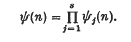
In this paper we are interested in statements about Diophantine approximation which are ‘almost always’ or ‘almost never’ true. Let

be s non-negative functions of the positive integer n, and let
A New Set of Reduction Tables - Kortbestek Tafel by J. C. Lieuwen; being Deel II of Zeevaartkundige Tafels; prepared for the (Dutch) Ministerie van Marine. 's-Gravenhage, 1949; 160, ii; cloth, 11·6 × 8·2 inches; no price stated.
-
- Journal:
- The Journal of Navigation / Volume 3 / Issue 2 / April 1950
- Published online by Cambridge University Press:
- 18 January 2010, pp. 200-203
- Print publication:
- April 1950
-
- Article
- Export citation
The oscillatory behaviour of moving averages
-
- Journal:
- Mathematical Proceedings of the Cambridge Philosophical Society / Volume 46 / Issue 2 / April 1950
- Published online by Cambridge University Press:
- 24 October 2008, pp. 272-280
- Print publication:
- April 1950
-
- Article
- Export citation
-
The theory of graduation discusses methods of obtaining a smoothed series of values of a function from a given empirical set of values. This is usually done by replacing each observation by a weighted average of it and neighbouring observations. Thus if {xi} (i = 0, ± 1, …) is a sequence of values, we can replace them by the series

where the A's are constants which are chosen in some suitable manner. If we regard the xi as the sum of a functional part fi and an error term εi we may attempt to choose the A's in such a way that the functional part is reproduced as well as possible, e.g. that

for some desired type of function. If this is so and the error terms εi are independently distributed with zero mean and finite standard deviation σ, we find that

where the ηi are a series of random variables which are no longer independent of each other but which have zero mean and a standard deviation σ1 such that

A Survey of Navigation Systems and Instrument Aids
-
- Journal:
- The Journal of Navigation / Volume 3 / Issue 2 / April 1950
- Published online by Cambridge University Press:
- 18 January 2010, pp. 141-155
- Print publication:
- April 1950
-
- Article
- Export citation
Aerial Magnetic Survey
-
- Journal:
- The Journal of Navigation / Volume 3 / Issue 2 / April 1950
- Published online by Cambridge University Press:
- 18 January 2010, pp. 121-132
- Print publication:
- April 1950
-
- Article
- Export citation
Astro-Fix by Computation
-
- Journal:
- The Journal of Navigation / Volume 3 / Issue 2 / April 1950
- Published online by Cambridge University Press:
- 18 January 2010, pp. 107-120
- Print publication:
- April 1950
-
- Article
- Export citation
The Centre Belge de Navigation
-
- Journal:
- The Journal of Navigation / Volume 3 / Issue 2 / April 1950
- Published online by Cambridge University Press:
- 18 January 2010, p. 198
- Print publication:
- April 1950
-
- Article
- Export citation
Probability distributions and orthogonal parameters
-
- Journal:
- Mathematical Proceedings of the Cambridge Philosophical Society / Volume 46 / Issue 2 / April 1950
- Published online by Cambridge University Press:
- 24 October 2008, pp. 281-284
- Print publication:
- April 1950
-
- Article
- Export citation
-
Let f(x, αi) be the probability density function of a distribution depending on n parameters αi(i = 1,2, …, n). Then following Jeffreys(1) we shall say that the parameters αi are orthogonal if

Siting the Radar Scanner
-
- Journal:
- The Journal of Navigation / Volume 3 / Issue 2 / April 1950
- Published online by Cambridge University Press:
- 18 January 2010, pp. 189-193
- Print publication:
- April 1950
-
- Article
- Export citation
Aircraft Radio Altimeters
-
- Journal:
- The Journal of Navigation / Volume 3 / Issue 1 / January 1950
- Published online by Cambridge University Press:
- 18 January 2010, pp. 79-89
- Print publication:
- January 1950
-
- Article
- Export citation
Surface waves on deep water in the presence of a submerged circular cylinder. II
-
- Journal:
- Mathematical Proceedings of the Cambridge Philosophical Society / Volume 46 / Issue 1 / January 1950
- Published online by Cambridge University Press:
- 24 October 2008, pp. 153-158
- Print publication:
- January 1950
-
- Article
- Export citation
PSP volume 46 issue 1 Cover and Front matter
-
- Journal:
- Mathematical Proceedings of the Cambridge Philosophical Society / Volume 46 / Issue 1 / January 1950
- Published online by Cambridge University Press:
- 24 October 2008, pp. f1-f2
- Print publication:
- January 1950
-
- Article
-
- You have access
- Export citation
