Refine search
Actions for selected content:
26208 results in Theoretical Physics and Mathematical Physics
NAV volume 3 issue 2 Cover and Front matter
-
- Journal:
- The Journal of Navigation / Volume 3 / Issue 2 / April 1950
- Published online by Cambridge University Press:
- 18 January 2010, pp. f1-f12
- Print publication:
- April 1950
-
- Article
-
- You have access
- Export citation
Biographical Notes on Fellows Elected in 1949
-
- Journal:
- The Journal of Navigation / Volume 3 / Issue 2 / April 1950
- Published online by Cambridge University Press:
- 18 January 2010, pp. 194-197
- Print publication:
- April 1950
-
- Article
- Export citation
Institute Notices
-
- Journal:
- The Journal of Navigation / Volume 3 / Issue 2 / April 1950
- Published online by Cambridge University Press:
- 18 January 2010, p. 209
- Print publication:
- April 1950
-
- Article
- Export citation
An improved approximate analytic solution of the Thomas-Fermi equation for atoms
-
- Journal:
- Mathematical Proceedings of the Cambridge Philosophical Society / Volume 46 / Issue 2 / April 1950
- Published online by Cambridge University Press:
- 24 October 2008, pp. 356-357
- Print publication:
- April 1950
-
- Article
- Export citation
Supersonic flow over an inclined wing of zero aspect ratio
-
- Journal:
- Mathematical Proceedings of the Cambridge Philosophical Society / Volume 46 / Issue 2 / April 1950
- Published online by Cambridge University Press:
- 24 October 2008, pp. 307-315
- Print publication:
- April 1950
-
- Article
- Export citation
The Parseval formulae for monotonic functions. III
-
- Journal:
- Mathematical Proceedings of the Cambridge Philosophical Society / Volume 46 / Issue 2 / April 1950
- Published online by Cambridge University Press:
- 24 October 2008, pp. 249-267
- Print publication:
- April 1950
-
- Article
- Export citation
-
This sequence of papers is concerned with a group of theorems on Fourier transforms, and with the corresponding results for Fourier series. The transform theorems deal with the equations

when two of the functions concerned are monotonic; and the series theorems, with the equations


when two of the functions or sequences of coefficients are monotonic. A general survey of the problem was given in two earlier papers, which we shall call M.F. (I) and M.F. (II), and the results obtained were tabulated in M.F. (II). There is thus no need to restate the position in detail here. We shall merely recall as briefly as possible what has been proved already, so as to show the scope of the present paper.
Note on the motion of liquid near a position of separation
-
- Journal:
- Mathematical Proceedings of the Cambridge Philosophical Society / Volume 46 / Issue 2 / April 1950
- Published online by Cambridge University Press:
- 24 October 2008, pp. 293-306
- Print publication:
- April 1950
-
- Article
- Export citation
The American Institute
-
- Journal:
- The Journal of Navigation / Volume 3 / Issue 2 / April 1950
- Published online by Cambridge University Press:
- 18 January 2010, p. 198
- Print publication:
- April 1950
-
- Article
- Export citation
Radar and Charts: A discussion following a Report on Admiralty Chart 2649
-
- Journal:
- The Journal of Navigation / Volume 3 / Issue 2 / April 1950
- Published online by Cambridge University Press:
- 18 January 2010, pp. 156-165
- Print publication:
- April 1950
-
- Article
- Export citation
Lessons from some Collisions and Groundings at Sea
-
- Journal:
- The Journal of Navigation / Volume 3 / Issue 2 / April 1950
- Published online by Cambridge University Press:
- 18 January 2010, pp. 166-182
- Print publication:
- April 1950
-
- Article
- Export citation
The Accuracy Requirements of an En-Route Aid
-
- Journal:
- The Journal of Navigation / Volume 3 / Issue 2 / April 1950
- Published online by Cambridge University Press:
- 18 January 2010, pp. 205-206
- Print publication:
- April 1950
-
- Article
-
- You have access
- Export citation
A note on the relativistic invariance of quantized field theories
-
- Journal:
- Mathematical Proceedings of the Cambridge Philosophical Society / Volume 46 / Issue 2 / April 1950
- Published online by Cambridge University Press:
- 24 October 2008, pp. 316-318
- Print publication:
- April 1950
-
- Article
- Export citation
PSP volume 46 issue 2 Cover and Front matter
-
- Journal:
- Mathematical Proceedings of the Cambridge Philosophical Society / Volume 46 / Issue 2 / April 1950
- Published online by Cambridge University Press:
- 24 October 2008, pp. f1-f2
- Print publication:
- April 1950
-
- Article
-
- You have access
- Export citation
The expected number of aggregates in a random distribution of n points
-
- Journal:
- Mathematical Proceedings of the Cambridge Philosophical Society / Volume 46 / Issue 2 / April 1950
- Published online by Cambridge University Press:
- 24 October 2008, pp. 285-292
- Print publication:
- April 1950
-
- Article
- Export citation
The Council
-
- Journal:
- The Journal of Navigation / Volume 3 / Issue 2 / April 1950
- Published online by Cambridge University Press:
- 18 January 2010, p. 197
- Print publication:
- April 1950
-
- Article
- Export citation
Some metrical theorems in Diophantine approximation. III†
-
- Journal:
- Mathematical Proceedings of the Cambridge Philosophical Society / Volume 46 / Issue 2 / April 1950
- Published online by Cambridge University Press:
- 24 October 2008, pp. 219-225
- Print publication:
- April 1950
-
- Article
- Export citation
-
Let

be w sequences of differentiable functions defined in the ranges

where aj, bj may be − ∞, + ∞ respectively. For each j and each m ≠ n let
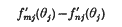
be monotonic and let there be a constant K independent of m, n, j, θj such that

Further results for the counterfeit coin problems
-
- Journal:
- Mathematical Proceedings of the Cambridge Philosophical Society / Volume 46 / Issue 2 / April 1950
- Published online by Cambridge University Press:
- 24 October 2008, pp. 226-230
- Print publication:
- April 1950
-
- Article
- Export citation
Star Altitude Curves for High Latitudes
-
- Journal:
- The Journal of Navigation / Volume 3 / Issue 2 / April 1950
- Published online by Cambridge University Press:
- 18 January 2010, p. 199
- Print publication:
- April 1950
-
- Article
- Export citation
A New Gravity Survey
-
- Journal:
- The Journal of Navigation / Volume 3 / Issue 2 / April 1950
- Published online by Cambridge University Press:
- 18 January 2010, p. 198
- Print publication:
- April 1950
-
- Article
- Export citation
A proof of liapounoff's inequality
-
- Journal:
- Mathematical Proceedings of the Cambridge Philosophical Society / Volume 46 / Issue 2 / April 1950
- Published online by Cambridge University Press:
- 24 October 2008, p. 353
- Print publication:
- April 1950
-
- Article
- Export citation
