Refine search
Actions for selected content:
26208 results in Theoretical Physics and Mathematical Physics
On the existence of metric differential geometries based on the notion of area
-
- Journal:
- Mathematical Proceedings of the Cambridge Philosophical Society / Volume 46 / Issue 1 / January 1950
- Published online by Cambridge University Press:
- 24 October 2008, pp. 67-72
- Print publication:
- January 1950
-
- Article
- Export citation
Annual Dinner 1949
-
- Journal:
- The Journal of Navigation / Volume 3 / Issue 1 / January 1950
- Published online by Cambridge University Press:
- 18 January 2010, pp. 95-96
- Print publication:
- January 1950
-
- Article
- Export citation
Numerical integration by systematic sampling
-
- Journal:
- Mathematical Proceedings of the Cambridge Philosophical Society / Volume 46 / Issue 1 / January 1950
- Published online by Cambridge University Press:
- 24 October 2008, pp. 111-115
- Print publication:
- January 1950
-
- Article
- Export citation
-
Recent investigations by F. Yates (1) in agricultural statistics suggest a mathematical problem which may be formulated as follows. A function f(x) is known to be of bounded variation and Lebesgue integrable on the range −∞ < x < ∞, and its integral over this range is to be determined. In default of any knowledge of the position of the non-negligible values of the function the best that can be done is to calculate the infinite sum
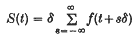
for some suitable δ and an arbitrary origin t, where s ranges over all possible positive and negative integers including zero. S is evidently of period δ in t and ranges over all its values as t varies from 0 to δ. Previous writers (Aitken (2), p. 45, and Kendall (3)) have examined the resulting errors for fixed t. (They considered only symmetrical functions, and supposed one of the lattice points to be located at the centre.) Here we do not restrict ourselves to symmetrical functions and consider the likely departure of S(t) from J (the required integral) when t is a random variable uniformly distributed in (0, δ). It will be shown that S(t) is distributed about J as mean value, with a variance which will be evaluated as a function of δ, the scale of subdivision.
Projective mutual invariants of a space cubic and a linear complex
-
- Journal:
- Mathematical Proceedings of the Cambridge Philosophical Society / Volume 46 / Issue 1 / January 1950
- Published online by Cambridge University Press:
- 24 October 2008, pp. 195-198
- Print publication:
- January 1950
-
- Article
- Export citation
Rayleigh's problem for a semi-infinite plate
-
- Journal:
- Mathematical Proceedings of the Cambridge Philosophical Society / Volume 46 / Issue 1 / January 1950
- Published online by Cambridge University Press:
- 24 October 2008, pp. 127-140
- Print publication:
- January 1950
-
- Article
- Export citation
The distribution of stress in the neighbourhood of a flat elliptical crack in an elastic solid
-
- Journal:
- Mathematical Proceedings of the Cambridge Philosophical Society / Volume 46 / Issue 1 / January 1950
- Published online by Cambridge University Press:
- 24 October 2008, pp. 159-163
- Print publication:
- January 1950
-
- Article
- Export citation
A note on boundary perturbations
-
- Journal:
- Mathematical Proceedings of the Cambridge Philosophical Society / Volume 46 / Issue 1 / January 1950
- Published online by Cambridge University Press:
- 24 October 2008, pp. 206-207
- Print publication:
- January 1950
-
- Article
- Export citation
Liverpool Port Radar Station
-
- Journal:
- The Journal of Navigation / Volume 3 / Issue 1 / January 1950
- Published online by Cambridge University Press:
- 18 January 2010, pp. 96-97
- Print publication:
- January 1950
-
- Article
- Export citation
Elastic deformations of infinite strips
-
- Journal:
- Mathematical Proceedings of the Cambridge Philosophical Society / Volume 46 / Issue 1 / January 1950
- Published online by Cambridge University Press:
- 24 October 2008, pp. 164-181
- Print publication:
- January 1950
-
- Article
- Export citation
A sextic primal in five dimensions
-
- Journal:
- Mathematical Proceedings of the Cambridge Philosophical Society / Volume 46 / Issue 1 / January 1950
- Published online by Cambridge University Press:
- 24 October 2008, pp. 91-105
- Print publication:
- January 1950
-
- Article
- Export citation
Notes on the secular determinant in molecular orbital theory
-
- Journal:
- Mathematical Proceedings of the Cambridge Philosophical Society / Volume 46 / Issue 1 / January 1950
- Published online by Cambridge University Press:
- 24 October 2008, pp. 202-205
- Print publication:
- January 1950
-
- Article
- Export citation
On the iteration of a continuous mapping of a compact space into itself
-
- Journal:
- Mathematical Proceedings of the Cambridge Philosophical Society / Volume 46 / Issue 1 / January 1950
- Published online by Cambridge University Press:
- 24 October 2008, pp. 46-56
- Print publication:
- January 1950
-
- Article
- Export citation
-
1. The questions considered in this note are suggested by the elementary topology of the trajectories of systems of non-linear differential equations. Such a system may be assumed in the form

and the values of the dependent variables x1, x2, …, xn at ‘time’ t can be represented by a point P(t) in a ‘phase space’
 . As t varies, P(t) describes a curve in , which is a trajectory of (1). Now it often happens that contains a subspace E (usually of lower dimension) with the following properties: (i) by considering the trajectories generated by points P(t) which are, for t = 0, in E, all the trajectories of (1) are obtained; (ii) if P(0) is in E, then P(t) is not in E for 0 < t < c, where c is a constant independent of P(0) in E; (iii) if P(0) is in E, then the trajectory meets E again for some finite t at a point P(T) (T is not necessarily the same for all points of E). By considering P(T) as the image of P(O), a mapping of E into itself is defined which is associated with the system (1), and the topology of the trajectories of (1) can be studied conveniently by discussing this mapping. When the functions fi in (1) satisfy the continuity and Lipschitz conditions of the classical existence-and-uniqueness theorem, the mapping is one-one and continuous. The study of this ‘transformation theory’, initiated by Poincaré, has been developed chiefly by G. D. Birkhoff(l,2). His results have been applied to problems of ‘non-linear mechanics’ by N. Levinson(3).
 . As
. As On differentiation and Denjoy-behaviour of functions of two real variables
-
- Journal:
- Mathematical Proceedings of the Cambridge Philosophical Society / Volume 46 / Issue 1 / January 1950
- Published online by Cambridge University Press:
- 24 October 2008, pp. 28-45
- Print publication:
- January 1950
-
- Article
- Export citation
The Earth's Magnetic Field
-
- Journal:
- The Journal of Navigation / Volume 3 / Issue 1 / January 1950
- Published online by Cambridge University Press:
- 18 January 2010, pp. 1-9
- Print publication:
- January 1950
-
- Article
- Export citation
Admiralty Chart 2649: A Chart Adapted for use with Radar
-
- Journal:
- The Journal of Navigation / Volume 3 / Issue 1 / January 1950
- Published online by Cambridge University Press:
- 18 January 2010, pp. 22-33
- Print publication:
- January 1950
-
- Article
- Export citation
Surface waves on deep water in the presence of a submerged circular cylinder. I
-
- Journal:
- Mathematical Proceedings of the Cambridge Philosophical Society / Volume 46 / Issue 1 / January 1950
- Published online by Cambridge University Press:
- 24 October 2008, pp. 141-152
- Print publication:
- January 1950
-
- Article
- Export citation
Annual General Meeting
-
- Journal:
- The Journal of Navigation / Volume 3 / Issue 1 / January 1950
- Published online by Cambridge University Press:
- 18 January 2010, pp. 90-95
- Print publication:
- January 1950
-
- Article
- Export citation
Pressure Pattern Flying - Theoretical Aspects of Pressure-Pattern Flying. J. S. Sawyer; H.M. Stationery Office Meteorological Report No. 3, M.O.496C, October 1949; 64 pages, 24 illustrations; paper 9·6 × 6·0 inches; 1s. 3d.
-
- Journal:
- The Journal of Navigation / Volume 3 / Issue 1 / January 1950
- Published online by Cambridge University Press:
- 18 January 2010, p. 98
- Print publication:
- January 1950
-
- Article
- Export citation
On two theorems of S. Verblunsky
-
- Journal:
- Mathematical Proceedings of the Cambridge Philosophical Society / Volume 46 / Issue 1 / January 1950
- Published online by Cambridge University Press:
- 24 October 2008, pp. 57-66
- Print publication:
- January 1950
-
- Article
- Export citation
-
In connexion with moment problems, S. Verblunsky proved the following two theorems:
Theorem I. (a) If f(x) is integrable in (−∞, +∞) and satisfies 0 ≤f(x) ≤ 1, then there exists a function σ(x), bounded and non-decreasing in (−∞, +∞), such that, for ζ = ξ + iη and η ≠ 0,

An Aircraft Approach Procedure: Some tests with aircraft using Distance Measuring Equipment and the Multiple Track Radar Range
-
- Journal:
- The Journal of Navigation / Volume 3 / Issue 1 / January 1950
- Published online by Cambridge University Press:
- 18 January 2010, pp. 43-60
- Print publication:
- January 1950
-
- Article
- Export citation
