Refine search
Actions for selected content:
237328 results in Physics and Astronomy
A far-infrared search for planet nine using AKARI all-sky survey
-
- Journal:
- Publications of the Astronomical Society of Australia / Volume 42 / 2025
- Published online by Cambridge University Press:
- 22 May 2025, e061
-
- Article
-
- You have access
- Open access
- HTML
- Export citation
-
An unusual orbital element clustering of Kuiper belt objects (KBOs) has been observed. The most promising dynamic solution is the presence of a giant planet in the outer Solar system, Planet Nine. However, due to its extreme distance, intensive searches in optical have not been successful. We aim to find Planet Nine in the far-infrared, where it has the peak of the black body radiation, using the most sensitive all-sky far-infrared survey to date, AKARI. In contrast to optical searches, where the energy of reflected sunlight decreases by $d^{4}$, thermal radiation in the infrared decreases with the square of the heliocentric distance $d^{2}$. We search for moving objects in the AKARI Single Scan Detection List. We select sources from a promising region suggested by an N-body simulation from Millholland and Laughlin 2017: $30^{\circ}\lt$ R.A. $\lt50^{\circ}$ and $-20^{\circ}\lt$ Dec. $\lt20^{\circ}$. Known sources are excluded by cross-matching AKARI sources with 9 optical and infrared catalogues. Furthermore, we select sources with small background strength to avoid sources in the cirrus. Since Planet Nine is stationary in a timescale of hours but moves on a monthly scale, our primary strategy is to select slowly moving objects that are stationary in 24 h but not in six months, using multiple single scans by AKARI. The selected slowly moving AKARI sources are scrutinised for potential contamination from cosmic rays. Our analysis reveals two possible Planet Nine candidates whose positions and flux are within the theoretical prediction ranges. These candidates warrant further investigation through follow-up observations to confirm the existence and properties of Planet Nine.


2. - Phobos and Deimos
-
- Book:
- The International Atlas of Mars Exploration
- Published online:
- 13 June 2025
- Print publication:
- 22 May 2025, pp 576-585
-
- Chapter
- Export citation
14 - Vector-Based Form and Force Diagrams in Three Dimensions
- from Part II - Concepts from Maxwell’s Articles on Structural Mechanics
-
-
- Book:
- The Geometry of Equilibrium
- Published online:
- 03 May 2025
- Print publication:
- 22 May 2025, pp 179-184
-
- Chapter
- Export citation
References
-
- Book:
- The Geometry of Equilibrium
- Published online:
- 03 May 2025
- Print publication:
- 22 May 2025, pp 293-302
-
- Chapter
- Export citation
1876: On Bow’s method of drawing diagrams in graphical statics, with illustrations from Peaucellier’s linkage
- from Part III - Annotated Original Articles by Maxwell on Structural Mechanics
-
- Book:
- The Geometry of Equilibrium
- Published online:
- 03 May 2025
- Print publication:
- 22 May 2025, pp 287-292
-
- Chapter
- Export citation
Preface
-
- Book:
- The Geometry of Equilibrium
- Published online:
- 03 May 2025
- Print publication:
- 22 May 2025, pp xi-xii
-
- Chapter
- Export citation
Cross-correlating the EMU Pilot Survey 1 with CMB lensing: Constraints on cosmology and galaxy bias with harmonic-space power spectra
-
- Journal:
- Publications of the Astronomical Society of Australia / Volume 42 / 2025
- Published online by Cambridge University Press:
- 21 May 2025, e062
-
- Article
-
- You have access
- Open access
- HTML
- Export citation
-
We measured the harmonic-space power spectrum of Galaxy clustering auto-correlation from the Evolutionary Map of the Universe Pilot Survey 1 data (EMU PS1) and its cross-correlation with the lensing convergence map of cosmic microwave background (CMB) from Planck Public Release 4 at the linear scale range from $\ell=2$ to 500. We applied two flux density cuts at $0.18$ and $0.4$ mJy on the radio galaxies observed at 944MHz and considered two source detection algorithms. We found the auto-correlation measurements from the two algorithms at the 0.18 mJy cut to deviate for $\ell\gtrsim250$ due to the different criteria assumed on the source detection and decided to ignore data above this scale. We report a cross-correlation detection of EMU PS1 with CMB lensing at $\sim$5.5 $\sigma$, irrespective of flux density cut. In our theoretical modelling we considered the SKADS and T-RECS redshift distribution simulation models that yield consistent results, a linear and a non-linear matter power spectrum, and two linear galaxy bias models. That is a constant redshift-independent galaxy bias $b(z)=b_g$ and a constant amplitude galaxy bias $b(z)=b_g/D(z)$. By fixing a cosmology model and considering a non-linear matter power spectrum with SKADS, we measured a constant galaxy bias at $0.18$ mJy ( $0.4$ mJy) with $b_g=2.32^{+0.41}_{-0.33}$ ( $2.18^{+0.17}_{-0.25}$) and a constant amplitude bias with $b_g=1.72^{+0.31}_{-0.21}$ ( $1.78^{+0.22}_{-0.15}$). When $\sigma_8$ is a free parameter for the same models at $0.18$ mJy ( $0.4$ mJy) with the constant model we found $\sigma_8=0.68^{+0.16}_{-0.14}$ ( $0.82\pm0.10$), while with the constant amplitude model we measured $\sigma_8=0.61^{+0.18}_{-0.20}$ ( $0.78^{+0.11}_{-0.09}$), respectively. Our results agree at $1\sigma$ with the measurements from Planck CMB and the weak lensing surveys and also show the potential of cosmology studies with future radio continuum survey data.


Three-dimensional simulations of accretion disks in pre-CE systems
-
- Journal:
- Publications of the Astronomical Society of Australia / Volume 42 / 2025
- Published online by Cambridge University Press:
- 21 May 2025, e076
-
- Article
-
- You have access
- Open access
- HTML
- Export citation
-
Before a binary system enters into a common envelope (CE) phase, accretion from the primary star onto the companion star through Roche Lobe overflow (RLOF) will lead to the formation of an accretion disk, which may generate jets. Accretion before and during the CE may alter the outcome of the interaction. Previous studies have considered different aspects of this physical mechanism. Here we study the properties of an accretion disk formed via 3D hydrodynamic simulations of the RLOF mass transfer between a 7 M $_{\odot}$, red supergiant star and a 1.4 M $_{\odot}$, neutron star companion. We simulate only the volume around the companion for improved resolution. We use a 1D implicit mesa simulation of the evolution of the system during 30 000 yr between the on-set of the RLOF and the CE to guide the binary parameters and the mass-transfer rate, while we simulate only 21 yr of the last part of the RLOF in 3D using an ideal gas quasi-isothermal equation of state. We expect that a pre-CE disk under these parameters will have a mass of $\sim 5\times 10^{-3}$ M $_{\odot}$ and a radius of $\sim40\ R_\odot$ with a scale height of $\sim 5\ R$ $_{\odot}$. The temperature profile of the disk is shallower than that predicted by the formalism of Shakura and Sunyaev, but more reasonable cooling physics would need to be included. We stress test these results with respect to a number of physical and numerical parameters, as well as simulation choices, and we expect them to be reasonable within a factor of a few for the mass and 15% for the radius. We also contextualise our results within those presented in the literature, in particular with respect to the dimensionality of simulations and the adiabatic index. We discuss the measured accretion rate in the context of the Shakura and Sunyaev formalism and debate the viscous mechanisms at play, finishing with a list of prospects for future work.


WALLABY pilot survey: Spatially resolved gas scaling relations within the stellar discs of nearby galaxies
-
- Journal:
- Publications of the Astronomical Society of Australia / Volume 42 / 2025
- Published online by Cambridge University Press:
- 21 May 2025, e046
-
- Article
-
- You have access
- Open access
- HTML
- Export citation
-
The scatter in global atomic hydrogen (Hi) scaling relations is partly attributed to differences in how Hi and stellar properties are measured, with Hi reservoirs typically extending beyond the inner regions of galaxies where star formation occurs. Using pilot observations from the Widefield ASKAP L-band Legacy All-sky Blind Survey (WALLABY), we present the first measurements of Hi mass enclosed within the stellar-dominated regions of galaxies for a statistical sample of 995 local gas-rich systems, investigating the factors driving its variation. We examine how global Hi scaling relations change when measurements are restricted to $R_{\text{25}}$ and $R_{\text{24}}$ – the isophotal radii at 25 and 24 mag arcsec $^{-2}$ in the i-band – and explore how the fraction of Hi mass and Hi surface density within these radii correlate with other galaxy properties. On average, 68% of the total Hi mass is enclosed within $R_{\text{25}}$ and 54% within $R_{\text{24}}$, though significant variation exists between galaxies, ranging from $\sim$20% to 100%. The fraction of Hi mass within $R_{\text{25}}$ shows a mild correlation with stellar properties, with galaxies of higher stellar mass, greater stellar surface density, or redder colours enclosing a larger fraction of their Hi reservoirs. These correlations do not significantly strengthen when considering $R_{\text{24}}$. Conversely, global Hi surface densities show no significant correlation with stellar mass or stellar surface density, but trends start emerging when these are measured within the inner regions of galaxies. The strongest correlation is observed with optical colour, with bluer galaxies having higher average Hi surface densities within $R_{\text{25}}$. This trend of the average Hi surface density with optical colour strengthens when we restrict from $R_{\text{25}}$ to $R_{\text{24}}$, suggesting a closer connection between inner Hi reservoirs and star formation. This study underscores the value of (at least marginally) resolved Hi surveys of statistical samples for advancing our understanding of the gas-star formation cycle in galaxies.


Eulerian and Lagrangian electron energisation during magnetic reconnection
-
- Journal:
- Journal of Plasma Physics / Volume 91 / Issue 3 / June 2025
- Published online by Cambridge University Press:
- 21 May 2025, E90
-
- Article
-
- You have access
- Open access
- HTML
- Export citation
Modelling the impact of circumbinary disk accretion on post-AGB binary evolution and surface chemistry
-
- Journal:
- Publications of the Astronomical Society of Australia / Volume 42 / 2025
- Published online by Cambridge University Press:
- 21 May 2025, e075
-
- Article
-
- You have access
- Open access
- HTML
- Export citation
-
Post-asymptotic giant branch (post-AGB) binaries are surrounded by dusty circumbinary disks and exhibit unexpected orbital properties resulting from poorly understood binary interaction processes. Re-accreted gas from the circumbinary disk alters the photospheric chemistry of the post-AGB star, producing a characteristic underabundance of refractory elements that correlates with condensation temperature – a phenomenon known as chemical depletion. This work investigates how re-accretion from a disk drives chemical depletion, and the impact accreted matter has on post-AGB evolution. We used the MESA code to evolve 0.55 and 0.60 M $_{\odot}$ post-AGB stars with the accretion of refractory element-depleted gas from a circumbinary disk. Our study adopts observationally-constrained initial accretion rates and disk masses to reproduce the chemical depletion patterns of six well-studied post-AGB binary stars: EP Lyr, HP Lyr, IRAS 17038-4815, IRAS 09144-4933, HD 131356, and SX Cen. We find high accretion rates ( $\gt 10^{-7}$ M $_{\odot}\,\mathrm{yr}^{-1}$) and large disk masses ( $\gtrsim10^{-2}$ M $_{\odot}$) necessary to reproduce observed depletion, particularly in higher-mass, hotter post-AGB stars ( $T_{\textrm{eff}}\gtrsim$ 6 000 K). A slower evolution (lower core mass) is required to reproduce cooler ( $T_{\textrm{eff}}\lesssim$ 5 000 K) depleted post-AGB stars. Rapid accretion significantly impacts post-AGB evolution, stalling stars at cooler effective temperatures and extending post-AGB lifetimes by factors of around 3 to 10. Despite this, extended post-AGB timescales remain within or below the planetary nebula visibility timescale, suggesting accretion cannot account for the observed lack of ionised PNe in post-AGB binaries. Our findings constrain accretion-flow parameters and advance our understanding of disk-binary interactions in post-AGB systems.


On the Aldous-Caputo Spectral Gap Conjecture for Hypergraphs
- Part of
-
- Journal:
- Mathematical Proceedings of the Cambridge Philosophical Society / Volume 179 / Issue 2 / September 2025
- Published online by Cambridge University Press:
- 21 May 2025, pp. 259-298
- Print publication:
- September 2025
-
- Article
- Export citation
-
In their celebrated paper [CLR10], Caputo, Liggett and Richthammer proved Aldous’ conjecture and showed that for an arbitrary finite graph, the spectral gap of the interchange process is equal to the spectral gap of the underlying random walk. A crucial ingredient in the proof was the Octopus Inequality — a certain inequality of operators in the group ring $\mathbb{R}\left[{\mathrm{Sym}}_{n}\right]$ of the symmetric group. Here we generalise the Octopus Inequality and apply it to generalising the Caputo–Liggett–Richthammer Theorem to certain hypergraphs, proving some cases of a conjecture of Caputo.

A geometric description of the Reidemeister–Turaev torsion for abelian representations on 3-manifolds
- Part of
-
- Journal:
- Mathematical Proceedings of the Cambridge Philosophical Society / Volume 179 / Issue 2 / September 2025
- Published online by Cambridge University Press:
- 21 May 2025, pp. 233-258
- Print publication:
- September 2025
-
- Article
- Export citation
-
Let M be a closed oriented 3-manifold equipped with an Euler structure e and an acyclic representation of its fundamental group. We define a twisted self-linking homology class of the diagonal of the two-point configuration space of M with respect to e. This twisted self-linking homology class appears as an obstruction in the Chern–Simons perturbation theory. When the representation is the maximal free abelian representation $\rho_0$, we prove that our self-linking class is a properly defined “logarithmic derivative” of the Reidemeister–Turaev torsion of $(M,\rho_0,e)$ equipped with the given Euler structure.


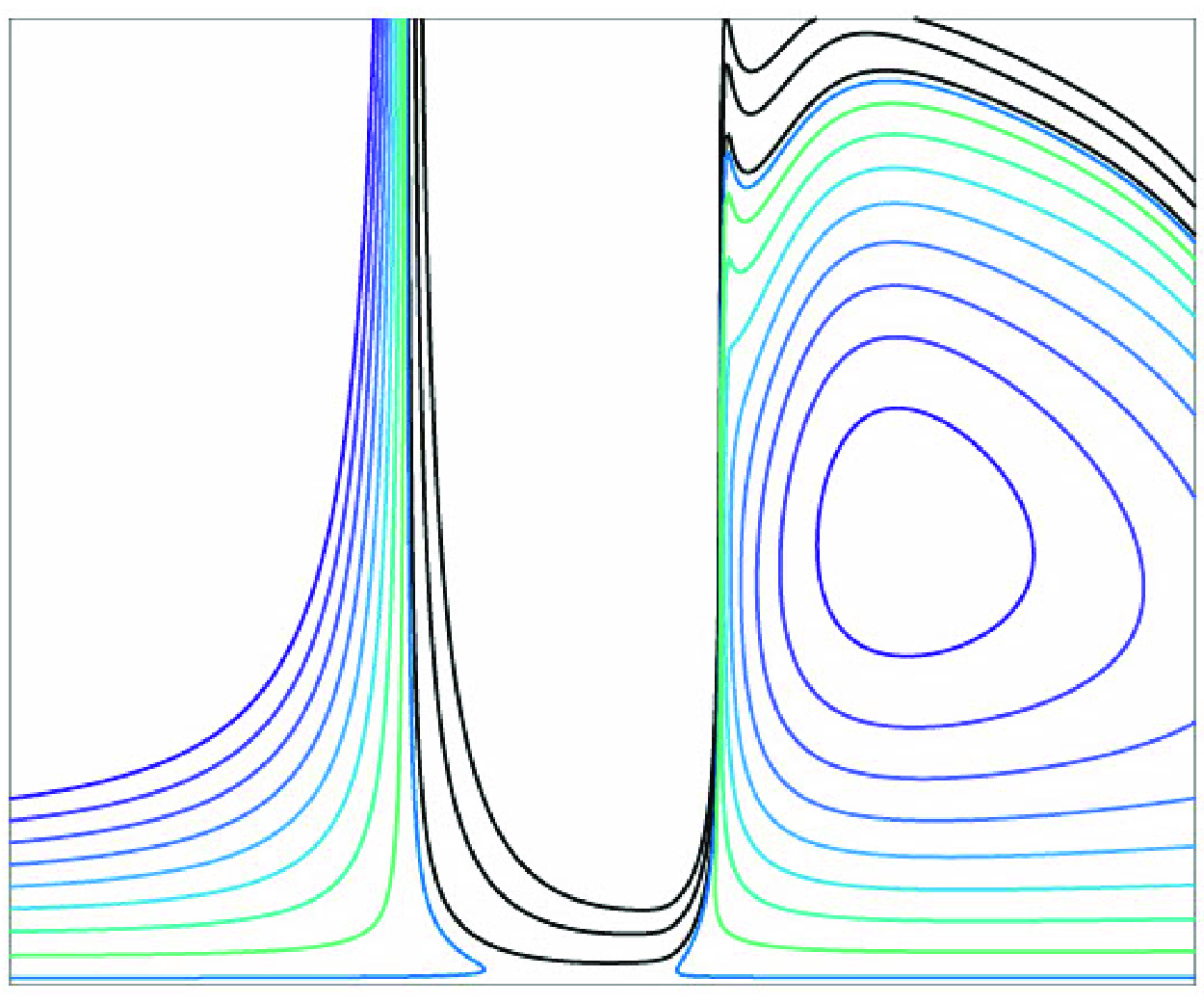
Singularity in the boundary layer on an upstream-sliding wall
-
- Journal:
- Journal of Fluid Mechanics / Volume 1011 / 25 May 2025
- Published online by Cambridge University Press:
- 21 May 2025, A49
-
- Article
-
- You have access
- Open access
- HTML
- Export citation
Energetic bounds on gyrokinetic instabilities. Part 5. Contrasting optimal and normal modes over the geometric landscape
-
- Journal:
- Journal of Plasma Physics / Volume 91 / Issue 3 / June 2025
- Published online by Cambridge University Press:
- 21 May 2025, E79
-
- Article
-
- You have access
- Open access
- HTML
- Export citation
On the convergence of bootstrap current to the Shaing–Callen limit in stellarators
- Part of
-
- Journal:
- Journal of Plasma Physics / Volume 91 / Issue 3 / June 2025
- Published online by Cambridge University Press:
- 20 May 2025, E77
-
- Article
-
- You have access
- Open access
- HTML
- Export citation
-
The bootstrap current in stellarators can be presented as a sum of a collisionless value given by the Shaing–Callen asymptotic formula and an off-set current, which non-trivially depends on plasma collisionality and radial electric field. Using NEO-2 modeling, analytical estimates and semi-analytical studies with the help of a propagator method, it is shown that the off-set current in the $1/\nu$ regime does not converge with decreasing collisionality $\nu _\ast$ but rather shows oscillations over $\log \nu _\ast$ with an amplitude of the order of the bootstrap current in an equivalent tokamak. The convergence to the Shaing–Callen limit appears in regimes with significant orbit precession, in particular, due to a finite radial electric field, where the off-set current decreases as $\nu _\ast ^{3/5}$. The off-set current strongly increases in case of nearly aligned magnetic field maxima on the field line where it diverges as $\nu _\ast ^{-1/2}$ in the $1/\nu$ regime and saturates due to the precession at a level exceeding the equivalent tokamak value by ${v_E^\ast }^{-1/2}$, where $v_E^\ast$ is the perpendicular Mach number. The latter off-set, however, can be minimized by further aligning the local magnetic field maxima and by fulfilling an extra integral condition of “equivalent ripples” for the magnetic field. A criterion for the accuracy of this alignment and of ripple equivalence is derived. In addition, the possibility of the bootstrap effect at the magnetic axis caused by the above off-set is also discussed.


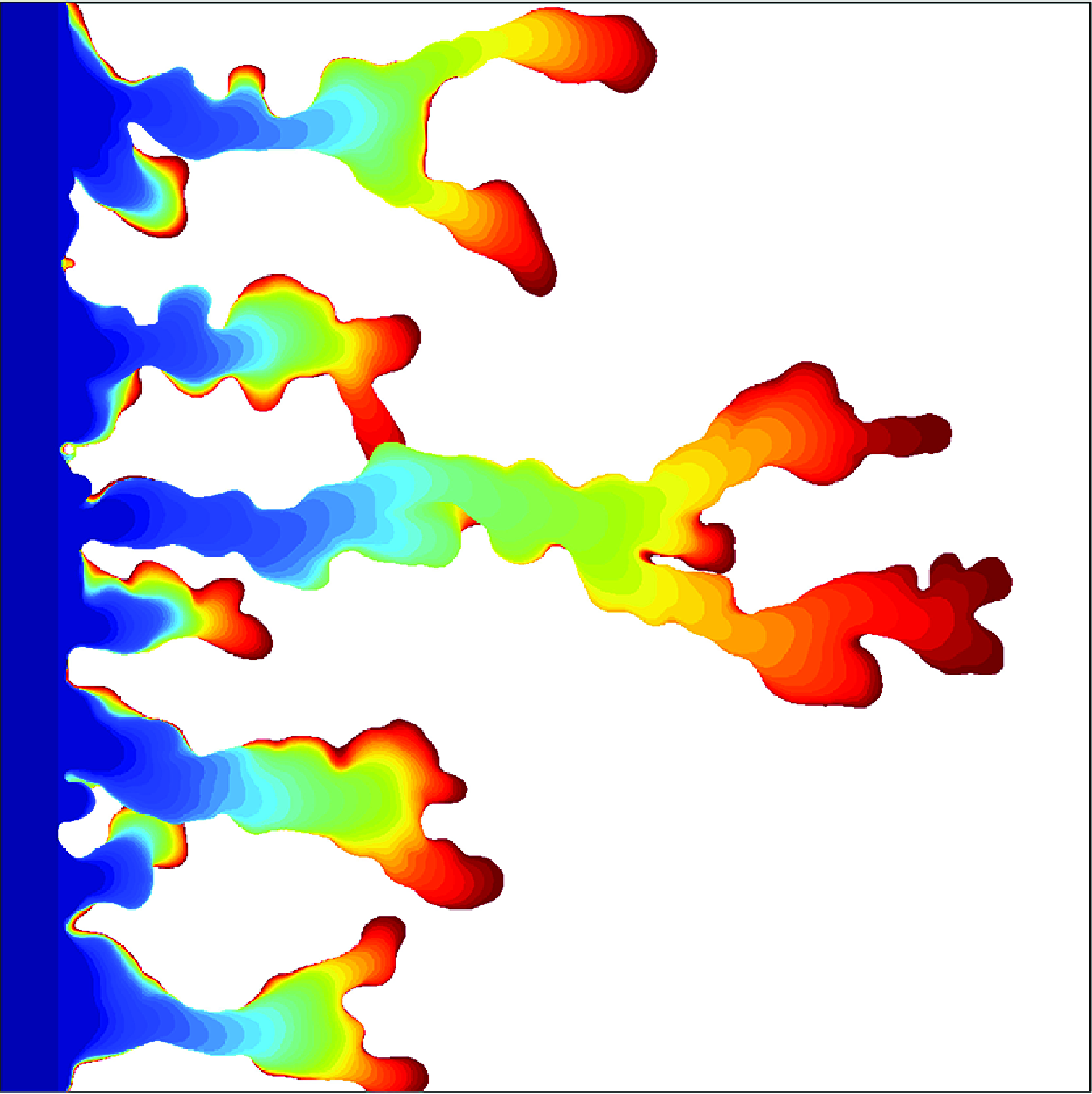
A two-dimensional depth-integrated model for immiscible two-phase flow in open rough fractures
-
- Journal:
- Journal of Fluid Mechanics / Volume 1011 / 25 May 2025
- Published online by Cambridge University Press:
- 20 May 2025, A43
-
- Article
-
- You have access
- Open access
- HTML
- Export citation
-
Immiscible two-phase flows in geological fractures are relevant to various industrial applications, including subsurface fluid storage and hydrocarbon exploitation. Direct numerical simulations (DNS) of first-principle equations, which resolve three-dimensional (3-D) fluid–fluid interfaces, can address all types of flow regimes but are computationally intensive. To retain most of their advantages while reducing the computational cost, we propose a novel two-dimensional (2-D) model based on integrating the 3-D first-principle equations over the local fracture aperture, assuming the lubrication approximation and a parabolic out-of-plane velocity profile, and relying on the volume-of-fluid method for fluid–fluid interface capturing. Such existing models have, so far, been restricted to single-phase permanent flow in rough fractures and two-phase flow in 2-D porous media. Wall friction and out-of-plane capillary pressure are incorporated as additional terms in the 2-D momentum equation. The model then relies on a geometric description reduced to the fracture’s aperture field and mean topography field. Implemented in OpenFOAM, it is validated against 3-D DNS results for viscous fingering in a Hele-Shaw cell, and applied to a realistic synthetic rough fracture geometry over a wide range of capillary numbers ( $Ca$). We then analyse to which extent, under which conditions and why this depth-integrated 2-D model, with a tenfold reduction in computational cost, provides convincing results compared with 3-D DNS predictions. We find that it performs surprisingly well over nearly the entire range of $Ca$ for which 3-D DNS models are relevant, in particular because it properly accounts for the out-of-plane capillary forces and wall friction.


On Thompson groups for Ważewski dendrites
- Part of
-
- Journal:
- Mathematical Proceedings of the Cambridge Philosophical Society / Volume 179 / Issue 1 / July 2025
- Published online by Cambridge University Press:
- 19 May 2025, pp. 189-231
- Print publication:
- July 2025
-
- Article
-
- You have access
- Open access
- HTML
- Export citation
-
We study a family of Thompson-like groups built as rearrangement groups of fractals introduced by Belk and Forrest in 2019, each acting on a Ważewski dendrite. Each of these is a finitely generated group that is dense in the full group of homeomorphisms of the dendrite (studied by Monod and Duchesne in 2019) and has infinite-index finitely generated simple commutator subgroup, with a single possible exception. More properties are discussed, including finite subgroups, the conjugacy problem, invariable generation and existence of free subgroups. We discuss many possible generalisations, among which we find the Airplane rearrangement group $T_A$. Despite close connections with Thompson’s group F, dendrite rearrangement groups seem to share many features with Thompson’s group V.


The influence of free-stream turbulence on the fluctuating loads experienced by a cylinder exposed to a turbulent cross-flow
-
- Journal:
- Journal of Fluid Mechanics / Volume 1011 / 25 May 2025
- Published online by Cambridge University Press:
- 19 May 2025, A47
-
- Article
-
- You have access
- Open access
- HTML
- Export citation
-
The impact of several ‘flavours’ of free-stream turbulence (FST) on the structural response of a cantilever cylinder, subjected to a turbulent cross-flow is investigated. At high enough Reynolds numbers, the cylinder generates a spectrally rich turbulent wake that contributes significantly to the experienced loads. The presence of FST introduces additional complexity through two primary mechanisms: directly, by imposing a fluctuating velocity field on the cylinder’s surface, and indirectly, by altering the vortex shedding dynamics, modifying the experienced loads. We employ concurrent temporally resolved particle image velocimetry and distributed strain measurements using Rayleigh backscattering fibre optic sensors to instrument the surrounding velocity field and the structural strain respectively. By using various turbulence-generating grids, and manipulating their distance to the cylinder, we assess a broad FST parameter space allowing us to explore individually the influence of the transverse integral length scale ( $\mathcal{L}_{13}/D$) and turbulence intensity of the FST on the developing load dynamics. The FST enhances the magnitude of the loads acting on the cylinder. This results from a decreased vortex formation length, increased coherence of regular vortex shedding, and energy associated with this flow structure in the near wake. The cylinder’s structural response is driven mainly by the vortex shedding dynamics, and its modification induced by the presence of FST, i.e. the indirect effect outweighs the direct effect. From the explored FST parameter space, turbulence intensity was seen to be the main driver of enhanced loading conditions, presenting a positive correlation with the fluctuating loads magnitude at the root.

Reduced modelling of scrape-off losses of runaway electrons during tokamak disruptions
-
- Journal:
- Journal of Plasma Physics / Volume 91 / Issue 3 / June 2025
- Published online by Cambridge University Press:
- 19 May 2025, E78
-
- Article
-
- You have access
- Open access
- HTML
- Export citation
-
Accurate modelling of runaway electron generation and losses during tokamak disruptions is crucial for the development of reactor-scale tokamak devices. In this paper, we present a reduced model for runaway electron losses due to flux surface scrape-off caused by the vertical motion of the plasma. The model is made compatible with computationally inexpensive one-dimensional models averaging over a fixed flux-surface geometry, by formulating it as a loss term outside an estimated time-varying minor radius of the last closed flux surface. We then implement this model in the disruption modelling tool DREAM and demonstrate its impact on selected scenarios relevant for ITER. Our results indicate that scrape-off losses may be crucial for making complete runaway avoidance possible even in a $15\,\rm MA$ DT H-mode ITER scenario. The results are however sensitive to the details of the runaway electron generation and phenomena affecting the current density profile, such as the current profile relaxation at the beginning of the disruption.

