To save content items to your account,
please confirm that you agree to abide by our usage policies.
If this is the first time you use this feature, you will be asked to authorise Cambridge Core to connect with your account.
Find out more about saving content to .
To save content items to your Kindle, first ensure no-reply@cambridge.org
is added to your Approved Personal Document E-mail List under your Personal Document Settings
on the Manage Your Content and Devices page of your Amazon account. Then enter the ‘name’ part
of your Kindle email address below.
Find out more about saving to your Kindle.
Note you can select to save to either the @free.kindle.com or @kindle.com variations.
‘@free.kindle.com’ emails are free but can only be saved to your device when it is connected to wi-fi.
‘@kindle.com’ emails can be delivered even when you are not connected to wi-fi, but note that service fees apply.
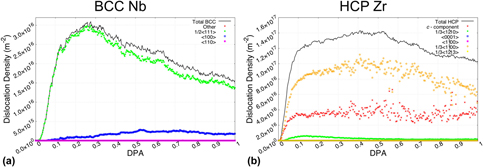
Irradiation resistance of metallic nanostructured multilayers is determined by the interactions between defects and phase boundaries. However, the dose-dependent interfacial morphology evolution can greatly change the nature of the defect–boundary interaction mechanisms over time. In the present study, we used atomistic models combined with a novel technique based on the accumulation of Frenkel pairs to simulate irradiation processes. We examined dose effects on defect evolutions near zirconium–niobium multilayer phase boundaries. Our simulations enabled us to categorize defect evolution mechanisms in bulk phases into progressing stages of dislocation accumulation, saturation, and coalescence. In the metallic multilayers, we observed a phase boundary absorption mechanism early on during irradiation, while at higher damage levels, the increased irradiation intermixing triggered a phase transformation in the Zr–Nb mixture. This physical phenomenon resulted in the emission of a large quantity of small immobile dislocation loops from the phase boundaries.
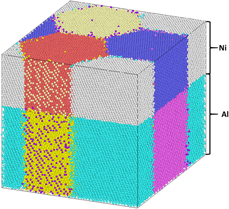
Reactions in Ni/Al nanolaminates exhibit high combustion temperatures and wave speeds that are customizable through changes to nanostructure. Nanolaminates fabricated via vapor deposition exhibit columnar grains with average diameters on the order of the individual layer thickness; yet, their role on nanolaminate combustion has not been previously investigated. The current work uses molecular dynamics simulations to elucidate the effect of grain size on reaction rates and combustion temperatures in Ni/Al nanolaminates. Decreasing grain size is shown to increase reaction rates as well as increase peak temperatures consistent with the excess enthalpy of smaller grain sizes. Additionally, grain boundaries provide heterogenous nucleation sites for the diffusion-restricting B2–NiAl phase. Focusing on Ni diffusion into liquid Al, an effective diffusion coefficient is computed as a function of grain size, which may be used in thermodynamic models for this stage of the reaction.
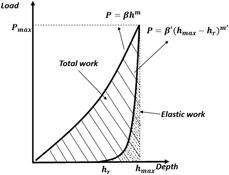
Concurrently assessing localized residual stresses and mechanical properties in cases where there are gradients in stresses and properties (such as those resulting in metallic alloys from shot peening processes) is challenging. Most indentation-based stress measurements assume uniform properties, which is not necessarily the case in this common industrial process. By using the energy envelope describing the total work of indentation by a load–displacement curve from instrumented indentation, localized residual stresses after shot peening were evaluated experimentally. A framework is developed to describe the appropriate indentation depth at which to assess properties that effectively define the volumetric resolution of the method. The residual stresses predicted via the nanoindentation experiment and energy analysis were validated with X-ray measurement of residual stresses on a shot-peened 52100 steel. The energy method can be applied directly from the indentation load–displacement curve without considering the contact area.
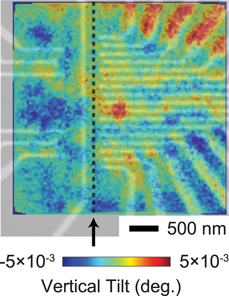
Increasing the number of quantum bits while preserving precise control of their quantum electronic properties is a significant challenge in materials design for the development of semiconductor quantum computing devices. Semiconductor heterostructures can host multiple quantum dots that are electrostatically defined by voltages applied to an array of metallic nanoelectrodes. The structural distortion of multiple-quantum-dot devices due to elastic stress associated with the electrodes has been difficult to predict because of the large micrometer-scale overall sizes of the devices, the complex spatial arrangement of the electrodes, and the sensitive dependence of the magnitude and spatial variation of the stress on processing conditions. Synchrotron X-ray nanobeam Bragg diffraction studies of a GaAs/AlGaAs heterostructure reveal the magnitude and nanoscale variation of these distortions. Investigations of individual linear electrodes reveal lattice tilts consistent with a 28-MPa compressive residual stress in the electrodes. The angular magnitude of the tilts varies by up to 20% over distances of less than 200 nm along the length of the electrodes, consistent with heterogeneity in the metal residual stress. A similar variation of the crystal tilt is observed in multiple-quantum-dot devices, due to a combination of the variation of the stress and the complex electrode arrangement. The heterogeneity in particular can lead to significant challenges in the scaling of multiple-quantum-dot devices due to differences between the charging energies of dots and uncertainty in the potential energy landscape. Alternatively, if incorporated in design, stress presents a new degree of freedom in device fabrication.
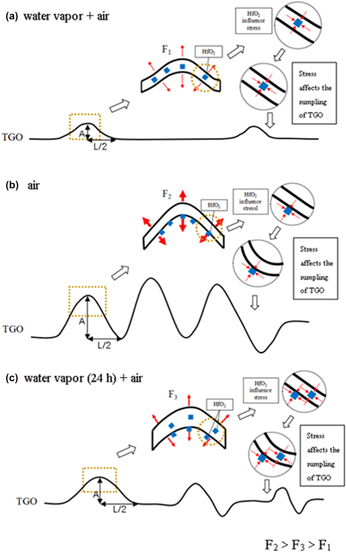
The cyclic oxidation experiment of yttria-stabilized zirconia coatings deposited on NiCoCrAlYHf alloys by air plasma spraying was investigated at 1050 °C in air and in air containing water vapor. The results revealed that water vapor has a great influence on the oxidation resistance of the thermal barrier coatings (TBCs). Compared with the samples oxidized in air atmosphere, TBCs oxidized in air containing water vapor had a longer lifetime. It was also found that different atmospheres could lead to different HfO2 formation positions, which could decrease the rumpling in the oxide layer. In particular, after the coatings on Hf-doped NiCoCrAlY were first pretreated in air containing water vapor for 24 h at 1050 °C, the lifetime of the pretreated coating was doubled compared to the coating in laboratory air only. The water vapor pretreatment of the coatings could be an important method for optimizing the lifetime of TBCs.
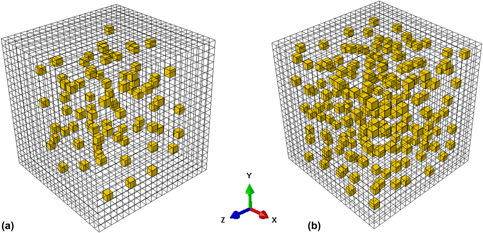
Nanodomained heterogenous structures characterized by randomly dispersed nanograins (NGs) embedded in the coarser grains (CGs) have demonstrated an exciting potential to break the strength–ductility trade-off, providing high strength without the loss of ductility. Here, using a combination of discrete crystal plasticity finite element (discrete-CPFE) model and dislocation density-based CPFE model, we study the effects of grain size, volume fraction of nanograins on the strength and deformation in nanodomained materials. Our analysis shows that the overall flow stresses of nanodomained samples are equal or higher than the strengths predicted by rule of mixtures. Smaller NGs or higher volume fraction of NGs can make the nanodomained samples stronger, as they can be more effective to promote the dislocation accumulations inside the CGs and eventually raise the critical resolved shear stress for each slip system during the plastic flow. Areas surrounding NGs stored higher dislocation densities and less plastic strain, due to the restricted dislocation motion. Furthermore, NGs grain embedded in the CGs can effectively reduce the anisotropy of strength in the nanodomained samples.
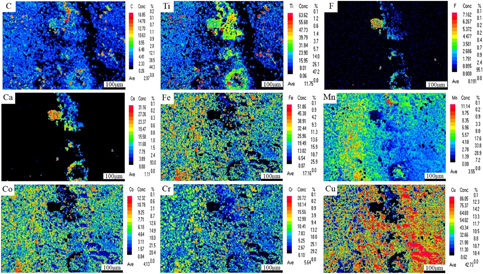
The FeMnCoCr high-entropy alloy/TiC/CaF2 self-lubricating coatings were successfully prepared on a Cu–Zr–Cr alloy for continuous casting mold by laser cladding for wear-resistance. The intriguing finding was that the laser-cladded FeMnCoCr is mainly composed of face-centered cubic and hexagonal close-packed solid solution phases. During the cladding process, the FeMnCoCr/TiC or the FeMnCoCr/TiC/CaF2 mixed sufficiently with Cu matrix, while FeMnCoCr exhibited a spherical shape owing to being insoluble in Cu. The average hardness of the FeMnCoCr/TiC/CaF2 self-lubricating high-entropy alloy (HEA) coatings was twice that of the pure FeMnCoCr HEA coating. By addition of TiC, the friction coefficient and wear rate were decreased from 0.35 and 3.68 × 10⁻¹⁵ mm3/m to 0.27 and 3.06 × 10⁻¹⁵ mm3/m, respectively. When CaF2 was added, the friction coefficients and wear rate were decreased to 0.16 and 2.16 × 10⁻¹⁵ mm3/m, respectively, which was 54% lower than the pure FeMnCoCr HEA coating. The main wear mechanism of the FeMnCoCr coating is abrasive wear while that of the FeMnCoCr/TiC coating is abrasive and adhesion wear. But adhesion wear is dominant for the FeMnCoCr/TiC/CaF2 coating.
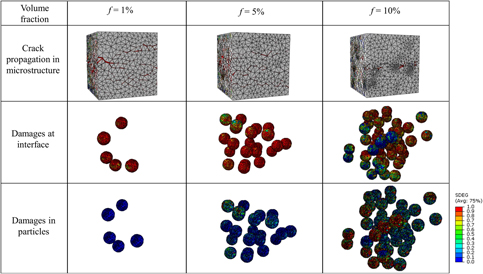
Metal matrix composites (MMCs) have great potential to replace monolithic metals in many engineering applications due to their enhanced properties, such as higher strength and stiffness, higher operating temperature, and better wear resistance. Despite their attractive mechanical properties, the application of MMCs has been limited primarily due to their high cost and relative low fracture toughness and reliability. Microstructure determines material fracture toughness through activation of different failure mechanisms. In this paper, a 3D multiscale modeling technique is introduced to resolve different failure mechanisms in MMCs. This approach includes 3D microstructure generation, meshing, and cohesive finite element method based failure analysis. Calculations carried out here concern Al/SiC MMCs and focus on primary fracture mechanisms which are correlated with microstructure characteristics, constituent properties, and deformation behaviors. Simulation results indicate that interface debonding not only creates tortuous crack paths via crack deflection and coalescence of microcracks but also leads to more pronounced plastic deformation, which largely contributes to the toughening of composite materials. Promotion of interface debonding through microstructure design can effectively improve the fracture toughness of MMCs.
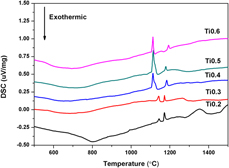
CrFeNiTix (x = 0.2, 0.3, 0.4, 0.5, and 0.6 molar ratio) compositionally complex alloys were fabricated by vacuum arc melting to investigate the microstructure, hardness, and compressive properties. The results revealed that CrFeNiTix alloys consisted of the principal face-centered cubic (FCC) phase and body-centered cubic (BCC) solid solution, with an amount of (Ni, Ti)-rich hexagonal close-packed phase. CrFeNiTix alloys exhibited the typical dendrite. Ti0.2 and Ti0.3 alloys were composed of FCC and BCC solid solutions in the dendrite, as well as ε (Ni3Ti) and R (Ni2.67Ti1.33) phases in the inter-dendrite, simultaneously. For Ti0.4, Ti0.5, and Ti0.6 alloys, (Fe, Cr)-rich solid solution separated out and ε phase transformed into R phase gradually. Meanwhile, TEM analysis indicated that Ti0.4 alloy matrix consisted of the principal FCC phase containing (Ni, Ti)-rich intragranular nanoprecipitates. The hardness values of CrFeNiTix alloys were increased with the addition of Ti content and the high compressive strength of CrFeNiTix alloys was maintained, which was attributed to the solid solution strengthening and precipitation hardening.
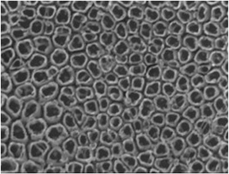
Surface properties of titanium implants are key factors for rapid and stable bone tissue integration. So, in order to promote the osseointegration of implants, various surface treatments have been proposed. The objective of these surface treatments is to improve protein adsorption, cell adhesion and differentiation, and consequently, the tissue integration of titanium implants. In this paper, we propose to describe and compare the different strategies available in the literature to produce micro- and nanostructured surfaces on titanium, especially the recent results using electrochemical anodization. Anodization is a cost-effective process that produces nanostructures based on the electrolytic growth of columnar titanium oxide layers. By mastering the electrolyte composition and voltage, a regular array of pores with controlled diameters ranging from 15 to 200 nm are easily produced. Then we will present the latest results on the osteointegration of the surface composed anodized titania nanotubes.
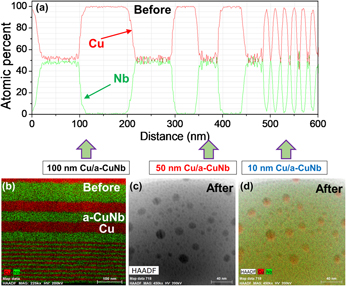
Nanocrystalline and nanolaminated materials show enhanced radiation tolerance compared with their coarse-grained counterparts, since grain boundaries and layer interfaces act as effective defect sinks. Although the effects of layer interface and layer thickness on radiation tolerance of crystalline nanolaminates have been systematically studied, radiation response of crystalline/amorphous nanolaminates is rarely investigated. In this study, we show that irradiation can lead to formation of nanocrystals and nanotwins in amorphous CuNb layers in Cu/amorphous-CuNb nanolaminates. Substantial element segregation is observed in amorphous CuNb layers after irradiation. In Cu layers, both stationary and migrating grain boundaries effectively interact with defects. Furthermore, there is a clear size effect on irradiation-induced crystallization and grain coarsening. In situ studies also show that crystalline/amorphous interfaces can effectively absorb defects without drastic microstructural change, and defect absorption by grain boundary and crystalline/amorphous interface is compared and discussed. Our results show that tailoring layer thickness can enhance radiation tolerance of crystalline/amorphous nanolaminates and can provide insights for constructing crystalline/amorphous nanolaminates under radiation environment.
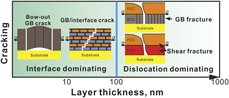
Fatigue performance of metallic nanolayered composites (NLCs) has been gaining more and more attention due to the rapid development in the field of both micro-electro-mechanical systems and high-performance engineering structure materials and the increasing demand for long-term fatigue reliability. Metallic NLCs have exhibited different damage behaviors due to the effect of high-density heterogeneous interface compared with bulk materials and thin metal films. In this review paper, the cyclic deformation damage behavior, fatigue cracking feature, and fatigue properties of some metallic NLCs are reviewed. Effects of length scales, including layer thickness and grain size, on fatigue damage behaviors of the NLCs are revealed, and the transition of the fatigue cracking behavior and the corresponding damage mechanism are discussed. Then, the fatigue properties of some typical metallic NLCs are presented and compared with that of bulk materials and metal thin films. The effect of interface type and grain boundary alignment is also discussed to correlate with fatigue cracking resistance of the NLCs. Finally, some prospective research topics on fatigue performance of metallic NLCs are addressed.
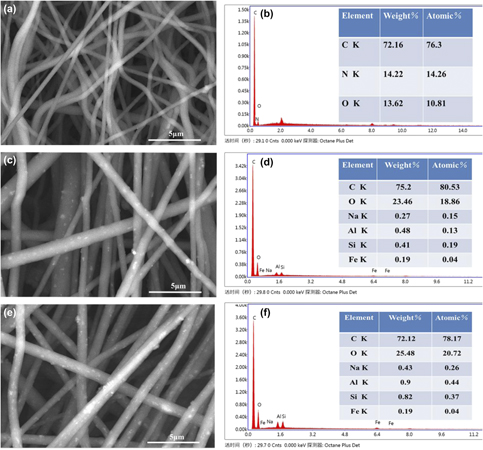
As distinctive spontaneous polarization and far-infrared radiation characteristics, the natural mineral tourmaline (TM) has the regulatory effect on crystallization behavior, which possesses potential application in biomimetic mineralization and bone regeneration. In this study, polyurethane (PU) and gelatin (GE) membranes with different adding proportion of TM nanoparticles were prepared via electrospinning. Additionally, the effect of TM nanoparticles on the mineralization process of hydrophobic PU and hydrophilic GE was investigated by immersing the composite TM/PU and TM/GE electrospun membranes in the 10× simulated body fluid (10SBF) at 37 °C for varying periods of time. SEM images confirmed the well-dispersed TM nanoparticles in the PU and GE electrospun fibers. The mineralization deposition was characterized by the SEM, EDS, XRD, and FTIR, and it indicated that two types of calcium phosphate deposits with different Ca/P molar ratios were obtained when TM/PU membranes and TM/GE membranes were incubated in 10SBF. Honeycomb-like hydroxyapatite crystals nucleated and grew faster on TM/PU and TM/GE membranes than the pure PU and GE membranes, respectively. Furthermore, with the increase of the added TM nanoparticles in the composite membranes, more calcium phosphate crystals were precipitated. These results showed that the added TM nanoparticles were able to improve the mineralization of polymer fibrous membranes, which is potential for the composite bone scaffold.
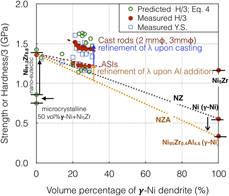
The effect of cooling rate on the microstructure evolution and the mechanical properties of ingots and rods of 2–5 mm diameter of (Ni0.92Zr0.08)100−xAlx (0 ≤ x ≤ 4 at.%) ultrafine eutectic composites have been investigated. The microstructure of the composites is comprised of micrometer size γ-Ni dendrites embedded in a nano/-ultrafine lamellar fcc γ-Ni and Ni5Zr matrix. The evolution of the microstructure at a wide range of cooling rates (10–104 K/s) has been analyzed in respect of volume fraction of the phases, lamellar spacing, and secondary dendritic arm spacing. All these composites exhibit high hardness up to 4.6 GPa and yield strength up to 1.6 GPa with large compressive plasticity up to 22% at room temperature. The effect of cooling rates on the strength and hardness, and the plasticity of the nanolamellar composites with wide range of alloy composition have been correlated.
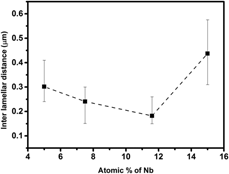
In the design of high-entropy alloys (HEAs) with desired properties, identifying the effects of elements plays an important role. HEAs with eutectic microstructure can be obtained by judiciously modifying the alloy compositions. In this study, the effect of Nb addition to FeCoNiCuNbx (x = 0.5, 5, 7.5, 11.6, 15) alloys was studied by varying the Nb concentration (at.%). FeCoNiCuNb0.5 HEA shows liquid phase separation to form Cu-rich and FeCoNiCu-rich phases. Detailed solidification paths are proposed for these alloys, which show eutectic, peritectic, and pseudo quasi-peritectic reactions. Increasing Nb content promotes the liquid phase separation tendency and causes the formation of Cu-rich spheres. The effect of Nb on the FeCoNiCu-rich phase was studied based on the nanoindentation and correlated with nanohardness. The compressive deformation properties of these alloys are studied at room temperature and high temperature and correlated with microstructure. Fractography results show the mode of fracture and are correlated with the microstructure obtained.
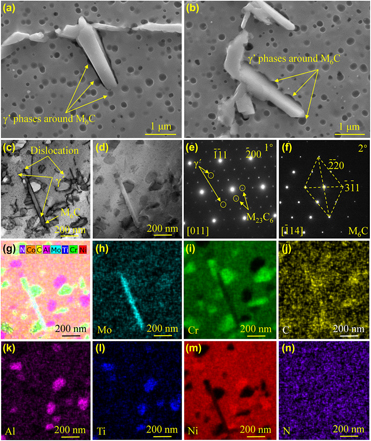
Coarsening mechanism of precipitations was investigated in a weld metal of Alloy 617 during long-term aging at 750 °C, and its effect on impact toughness was clarified distinctly. The needle-like M6C phases at the grain boundary nucleated and coarsened at 2000 h and then presented a stable size with aging to 8000 h. Spherical γ′ phase grew rapidly with the rate of 0.0121 nm/h when aged at 1000 h; then, its ripening rate (RR) reduced to 0.0033 nm/h at 8000 h and stabilized around it. The coarsening of M6C and γ′ was, respectively, controlled by interface diffusion and volume diffusion with the coarsening rate constant of 7.865 × 10⁻²⁰ m2/s and 1.519 × 10⁻²⁷ m3/s. Interaction of M6C and γ′ could facilitate their coarsening and cause dramatic decrease in toughness at the early stage. At aging to 8000 h and more, the lower RR of needle-like M6C phases and γ′ phases helped to form stable toughness at a later stage.
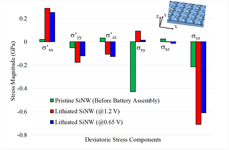
Silicon is a promising material for lithium-ion batteries. However, it expands by 300% on lithiation, leading to fracture. Nanostructuring of silicon is expected to be a promising method to improve the mechanical strength of the silicon electrodes. In the present work, a unique battery test cell was designed and fabricated to study the in situ stress evolution in the silicon nanowire (SiNW) electrode during electrochemical lithiation using synchrotron X-ray microdiffraction. The stress in the SiNWs at pristine state and during lithiation was evaluated using energy scans. The average stress in the pristine nanowires was found to be ∼40 MPa tensile, which changed to ∼325 MPa compressive on lithiation. Further, the deviatoric stress state in the SiNWs during lithiation was evaluated using Laue diffraction and the lithiated nanowires were found to be in triaxial stress state with high shear stresses. The technique and the findings provide new and more in-depth understanding of the stress evolution in the SiNWs during electrochemical lithiation.
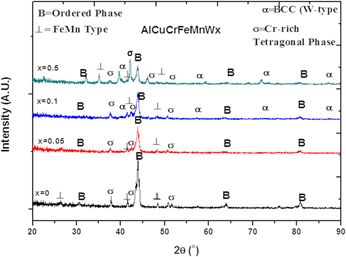
A novel series of nanocrystalline AlCuCrFeMnWx (x = 0, 0.05, 0.1, 0.5) high-entropy alloys (HEAs) were synthesized by mechanical alloying followed by spark plasma sintering. The phase evolution of the current HEAs was studied using X-ray diffraction (XRD), transmission electron microscopy, and selected area electron diffraction. The XRD of the AlCuCrFeMn sintered HEA shows evolution of ordered B2 phase (AlFe type), sigma phase (Cr rich), and FeMn phase. AlCuCrFeMnWx (x = 0.05, 0.1, 0.5 mol) shows formation of ordered B2 phases, sigma phases, FeMn phases, and BCC phases. Micro-hardness of the AlCuCrFeMnWx samples was measured by Vickers microindentation and the maximum value observed is 780 ± 12 HV. As the tungsten content increases, the fracture strength under compression increases from 1010 to 1510 MPa. Thermodynamic parameters of present alloys confirm the crystalline phase formation, and finally structure–property relationship was proposed by conventional strengthening mechanisms.