To save content items to your account,
please confirm that you agree to abide by our usage policies.
If this is the first time you use this feature, you will be asked to authorise Cambridge Core to connect with your account.
Find out more about saving content to .
To save content items to your Kindle, first ensure no-reply@cambridge.org
is added to your Approved Personal Document E-mail List under your Personal Document Settings
on the Manage Your Content and Devices page of your Amazon account. Then enter the ‘name’ part
of your Kindle email address below.
Find out more about saving to your Kindle.
Note you can select to save to either the @free.kindle.com or @kindle.com variations.
‘@free.kindle.com’ emails are free but can only be saved to your device when it is connected to wi-fi.
‘@kindle.com’ emails can be delivered even when you are not connected to wi-fi, but note that service fees apply.
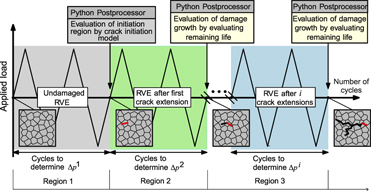
In the scope of this work, a micromechanical model based on the crystal plasticity finite element method is proposed and applied to describe the nucleation and growth of microstructurally short fatigue cracks in polycrystalline materials under cyclic loads. The microstructure is generated in the form of a representative volume element of a polycrystalline material with equiaxed grains having columnar structure along thickness and random crystallographic texture. With this model, we investigate the influence of loading amplitude on the crack growth behavior. It is shown that for smaller strain amplitudes, a single crack nucleates and propagates, while for larger strain amplitudes several independent crack nucleation sites form, from which microcracks start propagating. It is also observed that the global plastic strain amplitude decreases from the initial to the final cycle, during total strain-controlled loading. However, this can even increase the crack growth rate because the crack advance is governed by the local plastic slip which accumulates at the crack tip over the number of cycles. With this work, it is shown that micromechanical modeling can strongly improve our understanding of the mechanisms of short-crack nucleation and growth under fatigue loading.
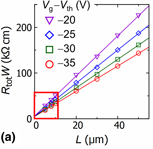
A crucial target in the printed electronics technologies is to realize all-printed thin-film transistors (TFTs), as being applicable to the industry. Here, the authors report printed polymer TFTs through the integration of the SuPR-NaP technique, a promising way for manufacturing ultrafine printed silver electrodes, with printed polymer semiconductor layers. The authors used a class of donor–acceptor-type copolymer, PDVT-10, and found that the devices exhibit excellent TFT characteristics. The devices allow the transfer length method measurements with high accuracy, where the estimated contact resistance is considerably small (4.7 kΩ cm) among the bottom-contact TFTs using printed silver electrodes, with also showing short-channel effects.
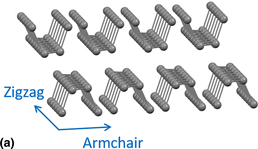
Herein, the authors report our pioneering demonstration of the anisotropic thermal properties of black phosphorus (BP) nanoflakes. The nanoflakes were produced using a scotch tape-based mechanical exfoliation technique. Their thickness was characterized using Atomic Force Microscopy The anisotropic direction of the nanoflakes was determined by the Raman Spectroscopy equipped with a polarized laser. Then, a temperature-dependent Raman spectroscopy method was utilized to study the thermal transport properties of the BP nanoflakes. The results indicated that the thermal conductivities of zigzag BP and armchair nanoflakes are 30.6 and 12.6 W/m·K, respectively. This fundamental thermal study gives insight into the future fabrication of nanoscale electronic devices with thermal properties that can be well controlled.
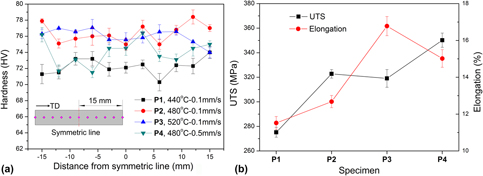
Hot extrusion experiments were conducted on Al–5.50Zn–2.35Mg–1.36Cu (wt%) alloy under various temperatures and extrusion speeds. Results indicated that dynamic recovery occurred at low temperature and then dynamic recrystallization was triggered at higher temperature or speed. High billet temperature reduced the grain size and increased the volume fraction of Al23CuFe4 and AlMgZn. When the extrusion speed was enhanced to 0.5 mm/s, the peak of MgZn2 phase diminished in the results of X-ray diffraction. The strong brass and S components appeared in all the extruded specimens. Texture intensity gradually decreased with increasing temperature and the fraction of texture components was also significantly affected by the extrusion parameters. The extruded alloy exhibited the highest ultimate tensile strength of 350.2 MPa at 480 °C and 0.5 mm/s and the best elongation of 16.78% at 520 °C and 0.1 mm/s. Moreover, the extrusion speed had more significant effects on the tensile properties than that of the temperature.
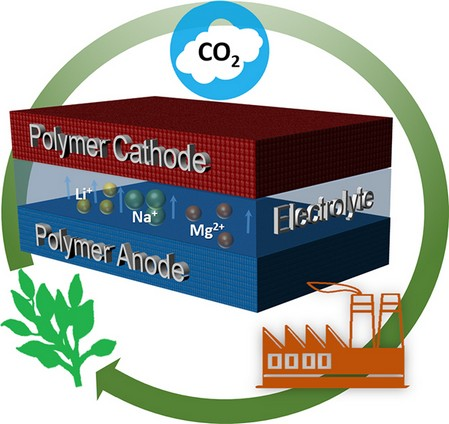
Polymer redox-active materials (redoxmers) have numerous applications in the emerging electrochemical energy storage systems due to their structural versatility, fast-cycling ability, high theoretical capacity as electrode materials, sustainability, and recyclability. This review examines recent developments in improving the cycling performance of such materials and provides a vista on the future research directions.
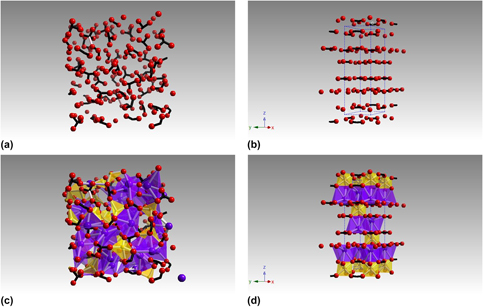
Carbonate glasses can be formed routinely in the system K2CO3–MgCO3. The enthalpy of formation for one such 0.55K2CO3–0.45MgCO3 glass was determined at 298 K to be 115.00 ± 1.21 kJ/mol by drop solution calorimetry in molten sodium molybdate (3Na2O·MoO3) at 975 K. The corresponding heat of formation from oxides at 298 K was −261.12 ± 3.02 kJ/mol. This ternary glass is shown to be slightly metastable with respect to binary crystalline components (K2CO3 and MgCO3) and may be further stabilized by entropy terms arising from cation disorder and carbonate group distortions. This high degree of disorder is confirmed by 13C MAS NMR measurement of the average chemical shift tensor values, which show asymmetry of the carbonate anion to be significantly larger than previously reported values. Molecular dynamics simulations show that the structure of this carbonate glass reflects the strong interaction between the oxygen atoms in distorted carbonate anions and potassium cations.
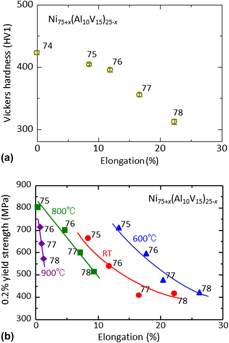
The effect of off-stoichiometry on the microstructures and tensile properties of Ni3Al–Ni3V pseudo-binary alloys was investigated by a scanning electron microscope, a transmission electron microscope, Vickers hardness test, and high-temperature tensile test. As the alloy deviates from a just-stoichiometric composition toward Ni-rich one, the microstructures constituted by two ordered phases, Ni3Al and Ni3V changed to those constituted by two ordered phases, Ni3Al and Ni3V, and one disordered phase, Ni solid solution. Also, the deviation from the stoichiometric composition resulted in a decrease in flow strength as well as Vickers hardness and conversely increase in tensile elongation. Higher tensile elongation in the off-stoichiometric alloys was induced by the transition from intergranular fracturing to transgranular fracturing. The trade-off relation in the yield strength (or hardness) versus tensile elongation curve, which was drawn plotting the data obtained from the alloys with different off-stoichiometric compositions, was most excellent at 600 °C but rapidly became worse at high temperatures beyond 600 °C. It was demonstrated that the deviation to the off-stoichiometric composition in the two-phase Ni3Al–Ni3V pseudo-binary alloy system was a useful alloying parameter to improve the balance of the flow strength and tensile ductility.
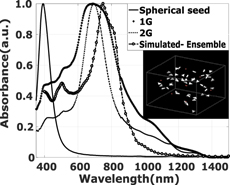
Bottom-up assembly of nanomaterials using solution-processed methods is ideally suited for use in fabrication of large-area optoelectronic devices. Tailorable visible and near-infrared absorption in shaped nanostructured noble metals is strongly influenced by localized plasmon resonance effects. Obtaining sharp and selective absorption with solution-processed methods is a challenge and requires suitable control on the growth kinetics, which ultimately results in appropriate size and morphology of the final product. In this work, a photo-assisted multigenerational growth process for synthesis of silver nanotriangle ink with narrow linewidth absorbance is developed. This technique combines photochemical and seed-mediated growth approaches. The resulting ink exhibits a sharp absorption at 700 nm with full width at half maximum of ∼170 nm, verified by absorption as well as dynamic light scattering, transmission electron microscopy, and field emission scanning electron microscopy measurements. Numerical modeling using finite-difference time-domain calculations yields a close match with observed absorption and is used to examine electric field distribution and enhancement factor resonating at 720 nm. The synthesis technique is potentially useable for production of highly selective absorbers in solution phase.
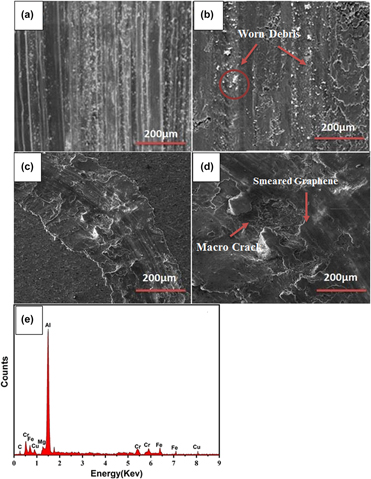
In the present work, mechanical, tribological, and electrochemical behaviors of Al Alloy 6061–(0–10) % B4C–(0.25–1.2) % graphene nanoplatelets (GNPs) composites, prepared by a combination of solution mixing and powder metallurgy, were investigated. Properties such as hardness, compressive strength, wear rates, and coefficient of friction (COF) were used to investigate the effects of GNPs on mechanical and self-lubricating tribological behavior. The corrosion resistance of composites was investigated using potentiodynamic polarization and electrochemical impedance techniques. Scanning electron microscopy, energy-dispersive X-ray spectroscopy (EDS), and EDS mapping were employed to study the distribution, the fracture profile, and wear mechanism. The AA 6061–10% B4C–0.6% GNPs composites exhibited sharp increase in hardness and compressive strength and significant decrease in wear rates and COF. However, for GNPs contents exceeding over 0.6 wt%, mechanical properties and wear performances deteriorated. Pulling out of sheared pultruded GNPs was observed during the fracture of composites. Worn surfaces of GNPs-containing composites showed the smeared graphene layer with some macro-cracks exhibiting delamination wear. It was found that the corrosion inhibition efficiency of GNPs was more pronounced in H3BO3 environment than in NaCl solution.
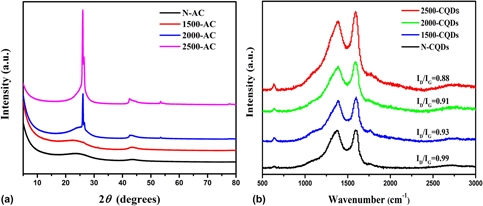
The microstructure of carbon quantum dots (CQDs) has a great influence on their fluorescence properties. Here, different microstructures of CQDs were synthesized by the selective oxidation of graphitized activated carbon using HNO3/HClO4 as the oxidant. We characterized the microstructure and surface chemistry of the CQDs, and the results show that the degree of graphitization of activated carbon has a significant effect on the structure and fluorescence properties of the obtained CQDs. The fluorescence of the CQD solution can be tuned from yellow to green by regulating the degree of graphitization of the activated carbon by heat treatment at high temperature (up to 2500 °C). Moreover, the increased degree of graphitization of the raw carbon precursor is beneficial for significantly reducing the fluorescence self-absorption quenching of the concentrated CQD solution. Importantly, the as-prepared CQDs have no cytotoxicity and can be used as bioimaging agents.
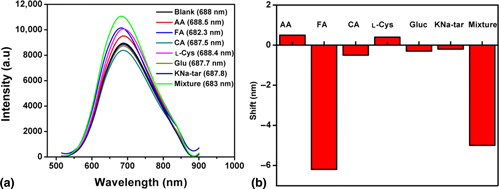
We herein report the detection of folic acid (FA) via the fluorometric method using water-soluble AgInS2 quantum dots (QDs). The optical analysis showed that the addition of FA to AgInS2 QDs results in significant, blue-shifted photoluminescence emission. A linear plot of the blueshift in the photoluminescence wavelength position against FA concentration was obtained in the range of 0.03–33 µM with the detection limit of 52 nM. Interference study showed the selective detection of FA in the presence of other biomolecules. The as-synthesized AgInS2 QDs can be employed as an optical sensor for the rapid detection of FA in aqueous solutions.
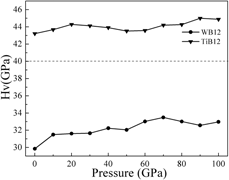
We apply the first-principles calculations to investigate the structure, mechanical, and thermodynamic properties of WB12 and TiB12 under high pressure (0–100 GPa). The calculated results show that WB12 and TiB12 are thermodynamically stable at the 0 GPa or high pressure. WB12 is more thermodynamically stable than TiB12. In particular, the calculated Vickers hardness of WB12 and TiB12 at the ground state is 29.9 GPa and 43.2 GPa, respectively, indicating that TiB12 is a potential superhard material. With increasing pressure, the calculated elastic modulus of WB12 and TiB12 increases gradually. The calculated electronic structure shows that the high Vickers hardness and elastic properties of WB12 and TiB12 derive from the 3D network B–B covalent bonds. In addition, the calculated Debye temperature at the ground state is 927 K for WB12 and 1339 K for TiB12, respectively. With increasing pressure, the calculated Debye temperature of WB12 and TiB12 increases gradually. Our work shows that TiB12 not only exhibits high hardness but also shows better thermodynamic properties in comparison with WB12.
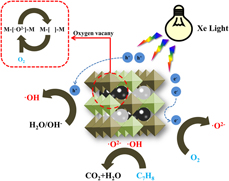
A series of double-perovskite LaAMnNiO6 (A = La, Pr, Sm) catalysts with mesoporous morphology was prepared by a sol–gel method and further applied into photothermal synergistic degradation of gaseous toluene. Transmission electron microscopy and Brunauer–Emmett–Teller characterizations confirmed that double-perovskite LaAMnNiO6 (A = La, Pr, Sm) had obvious mesoporous structure, which can provide a larger specific surface area and further enhancing the reactivity of catalyst. UV-vis and X-ray photoelectron spectroscopy characterization illustrated that LaSmMnNiO6 possessed higher adsorption oxygen content and light absorption capacity, which contribute to the occurrence of catalytic oxidation in the Mars–van Krevelen redox cycle mechanism. A group of active tests showed that the double-perovskite LaSmMnNiO6 catalyst had a lower reaction initiation temperature (starting reaction at 75 °C) and a lower activity temperature of optimal reaction (more than 90% at 255 °C). Moreover, the research on reaction kinetics of the catalyst demonstrated that LaAMnNiO6 (A = La, Pr, Sm) had lower activation energy and thus exhibited better catalytic activity. The results of the study indicate that the double-perovskite LaAMnNiO6 (A = La, Pr, Sm) has broad application prospects in the field of volatile organic pollutant degradation.
In this study, an injectable bone substitute (IBS) was produced by mixing a liquid and powder phase. The liquid phase consisted of 8 wt% methylcellulose (MC), 2.5% gelatin, and different amounts of graphene oxide (GO). The powder phase was composed of tetracalcium phosphate (TTCP), dicalcium phosphate dihydrate (DCPD), and calcium sulfate dihydrate (CSD). The results showed that 1 and 1.5 wt% GO added IBS samples showed higher stability, injectability, rheological properties, and biocompatibility than the other GO added IBS samples. GO addition significantly decreased the setting time, but it did not significantly affect the compressive strength of the samples.