Refine search
Actions for selected content:
212269 results in Engineering

On rotor noise interference
-
- Journal:
- Journal of Fluid Mechanics / Volume 1013 / 25 June 2025
- Published online by Cambridge University Press:
- 23 June 2025, A43
-
- Article
- Export citation
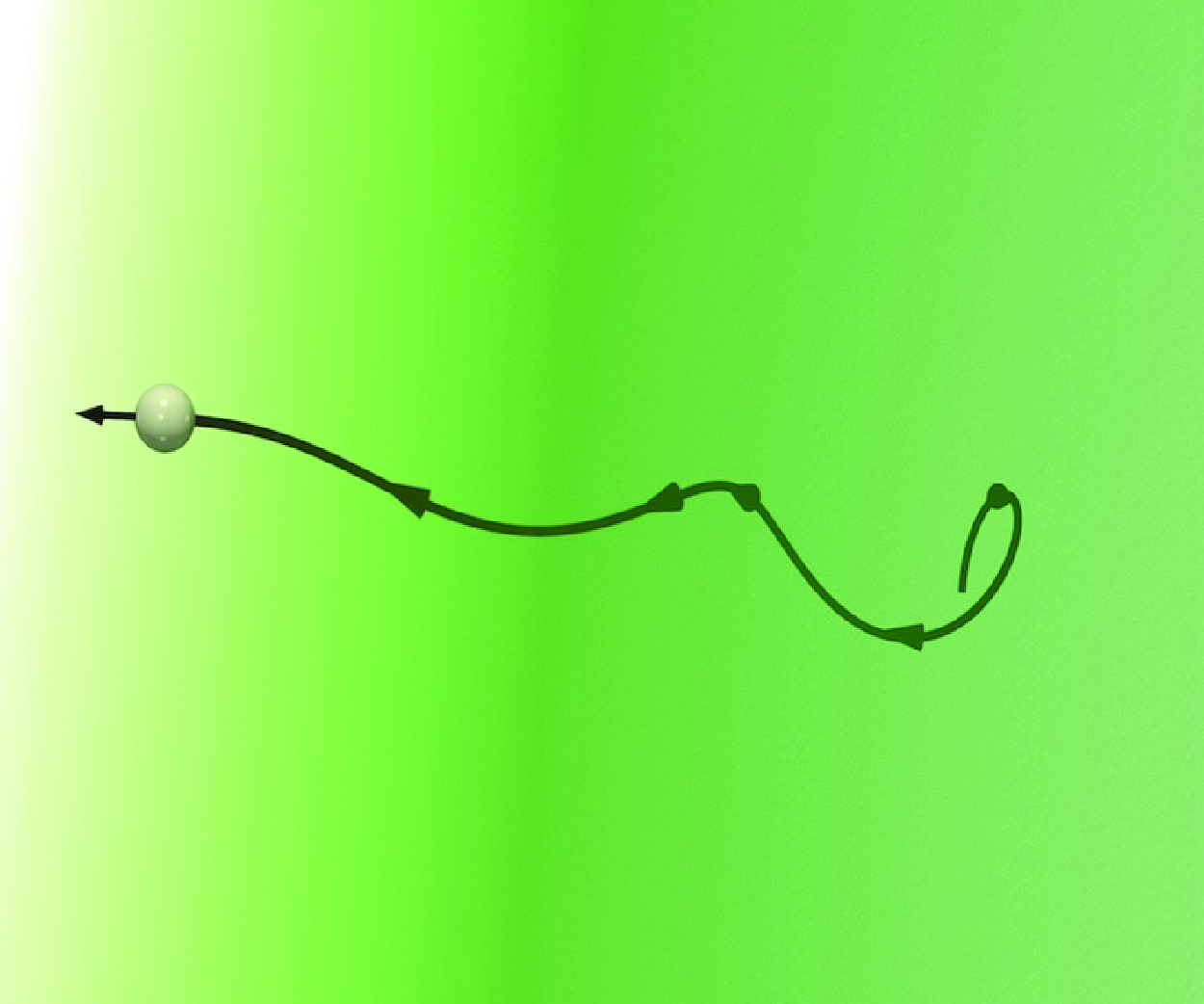
Viscotaxis of chiral microswimmer in viscosity gradients
-
- Journal:
- Journal of Fluid Mechanics / Volume 1013 / 25 June 2025
- Published online by Cambridge University Press:
- 23 June 2025, A42
-
- Article
- Export citation
Standardless quantification of crystalline polymorphic mixtures using the component decomposition method
-
- Journal:
- Powder Diffraction / Volume 40 / Issue 3 / September 2025
- Published online by Cambridge University Press:
- 20 June 2025, pp. 210-214
-
- Article
- Export citation
Optical tuning of vertical-cavity surface-emitting laser side-pumped neodymium-doped yttrium aluminum garnet laser cavity
-
- Journal:
- High Power Laser Science and Engineering / Volume 13 / 2025
- Published online by Cambridge University Press:
- 20 June 2025, e61
-
- Article
-
- You have access
- Open access
- HTML
- Export citation
Efficient output power configuration in a K-band power amplifier using a split-gate layout
-
- Journal:
- International Journal of Microwave and Wireless Technologies , First View
- Published online by Cambridge University Press:
- 20 June 2025, pp. 1-10
-
- Article
-
- You have access
- Open access
- HTML
- Export citation
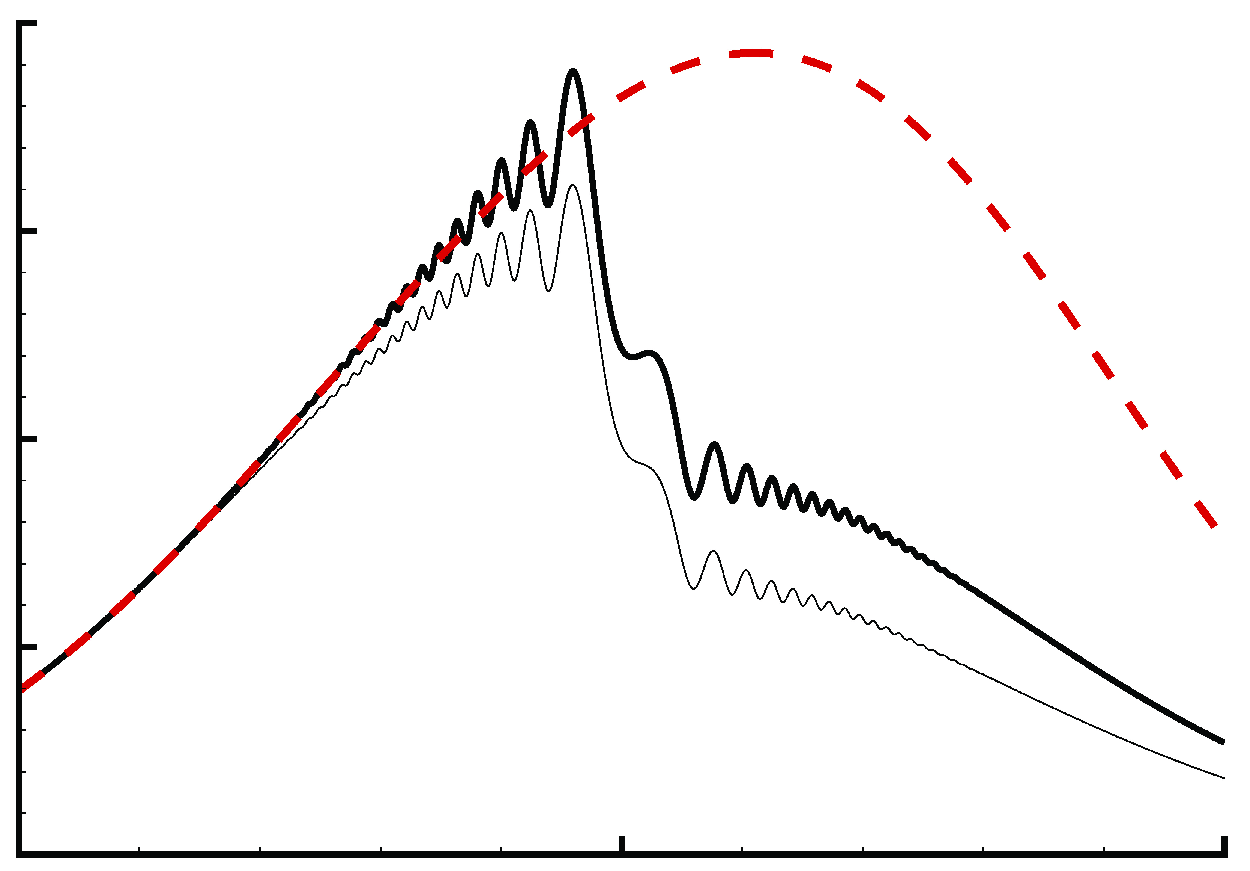
Nonlinear evolution of radiating modes in the presence of sound waves impinging on a supersonic boundary layer: subharmonic resonance
-
- Journal:
- Journal of Fluid Mechanics / Volume 1013 / 25 June 2025
- Published online by Cambridge University Press:
- 20 June 2025, A29
-
- Article
-
- You have access
- Open access
- HTML
- Export citation
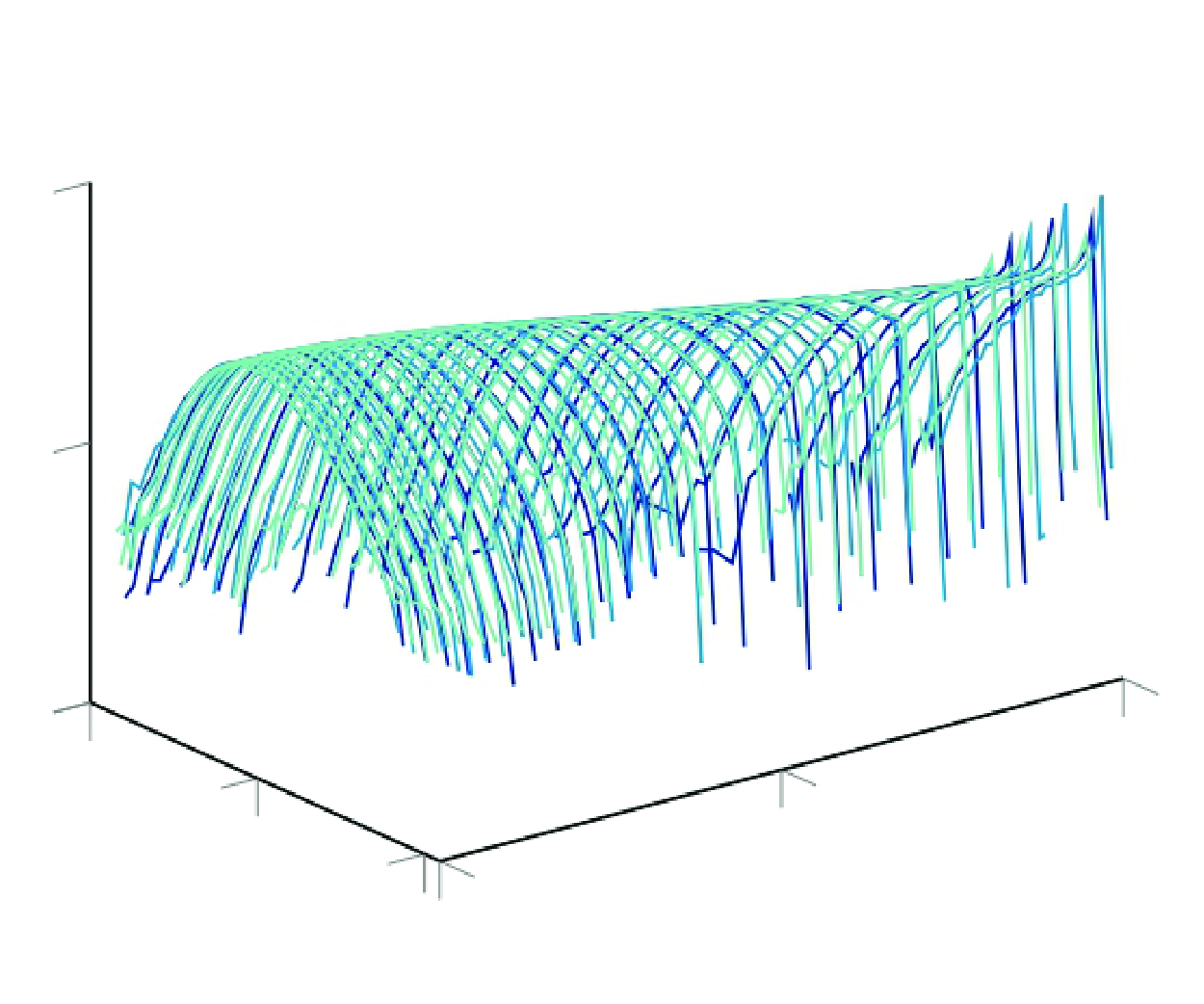
Passive scalar statistics in a turbulent round jet: symmetry theory and direct numerical simulation
-
- Journal:
- Journal of Fluid Mechanics / Volume 1013 / 25 June 2025
- Published online by Cambridge University Press:
- 20 June 2025, A33
-
- Article
-
- You have access
- Open access
- HTML
- Export citation
-
We analyse moment and probability density function (PDF) statistics of a passive scalar $\Theta$ at a Prandtl number of $Pr=0.71$ in a turbulent jet. For this, we conducted a direct numerical simulation at a Reynolds number of $Re=3500$ and, further, employed Lie symmetries applied to the multi-point moment equations, generalising recent work (Nguyen & Oberlack 2024b under review with Flow Turbul. Combust.) that focused on pure hydrodynamics. It is shown that the symmetry theory also provides highly precise results for free shear flows for all the quantities mentioned and statistical symmetries again play a key role. The scalar statistics are partly similar to the $U_z$ velocity statistics, and in particular, as in the above-mentioned work, a significant generalisation of the classical scalings has been derived so that a variation of the scaling laws solely controlled by the inflow is possible. An exponential behaviour of the scaling prefactors with the moment orders $m$ and $n$ for scalar and velocity is also discovered for any mixed moments. Instantaneous $\Theta$-moments and mixed $U_z$- $\Theta$-moments exhibit a Gaussian distribution with variation of the scaled radius $\eta =r/(z-z_0)$. Therein, the coefficient in the Gauss exponent is nonlinear with varying moment orders $m$ and $n$. The scalar PDF statistics are clearly different from the velocity statistics, i.e. already deviate from the Gaussian distribution on the jet axis, as is observed for the $U_z$ statistics, and become clearly skewed and heavy tailed for increasing $\eta$.


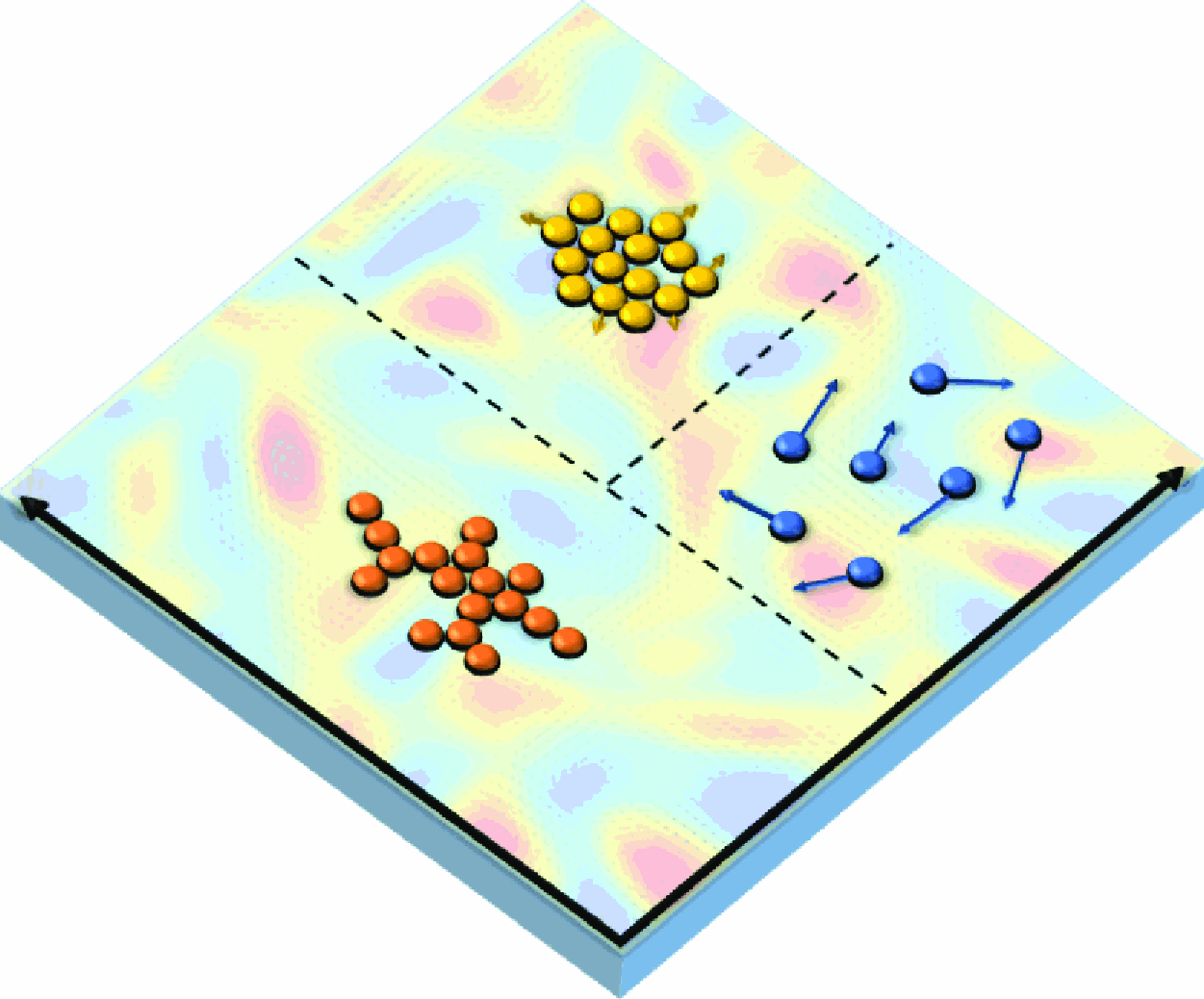
Particle clustering and dispersion in dense turbulent interfacial suspensions
-
- Journal:
- Journal of Fluid Mechanics / Volume 1013 / 25 June 2025
- Published online by Cambridge University Press:
- 20 June 2025, A31
-
- Article
-
- You have access
- Open access
- HTML
- Export citation
-
We investigate suspensions of non-Brownian, millimetric monodisperse spherical particles floating at quasi-two-dimensional fluid interfaces, from dilute to dense concentrations. Building upon the phase diagram in the capillary number ( $Ca$) and areal fraction ( $\phi$) constructed by Shin & Coletti (2024 J. Fluid Mech. 984, R7), we analyse the dynamics of both aggregation and dispersion. In the capillary-driven clustering regime ( $Ca \lt 1$), strong inter-particle bonds yield large, fractal-like clusters that grow by hit-and-stick collisions. In the drag-driven break-up regime ( $Ca \gt 1$, $\phi \lt 0.4$), turbulent fluctuations overcome capillarity and result in particles moving similarly to passive tracers and forming clusters by random adjacency. In the lubrication-driven clustering regime ( $Ca \gt 1$, $\phi \gt 0.4$), the close inter-particle proximity amplifies lubrication forces and results in large, crystal-like clusters. Above a threshold concentration that depends on $Ca$, self-similar percolating clusters span the entire domain. The particle transport exhibits a classic ballistic-to-diffusive transition, with the long-time diffusivity hindered by the reduced fluctuating energy at high concentrations. Nearby particles separate at initially slow rates due to strong capillary attraction, and then follow a super-diffusive dispersion regime. In dense suspensions, the process is characterised by the time scale associated with inter-particle collisions and by the energy dissipation rate defined by the lubrication force between adjacent particles. Our results provide a framework for predicting particle aggregation in interfacial suspensions such as froth flotation and pollutant dispersion, and may inform the design of advanced materials through controlled colloidal self-assembly.


Crystal structure of repotrectinib, C18H18FN5O2
-
- Journal:
- Powder Diffraction / Volume 40 / Issue 4 / December 2025
- Published online by Cambridge University Press:
- 20 June 2025, pp. 364-369
-
- Article
-
- You have access
- Open access
- HTML
- Export citation
3 - Magnetostatics
-
- Book:
- Electromagnetism
- Published online:
- 26 June 2025
- Print publication:
- 19 June 2025, pp 66-106
-
- Chapter
- Export citation
6 - Classical Field Theory
-
- Book:
- Electromagnetism
- Published online:
- 26 June 2025
- Print publication:
- 19 June 2025, pp 170-235
-
- Chapter
- Export citation
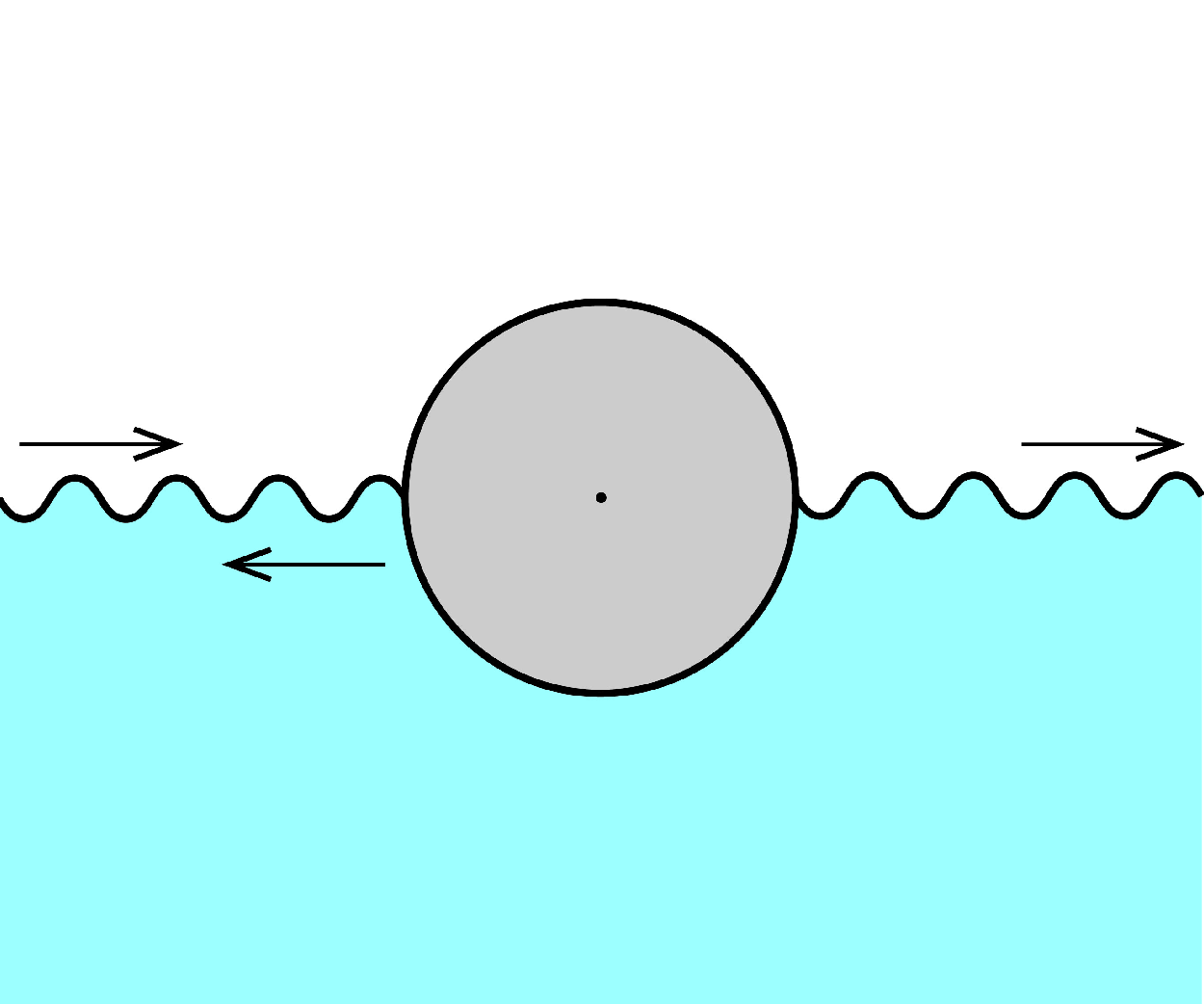
Theory of capillary-gravity wave scattering by a fixed, semi-immersed cylindrical barrier with contact line dissipation
-
- Journal:
- Journal of Fluid Mechanics / Volume 1013 / 25 June 2025
- Published online by Cambridge University Press:
- 19 June 2025, A27
-
- Article
-
- You have access
- Open access
- HTML
- Export citation
-
The scattering of surface waves by structures intersecting liquid surfaces is fundamental in fluid mechanics, with prior studies exploring gravity, capillary and capillary–gravity wave interactions. This paper develops a semi-analytical framework for capillary–gravity wave scattering by a fixed, horizontally placed, semi-immersed cylindrical barrier. Assuming linearised potential flow, the problem is formulated with differential equations, conformal mapping and Fourier transforms, resulting in a compound integral equation framework solved numerically via the Nyström method. An effective-slip dynamic contact line model accounting for viscous dissipation links contact line velocity to deviations from equilibrium contact angles, with fixed and free contact lines of no dissipation as limiting cases. The framework computes transmission and reflection coefficients as functions of the Bond number, slip coefficient and barrier radius, validating energy conservation and confirming a $90^\circ$ phase difference between transmission and reflection in specific limits. A closed-form solution for scattering by an infinitesimal barrier, derived using Fourier transforms, reveals spatial symmetry in the diffracted field, reduced transmission transitioning from gravity to capillary waves and peak contact line dissipation when the slip coefficient matches the capillary wave phase speed. This dissipation, linked to impedance matching at the contact lines, persists across a range of barrier sizes. These results advance theoretical insights into surface-tension-dominated fluid mechanics, offering a robust theoretical framework for analysing wave scattering and comparison with future experimental and numerical studies.

A proposed crystal structure of delamanid, C25H25F3N4O6
-
- Journal:
- Powder Diffraction / Volume 40 / Issue 4 / December 2025
- Published online by Cambridge University Press:
- 19 June 2025, pp. 397-404
-
- Article
-
- You have access
- Open access
- HTML
- Export citation
Appendix B - Grad, Div, and Curl
-
- Book:
- Electromagnetism
- Published online:
- 26 June 2025
- Print publication:
- 19 June 2025, pp 376-403
-
- Chapter
- Export citation
Appendices
-
- Book:
- Electromagnetism
- Published online:
- 26 June 2025
- Print publication:
- 19 June 2025, pp 337-425
-
- Chapter
- Export citation
Crystal structure of iprodione, C13H13Cl2N3O3
-
- Journal:
- Powder Diffraction / Volume 40 / Issue 3 / September 2025
- Published online by Cambridge University Press:
- 19 June 2025, pp. 231-235
-
- Article
-
- You have access
- Open access
- HTML
- Export citation
7 - Electromagnetic Radiation
-
- Book:
- Electromagnetism
- Published online:
- 26 June 2025
- Print publication:
- 19 June 2025, pp 236-272
-
- Chapter
- Export citation
Preface
-
- Book:
- Electromagnetism
- Published online:
- 26 June 2025
- Print publication:
- 19 June 2025, pp 1-6
-
- Chapter
- Export citation
A study on the expansion wave diffraction over bodies – ERRATUM
-
- Journal:
- Journal of Fluid Mechanics / Volume 1013 / 25 June 2025
- Published online by Cambridge University Press:
- 19 June 2025, E2
-
- Article
-
- You have access
- HTML
- Export citation
Further Reading
-
- Book:
- Electromagnetism
- Published online:
- 26 June 2025
- Print publication:
- 19 June 2025, pp 426-429
-
- Chapter
- Export citation
