Refine search
Actions for selected content:
212201 results in Engineering
Appendix A - Curves, Surfaces and Volumes
-
- Book:
- Electromagnetism
- Published online:
- 26 June 2025
- Print publication:
- 19 June 2025, pp 339-375
-
- Chapter
- Export citation
Non-porous viscous fingering of a thin film of fluid spreading over a lubricated substrate
-
- Journal:
- Journal of Fluid Mechanics / Volume 1013 / 25 June 2025
- Published online by Cambridge University Press:
- 19 June 2025, A32
-
- Article
-
- You have access
- Open access
- HTML
- Export citation
Crystal structure of palovarotene, C27H30N2O2
-
- Journal:
- Powder Diffraction / Volume 40 / Issue 4 / December 2025
- Published online by Cambridge University Press:
- 19 June 2025, pp. 370-375
-
- Article
-
- You have access
- Open access
- HTML
- Export citation
Localised performance of riblets with curved cross-sectional profiles in boundary layers past finite length bodies
-
- Journal:
- Journal of Fluid Mechanics / Volume 1013 / 25 June 2025
- Published online by Cambridge University Press:
- 19 June 2025, A21
-
- Article
-
- You have access
- Open access
- HTML
- Export citation
-
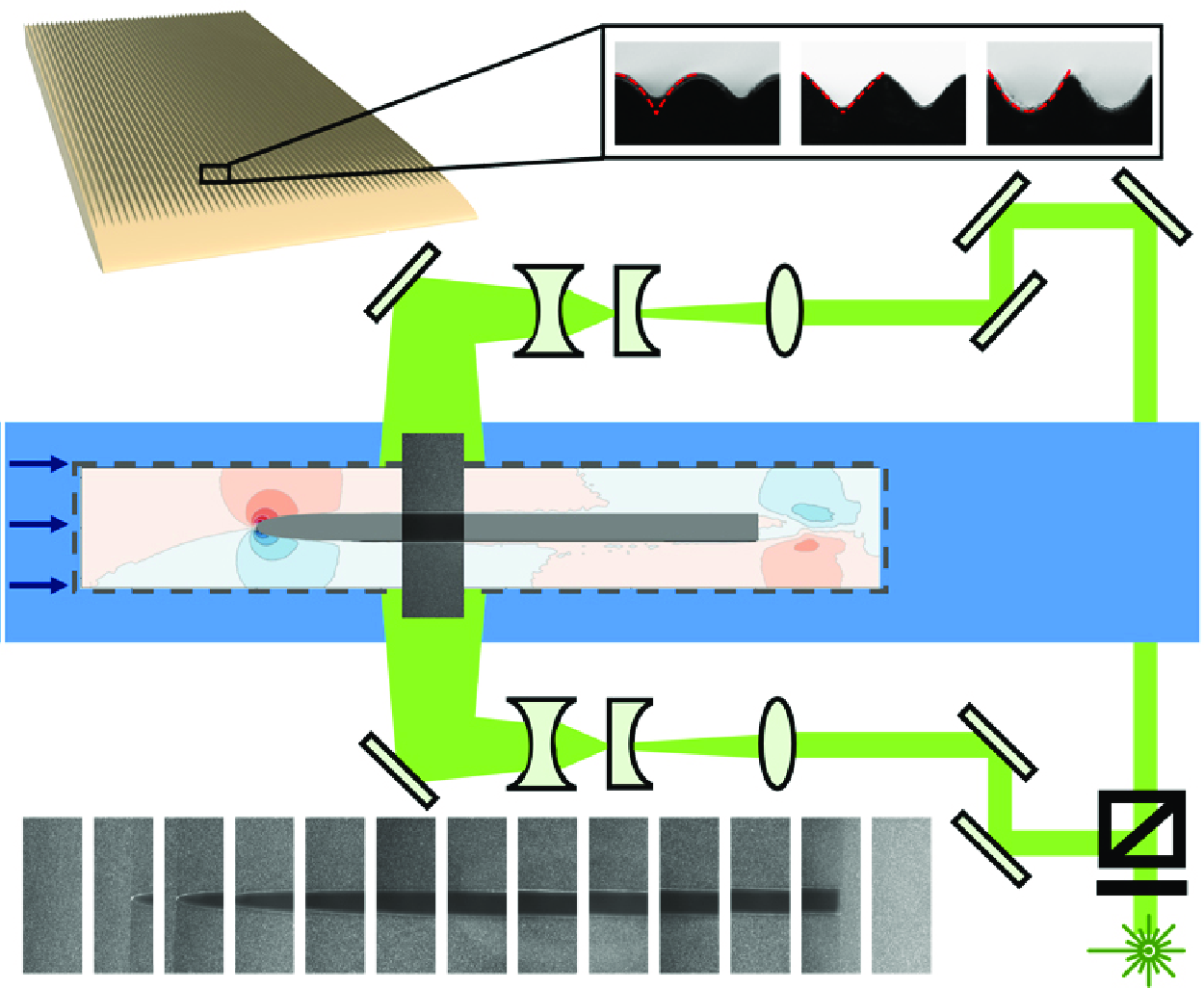
Riblets are a well-known passive drag reduction technique with the potential for as much as $9\, \%$ reduction in the frictional drag force in laboratory settings, and proven benefits for large-scale aircraft. However, less information is available on the applicability of these textures for smaller air/waterborne vehicles where assumptions such as periodicity and/or the asymptotic nature of the boundary layer (BL) no longer apply and the shape of the bodies of these vehicles can give rise to moderate levels of pressure drag. Here, we explore the effect of riblets on both sides of a finite-size foil consisting of a streamlined leading edge and a flat body in the Reynolds number range of $12\,200$– $24\,200$. We use high-resolution two-dimensional, two-component particle image velocimetry, with a double illumination and a consecutive-overlapping imaging technique to capture the velocity field in both the BL and the far field. We find the local velocity profiles and shear stress distribution, as well as the frictional and pressure components of the drag force and show the possibility of achieving reduction in both the frictional and pressure components of the drag force and record a maximum cumulative drag reduction of up to $6.5\, \%$. We present the intertwined relationship between the distribution of the spanwise-averaged shear stress distribution, the characteristics of the velocity profiles and the pressure distribution around the body, and how the local distribution of these parameters work together or against each other in enhancing or diminishing the drag-reducing ability of the riblets for the entirety of the body of interest.


Index
-
- Book:
- Electromagnetism
- Published online:
- 26 June 2025
- Print publication:
- 19 June 2025, pp 433-437
-
- Chapter
- Export citation
Transversely rotating angular particle in an inertial flow at moderate Reynolds numbers
-
- Journal:
- Journal of Fluid Mechanics / Volume 1013 / 25 June 2025
- Published online by Cambridge University Press:
- 19 June 2025, A30
-
- Article
-
- You have access
- Open access
- HTML
- Export citation
References
-
- Book:
- Electromagnetism
- Published online:
- 26 June 2025
- Print publication:
- 19 June 2025, pp 430-432
-
- Chapter
- Export citation
Unsupervised and supervised machine learning pipeline for super-resolution-based subgrid scale modelling in coarse-grid large-eddy simulations
-
- Journal:
- Journal of Fluid Mechanics / Volume 1013 / 25 June 2025
- Published online by Cambridge University Press:
- 19 June 2025, A28
-
- Article
-
- You have access
- Open access
- HTML
- Export citation
Contents
-
- Book:
- Electromagnetism
- Published online:
- 26 June 2025
- Print publication:
- 19 June 2025, pp vii-xii
-
- Chapter
- Export citation
Dedication
-
- Book:
- Electromagnetism
- Published online:
- 26 June 2025
- Print publication:
- 19 June 2025, pp v-vi
-
- Chapter
- Export citation
5 - Electromagnetism and Relativity
-
- Book:
- Electromagnetism
- Published online:
- 26 June 2025
- Print publication:
- 19 June 2025, pp 142-169
-
- Chapter
- Export citation
Appendix C - The Integral Theorems
-
- Book:
- Electromagnetism
- Published online:
- 26 June 2025
- Print publication:
- 19 June 2025, pp 404-425
-
- Chapter
- Export citation
Copyright page
-
- Book:
- Electromagnetism
- Published online:
- 26 June 2025
- Print publication:
- 19 June 2025, pp iv-iv
-
- Chapter
- Export citation
A unified framework for N-phase Navier–Stokes Cahn–Hilliard Allen–Cahn mixture models with non-matching densities
-
- Journal:
- Journal of Fluid Mechanics / Volume 1013 / 25 June 2025
- Published online by Cambridge University Press:
- 19 June 2025, A26
-
- Article
-
- You have access
- Open access
- HTML
- Export citation
Appendices: - Vector Calculus
-
- Book:
- Electromagnetism
- Published online:
- 26 June 2025
- Print publication:
- 19 June 2025, pp 337-338
-
- Chapter
- Export citation
4 - Electrodynamics
-
- Book:
- Electromagnetism
- Published online:
- 26 June 2025
- Print publication:
- 19 June 2025, pp 107-141
-
- Chapter
- Export citation
8 - Electromagnetism in Matter
-
- Book:
- Electromagnetism
- Published online:
- 26 June 2025
- Print publication:
- 19 June 2025, pp 273-336
-
- Chapter
- Export citation
Mitigation of thermoacoustic instabilities via porous plugs
-
- Journal:
- Journal of Fluid Mechanics / Volume 1013 / 25 June 2025
- Published online by Cambridge University Press:
- 18 June 2025, A25
-
- Article
-
- You have access
- Open access
- HTML
- Export citation

Dynamics of cavitation bubbles near a gas-entrapping rigid surface
-
- Journal:
- Journal of Fluid Mechanics / Volume 1013 / 25 June 2025
- Published online by Cambridge University Press:
- 18 June 2025, A9
-
- Article
- Export citation
-
We investigate the dynamics of a cavitation bubble near rigid surfaces decorated with a single gas-entrapping hole to understand the competition between the attraction of the rigid and the repulsion of the free boundary. The dynamics of laser-induced bubbles near this gas-entrapping hole is studied as a function of the stand-off distance and diameter of the hole. Two kinds of toroidal collapses are observed that are the result of the collision of a wide microjet with the bubble wall. The bubble centroid displacement and the strength of the microjet are compared with the anisotropy parameter $\zeta$, which is derived from a Kelvin impulse analysis. We find that the non-dimensional displacement $\delta$ scales with $\zeta$.


Lateral migration and bouncing of a deformable bubble rising near a vertical wall. Part 2. Highly inertial regimes
-
- Journal:
- Journal of Fluid Mechanics / Volume 1013 / 25 June 2025
- Published online by Cambridge University Press:
- 18 June 2025, A19
-
- Article
-
- You have access
- Open access
- HTML
- Export citation
-
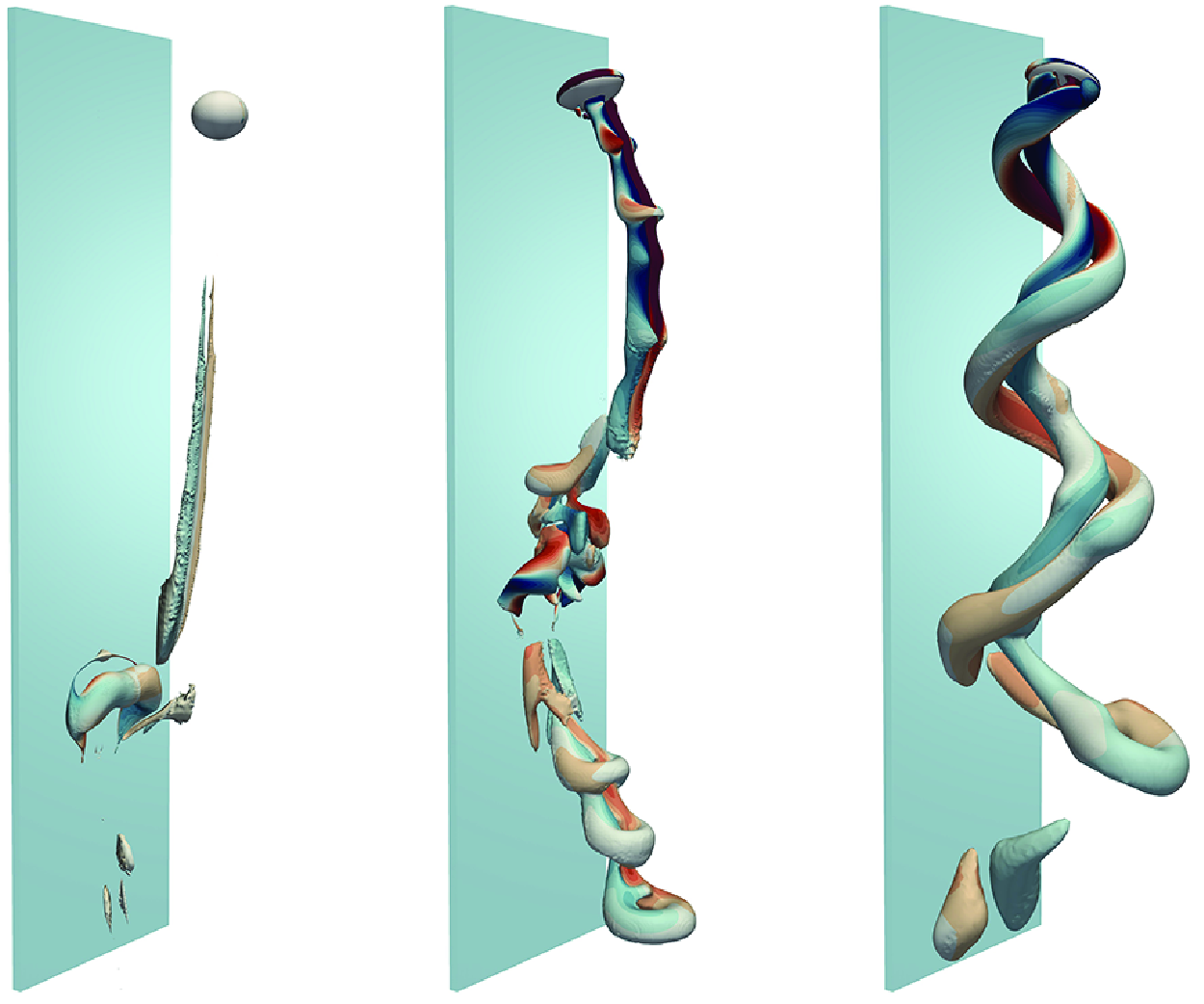
The fate of deformable buoyancy-driven bubbles rising near a vertical wall under highly inertial conditions is investigated numerically. In the absence of path instability, simulations reveal that, when the Galilei number, $Ga$, which represents the buoyancy-to-viscous force ratio, exceeds a critical value, bubbles escape from the near-wall region after one to two bounces, while at smaller $Ga$ they perform periodic bounces without escaping. The escape mechanism is rooted in the vigorous rotational flow that forms around a bubble during its bounce at high enough $Ga$, resulting in a Magnus-like repulsive force capable of driving it away from the wall. Path instability takes place with bubbles whose Bond number, the buoyancy-to-capillary force ratio, exceeds a critical $Ga$-dependent value. Such bubbles may or may not escape from the wall region, depending on the competition between the classical repulsive wake–wall interaction mechanism and a specific wall-ward trapping mechanism. The latter results from the reduction of the bubble oblateness caused by the abrupt drop of the rise speed when the bubble–wall gap becomes very thin. Owing to this transient shape variation, bubbles exhibiting zigzagging motions with a large enough amplitude experience larger transverse drag and virtual mass forces when departing from the wall than when returning to it. With moderately oblate bubbles, i.e. in an intermediate Bond number range, this effect is large enough to counteract the repulsive interaction force, forcing such bubbles to perform a periodic zigzagging-like motion at a constant distance from the wall.


