Refine search
Actions for selected content:
212197 results in Engineering
Open energy services: forecasting and optimization as a service for energy management applications at scale
- Part of
-
- Journal:
- Data-Centric Engineering / Volume 6 / 2025
- Published online by Cambridge University Press:
- 14 July 2025, e35
-
- Article
-
- You have access
- Open access
- HTML
- Export citation
Understanding the perspectives of older adults and physiotherapists on home-based lower-limb exoskeletons
-
- Journal:
- Wearable Technologies / Volume 6 / 2025
- Published online by Cambridge University Press:
- 14 July 2025, e31
-
- Article
-
- You have access
- Open access
- HTML
- Export citation
Numerical investigation of magnetic pole angle on the aerodynamic heating and force properties of hypersonic magnetohydrodynamic in two-dimensional axisymmetric geometry
-
- Journal:
- The Aeronautical Journal / Volume 129 / Issue 1341 / November 2025
- Published online by Cambridge University Press:
- 14 July 2025, pp. 3305-3326
-
- Article
- Export citation
Inter-scale energy transfer and interaction in a turbulent channel flow with randomly distributed wall roughness
-
- Journal:
- Journal of Fluid Mechanics / Volume 1015 / 25 July 2025
- Published online by Cambridge University Press:
- 14 July 2025, A2
-
- Article
- Export citation
Nonlinear evolution of vortical disturbances entrained in the entrance region of a circular pipe – CORRIGENDUM
-
- Journal:
- Journal of Fluid Mechanics / Volume 1014 / 10 July 2025
- Published online by Cambridge University Press:
- 14 July 2025, E2
-
- Article
-
- You have access
- HTML
- Export citation
A 100 Hz, 4.71 mJ, 3.8 μm, narrow-linewidth, electro-optic Q-switched self-optical parametric oscillator based on Nd:MgO:PPLN crystal
-
- Journal:
- High Power Laser Science and Engineering / Volume 13 / 2025
- Published online by Cambridge University Press:
- 14 July 2025, e70
-
- Article
-
- You have access
- Open access
- HTML
- Export citation

Combustion noise modelling of thermally perfect and multi-species gas flow in nozzles
-
- Journal:
- Journal of Fluid Mechanics / Volume 1014 / 10 July 2025
- Published online by Cambridge University Press:
- 11 July 2025, A39
-
- Article
- Export citation
-
Several hypotheses are employed to describe the fluctuating motions within nozzles and to analytically predict combustion noise generation mechanisms. One of these assumptions is that of a calorifically perfect gas mixture, where $c_p$ is constant. Nonetheless, a realistic flow rather encompasses heat capacities $c_p$ that vary with temperature, i.e. $c_p = c_p(T)$, such that the mixture is called thermally perfect. The influence of the mixture assumptions on noise generation mechanisms is re-examined in this paper. To do so, the quasi one-dimensional Euler equations for multi-species, isentropic and non-reactive flow are considered within the nozzle. Their linearisation yields a new prediction model in addition to showing a new entropy-to-entropy coupling mechanism. Relying on either the assumption of low frequencies or the Magnus’ expansion methodology, two analytical solutions are derived and studied. Validation of these two prediction models is then provided relying on unsteady simulations of axisymmetric nozzles with superimposed incident waves. To generalise previous results, parametric studies are performed considering various nozzle flow geometries. Variations of up to $10\,\,\%$ are exhibited in a choked flow nozzle between the two mixtures, especially for the indirect entropy noise and the entropy-to-entropy transmission moduli.


Dynamic characteristics and stability analysis of multi-body aircraft deployment process based on bifurcation theory
-
- Journal:
- The Aeronautical Journal / Volume 129 / Issue 1340 / October 2025
- Published online by Cambridge University Press:
- 11 July 2025, pp. 2938-2967
-
- Article
- Export citation
Turbulence-resolving integral simulations for wall-bounded flows
- Part of
-
- Journal:
- Journal of Fluid Mechanics / Volume 1014 / 10 July 2025
- Published online by Cambridge University Press:
- 11 July 2025, A40
-
- Article
-
- You have access
- Open access
- HTML
- Export citation
-
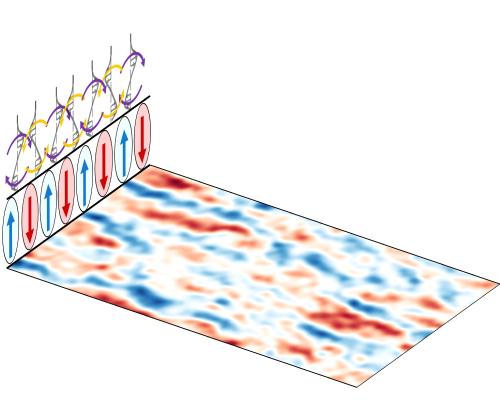
The physical fidelity of turbulence models can benefit from a partial resolution of fluctuations, but doing so often comes with an increase in computational cost. To explore this trade-off in the context of wall-bounded flows, this paper introduces a framework for turbulence-resolving integral simulations (TRIS) with the goal of efficiently resolving the largest motions using a two-dimensional, three-component representation of the flow defined by instantaneous wall-normal integrals of velocity and pressure. Self-sustaining turbulence with qualitatively realistic large-scale structures is demonstrated for TRIS on an open-channel (half-channel) flow configuration using moment-of-momentum integral equations derived from Navier–Stokes with relatively simple closure approximations. Evidence from direct numerical simulations (DNS) suggests that TRIS can theoretically resolve $35\,\%{-}40\,\%$ of the turbulent skin friction enhancement for friction Reynolds numbers between $180$ and $5200$, without a noticeable decrease or increase as a function of Reynolds number. The current implementation of TRIS can match this resolution while simulating one flow through time in ${\sim}1$ minute on a single processor, even for very large Reynolds numbers. The framework facilitates a detailed apples-to-apples comparison of predicted statistics against data from DNS. Comparisons at friction Reynolds numbers of $395$ and $590$ show that TRIS generates a relatively accurate representation of the flow, while highlighting discrepancies that demonstrate a need for improving the closure models. The present results for open-channel flow represent a proof of concept for TRIS as a new approach for wall-bounded turbulence modelling, motivating extension to more general flow configurations such as boundary layers on immersed objects.


A review on advancement in strategies for low-NOx hydrogen combustion with micromix technology
-
- Journal:
- The Aeronautical Journal / Volume 129 / Issue 1341 / November 2025
- Published online by Cambridge University Press:
- 11 July 2025, pp. 3252-3304
-
- Article
- Export citation
Tilting of vortex rings in the oblique collision reduces the longitudinal quadrupole and octupole modes of aerodynamic sound
-
- Journal:
- Journal of Fluid Mechanics / Volume 1015 / 25 July 2025
- Published online by Cambridge University Press:
- 11 July 2025, A1
-
- Article
- Export citation
Physics-constrained machine learning for reduced composition space chemical kinetics
-
- Journal:
- Data-Centric Engineering / Volume 6 / 2025
- Published online by Cambridge University Press:
- 10 July 2025, e34
-
- Article
-
- You have access
- Open access
- HTML
- Export citation
Design optimization platform for assistive wearable devices applied to a knee damper exoskeleton
-
- Journal:
- Wearable Technologies / Volume 6 / 2025
- Published online by Cambridge University Press:
- 10 July 2025, e30
-
- Article
-
- You have access
- Open access
- HTML
- Export citation
-
Designing optimal assistive wearable devices is a complex task, often addressed using human-in-the-loop optimization and biomechanical modeling approaches. However, as the number of design parameters increases, the growing complexity and dimensionality of the design space make identifying optimal solutions more challenging. Predictive simulation, which models movement without relying on experimental data, provides a powerful tool for anticipating the effects of assistive devices on the human body and guiding the design process. This study aims to introduce a design optimization platform that leverages predictive simulation of movement to identify the optimal parameters for assistive wearable devices. The proposed approach is specifically capable of dealing with the challenges posed by high-dimensional design spaces. The proposed framework employs a two-layered optimization approach, with the inner loop solving the predictive simulation of movement and the outer loop identifying the optimal design parameters of the device. It is utilized for designing a knee exoskeleton with a damper to assist level-ground and downhill gait, achieving a significant reduction in normalized knee load peak value by $ 37\% $ for level-ground and by $ 53\% $ for downhill walking, along with a decrease in the cost of transport. The results indicate that the optimal device applies damping torques to the knee joint during the Stance phase of both movement scenarios, with different optimal damping coefficients. The optimization framework also demonstrates its capability to reliably and efficiently identify the optimal solution. It offers valuable insight for the initial design of assistive wearable devices and supports designers in efficiently determining the optimal parameter set.


Separation control versus circulation control for loads alleviation of plunging unswept and swept wings
-
- Journal:
- The Aeronautical Journal / Volume 129 / Issue 1341 / November 2025
- Published online by Cambridge University Press:
- 10 July 2025, pp. 2985-3003
-
- Article
-
- You have access
- Open access
- HTML
- Export citation
Acoustothermal effect: mechanism and quantification of the heat source – ERRATUM
-
- Journal:
- Journal of Fluid Mechanics / Volume 1014 / 10 July 2025
- Published online by Cambridge University Press:
- 10 July 2025, E4
-
- Article
-
- You have access
- Open access
- HTML
- Export citation

Major role and longitudinal nature of stochastic resonance in promoting chaotic states in viscoelastic channel flow with low inlet perturbations
-
- Journal:
- Journal of Fluid Mechanics / Volume 1014 / 10 July 2025
- Published online by Cambridge University Press:
- 08 July 2025, R4
-
- Article
- Export citation
-
Stochastic resonance (SR) is universal phenomenon, where noise amplifies a weak periodic signal in bistable nonlinear systems, with wide applications in biology, climate science, engineering etc., although in fluid dynamics it remains underexplored. Recently, we unexpectedly found SR above non-modal elastic instability onset in an inertialess viscoelastic channel flow, where it emerges on the top of a chaotic streamwise velocity power spectrum $E_u$ due to its interaction with white-noise spanwise velocity power spectrum $E_w$ and weak elastic waves. These three conditions necessary for SR emergence differ from those required for the classical SR emergence mentioned above. Here, we consider SR in an inertialess viscoelastic channel flow with a smoothed inlet causing order of magnitude lower noise intensity than in our former studies. Our observations reveal that SR appears at the same conditions mentioned above, where SR is found just upon the instability onset in a lower subrange of a transition regime, in contrast, here, SR persists across all flow regimes – transition, elastic turbulence and drag reduction. Furthermore, we provide experimental evidence that SR, presented by a sharp peak in $E_u$, manifests as either a standing or propagating wave in the $x$-direction, with a rather uniform amplitude of streamwise velocity fluctuations and zero propagation velocity in the $z$-direction. These findings reveal a new mechanism underpinning the transition to a chaotic channel flow of viscoelastic fluids and establish SR as a robust framework for understanding complex flow dynamics. This work opens new avenues for exploring SR in other nonlinear systems and practical applications such as mixing enhancement and flow control in industrial and biological contexts.


Low-profile wideband microstrip filtering antenna with parasitic arc-shaped slot
-
- Journal:
- International Journal of Microwave and Wireless Technologies / Volume 17 / Issue 4 / May 2025
- Published online by Cambridge University Press:
- 08 July 2025, pp. 662-672
-
- Article
- Export citation
Assessing optical damage risks by simulating the amplification of back-reflection in a multi-petawatt laser system
-
- Journal:
- High Power Laser Science and Engineering / Volume 13 / 2025
- Published online by Cambridge University Press:
- 08 July 2025, e65
-
- Article
-
- You have access
- Open access
- HTML
- Export citation
Statistical treatment of dilute suspensions of electrified particles
-
- Journal:
- Journal of Fluid Mechanics / Volume 1014 / 10 July 2025
- Published online by Cambridge University Press:
- 08 July 2025, A38
-
- Article
-
- You have access
- Open access
- HTML
- Export citation
-
An analysis is presented of the suspensions of small, electrified particles in a gas. Two limits of interest for the electrodynamic particulate suspension technique are considered, corresponding to large and small values of the ratio $t_{coll}/t_s$ of the mean time between particle collisions to the viscous adaptation time required for the particles to reach their terminal velocities. The effect of the particle inertia can be neglected when this ratio is large, and only the distribution of particle charges at each point of the suspension needs to be computed. The way this distribution approaches an equilibrium form, determined elsewhere in the continuum regime when the mean free path of the particles is small compared with the suspension size, is described, as well as the connection between continuum regime and quasi-neutrality of the suspension. In the opposite case when $t_{coll}/t_s$ is small, the inertia of the particles plays an important role, and the joint distribution of particle charges and velocities is required. A Boltzmann equation is proposed for this distribution function, taking advantage of the fact that the charges of the particles have little effect on the redistribution of momentum and energy in the collisions. The equilibrium distribution function in the continuum regime is computed approximately, and hydrodynamic equations for the particle phase analogous to the Euler equations for a monoatomic gas are derived. The simplification of these equations when the particle inertia is negligible at the scale of the suspension is worked out.


Pulse-length dependence of the laser-induced damage behavior of a fused-silica antireflective metasurface
-
- Journal:
- High Power Laser Science and Engineering / Volume 13 / 2025
- Published online by Cambridge University Press:
- 07 July 2025, e64
-
- Article
-
- You have access
- Open access
- HTML
- Export citation
