Refine search
Actions for selected content:
212103 results in Engineering
Index
-
- Book:
- Wireless Communications and Machine Learning
- Published online:
- 21 October 2025
- Print publication:
- 03 July 2025, pp 287-292
-
- Chapter
- Export citation

Turbulence suppression in plane Couette flow using reduced-order models
-
- Journal:
- Journal of Fluid Mechanics / Volume 1014 / 10 July 2025
- Published online by Cambridge University Press:
- 03 July 2025, A18
-
- Article
- Export citation
-
We explore a reduced-order model (ROM) of plane Couette flow with a view to performing near-wall turbulence control. The ROM is derived through Galerkin projections of the incompressible Navier–Stokes system onto a basis of controllability modes. Such ROMs were found to reproduce key aspects of turbulence dynamics in Couette flow with only a few hundred degrees of freedom, and here we use them to devise a control strategy. We consider a ROM with an extra forcing term whose structure is given by a combination of eigenfunctions of a linear viscous diffusion equation, optimised in order to minimise the total fluctuation energy. The optimisation is performed at Reynolds numbers $Re=1000, 2000, 3000$, and produces a novel control mechanism wherein the optimal forcing leads the flow to laminarisation in all cases. The forcing acts by reducing the shear in a large portion of the channel, hindering the main energy input mechanism. The forced flow possesses a new laminar solution which is linearly stable at $Re=1000$ and unstable at higher $Re$, but whose transient growth of streaky structures is substantially lower than that of laminar Couette flow, leading the flow to full laminarisation when the forcing is removed. Forcings optimised in the ROM are subsequently applied in direct numerical simulations (DNS). The same control mechanisms are observed in the DNS, where laminarisation is also achieved. We show that the ROMs provide an effective framework to design turbulence control strategies, despite the high degree of truncation, which opens up interesting possibilities for turbulence control.


11 - Capacitor DACs
-
- Book:
- Analysis and Design of Data Converters
- Published online:
- 13 November 2025
- Print publication:
- 03 July 2025, pp 210-235
-
- Chapter
- Export citation
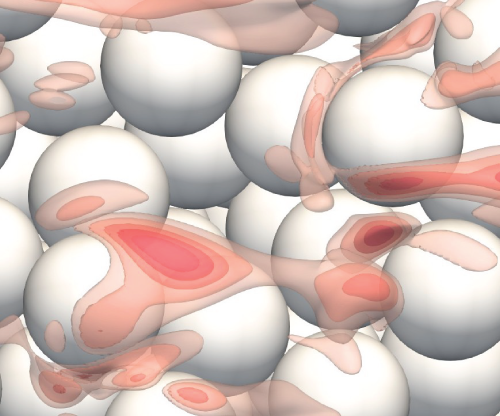
Turbulent flow over random sphere packs – kinetic energy budgets
-
- Journal:
- Journal of Fluid Mechanics / Volume 1014 / 10 July 2025
- Published online by Cambridge University Press:
- 03 July 2025, A17
-
- Article
-
- You have access
- Open access
- HTML
- Export citation
-
Based on data from pore-resolved direct numerical simulation of turbulent flow over mono-disperse random sphere packs, we evaluate the budgets of the double-averaged turbulent kinetic energy (TKE) and the wake kinetic energy (WKE). While TKE results from temporal velocity fluctuations, WKE describes the kinetic energy in spatial variations of the time-averaged flow field. We analyse eight cases which represent sampling points within a parameter space spanned by friction Reynolds numbers $Re_\tau \in [150, 500]$ and permeability Reynolds numbers $Re_K \in [0.4, 2.8]$. A systematic exploration of the parameter space is possible by varying the ratio between flow depth and sphere diameter $h/D \in \{ 3, 5, 10 \}$. With roughness Reynolds numbers of $k_s^+ \in [20,200]$, the simulated cases lie within the transitionally or fully rough regime. Revisiting the budget equations, we identify a WKE production mechanism via viscous interaction of the flow field with solid surfaces. The scaling behaviour of different processes over $Re_K$ and $Re_\tau$ suggests that this previously unexplored mechanism has a non-negligible contribution to the WKE production. With increasing $Re_K$, progressively more WKE is transferred into TKE by wake production. A near-interface peak in the TKE production, however, primarily results from shear production and scales with interface-related scales. Conversely, further above the sediment bed, the TKE budget terms of cases with comparable $Re_\tau$ show similarity under outer-scaling. Most transport processes relocate energy in the near-interface region, whereas pressure diffusion propagates TKE and WKE into deeper regions of the sphere pack.


14 - SAR ADC Fundamentals
-
- Book:
- Analysis and Design of Data Converters
- Published online:
- 13 November 2025
- Print publication:
- 03 July 2025, pp 284-309
-
- Chapter
- Export citation
1 - Introduction to Data Conversion
-
- Book:
- Analysis and Design of Data Converters
- Published online:
- 13 November 2025
- Print publication:
- 03 July 2025, pp 1-5
-
- Chapter
- Export citation
Notation
-
- Book:
- Wireless Communications and Machine Learning
- Published online:
- 21 October 2025
- Print publication:
- 03 July 2025, pp xii-xiv
-
- Chapter
- Export citation
2 - Channel Modeling, Estimation, and Compression
-
- Book:
- Wireless Communications and Machine Learning
- Published online:
- 21 October 2025
- Print publication:
- 03 July 2025, pp 37-90
-
- Chapter
- Export citation
16 - Advanced SAR ADCs
-
- Book:
- Analysis and Design of Data Converters
- Published online:
- 13 November 2025
- Print publication:
- 03 July 2025, pp 330-352
-
- Chapter
- Export citation
6 - Wireless for AI: Distributed and Federated Learning
-
- Book:
- Wireless Communications and Machine Learning
- Published online:
- 21 October 2025
- Print publication:
- 03 July 2025, pp 221-273
-
- Chapter
- Export citation
5 - Comparator Design Principles
-
- Book:
- Analysis and Design of Data Converters
- Published online:
- 13 November 2025
- Print publication:
- 03 July 2025, pp 70-101
-
- Chapter
- Export citation
9 - Resistor-Ladder DACs
-
- Book:
- Analysis and Design of Data Converters
- Published online:
- 13 November 2025
- Print publication:
- 03 July 2025, pp 158-173
-
- Chapter
- Export citation
Index
-
- Book:
- Analysis and Design of Data Converters
- Published online:
- 13 November 2025
- Print publication:
- 03 July 2025, pp 582-586
-
- Chapter
- Export citation
Acknowledgments
-
- Book:
- Analysis and Design of Data Converters
- Published online:
- 13 November 2025
- Print publication:
- 03 July 2025, pp xvi-xvii
-
- Chapter
- Export citation
3 - Sampling Circuits
-
- Book:
- Analysis and Design of Data Converters
- Published online:
- 13 November 2025
- Print publication:
- 03 July 2025, pp 20-59
-
- Chapter
- Export citation
23 - Nonidealities in ΔΣ Modulators
-
- Book:
- Analysis and Design of Data Converters
- Published online:
- 13 November 2025
- Print publication:
- 03 July 2025, pp 534-558
-
- Chapter
- Export citation
19 - Advanced SAR and Pipelining Techniques
-
- Book:
- Analysis and Design of Data Converters
- Published online:
- 13 November 2025
- Print publication:
- 03 July 2025, pp 418-438
-
- Chapter
- Export citation
2 - Basic Circuit Concepts
-
- Book:
- Analysis and Design of Data Converters
- Published online:
- 13 November 2025
- Print publication:
- 03 July 2025, pp 6-19
-
- Chapter
- Export citation
Contents
-
- Book:
- Wireless Communications and Machine Learning
- Published online:
- 21 October 2025
- Print publication:
- 03 July 2025, pp v-viii
-
- Chapter
- Export citation
Preface
-
- Book:
- Analysis and Design of Data Converters
- Published online:
- 13 November 2025
- Print publication:
- 03 July 2025, pp xv-xv
-
- Chapter
- Export citation
